
PIPs Are Shrinking IBM and "IBM is Managing Decline, Not Building Growth"

This morning: IBM PIPs Continue Until Morale Improves, Silent or Quiet Firings at IBM Explained
Today we talked about PIPs at IBM. For the uninitiated, PIPs are not unique to IBM; it's how companies get rid of people silently, without paying them compensation, using the pretext of low or bad or insufficient "performance" (P). The other "P" stands for "Plan", but the only real plan is dismissal, they just need to pretend to have given an opportunity like offering someone another role in another department, e.g. one that will be shut down soon; they bend the law, work around the law, sometimes even break employment law to save a sum of money called "Severance" and save face for shareholders, to avoid using the term "layoffs" (or RAs as IBM fancies calling these).
Some more PIPs are being reported this afternoon, even if belatedly:
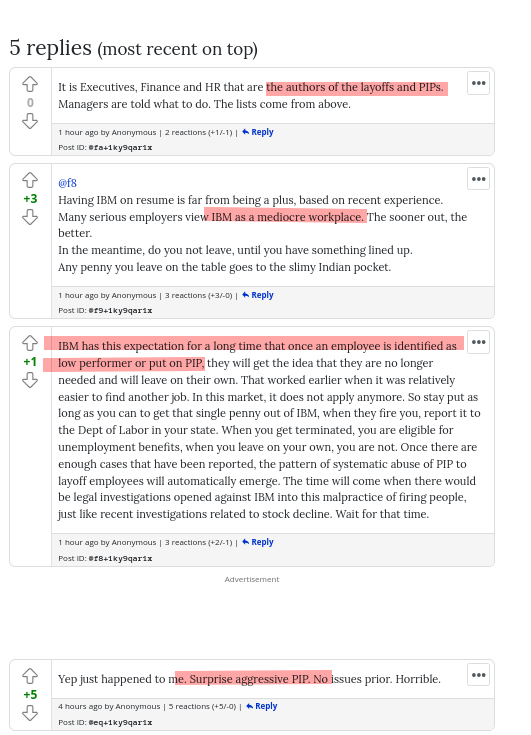
That speaks for itself.
"Has a manager ever been put on PIP for not assigning enough PIPs to enough direct reports ?" someone asked. Another then asked: "At what level do you become exempt from pip?"
In another page someone has just said: "That's a KPI (Key Performance Indicator) metric for ALL Managers at IBM and Kyndryl - you must be able to lie and throw your employees under the bus without hesitation."
It is advantageous to be cold-hearted sociopaths. Some try to associate them with a demography, but we won't cite or quote such comments.
"Yes," someone else said, "it’s happening in my area also. They are plotting ways to avoid paying severance to save the company money. If they make your role unsustainable then problem solved. How do these guys look themselves in the mirror each morning? Spineless."
When middle managers or line managers are asked to make a list of "low performers" they ought to know exactly what they're doing. They are marking people for dismissal, it is not about performance at all.
There are predictions of a fallout soon after IBM's massive stock tumble:
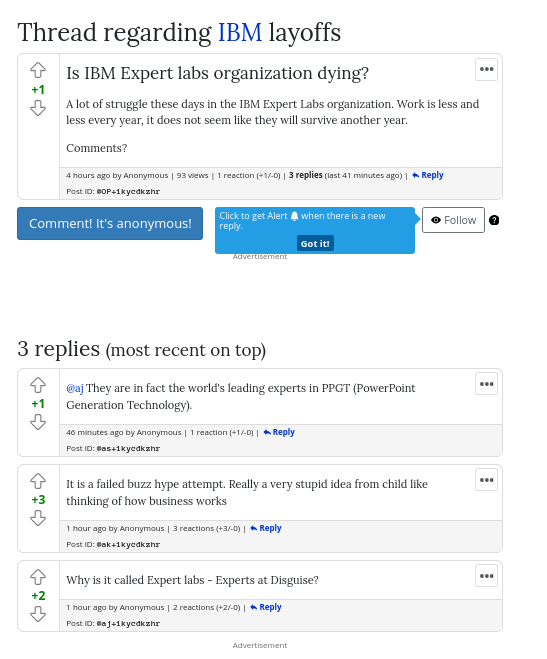
Same for "Consulting" and several other areas.
"IBM = Inconsequential Business Machines," someone has just said. "They are really good a buzz words and click bait," someone replied an hour ago.
Yes, and producing fake news with buzzwords. Later they cover up for the culprits and the fraud. It is truly bad for the general image of the media.
Speaking candidly, some people debate the future (or lack thereof) at a stagnant and stagnating IBM. After 110 years it is going downhill very fast while the CEO buys buzzwords:
IBM Is Managing Decline, Not Building Growth
IBM’s problem is not that the mainframe disappears tomorrow. It is that most new workloads are being built elsewhere.
AWS, Azure, Google Cloud and Linux are now the defaults for new applications, while IBM Z, AIX and IBM i increasingly depend on existing customers, transaction growth and hardware-refresh cycles.
AI is weakening the mainframe’s strongest defense: the difficulty of understanding decades of undocumented COBOL and business logic. Toyota’s use of Amazon Q to analyze legacy COBOL and support migration planning is a warning. AI does not need to replace the mainframe directly; it only needs to make leaving cheaper, faster and less risky.
IBM’s traditional software is also exposed. DataStage faces cloud-native ELT, zero-ETL, Redshift, S3 and Iceberg. Red Hat remains useful, but many customers can choose EKS, AKS or GKE instead of OpenShift—and Amazon Linux instead of RHEL.
IBM Cloud is not a credible fourth hyperscaler, and IBM is not investing in AI infrastructure at anything close to Amazon, Microsoft or Google. Its AI strategy increasingly depends on competitors owning the compute, models, distribution and economics.
Quantum offers no immediate rescue. IBM is a serious contender, not the undisputed leader, and commercial returns remain years away.
IBM has repeatedly acquired companies—Lotus, Informix, Rational and many others—without consistently creating lasting platform leadership. Continuing to buy software companies while distributing billions through dividends does not address the underlying problem.
IBM should make an honest choice: cut the dividend and reinvest aggressively, or break up and sell its valuable businesses while they still command premium value.
Harvesting legacy cash, buying another company and protecting the dividend is not a growth strategy. It is managed decline.
All the commenters agreeing, at least until some trolls passes along.
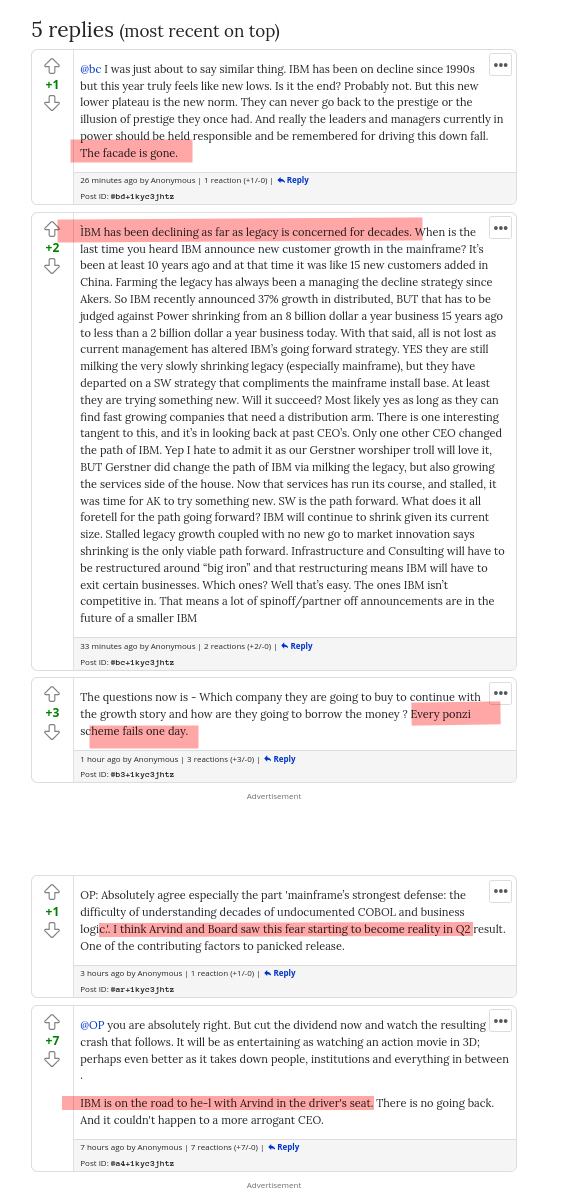
IBM is going down the drain and, as we noted a couple of hours ago, it takes Red Hat down with it. █