
Eight Months of Strikes in EPO, Organised by the Staff Union (SUEPO) Also in Berlin
In Berlin, only one member of staff voted against the action plan
Earlier this year the SUEPO Local Bureau Berlin explained the legality of this year's strikes and laid out an early plan for actions that persist until now. It would help to remind our readers, as a refresher, the legal basis of this. In the words of SUEPO Local Bureau Berlin:
INTERNATIONALE GEWERKSCHAFT IM EUROPÄISCHEN PATENTAMT
STAFF UNION OF THE EUROPEAN PATENT OFFICE
UNION SYNDICALE DE L'OFFICE EUROPEEN DES BREVETSSUEPO Berlin
ACTION PLAN
202617 February 2026
su26001bpExplanations of industrial action
"work to rule"
Is an industrial action such as “work to rule” legal?
The answer is clear: Yes, such industrial action is perfectly legal.
In the past, the EPO had tried to suppress "work to rule" and "go slow" industrial action with specially introduced regulations, i.e. former Circular No. 347. These regulations were declared illegal and void by the Administrative Tribunal of the International Labour Organization (ILOAT) in judgment 4430 of 07.07.2021. This was the final instance to establish that the EPO had violated the fundamental right to strike and freedom of association for many years. Judgement 4430 states under Point 16(i), literally:
"Secondly, “go slow” and “work to rule” are legitimate forms of industrial action protected by the ordinary conception of the right to strike. Accordingly, by declaring that employees engaging in these forms of industrial action did not have the “protection granted by the right to strike” as ordinarily understood, this provision violated the right to strike." (Underscore added)Any colleague who follows any of the "work to rule" industrial action measures are protected by the right to strike and by the right to freedom of association legally protected.
Is such industrial action effective?
Yes, such industrial action has proven to be very effective in the EPO in the past.
The first time that SUEPO called for such an action (so-called "blocking B84/B85 communications") was in 2001. It was essentially carried out by patent examiners. The aim of the action was to delay the further processing of the file and thus the publication of the granting decision in the European Patent Bulletin after the decision to grant a patent.
Since the member states can only receive their share of the renewal fees from the applicant after the effective grant decision, this industrial action significantly delayed the payments of the patent proprietors to the member states, which led to reduced income for latter.
During the phase of the labour dispute at that time, the incumbent EPO President, Ingo Kober stated in his Circular No. 74 dated 28.03.2001 among other things:
"The action plan adopted on 27 March also calls for a blocking of B84/B85 communications. During the past two years, these actions have already caused serious damage and disruption. They are deliberately designed so that the participants can only be identified long afterwards, if at all. They seek, through (covert) industrial action, to pressure management, which has no possibility of taking counter-measures."In order to end the industrial action, the EPO made extensive commitments to the employees at the time.
What could such an industrial action look like under today's conditions?
All colleagues can take part in the "work to rule" action by adhering exactly to the applicable working time regulations and not exceeding the specified daily working hours. In particular, examiners and colleagues who are involved in the search, the patent granting process and in the publication of the decision for grant can take part in the action.
As a first measure, all examiners are called upon to concentrate on the search work and increase their search to examination ratio, making sure when possible that timeliness goals in search are well fulfilled. This is essential for providing a high quality service to the applicants and contributes to the reduction of search backlog the current stock is above 120.000 searches-.
Team goals in terms of searches must also be taken into account. When processing the search backlog, the stock managers, team members and team managers can also exchange information to agree on a fair distribution of the search files.
A further measure aims to significantly improve the quality of the grants. All examiners are called upon to apply the provisions of the EPC, the case law of the Boards of Appeal and the internal rules for patent examination, especially for grants, with particular care. This includes, but is not limited to: verifying completeness of the search top-up search , checking carefully potentially added subject-matter, requesting the applicant to correct deficiencies in the description, raising identified clarity objections, etc.
Should queries or discussions among one another be necessary here, respectful and collegial interaction with one another is very important with a view to strengthening a trusting cooperation and enhance quality.
Written communication with the applicant and circulation within Patent Workbench must also take place until all deficiencies are solved in the patent application. Discussions between members of the Examining Division should remain confidential, while notes in the Patent Workbench should in any case remain generic.
The Examining Division should summon to oral proceedings when considered expedient for the conclusion of the procedure. As a result, refusing patent applications which do not comply with the requirements of the EPC must follow.
It’s also the right time to concentrate in complex applications, and in general in those applications where an easy outcome is not foreseeable as the next procedural action. High quality interaction with the applicant, through written communication, is essential to identify and solve deficiencies which will lead, in the future, to the closure of the applications.
Opposition work should be also prioritised. Most opposition work finished is currently delayed, something which is not compatible with the legal certainty and with the service to applicants. The formalities examiners and colleagues who continue to process the file after the internal grant decision of the Examining Division can help with the actions, e.g. by requesting to check all application documents for correctness with reasonable care and calm before forwarding them internally for publication in the European Patent Bulletin and, if necessary, to provide feedback in order to eliminate any quality problems.
Directors and team leaders, who also benefit from the actions against a deterioration of the salary adjustment method, are also called upon to support and make their contribution to the action, by e.g. strengthening the composition of the Examining Divisions, allowing them to carry out their tasks unhindered and objectively independently, and by supporting all other colleagues.
The following applies: Let's all send a clear signal of our displeasure to the Administrative Council!
At the time of the above action plans (slowing down applications and more) the administration was able to negotiate a compromise. Plans were made to go on strike the following month, March. Here's the proposal:
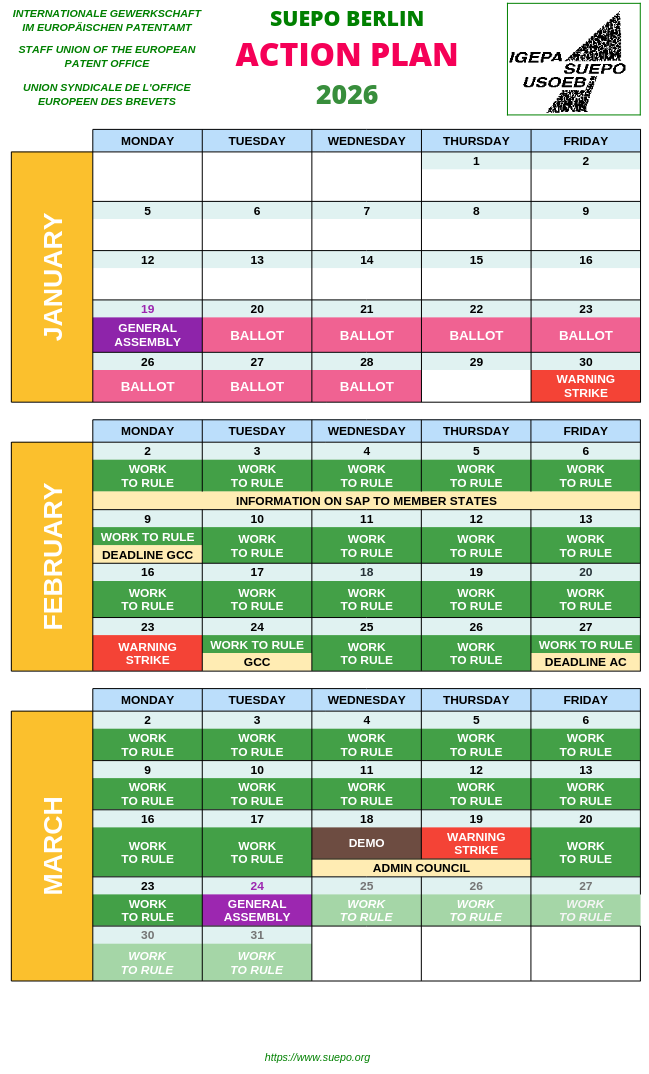
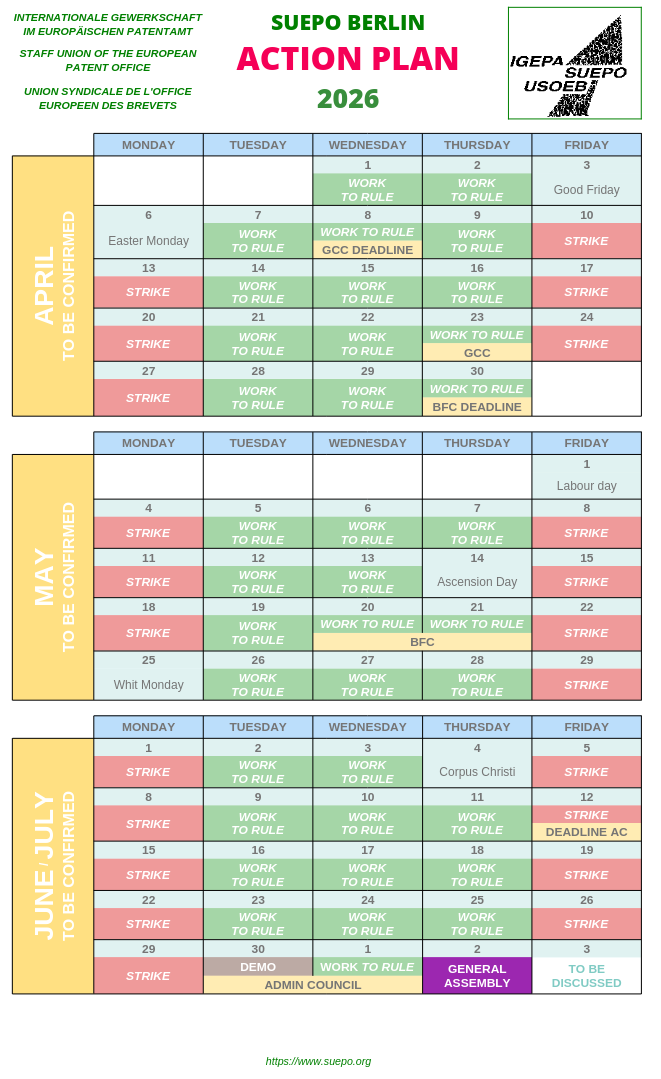
Once approved, they had more concrete plans and they said: "The following SUEPO Berlin Action plans April-June 2026 and January-March 2026 summarize the Industrial Action adopted by SUEPO Berlin for the first half of 2026."
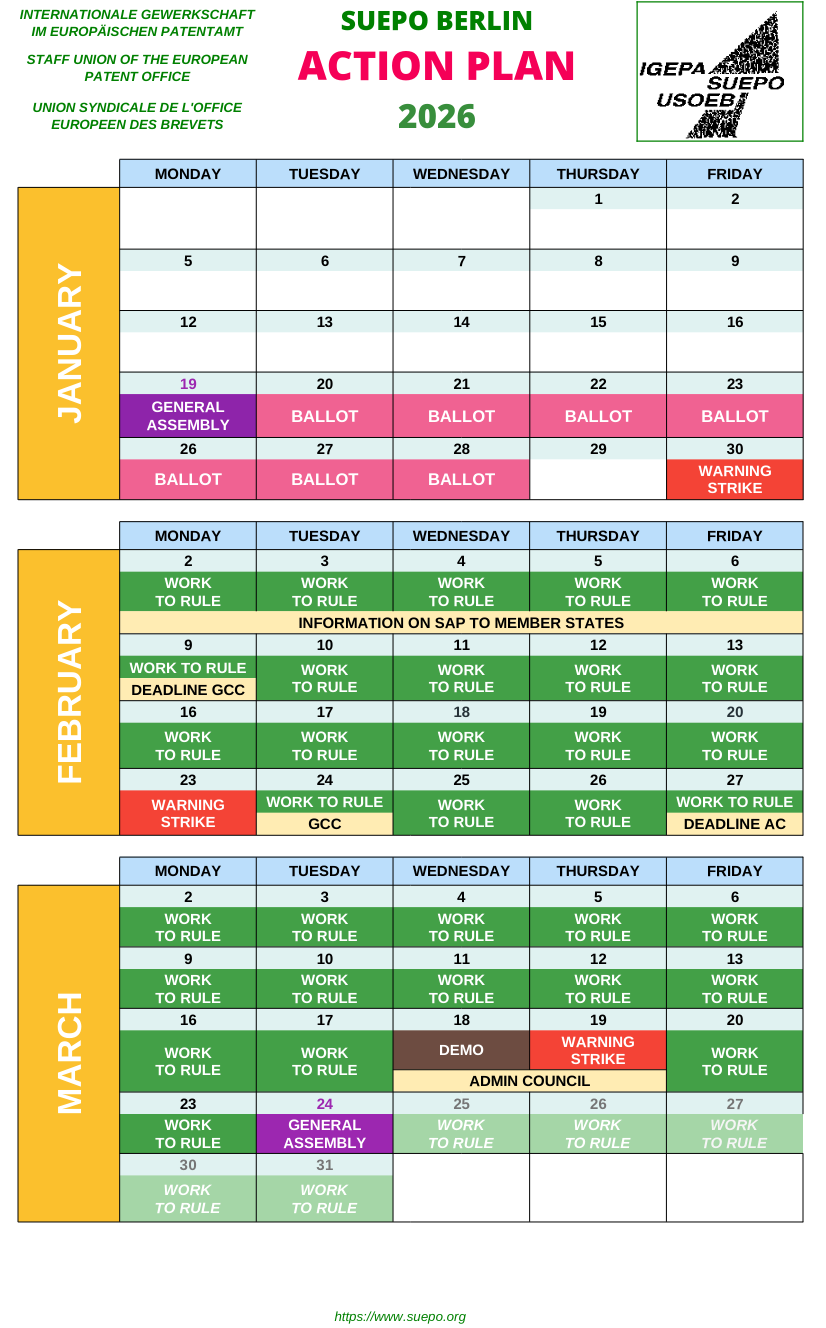
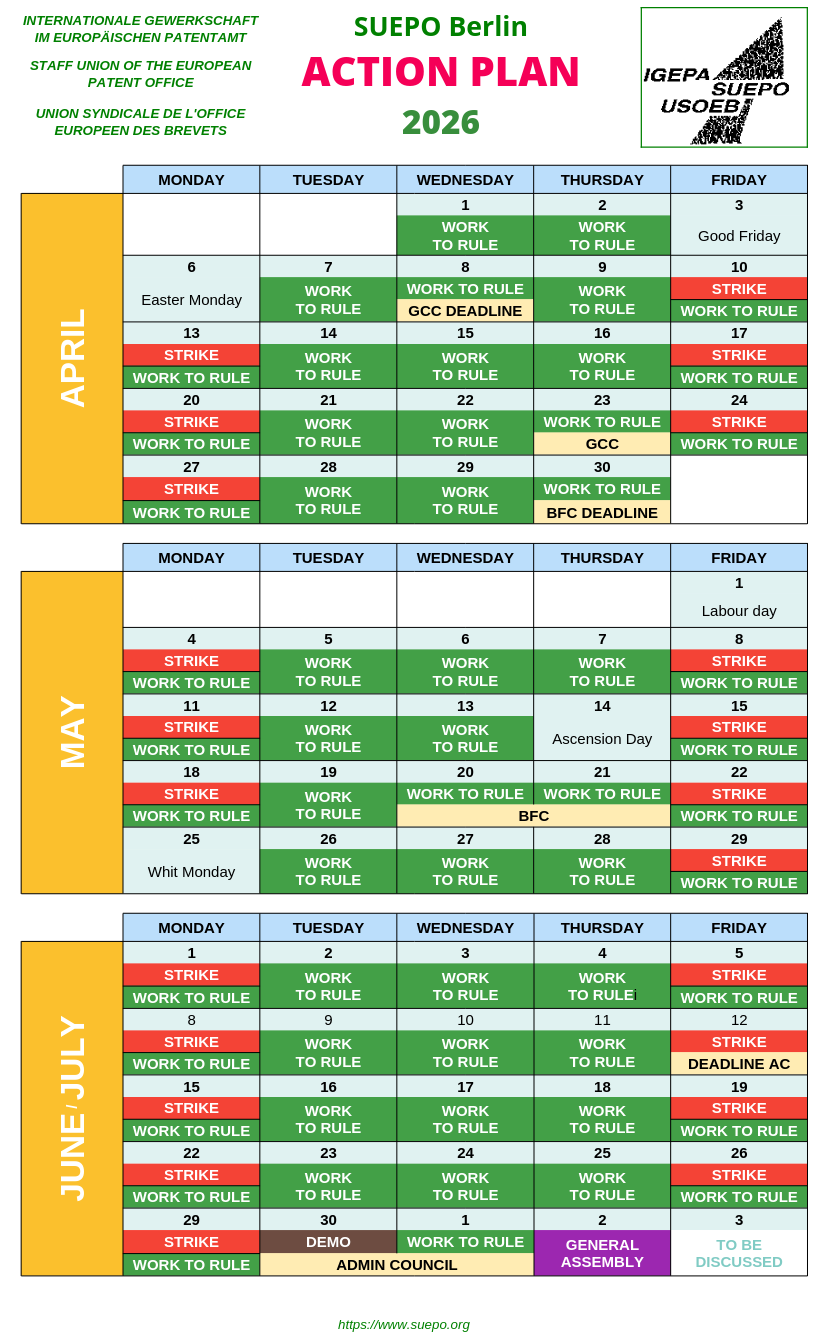
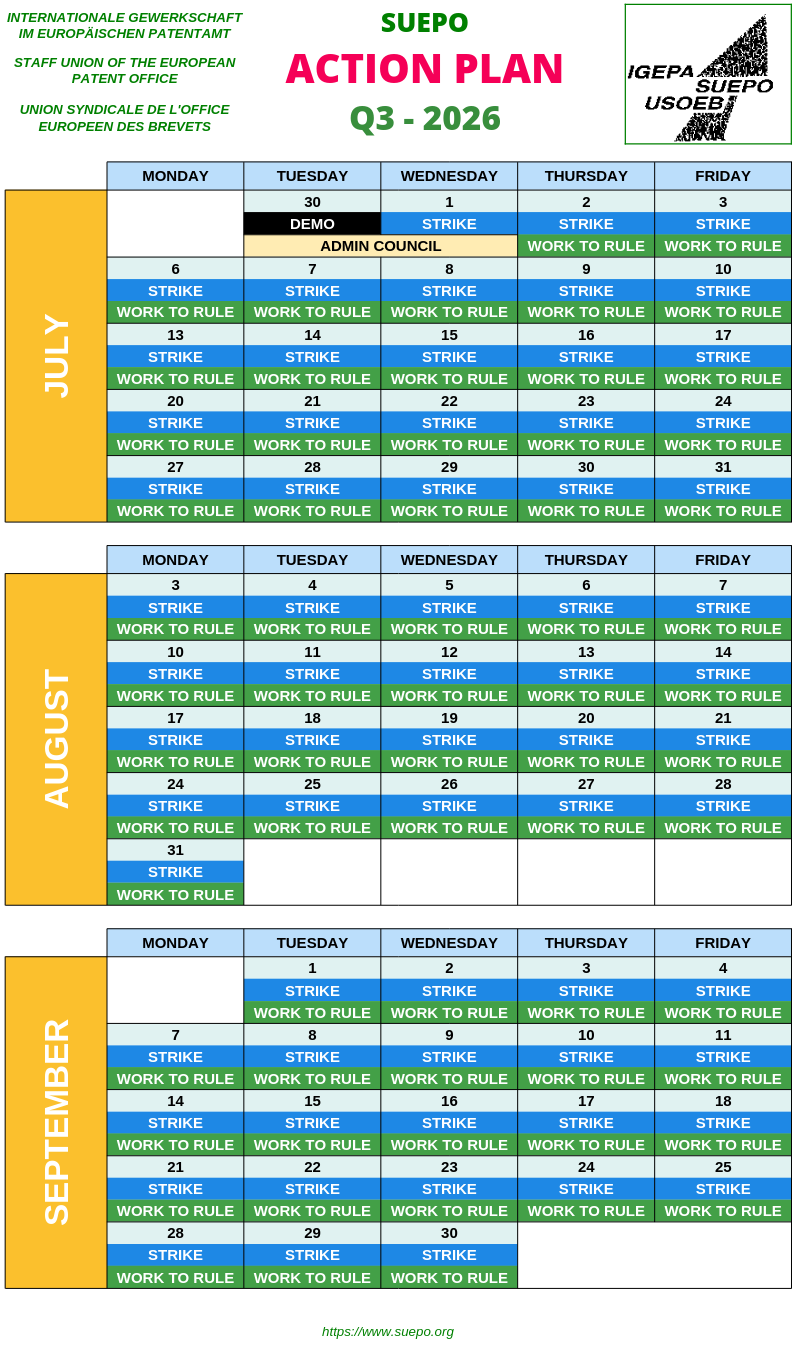
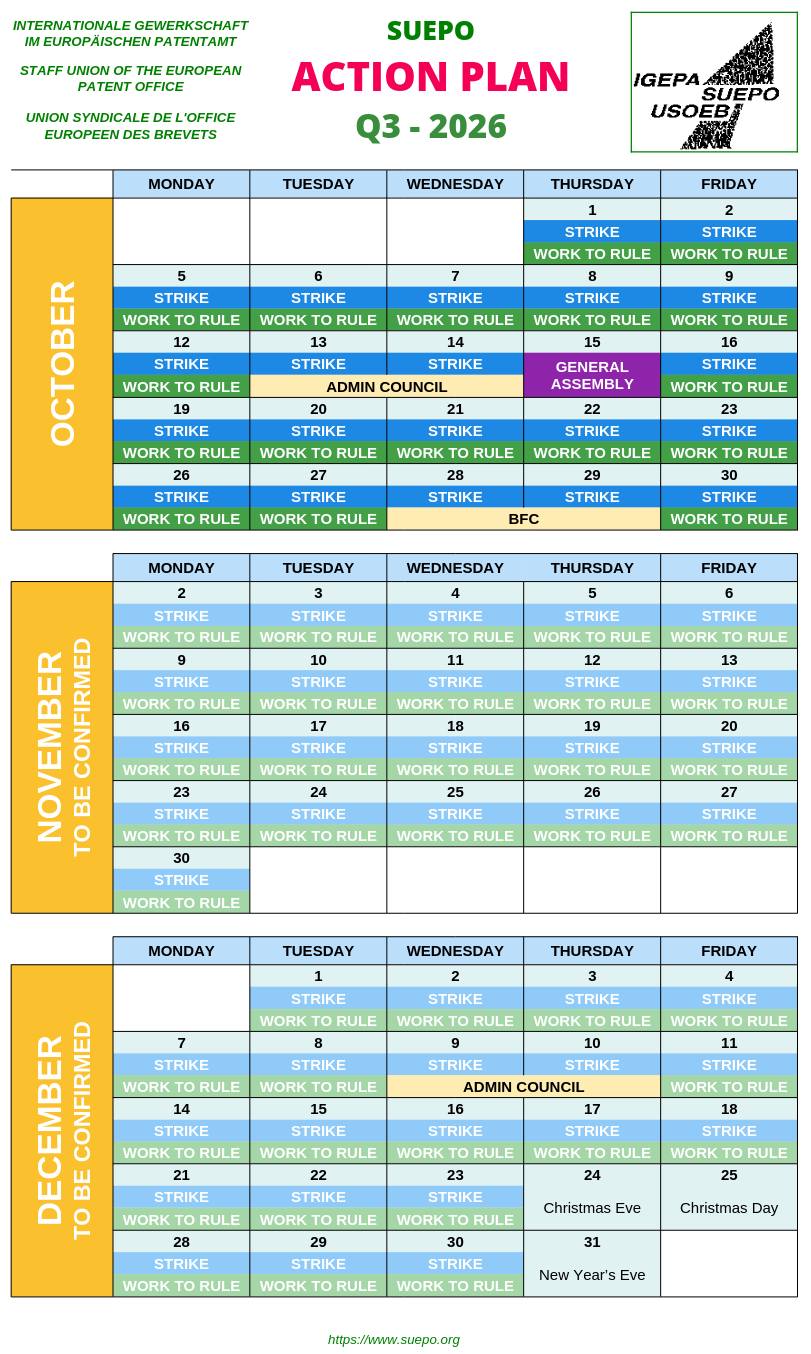
Recent and upcoming actions leading up to the meeting that can introduce a potential replacement for EPO leadership:
We'll soon look at the high participation rates and what comes next. █