
European Patent Office (EPO) Series: Temporary Public Office or Permanent Personal Feather-Bed?
Previous Parts:
Part 37
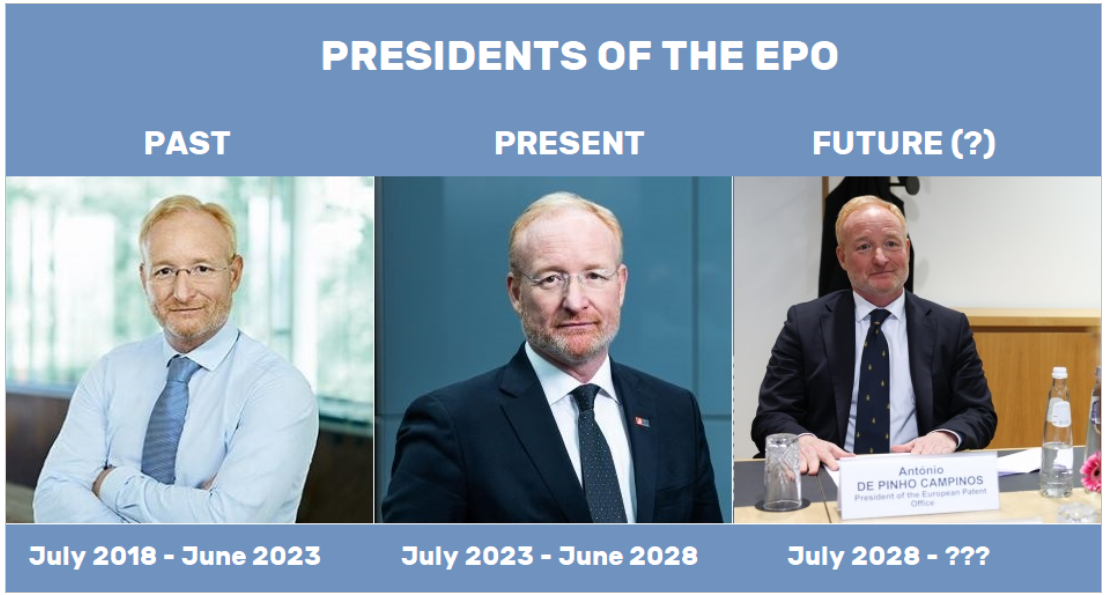
António Campinos appears intent on transforming the position of
EPO President – originally envisaged as a temporary public office –
into his own permanent personal feather-bed.
When the European Patent Convention (EPC) was drawn up in the 1970s, its architects envisaged that the President of the European Patent Office would serve a single five-year term before handing over to a successor. The presidency was intended to be a stewardship, not a personal possession. There was a broad expectation that – in line with the established practice at other intergovernmental bodies – the office would be rotated among candidates from the member states, thereby reflecting the EPO's international character and preventing the concentration of power in the hands of any one individual.
However, beyond stipulating that the appointment would run for five years, the drafters of the EPC didn't include any provisions governing the appointment procedure or specifying the terms of the appointment itself. All further details were left to the discretion of the Administrative Council. Back in the day that may have seemed like a reasonable arrangement but times have changed since then.
Indeed, as we shall see in due course, it would appear that – under the pernicious influence of Campinos and his trusty amigos – the members of the present-day Administrative Council have no scruples about exploiting the legal loopholes left by the drafters of the EPC to their own advantage.
Already during the reign of Sun-King Battistelli the original vision of a single five-year term was considered a relic of the past. In June 2014, a year before Battistelli's term of office was due to expire, the Administrative Council – at that time chaired by Battistelli's "protector" the notoriously corrupt Jesper Kongstad – ignored the concerns expressed by EPO staff and decided to extend the Corsican despot's mandate by another three years in order to save themselves the bother of having to organise a selection procedure to find a successor.
Eight years later, the current incumbent António Campinos managed to push the envelope further than his predecessor by securing a second mandate for a full five-year term. Despite protests by EPO staff which were ignored as usual, a decision to reappoint Campinos was taken by the Administrative Council at its 171st meeting which was held on 29th and 30th June 2022.
At the time of writing, Campinos is already more than half-way through his second mandate and he is openly and actively seeking a rubber-stamped reappointment for a further unprecedented third mandate. His ambitions in this regard suggest that he views the position of EPO President not as a temporary public office but rather as his own permanent personal feather-bed where he hopes to repose in comfort until retirement.
We remind our readers that Campinos was born in Poitiers (France) on 24th October 1968. This means that if he did succeed in securing reappointment, he would be approaching the threshold of the traditional retirement age of 65 when his third term expired at the end of June 2033. Of course, for all we know, Campinos might have plans to stay on until he reaches his 70s, just like Christoph Ernst, the EPO's geriatric Vice-President of Legal and International Affairs who will turn 72 this year.
It is worth recalling here that top appointments in the institutions of the European Union typically run for a five-year term and the possibility of an extension of tenure is strictly limited to one further five-year term.
This applies, for example, to the position of the President of the European Council currently held by António Costa. It also applies to the heads of EU agencies such as the Alicante-based trademark and design registration agency EUIPO.
The appointment of EUIPO's Executive Director is governed by Article 158 of the EU Trademark Regulation which contains the rules governing the "Appointment and removal of the Executive Director and extension of term of office". The relevant provisions of that article prescribe that "[t]he term of office of the Executive Director shall be five years" and that, contingent on an assessment which is to take place by the end of that period, reappointment is possible "once and for no more than five years".
However, as explained in the introduction to the present series, over at the EPO it is a completely different story. The current rules as laid down in Administrative Council decision CA/D 5/24 [2] place no restriction on the number of times that a President of the EPO can be reappointed.
A careful examination of the official record of the EPO's Administrative Council during recent years indicates that this "exceptional" situation didn't come about by accident but was rather the result of deliberate design.
As a matter of fact, at the same time as the Council approved the reappointment of Campinos for a second term during its 171st meeting in June 2022, it also began to lay the groundwork for a "legal framework" which would permit him to obtain a third mandate.
The relevant measures were adopted by the Council under the cover of a program entitled "Modernisation of the EPO's external governance". According to the official narrative which appears on the EPO's so-called "Transparency Portal", this program was aimed at "rendering the working arrangements, organisational setup and procedural rules of the Administrative Council and its subsidiary bodies more robust, effective, modern and transparent".
The official records of the Council reveal that the initial proposal submitted by the Chairman was endorsed in a "closed session" during the 171st meeting in June 2022 and that during the subsequent 172nd meeting held on 13th October 2022, the Council "unanimously decided to support the roadmap for modernising the EPO's external governance proposed by the Chairperson".
The "roadmap for modernising the EPO's external governance" involved three "baskets" of measures, two of which were delivered in 2023. The adoption of the first two baskets [1, 2] proceeded in a relatively open and transparent manner, at least by EPO standards. For example, CA/31/23 and CA/62/23 are publicly available documents which contain details about the implementation of various "Basket I" measures.
At the same time as the first two baskets were being adopted in 2023 "the Office also began preparations on a third basket" which included "conceptualising the way forward for codifying the appointment and reappointment procedures for the President and the Vice-Presidents".
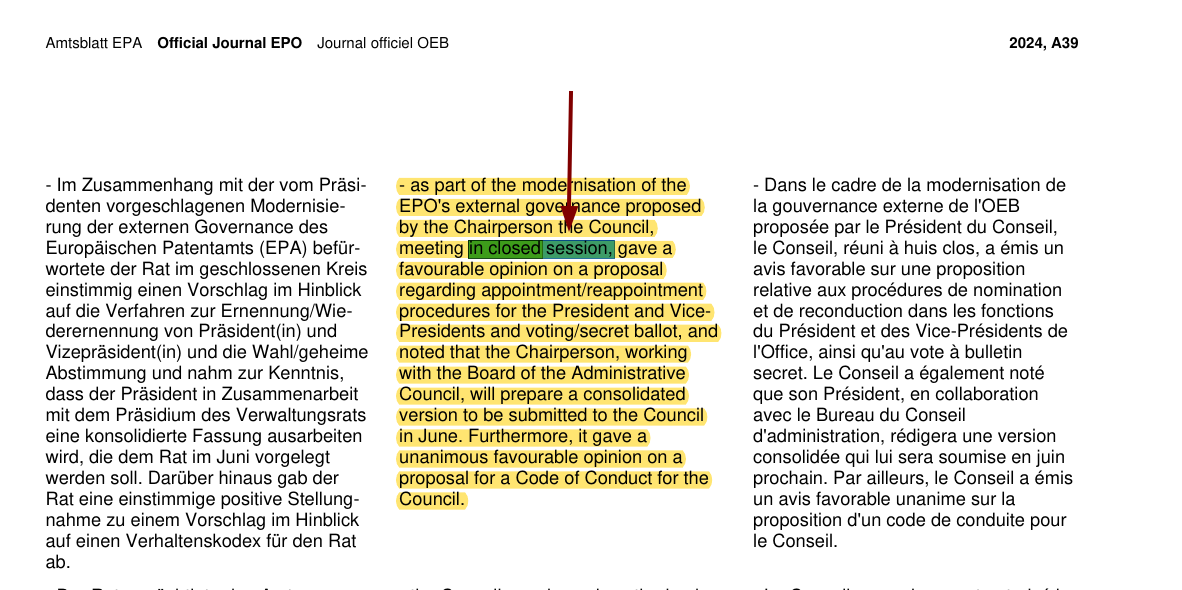
When it came to "Basket III" in 2024 things suddenly became much more secretive. With the exception of CA/43/24 which relates to a "Code of Conduct on the prevention and management of conflicts of interest for the Administrative Council of the European Patent Organisation", all of the proposal documents related to this third basket of measures are categorised as "C" documents. This means that they are classified as "confidential" and thus not available for public inspection. In addition to this, all of the related Council discussions took place "in closed session" – in other words, with the deliberate exclusion of all external observers such as EPO staff representatives.
The upshot of all this is that the "Basket III" measures – including "codifying the appointment and reappointment procedures for the President and the Vice-Presidents" – were discussed and decided on by the Council delegates behind closed doors and completely immune from any external scrutiny.
Despite the secrecy surrounding the adoption of these measures, the official published reports of the Council meetings provide a few crumbs of information which allow us to get a general idea of what went on.
The report of the 178th meeting held in March 2024 states that "the Council, meeting in closed session, gave a favourable opinion on a proposal regarding appointment/reappointment procedures for the President and Vice-Presidents and voting/secret ballot, and noted that the Chairperson, working with the Board of the Administrative Council, will prepare a consolidated version to be submitted to the Council in June".
The report of the 179th meeting held in June 2024 confirms the adoption of the "consolidated version" prepared by the Council Chairman, Josef Kratochvíl: "In closed session, the Council adopted the decisions laying down the rules for appointing and reappointing, and extending the term of office of the President and Vice-Presidents of the European Patent Office and related amendments to its Rules of Procedure (RoP)".
From the minutes of the 179th meeting – which are not published on the Council's website – it emerges that the final version of the proposal was presented to the Council in a confidential "C" document (CA/C 10/24) which included an addendum with a "complementary expert opinion".
Because the document CA/C 10/24 and its addendum are not publicly available we don't know who was responsible for drawing up the "expert opinion" or what its contents might be. What we do know, however, is that the vote in favour of the proposal was not unanimous. Of the 39 delegations present at the meeting, only 28 voted for the proposal. There were 7 votes against and 4 abstentions.
Although the proposal document CA/C 10/24 is not publicly accessible, the decisions adopted by the Council on the basis of this proposal can be accessed via the so-called "Transparency Portal" on the EPO's official website:
• CA/D 5/24 which contains the "Rules for appointing and reappointing, and extending the term of office of the President of the European Patent Office";
• CA/D 6/24 which contains the "Rules for appointing and reappointing, and extending the term of office of the Vice-Presidents of the European Patent Office";
• CA/D 7/24 which contains related amendments to the Council's Rules of Procedure.
The significance of CA/D 5/24 has already been explained in the introduction to the present series. This decision permits the Council to reappoint the President of the Office for an unlimited number of five-year terms. The decision as to whether or not a competitive selection procedure should be held is left entirely to the discretion of the Council.
CA/D 6/24 contains a similar arrangement for the appointment and reappointment of the EPO's Vice-Presidents who invariably come from the ranks of the Administrative Council or occasionally – for example, in the case of Steve Rowan – from the EUIPO Management Board.
The third decision, CA/D 7/24, made a number of amendments to the Council's Rules of Procedure. Most significantly, it introduced a new paragraph 6 into Article 10 of the Rules of Procedure: "Votes on elections and re-elections and on appointments, reappointments and extensions of terms of office shall be taken by secret ballot."
The goal of these measures – according to the official narrative – was the "modernisation of the EPO's external governance". As always, the public is assured in soothing tones that everything was done "in line with global best practices and standards". But does such a claim really stand up to scrutiny?
A more objective and impartial analysis indicates that the adopted measures were not so much designed to promote "good governance" but rather to serve the self-interest of the EPO's senior managerial clique and their amigos on the organisation's governing body.
The fact of the matter is that, by means of a highly secretive procedure conducted behind closed doors and effectively exempt from any external scrutiny, the Administrative Council created a "legal framework" which permits the unrestricted reappointment of senior EPO officials.
At the same time, the selection procedures for these positions became more secretive and less transparent as a consequence of the amendment to the Council's Rules of Procedure which stipulates that "votes on elections and re-elections and on appointments, reappointments and extensions of terms of office shall be taken by secret ballot". This means that there is no longer any official record of which delegations voted for a particular candidate. How such an arrangement can be considered in the public interest remains a mystery which the Administrative Council has failed to explain.
In any event, the bottom line here is that with the adoption of CA/D 5/24 in June 2024, the stage was set for the rubber-stamped reappointment of Campinos for a third term.
Whether or not such a reappointment would be in the interests of the organisation and its executive organ, the European Patent Office, is a question that could legitimately be asked. However, as things stand, it does not seem to be a question that any member of the Administrative Council is likely to ask – at least not in public.
If all goes according to plan in October of this year, the outcome of the carefully choreographed reappointment charade will resemble a coronation rather than an election, with the Administrative Council cast in the role of an enthusiastic applause machine. One can only wonder what the Convention's drafters would make of the notion that an initial five-year appointment was merely the opening instalment of an indefinitely renewable personal sinecure.
An important point which should not be overlooked here is that in an intergovernmental public authority such as the European Patent Office, periodic changes in leadership are desirable because they reduce the risk of entrenched personal networks and help to ensure that the organisation does not become overly identified with the management style and priorities of a single individual. Rotation also serves to reinforce the principle that the office of President is intended to serve the institution and its stakeholders rather than a particular person or clique.
For the moment, however, there are no visible signs that the Administrative Council has the slightest interest in contemplating a change in leadership at the EPO. On the contrary, the Council seems to be content to continue operating under the motto of "business as usual". As far as the majority of delegates are concerned, the reappointment of Campinos for a third mandate is the "default option" and there is no discernible alternative in sight.
But even if his reappointment has the appearance of being a "done deal" as far as the Administrative Council is concerned, Campinos is acutely aware of the fact that ultimately the decision will not lie solely in the hands of his trusty rubber-stamping amigos on the organisation's governing body.
Although it might seem that the European political establishment has abdicated all responsibility when it comes to the day-to-day running of the European Patent Office, the fact of the matter is that it can still exercise an active role in EPO affairs when it comes to sponsoring senior managerial appointments.
Any candidate for the position of EPO President needs to have the official endorsement of the government of their home country. In addition to this, the fact that 27 of the EPO's 40 contracting states are also member states of the European Union means that a candidate who is capable of obtaining support at EU level has a very strong chance of winning.
While it may be true that the EU states rarely if ever vote as a single unified bloc on the EPO's Administrative Council, the support of a majority of those states would significantly bolster the position of an aspiring candidate striving to reach the 30 vote quota needed to secure a three-quarters majority.
In the case of Campinos, for the purposes of his EPO career his "home country" is Portugal. As we explained in the earlier parts of this series, his efforts to secure reappointment at the EPO are ultimately dependent on the goodwill of the Portuguese political establishment – the "Brotherhood of São Bento" – in particular the Portuguese Prime Minister Luís Montenegro at a domestic level and the President of the European Council António Costa at EU level.
In the concluding parts of this series which will follow shortly our focus will return to the role of the Portuguese political establishment as the EPO President's reappointment campaign enters a critical phase in the run-up to the 188th meeting of the Administrative Council scheduled to take place on 13th and 14th October 2026. █