
IBM is Almost Defunct
This is what IBM has left to sell now: (selling itself)

Also see: Visual Evidence/Documentation of IBM Dying Like the Dinosaurs (many abandoned IBM facilities)
IBM is laying off loads of people in secret. It also suspends operations in many facilities. Now it sells some of these facilities. Two hours ago someone spoke of hiring freeze while insiders brace for a large round of RAs:
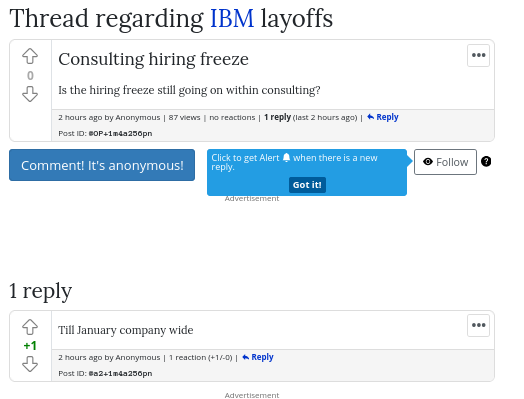
As another thread puts it "this isn’t your granddads IBM anymore", it just uses the same old name, but it's not the same company.
Quoting some detailed comments:
The quote is 100% accurate. The standards, values, morals and just good old fashion hard work are long gone. Ironically the new IBM has been coasting on the old IBMs reputation for decades now. They aren’t the same and average joe on Main Street is also starting to realize this as well. It’s the truiest and easiest example of depicting something that is a shell of its former self.
Someone then replied: "the dinosaurs who have all the experience and are getting pushed out the door and replaced by college hires who can’t hold a normal conversation with other humans? Yeah that’ll fix it all."
Lengthier story:
The two versions of IBM share one key thing...as much as they want to be a master of the universe inventing PCs and desktop computing and PowerPC and Watson (on Jeopardy) and "hybrid" cloud, both companies live or die with that one indispensable asset. I'm a Boomer and I benefited greatly from just being part of that generation. (Really cheap education; a first house that cost maybe 4X annual salary; ...) IBM also benefited from being in the right place at the right time. A bunch of magnificently rich banks, insurance companies and other organizations all wrote a total of several billion lines of non portable, non shareable COBOL code and that locks them on this one asset which is shared by the two IBMs you spoke of. The chain of events that led to a horrible processor running a worse OS augmented by marginal DBs and transaction systems being essential to the operation of the western world could not possibly be repeated. But it did fall into the lap of the old IBM which bequeathed it to successive generations including the new IBM.They failed to see what they had in the PC because they saw it mostly as an access point to mainframes. They overpromised and underdelivered on their desktop OS. They had a massive lead on Intel on scientific computing but, as the old expression goes, time and tide wait for no man, so they got rolled. They switched from computer engineering to financial engineering with genius ideas like RoadMap 2015.
They bought and destroyed an uncountable number of companies. Even IBM has figured out that they should be probably keep Red Hat arrive. But they insist that a lot of their cool stuff needs to be on Z which is as far from a natural fit as you can get.
As time goes on, it is clearer and clearer that there is ONLY ONE asset holding the two generations of IBM in any sort of business position. The problem is that those banks and insurance companies and other organizations would love nothing more than to move off a platform that requires bizarre knowledge to run. The old IBM could comfortably run a business in a way that supported employees. The new IBM pretends to be things like AI. (If anyone at that White House meeting even thought about IBM, they would have say "sure, go ahead...keep training your model" and patted IBM on the head.) The new IBM can actually see that they need to cut costs to the bone to keep their one and only asset keeping the lights on. And that, along with bizarre financial engineering and other poor business decisions is how old IBM moved to new IBM. By the way, there is no going back.
A couple more:
There was an old story in legal circles back in the day of a judge saying I want that IBMer on my jury. I have personally experienced this preference for IBMers during jury duty. The preference was not for judgment or intelligence but for a reputation for rock solid integrity.
IBM made plenty of d-mb mistakes back then. System FS. Building os/2 on the 286 instead of the 386 to save a warehouse full of already built machines but driving Gates to develop os/2 NT soon to be renamed windows NT. Hobbling the AS/400 to avoid encroaching on mainframes. A stupid attempt to establish proprietary dominance around Micro Channel. Sitting on relational databases for years and then actually helping Larry Ellison’s new startup productize them.
IBM made many mistakes, but IBMers as a rule acted from a relative high ground of personal character and candor. They weren’t saints. They could hard sell. And they could deflect questions. But there were boundaries beyond which they simply would not go. And everybody knew there was a limit to how dirty IBM would play. A limit that came from deep inside, not from a fear of getting caught. A limit tighter than the one many competitors observed.
Under Sam those limits loosened up a bit mainly as a result of massive poorly vetted hiring into GBS. Under Ginni ethics became something we talked about once a year during online Business Conduct Guidelines training and possibly Defense Industry Initiative training. Ethics became at IBM, as at many competitors, “the game” we played … and when you cheat don’t get caught.
I think this distinction is important. An institution can make serious strategic and technical mistakes while still maintaining a strong culture of personal integrity. Historically, IBM appeared to understand that distinction. Its reputation was built not simply on technical competence, but also on the expectation that employees would operate within certain ethical boundaries, even when doing so was commercially inconvenient.
The concern is that this culture has eroded over time. Integrity increasingly appears to be treated as a suggestion rather than a consistently enforced principle. Across successive generations of leadership, the emphasis seems to have shifted toward business objectives, management priorities, and organizational expediency, with accountability and ethical considerations too often taking a secondary role.
I have personally sat in a department meeting, after the RA of the past year, and witnessed an example that illustrates these concerns. During an internal departmental meeting, a senior manager of a unit process (UP) department openly state that individuals who were no longer employed by IBM should have their names removed from patents and scientific publications. There was a noticeable reaction in the audience to the statement. Such a position raises serious ethical and legal concerns. This was in response to a question posed by a member of the team in the audience. The suggestion that professional recognition could be withdrawn simply because someone has left the organization stands in direct conflict with what IBM used to be and stand for along with every professional and academic integrity standard we all grew up with.
What makes this particularly troubling is not merely the statement itself, but what it suggests about the broader organizational culture change at IBM. When a senior manager expresses such a position in a professional setting such as a department meeting, it raises legitimate questions about leadership judgment, accountability, and the extent to which established ethical standards are being upheld.
Ultimately, the difference between an organization that genuinely values integrity and one that merely promotes it is revealed when ethical conduct comes at a cost. Once those boundaries become negotiable, the damage extends beyond individual decisions: it undermines trust, weakens institutional credibility, and diminishes the very reputation that once distinguished IBM.
IBM is doomed. It just tries to test how much more patience the shareholders have. █