
In the United Kingdom, Rising Cost of Hardware Benefits GNU/Linux
GNU/Linux rose from about 4% to almost 6% in one year
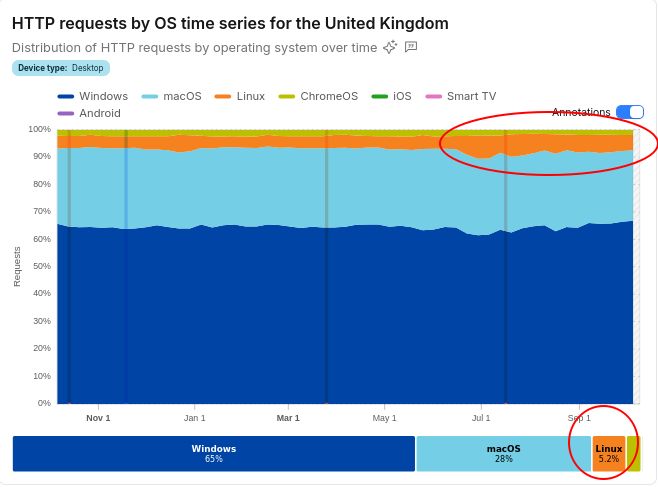
In the United Kingdom, statCounter estimates that GNU/Linux has a market share of about 5%. I remember how over a decade ago it was around 2% and I could believe this based on personal observations.
As noted last week, more and more businesses here are moving to GNU/Linux, not just in the "back end" (server/s) and phones (Android).
When businesses are tight with money/budget, and moreover with growing awareness of security, there's a temptation to convert existing "Windows PCs" into GNU/Linux workstations.
The costs associated with hardware go up very sharply this year. That too is a contributing factor. I'm sure it is, as people I know are reluctant to buy a new computer (seeing the price tags and specs).
There's no obvious workaround except reusing/upcycling/recycling "old" PCs. As Andy put it yesterday*, "don't buy cheap memory modules, there's obviously a lot of counterfeit hardware going around in the current component crisis."
Seems like he was a victim. It cost him a lot! Days wasted.
It has been a very long time since I last had hardware problems. My writing laptop will soon have an uptime of 3 years. █
___
* From "Memory is everything", likely just temporarily there in the front page:
Yesterday I asked "What was wrong with plain old
$ ./configure && make && make installWell actually using
wafand changing clang compiler options to be a lot more verbose helped me track down a possible memory malfunction, a likely root cause of a lot of software trouble I've had lately.Long and short of it is that
memtesteris thorough and slow, but because you can only point it at free memory I missed an important point that the already allocated high mem was suspect. Going to the BIOS I found that a cheap DDR4 DIMM I'd put in was defective. Swapping it out made reliable compiling work again.It's an interesting point that so much error correction is applies nowadays that serious problems can go hidden for a long time. Compiling sensitive DSP code, as for Ardour, won't sweep this under the rug. Having the compiler fail in different places on each run is a giveaway.
This also explains why gzip failed compressing a 5G file. I just tried compressing the same data again and got reliable level 9 compression first time, albeit more slowly. I read a bit more about memory stability on modern motherboards and found setting the system memory to more stable settings (underclocked and higher voltage) has a huge effect on overall performance. Much better to trade stability for speed. And do not assume that the "auto" setting will pick the best values. Also, don't buy cheap memory modules, there's obviously a lot of counterfeit hardware going around in the current component crisis.