
The Local Staff Committee Munich (LSCMN) Speaks of Deterioration of Working Conditions at the European Patent Office (EPO)
"At least 3 days per week in the Office for an allocated office"
9 days ago regarding Pschorr 5-6: Discussion About Potential Sale of EPO Buildings and Enshittification of Europe's Largest Patent Office
Yesterday:
Imagine working in a company or someplace where you don't have a working desk or where you need to justify getting one (or temporarily apply for one online). Welcome to Europe's second-largest institution.
In a publication dated yesterday the LSCMN said it had met a manager who thinks staff should work day and night (it's illegal by the way!) and Madame Bergot, who should be no stranger to anyone who has read us long enough (we've covered her mischievous behaviour for over 12 years).
Let's reproduce the contents of this publication:
Örtlicher Personalausschuss München Innenstadt, Haar und Brüssel
Local Staff Committee Munich City, Haar and Brussels
Le Comité local du Personnel de Munich Ville, Haar et BruxellesMunich, 13-10-2026
sc26021mpAllocation of workplaces following the move to Pschorr 5-6
Dear Colleagues,
In the meeting of the Local Staff Committee Munich (LSCMN) with Ms Simon (VP4) in her capacity as Site-Manager and Ms Bergot (PD4.3) as deputy Site-Manager, the Administration confirmed that staff will move from Pschorr 1-4 to Pschorr 5-6 in the middle of 20271 and that colleagues who are present in the Office at least three days per week will be eligible for an allocated office.
After the meeting, the LSCMN requested in writing clarification of the rules and criteria that will be applied for the allocation of workplaces after the move. The Administration replied as follows:
As explained during the implementation of Bringing our Teams Together, the allocation of workplaces is based on guiding principles rather than strict rules. In particular, an allocated workplace, whether in a shared or individual office, may be assigned by the line manager to staff who are mostly present on site. In practice, this corresponds to around three days per week, or approximately 120 days of presence over a 12-month period.As presence patterns may change over time, managers should consider the staff member’s actual presence over an appropriate period, which may extend up to the preceding 12 months, when assessing the situation. The 120-day figure should therefore be understood as a guiding principle rather than an automatic eligibility criterion. Relevant circumstances that may temporarily affect presence, such as maternity leave or other temporary situations, must also be taken into account on a case-by-case basis.
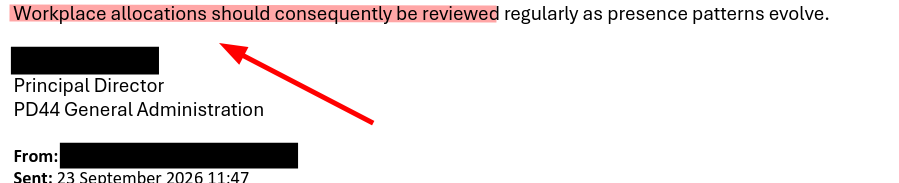
The intention is to allow managers to exercise appropriate judgement based on the individual circumstances and the actual use of workspace, while applying the guiding principles consistently. Workplace allocations should consequently be reviewed regularly as presence patterns evolve.
The full written exchanges with the Administration are annexed to this paper.
Sincerely yours,
The Local Staff Committee Munich____
1 “Report on the meeting between VP4, Deputy and Site Managers and the Local Staff Committee Munich on 16 September 2026”, LSCMN paper of 5 October 2026 (sc26020mp)
From: PD44 Office
Sent: 29 September 2026 09:11
To: ---------------
Cc: --------------- VP4 OFFICE; Social Dialogue; DL-LSCMN; ---------------
Subject: Allocation of offices following the move to PH5-6Dear ---------------
As explained during the implementation of Bringing our Teams Together, the allocation of workplaces is based on guiding principles rather than strict rules. In particular, an allocated workplace, whether in a shared or individual office, may be assigned by the line manager to staff who are mostly present on site. In practice, this corresponds to around three days per week, or approximately 120 days of presence over a 12-month period.
As presence patterns may change over time, managers should consider the staff member’s actual presence over an appropriate period, which may extend up to the preceding 12 months, when assessing the situation. The 120-day figure should therefore be understood as a guiding principle rather than an automatic eligibility criterion. Relevant circumstances that may temporarily affect presence, such as maternity leave or other temporary situations, must also be taken into account on a case-by-case basis.
The intention is to allow managers to exercise appropriate judgement based on the individual circumstances and the actual use of workspace, while applying the guiding principles consistently. Workplace allocations should consequently be reviewed regularly as presence patterns evolve.
---------------
Principal Director
PD44 General AdministrationFrom: ---------------
Sent: 23 September 2026 11:47
To: --------------- VP4 OFFICE <vp4office@epo.org>; Social Dialogue
<socialdialogue@epo.org>
Cc: DL-LSCMN <lscmn@epo.org>
Subject: Allocation of offices following the move to PH5-6
Dear --------------- dear colleagues,
During last week's meeting with the Site Manager regarding the move from PH1-4 to PH5-6, it was indicated that colleagues who are present in the Office at least three days per week will be eligible for an allocated office.
Could you please clarify the rules and criteria that will be applied for the allocation of offices? For example, it is necessary that staff know whether a specific reference period for on-site presence will be taken into account and, if so, which period will be considered.
This information helps colleagues who have a particular need for, or interest in, an allocated office to ensure that any relevant requirements are taken into account.
Thank you in advance for your clarification.
Kind regards,
--------------- on behalf of the LSC Munich
So an IO (or Patent Office) that grants lots of illegal patents to hoard money now asserts (still) that "the allocation of workplaces" is not automatic. Let that sink in.
Is it surprising at all that patent applications (and granted patents) are getting worse and job applicants walk away? █