
Bonum Certa Men Certa

Systematic Abandonment of the Independence of Judiciary at the EPO (or Collective Amnesia)

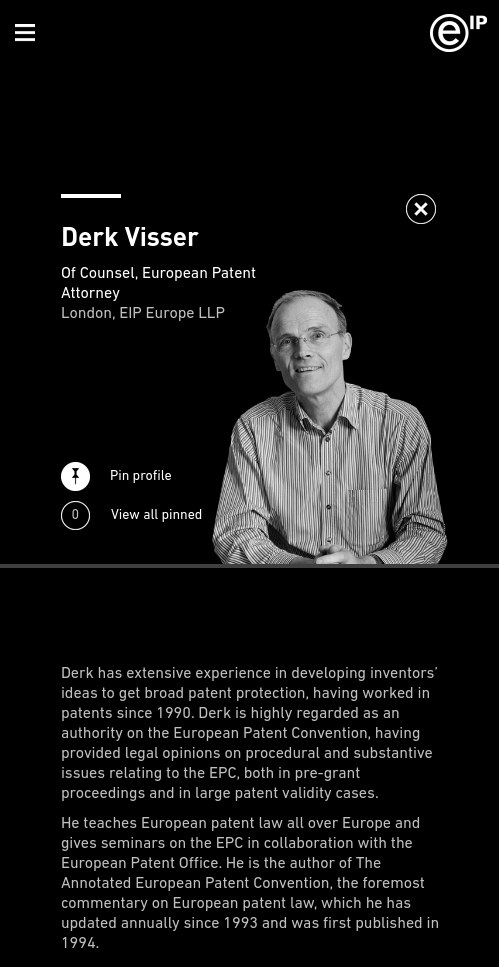
Derk Visser at EIP


Summary: The 'constitution' or the convention upon which the EPO is based (known as EPC) is routinely violated and nobody seems to care anymore; the EPO governs itself and conducts itself without as much as a fundamental legal text

European Patent Office (EPO) President António Campinos has done absolutely nothing to undo Battistelli's attacks on the autonomy of EPO judges. Nothing! To make matters worse, Campinos is already meddling in upcoming/ongoing cases, including one that shapes EPO policy on software patents in Europe. So one might say that Campinos is no different -- or potentially worse -- than Battistelli.


Isn't it fascinating that EPC experts aren't saying a darn thing anymore? Does that seem normal to them? In the age of Donald Trump have we buried the fundamental tenants of "separation of powers"?

In the blog of a company that pays him, the famous Derk Visser (author of a famous book) and the EPI (they like to make it all lowercase) push for more patent maximalism through the besieged boards that are illegally bullied by the Office (an EPC violation). Yesterday he published "When is a sub-range novel?"

The December issue 4|2019 of the journal epi Information contains four interesting contributions to the discussion on the novelty test for sub-ranges as used by the EPO.

The EPO has a special novelty test to determine whether a claimed numerical sub-range of a known broad range is novel over the known range. A sub-range must comply with each of the three criteria of the test. The criteria are, that the sub-range (i) must be narrow compared to the broad range, (ii) be far removed from known examples within the broad range, and (iii) is not an arbitrary specimen of the prior art but another invention (purposive selection, new technical teaching).

The test was formulated in 1985 by the technical board of appeal in decision T198/84 and subsequently used broadly within the EPO. Recently, several articles have criticized the test. In 2013 Thomas Leber of the EPO regarded compliance of the three criteria with the EPC questionable (see JIPLP, vol. 8, issue 7, July 2013, pages 561-565). More recently, I argued that the three criteria are incompatible with recent EPO case law on novelty (epi Information, issue 4|2019, page 27-33).

The latest edition of the Guidelines for Examination in the EPO, which entered into force on 1 November 2019, has removed the purposive selection criterion from the test (see section G-VI, 8(ii)). However, the latest edition of the book Case Law of the Boards of Appeal of the European Patent Office, 9th edition, published July 2019, still mentions the three criteria of the test (see chapter I.C.6.3.1). In addition, the book mentions a large body of contradictory case law about the purposive selection. Roel van Woudenberg argues in his recent article, that the purposive selection criterion should be kept in the test, as being consistent with the disclosure test used for novelty (see epi Information, issue 4|2019, page 34-39).

[...]

The above course of events shows that only because the President of the epi had written a letter to the EPO, did users of the EPC learn about the development of the case law and the adoption of the two-part test by most boards of appeal. If the President of the epi had not submitted his request, the users of the EPC would still be unaware of the development of the case law and, as a consequence, would still be uncertain about what test for novelty of a sub-range to use in appeal cases.


"The latest edition of the Guidelines for Examination in the EPO," as Derk Visser calls it, contains serious violations of the EPC, e.g. allowing illegal software patents under the guise of "HEY HI" (AI). Derk Visser should understand this better than anyone, but maybe he'd rather look away. It helps sell more copies of his book.

These patent maximalists aren't honest. They're profit-driven and they know what kind of system brings them more money. For instance, they like to tell us all that rich countries are rich because of patents but in practice they reverse cause and effect. It's because they're rich they come up with protectionism and monopoly mechanisms (to maintain inequality, imperil competition). The EPO does so-called 'studies' to perpetuate these lies. They (mis)use words like "property", "assets", "right" and "invention"...

Now, citing the famous Derk Visser, whom we recently mentioned here (like a month earlier and past years), IP Kat's patent maximalist Rose Hughes (there are a few of them who 'took over' the feline blog in recent years) does a "me too". It is mere repetition. Does the European Patent Institute (EPI), a front group of litigation companies, control the EPO's decision-making process nowadays? This is insane. But the connections between EPI and EPO go quite a long way back (like exposing whisleblowers and quelling dissent).

Here's what the AstraZeneca attorney wrote:

According to the European Patent Institute (EPI), the law on the novelty of selection inventions is unclear, given the diverging opinions of the Boards of Appeal. In view of this purported lack of clarity, the EPI president (Francis Leyder) wrote a letter to the President of the EPO requesting the President to refer the issue to the EBA. The President of EPI cited a number of recent Boards of Appeal decisions that did not apply the “purposive selection" criteria (including T 1233/05, T 1131/06, T 230/07, T 1130/09, T 2041/09, T 378/12 and T 1404/14) and a two recent decisions that did (T 66/12 and T 673/12). In the view of EPI “[i]t is clear from the above that there are clearly two incompatible lines of Board of Appeal decision as to what are the criteria to be used in deciding whether a sub-range is novel”. The President of EPI therefore suggested a referral from the EPO President to the EBA, that might ask the following question:

“What are the criteria to be used in assessing the novelty of a claim where the allegedly distinguishing feature of the claim relative to a prior art document is a sub-range of a broader range disclosed in that prior art document”.

[...]

It seems that proponents of a referral with respect to selection inventions can now only hope for a referral by a Board of Appeal (Article 112(1) EPC). Indeed, EPI urges parties in appeal proceedings who find themselves involved in a case where the use or not of the “purposive selection” criteria is influential to the case, to request the Board to refer the issue to the EBA. The opposing view is that a referral is not necessary, as the Boards of Appeal do seem to be following the approach now set out by the guidelines. Indeed, Roel van Woudenberg could be said to be pushing the issue merely because he disagrees with the removal of the purposive selection criteria (as argued his article cited by EPI).

Selection inventions have always been a hotly debated issue. In another article cited by EPI, authored by Derk Visser, it is argued that all three criteria listed in the guidelines are inconsistent with recent case law on novelty. As with second medical use inventions (another form of selection invention), critics are keen that an inventor should not “get something for nothing” by salami slicing (or as some-would have it, “sashimi slicing”) the prior art. The boarder question surrounding the EPI recent request for a referral on sub-ranges is whether the EPO is currently striking the right balance on selection inventions. What do readers think?


As usual, comments are a tad better (for the few who still comment there or have their comments approved). MaxDrei would be better off pointing out that EBA at EPO lacks independence now, by its own admission. It's compelled to allow violations of the EPC by the Office. But he tackled this from another angle:

Robin Jacob has been known to advise audiences that "We can learn a lot from the Americans. Watch carefully what they do. And then make sure not to make the same mistake that they did."

Observing what the Supreme Court of the USA does to patent law, one might think that, over here, a reference to the EBA can sometimes be premature.

As here, I think. The case law of the EPO emerges like Darwinian evolution. I mean, survival of the "fittest" line of legal logic. Is that not how the best EBA case law has emerged, over the last 40 years? It will do so here, I would think.

Sometimes patience is called for. Given time, things will all work out for the best. Meanwhile, our advocacy skills will decide which of the rival lines will prevail. For me, the "seriously contemplate" test can be reconciled with the Gold Standard, and makes a lot of sense.


The EBA and the other boards (BoAs) still lack their independence. Even with the UPC in its deathbed we remain stuck with courts that don't have the ability to properly enforce the EPC and nobody talks about it anymore (IP Kat in 2020 has no connection to IP Kat of 2015. Different people!), so we ought to change that.

The next comment, "In reply to MaxDrei," says, "I think that the proponents of a referral have a different conceptual view of law, namely as a system where there is some correct answer "out there" to any legal question (that just needs to be divulged by the judges, the Enlarged Board in this case). This correct answer is then not affected by the pleadings of the parties or our advocacy skills, such that there is also no such thing as a premature referral. Any delay just increases legal uncertainty for parties (and EQE candidates, perhaps), in this view. The epi President indeed uses "lack of clarity" a few times in his letter. Perhaps the proponents of a referral have a somewhat Dworkian view, whereas the wait-and-see attitude of the EPO fits with the Hartian view."

This "lack of clarity" nonsense is used routinely by the anti-35 U.S.C. €§ 101 lobbyists in the US. So-called Section 101 'reform' is a joke. Coons et al took bribes/money from litigation firms and have attempted since 2017 -- always in vain -- to sell laws for those who bribed them. It's corruption. EPI just does more of the same thing here.

There are a couple more follow-ups there this morning, including mentions of evergreening:

Thanks to egna for that suggestion of a contest between Dworkian and Hartian schools of thought. I must say, that had not occurred to me but I daresay he has his finger on the point.

egna also flags up the difficulties faced by EQE candidates. Quite right too. But in the greater scheme of things, we are talking about the rather short 18 month period covered by Art 54(3) and industry uncertainty about prior art generated within that brief period. That's not the largest source of legal uncertainty in patent law in EPC land, is it?

Personally, I think the bigger mischief lies in deciding obviousness according to a rubric written differently in the Supreme Court of each separate national jurisdiction of the 38 EPC Member States. Why can't they all accept the established case law of the Boards of Appeal of the EPO, as they do (more or less) already on other repercussions that derive, directly and unambiguously, from acceptance the EPO's "Gold Standard".


Well that's indeed the thing, isn't it, Attentive. Consider the skilled person, interested in the "disclosure" of a document, wanting to milk it for everything derivable from it. The Gold Standard limits the "disclosure" to that which is "derivable" directly and unambiguously, from the document. But the imaginary addressee has at its disposal, to assist in the task of deriving stuff, all the common general knowledge that can be imputed to the hypothetical skilled person. Under those conditions, what the skilled person is deemed to seriously contemplate during the contemplation of the document can be seen as within the ambit of that which the skilled person derives, directly and unambiguously, from the document.

Or, to put it another way, when one deems the skilled person to be the possessor of an enormous reservoir of common general knowledge, one necessarily imputes to that imaginary being subject matter that it cannot help but "contemplate" seriously and inevitably, when performing the task of deriving disclosure from the document.

Or, to put it another way, is not the "implicit" disclosure and what the reader will "seriously contemplate" two ways of expressing much the same thought?

After all, we here in Europe do need a pragmatic solution to the "Art 54(3) art" problem which balances the need for fair protection, as between the earlier and the later Applicant, with reasonable legal certainty for the public. The AIA solution in the USA, in making all 54(3) art available for obviousness attacks, fails that test by giving too much power to the first filer. Rendering nugatory any 54(3) attacks on later filings awards too much protection to the later filer, and enables anti-social evergreening by bulk filers. A golden middle way is needed.


Going back to the whole "lack of clarity" nonsense, we've just seen more of that from Bloomberg's Decker. It's that latest spin by the patent maximalists, in relation to this new article about SCOTUS not wasting time on fake patents such as software patents. Decker decided to spin it like this: "Solicitor General in both Berkheimer and Hikma v Vanda (a method of treatment case) had said SCOTUS had created confusion over 101 but neither was good venue, perhaps because CAFC had upheld some claims in each case. Athena was suggested as an alternative."

The Solicitor General advised against SCOTUS revisiting the issue. We covered this before. Benjamin Henrion's response was: "SCOTUS Justices on Monday also rejected appeals to clarify the rules regarding software patents. The Supreme Court’s action leaves it to Congress to resolve an issue that’s created a legal gray area for such discoveries..."

No, that has nothing to do with Congress, but on goes Decker by tweeting: "The three software cases are HP v Berkheimer (scotus had asked for SG a year ago; SG said perhaps Athena a better area); Garmin v Cellspin and Power Analytics v. Operation Technology.

The Solicitor General (SG) actually took an OK position. And nothing is going to change. Coons et al haven't made progress since 2017. Coons et al are hardly even mentioned by the media anymore.

Going back to Europe, nothing has changed at the EU/EP since summer. They made a statement on European Patents which pertain to and cover life/nature. They oppose these.

Recently, the EPO entertained the possibility of allowing automatically-generated patents, but perhaps foreseeing the chaos this would entail it 'bailed out' (albeit there's an appeal on its way, based on press reports).

Earlier this week SS Rana & Co said:

In a landmark ruling, the European Patent Office (EPO) has rejected two patent applications[1] wherein request was lodged with the EPO for designating machine (Artificial Intelligence) as an “inventor”[2].

The ground cited for rejecting the aforementioned patent applications is that the patent applications did not meet the requisite requirement as enumerated under the EPC that an inventor designated in the application should be a human being, not a machine.

The above artificial intelligence inventor namely, “DABUS” has been in news ever since patent applications were filed with the EPO on behalf of DABUS. DABUS has been invented by Dr Stephen Thaler, Founder & Board Chairman at Imagitron, LLC.


But the EPO still allows illegal (as per the EPC) patents on software provided they're wrapped up as "HEY HI" and that's a very serious problem. As recently as this week KEI explained this whole "HEY HI" thing to the USPTO when it said: "In Europe the Court of Justice of the European Union (CJEU) has also declared on various occasions, particularly in its landmark Infopaq decision (C-5/08 Infopaq International A/S v Danske Dagbaldes Forening), that copyright only applies to original works, and that originality must reflect the “author’s own intellectual creation.” This is usually understood as meaning that an original work must reflect the author’s personality, which clearly means that a human author is necessary for a copyright work to exist. The second option, that of giving authorship to the programmer, is evident in a few countries such as the Hong Kong (SAR), India, Ireland, New Zealand and the UK. This approach is best encapsulated in UK copyright law, section 9(3) of the Copyright, Designs and Patents Act (CDPA), which states: “In the case of a literary, dramatic, musical or artistic work which is computer-generated, the author shall be taken to be the person by whom the arrangements necessary for the creation of the work are undertaken.” Furthermore, section 178 of the CDPA defines a computer-generated work as one that “is generated by computer in circumstances such that there is no human author of the work”. The idea behind such a provision is to create an exception to all human authorship requirements by recognizing the work that goes into creating a program capable of generating works, even if the creative spark is undertaken by the machine." (more on that in the upcoming installment of Daily Links).

Recent Techrights' Posts

Five Years After Its Formation Libera.Chat Has the Most Simultaneous Users in Internet Relay Chat (IRC)
netsplit.de also measures the cross-network total at over 300k, probably for the first time in years
 
Laptop Bricked After Microsoft Certificates Expiry
Is "Jim" dead?
Monoculture in Europe as National (or Continental) Security Threat
We need more browser diversity
Canada 5-0: GNU/Linux Rises to 5.0%, Windows Rapidly Falls to New Lows
Will we be seeing 6-0 (6%) by year's end and will Microsoft be shown two red cards?
Over at Tux Machines...
GNU/Linux news for the past day
IRC Proceedings: Sunday, June 28, 2026
IRC logs for Sunday, June 28, 2026
Gemini Links 29/06/2026: Sansieviera, HiFi, and Self-Signed Certificates
Links for the day
Outsourcing is Not Security
Outsourcing to Microsoft is the opposite of security
Links 28/06/2026: Turkey's State Broadcaster Suspends Commentator, Journalists Under Attack
Links for the day
Debugpoint.com Turns to LLM Slop for 'Help'
This is how sites die
Follow the Real Security Experts
Werner Koch
Assessing the Upcoming (July) Proprietary/GAFAM Cuts
The total (or %) matters to us because it can help shed light on what scale of layoffs to expect next week
Microsoft Lunduke Does Not Correct or Clarify Misinformation That He Posted (or Repeats It Instead)
Not the first time [...] detracts and/or distracts from legitimate criticisms
How Not to Do Security
Asking Microsoft for permission
Gemini Links 28/06/2026: Simulation Theory and Pursuit of Novelty
Links for the day
The Slop 'Religion' is Dying: From Widespread (Paid-for) Hype to Widespread Hate
Wait till "sentiment" in Wall Street - not just general (public) "sentiment" - shifts strongly against slop
For Whistleblowers' Sake, Choose Hosting Platforms Wisely
Techrights is hard to 'sedate'
How to Discreetly Leak Important Information to Techrights
Some years ago we published multi-part series about how to contact us securely
Expect Many More Whistleblowers From Microsoft
We envision many pissed off workers from Microsoft will become whistleblowers after next week's giant wave
Efforts to Resume Progress on FreeJS, LibreJS, and Reduce Dependence on Microsoft
It's still in a relatively early development stage
Whistleblowers Improve the World
we should appreciate and respect whistleblowers
Microsoft Windows Plunges to All-Time Lows in Japan
Microsoft is disintegrating; many people no longer use (nor need) Windows
GNU/Linux Turns 43 in 3 Months From Now
The Manifesto of the Free software movement (GNU Manifesto, 1985) turned 40 last year
SLAPP Censorship - Part 121 Out of 200: One Day We'll Discover What Company or Rich Person/s Funded the Lawfare Against Us
Even if the law firm shoulders some of the losses, then it is in effect an investor in the lawfare, according to established caselaw
Working on "Linux", But on Microsoft's Payroll
Under the totally false guise of "security" those same people are now promoting TPMs and other horrible things
Links 28/06/2026: Energy Crunch, EEE by Microsoft, and John Bolton Pleads Guilty in Dictatorship of SLAPPs
Links for the day
Jim Not Dead Yet
Let's wait a few more days
Microsoft Layoffs So Big They Cannot Even Wait for 'D-Day' (July 1)
"Layoffs at Xbox Appear to Have Already Begun, with Multiple Compulsion Games Employees Announcing Their Departures"
Over at Tux Machines...
GNU/Linux news for the past day
IRC Proceedings: Saturday, June 27, 2026
IRC logs for Saturday, June 27, 2026
Links 28/06/2026: Heatwave in Europe and Media Failing to Actually Criticise Power
Links for the day
Gemini Links 28/06/2026: Poems, Photographs, and Neoliberalism as Religion
Links for the day
SLAPP Censorship - Part 120 Out of 200: Garrett Undermines His Own Application Because His Friend Graveley Failed to Accomplish What They Had Both Aimed For
Hold off the "popcorn"
Don't Settle for Slop
Slop is a bit of a symptom of where society is told to go
Gemini Links 27/06/2026: Photography From Interlaken to Shynige Platte, Slop 'Code', and Distro Hopping
Links for the day
TIGER COMPUTING LTD Sent Us Threats Half a Decade Ago (Because of Criticism of Their In-House Debian Developer), Now the Company's Debt is Deepening
So what is they're connected to the military?
GNU/Linux in Mexico Near All-Time High
With all the tourists packing the place (or hotels) we can imagine big changes to be seen next month (many portable devices)
Summer Plans in Tux Machines
July is nearly upon us
Gopher (Protocol) Turns 35, Gemini is 28 Years Younger
Bad technology comes and goes very fast
Be Like Stallman and Assange, Not Like MElon or Bill Epsteingate
these people treat women like worse than dirt
Exposure Leads to More Whistleblowing
In areas like IBM or European patent affairs we've always earned a lot of trust
European Patent Office (EPO) Series Will Run Well Into July
We still have a very significant chunk of EPO "trench" stories
Links 27/06/2026: Journalists Kicked Out of China, Torture in Iran and Turkey
Links for the day
How Microsoft is Preventing or Slowing Down Adoption of GNU/Linux (Fake 'GNU' Controlled by GitHub in Windows, WSL, Sabotage at Boot Level, Not Limited to Dual-Booting)
Microsoft is still at it
Rising Computer Prices Good News for GNU/Linux and Free Software
This can greatly assist the adoption of BSDs and GNU/Linux
Links 27/06/2026: More Restrictions on Social Control Media and Russia is Leveraging Cellebrite/Back Doors
Links for the day
Saying "No" is Not a Bad Thing
Society benefits from people who say "No!" even when it seems impolite (and possibly inconvenient) to say so
Next Week's "Bloodbath" at Microsoft Includes "Silent Layoffs" (Which Microsoft Won't Count)
The notion of "silent layoffs" is fast becoming the "new normal"
Akira Urushibata on the Likely False (Unverifiable) Claims Anthropic Makes About Defects for Marketing/Hype
Some pro-LLM person has managed to derail the discussion on this topic
European Patent Office (EPO) Series: "Team Campinos" in Split
The EPO team was of course headed by Campinos himself who delivered a "forward-looking" keynote speech to the assembled audience consisting mainly of Administrative Council delegates from the national IP offices
Supporting Women in the Free Software Community
The common theme here is abuse of women
Left IBM After Many Years, Came to Microsoft/XBox, Now Silent Layoffs at XBox
many inside XBox will have their last day next week
Gemini Links 27/06/2026: Homeworlds and Tarot Cards
Links for the day
Over at Tux Machines...
GNU/Linux news for the past day
IRC Proceedings: Friday, June 26, 2026
IRC logs for Friday, June 26, 2026