
WELL, AS one can expect (and this was our expectation all along; right from the start or the nomination phase), António Campinos has done nothing whatsoever to hold his predecessor accountable. After all, he gave him this job. The corrupt president proceeded to heading a law school (yes, the irony!).
"Benalla is to Battistelli what the convicted person is to Frédéric Angermann, the person responsible for Battistelli's financial abuses. They're robbing the EPO while destroying it."Well, somebody has just 'leaked' to us the translation published here along with additional (several more) articles regarding this matter.
Benalla is to Battistelli what the convicted person is to Frédéric Angermann, the person responsible for Battistelli's financial abuses. They're robbing the EPO while destroying it. It's a miracle that neither has been sentenced to prison (yet) or simply another bit of evidence that the French legal system is corrupt (see how they let Lagarde off the hook following a conviction, allowing her to become head of Europe's largest bank) and EPO immunity breeds criminality of the highest order.
Here's an English translation of the article dated a month ago:
Serious dysfunctions within the financial justice system
By Laurent Mauduit Article published February 4, 2020.
In a display of double standards, two contradictory judgements have been handed down for the same offences. The former Secretary General of the National Institute of Industrial Property (INPI), who has since become a financial magistrate, was acquitted by the Budget and Finance Disciplinary Court (CDBF), while the public accountant who validated the payments from which he benefited was convicted in the Court of Auditors.
This story is currently making a lot of noise at the Court of Auditors and the Council of State, even though it has not received any publicity beyond these two institutions. And with good reason: it shows financial justice in an atrocious light. The former Secretary General of the National Institute of Industrial Property (INPI), who has since become a Master of the Court of Auditors, was acquitted by the Court of Budgetary and Financial Discipline (CDBF). Meanwhile, the public accountant who allowed the disputed payments was convicted of the same type of charges by the Court of Auditors.
It is an understatement to say that the INPI file has been thoroughly examined by the Court of Auditors. For many years, financial magistrates have periodically plumbed the depths of this public institution’s accounts and each time raised numerous grievances, but to little effect. Within the Court, the Institute has long had a shambolic reputation.
In a referral dated May 27, 2019 (), addressed to Bruno Le Maire and Gérald Darmanin, the First President of the Court of Auditors at the time, Didier Migaud, underlined the recurrent problems within the INPI: “The persistence of dysfunctions within the INPI, even though these shortcomings and bad practices have long been the subject of criticism by the Court as well as other intervenors, is not acceptable. It is all the more unacceptable because the INPI must be above reproach, in terms of the exemplary nature of public management in general, and of patent management in particular, and its work must be carried out in of optimum efficiency and regularity, given its absolutely strategic nature for French economic competitiveness,” he wrote.
This is how the INPI once again hit the headlines and prompted two judgements for the same offences, one from the Court of Auditors, the other from the CDBF. The reason for the two judgements was that the two courts do not have the same jurisdiction. The Court of Auditors judges accounting officers who are responsible for verifying the regularity of expenditure (and not the authorising officers) under accounting regulations, in particular Article 60 of the Finance Act of 1963. It is this section that enshrines the noted rule: “Public accountants are personally and financially responsible for the collection of revenue, the payment of expenditure, and the custody and preservation of funds and assets belonging to or entrusted to the various legal persons governed by public law that have a public accountant.”
An equal number of members of the Court of Audit and the Council of State make up the CDBF, which judges the authorising officers on the basis of the laws and regulations governing public management.
Thus, new irregularities noted between 2008 and 2012 at the INPI gave rise to two separate proceedings. On the occasion of a public hearing on 28 September 2017, the Court of Audit judged the first of two successive public accountants. The judgement of the Court of Auditors can be read on its website or consulted below:
A reading of this judgement shows that the complaints there were numerous complaints against the two accountants. According to the complaints, the second accountant alone, for the years 2011 and 2012, was in debt to the INPI for considerable sums: 46,304 euros, then 109,257.87 euros, then 23,400 euros, then 2,860 euros, then 888 euros, all plus interest as of December 12, 2014.
The judgement does not make it possible to guess the identity of the INPI officials involved, but their irregularities are meticulously described. We learn that the Institute reimbursed “payments for ‘overnight stays’ at actual expenses and without a ceiling on the basis of INPI regulations which would institute a permanent derogation from the laws in force”; “payments of travel expenses without a travel order or with a permanent travel order, one of the payments without a travel order relating to a trip for a spouse”; “payments for transport booked at expensive rates”; “payment of taxi fares without prior authorisation, or for journeys to and from work”.
We also learn that “the accountants approved payment for visa expenses and a trip to China by the wife of the Director General on the basis of an administrative certificate signed by the Secretary General and endorsed by the State Controller”. And so it continues.
And then there is the second judgement, handed down on 23 January 2020 by the CDBF, against the same leaders of the INPI. The judgement can be downloaded on the Court of Auditors website or consulted below:
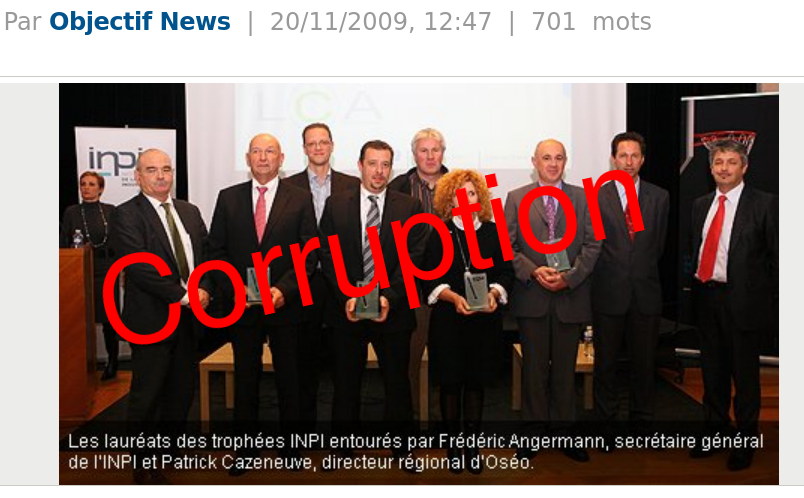
This ruling still does not make it possible discern which leaders were involved since they are anonymised. But the ruling can also be seen on the Légifrance website, and the identity of the three persons concerned can be found. They are Yves Lapierre, Director General of the INPI from 26 August 2010 to 6 October 2016; and Sophie Spilliaert, Administrative and Financial Director of the INPI from October 1, 2012, to January 30, 2016; and, finally Frédéric Angermann, Secretary General of the INPI from February 22, 2007, to October 31, 2012.
On reading the judgement, the irregularities committed by Frédéric Angermann are of particular interest. There are several reasons for this. Firstly, after his time at the INPI, he would become in 2012 a Master of the Court of Auditors, Deputy Rapporteur to the Constitutional Council and member of the Tax Infringement Commission (CIF). He is therefore one of the judges that the magistrates of the Court of Auditors, together with members of the Council of State, are judging in this ruling.
Furthermore, some of the irregularities may not involve large sums of money but are incongruous, to say the least. According to our information, the person concerned was living in Lille at the time—which he did not wish to confirm—and was therefore reimbursed for the “overnight stays” referred to above when he came to Paris to work and stayed at the hotel. He also routinely took taxis from the Gare du Nord train station to get to work, although this type of trip would not normally be reimbursed.
Above all, if he attracts attention, it is because he was acquitted by his peers. Amazing as it may seem, the accountant (this is the second one) was convicted for having validated some of these irregular payments to the Secretary General, but the Secretary General himself slipped through the judicial net. This suggests that financial justice is just not functioning properly.
This is all the more reason to believe that the grounds of the CBDF’s ruling come as a surprise to experts. We have interviewed lawyers who specialize in these cases as well as a professor of public law. All agree that the CDBF ruling is, to say the least, lenient and twists the law to arrive at an acquittal.
Sleight of Hand Around Financial Loss
Firstly, the judgement grants the former Secretary General of the INPI the benefit of a statute of limitations for many of the claims against him, using arguments that appear to be ill-founded in law. Indeed, the judgement considers that some of the irregular expenses are time-barred. However, it reaches this decision only after tortuous legal reasoning. First argument: “Under the terms of Article L. 314-2 of the Code of Financial Courts: ‘No action may be brought before the Court of Justice after the expiry of a period of five completed years from the day on which the act likely to give rise to the application of the penalties provided for in this Title has been committed’.” However, the judgement rightly points out the following: “The procureur général’s referral reiterates several times that ‘the Court has long accepted that a decision covered by the statute of limitations may lead to the liability of its author where it continued to have effect during the period not prescribed, in particular as regards remuneration’.”
In other words, if a bonus, compensation, remuneration or expenses have been improperly voted by the board of directors of an institution, the statute of limitations applies for the period beginning five years after that vote or decision. However, if the beneficiary of this irregular measure continues to receive the sums concerned during the non-prescription period, he is liable.
However, by an entangled legal reasoning, the judgement considers that in this case the provision, exceptionally, does not apply. Conclusion: “Since the breaches relating to procedural defects occurred during the prescribed period, it is no longer possible, due to the provisions of the aforementioned Article L. 314- 2, to seek the liability of the perpetrator on this count [...] It follows that, as regards the reimbursement of expenses without a travel order, the elements constituting the offences provided for in Articles L. 313-4 and L. 313-6 of the Code of Financial Courts are not met.” Many of the complaints against the three INPI directors collapsed by the same token.
This decision of the CDBF on the statute of limitations is unprecedented. If it were not subsequently overturned by the Council of State, it would lead to a major reversal of case law in this area, prohibiting the prosecution and punishment of numerous irregularities.
But this judgement is even more surprising in that it defends the idea that the public accountant having previously been convicted for some of the charges also made against the Secretary General—in particular, the hotel nights in Paris, which was his place of work at the time—meant the Secretary General could no longer be prosecuted.
Here again, the legal reasoning is tortuous, because first of all, the judgement acknowledges that there was indeed an irregularity. It is so convoluted that, here again, the grounds deserve to be read carefully: “By two decisions of 11 and 16 January 2012, the Director General of the INPI decided that the Secretary General would be reimbursed for his accommodation and meal expenses in the jurisdiction of his administrative residence, on the basis of Article 19 of the regulation of 20 June 2011, according to which ‘Staff members who, by absolute necessity of service, are prevented from returning to their homes at the end of their working day will be reimbursed for their on-site accommodation expenses as well as for their corresponding meal expenses.’ The same article states that ‘The absolute necessity of the service shall be defined by the Director General of the institution and shall be the subject of a detailed decision.’ However, there is no provision in the Decree of 3 July 2006 for the reimbursement of accommodation costs when the staff member is at his or her administrative residence. On this point, the regulation adopted by the INPI contradicts the provisions of the Decree of 3 July 2006 and the two decisions mentioned above, taken in application of the regulation, are for this reason irregular.”
The favour granted by the Director General to the Secretary General is therefore indeed an irregularity. This is what the judgement confirms as follows: “In application of the principles set out in points 2 to 5, the irregularities affecting the payment of INPI travel expenses, adopted during the prescribed period, vitiate the decisions taken pursuant to the said regulation, namely the two decisions of 11 and 16 January 2012 which were made during a period which was not prescribed. The liability of their author, in this case the Director General of the INPI, may therefore usefully be sought, and the fact of having made those irregular decisions constitutes an infringement of the rules relating to the execution of expenditure within the meaning of Article L. 313-4 of the Code of Financial Courts.”
The judgement therefore recognizes that the Director General, who granted these favours, is at fault and that his liability is established. But the beneficiary of these favours is exonerated for this staggering reason—because the public accountant was previously convicted by the Court of Auditors for having allowed this expenditure: “However, for this failure to constitute an unjustified advantage granted to another person within the meaning of Article L. 313-6 of the Code of Financial Courts, it must have caused financial damage to the INPI. However, by a ruling handed down by the Court of Auditors on 27 October 2017, the INPI’s public accountant was held liable for the same facts as those prosecuted before the Court of Budgetary and Financial Discipline, and was found to be in debt to the INPI for a sum corresponding to travel expenses paid irregularly. As the financial loss is no longer constituted, the elements constituting the offence provided for in Article L. 313-6 of the Code of Financial Courts are therefore no longer present.”
One has to admire the judicial somersault: since the public accountant has been sentenced to reimburse the INPI out of her personal funds for the irregularities authorised by the Director General for the benefit of the Secretary General, the financial loss suffered by the INPI no longer exists. And therefore, there is no longer grounds for prosecution. An excellent game of three-card monte.
The sleight of hand is easy to spot. Article L313-6 of the Code of Financial Jurisdiction stipulates the following: “Any person referred to in Article L. 312-1 who, in the exercise of his duties or powers, in disregard of his obligations, has procured for another person an unjustified advantage, pecuniary or in kind, resulting in damage to the Treasury, the community or the body concerned, or has attempted to procure such an advantage, shall be liable to a fine of not less than 300 euros and not more than to double the amount of the gross annual salary or wages he or she was receiving at the time of the offence.”
Reading this article, it is clear that it applies with three reservations. Firstly, it must not be established that the person responsible for the irregularity was not aware of his or her obligations—which is clearly not the case here. Secondly, the irregularity must have generated an unjustified advantage—which in this case is clearly established. And thirdly, it must have caused financial damage to the body or institution concerned.
It is this third provision that the judgement plays on by means of what must be called a judicial sleight of hand. For, on reading the judgement, one question stands out: what did the public accountant do the day after her conviction? Did she not ask the minister responsible, in this case budget minister Gérald Darmanin, for a remission? We asked the accountant the question, but we could not get an answer. In any case, it is allowed by law and it is common practice: the budget minister frequently grants a remission, which can be substantial, to public accountants who request it.
But if that is what happened in the present case, the CBDF would not be justified in ruling that there is no longer any financial damage. The financial loss would still exist, but if an ex gratia remission has been granted, this loss would no longer be borne by the INPI but by the Treasury. Or by the INPI, if the Minister had decided it should cover the cost. However, the CDBF states that there is no longer any financial loss, but the ruling is not reasoned on this point—which, according to our public law experts, is a major legal error, for by the same token, the CDBF would have had no reason to grant an acquittal.
This is precisely what happened. Mediapart questioned the budget minister, Gérald Darmanin, and he told us through a staff member that he had granted a remission to the two accountants concerned: “The accountants who were debited by order of the Court of Auditors have obtained remission of their debts, these remissions were borne by the INPI, without cost to the state budget,” we were told at Bercy. So, how can the CDBF ruling claim that the financial damage to the INPI has disappeared? To grant the acquittal, the CDBF therefore relies on an argument that is in fact false: the INPI has indeed always suffered financial damage.
The two rulings of the Court of Auditors and the CDBF are therefore not only very unfair, in that they afflict the public accountant and exonerate the Secretary General, but they also demonstrate a very serious malfunctioning of this financial jurisdiction. What is most worrying is that the court that has the power of cassation in this matter is the Council of State, which provides half of the judges in the CBDF. Clearly, the Council of State is judge and party, which is always unhealthy.
In this procedure, there is therefore no possibility of appeal. The only recourse, therefore, is an appeal in cassation to the Council of State. Questioned by Mediapart, the public prosecutor at the Court of Auditors, Catherine Hirsch de Kersauson, replied: “The deadline for appeal is two months, which gives me time for reflection. You will understand in this context that I do not wish to comment on the substance.” We also questioned the accountant, but she did not respond to our e-mail.
According to the professor of public law we consulted, there could, however, be many grounds for appealing this decision, particularly due to the error of fact on which it is based and the erroneous reasoning that results from it.
We have also submitted several questions to Frédéric Angermann, the former Secretary General of the INPI who has become a Master of the Court of Auditors.
These questions can be found under the “Go Further” tab associated with this article. The interested party did not wish to answer our questions precisely, but sent us some general remarks, which can also be found under the same tab.
Go Further
Before this article went online, we submitted several questions to Frédéric Angermann. Here is the email we sent him:
“Dear Sir, I will soon be writing an article on Mediapart about the two judgements of the Court of Auditors and the Court of Budgetary Discipline concerning the INPI. As I want to be as precise as possible and am very respectful of the rules of debate, I would like to reach out to you for your version of the facts and your observations.
I therefore take the liberty of submitting my questions to you, on the understanding that I will naturally publish any answers that you are kind enough to pass on.
- The CBDF’s judgement of 23 January 2020 anonymised the names of all the persons mentioned in the INPI case. But I imagine that the Director General of the INPI in question is indeed you, correct?
- Can you confirm that at the time you were living in Lille while working in Paris, and that this is the reason for the ‘overnight stays’ and taxi expenses mentioned in the judgement.
- Do you think it is fitting that the public accountant was convicted on some of these grounds by the Court of Auditors and that the CDBF used that as an argument for considering that the damage was no longer constituted and therefore to acquit you?
- To what do you attribute this paradoxical situation in which the accounting officer was convicted and you were discharged? Could your status as a financial magistrate have contributed to this leniency?
- I see that you are the auditor of the European Patent Office, long chaired by Benoît Battistelli, your predecessor at the INPI. Is he the one who sponsored you to become an auditor? Is the proximity that you maintain with him likely to guarantee your independence?
Thank you, sir, and my best regards to you.”
In response, Frédéric Angermann sent us this email:
“Dear Sir,
I received your email with great interest and I apologize for the delay in responding, which is due to my professional commitments.
I do not at this stage intend to provide answers to your questions on points that were dealt with by the courts, which, in this context, do not concern me although their nature and structure seem to me to be such that they would be likely to appear relevant to you.
The courts have ruled on the various points you raise, and I have been acquitted of the sole charge against me. I would now like to turn the page on this case, particularly in view of the consequences that it has already had and is having on my personal and professional life.
I have three clarifications:
- A non-anonymised version of this judgement is available online on Légifrance, in particular via the Court of Auditors’ website and the following link: https://www.ccomptes.fr/fr/publications/institut-national-de-la-propriete-industrielle-inpi-1. Click on ‘read more’ on the home page.
- I was Secretary General of INPI from February 2007 to October 2012.
- The conditions of my appointment as statutory auditor of the European Patent Office (EPO), member of the college of statutory auditors: Mr. Benoît Battistelli, President of the EPO from July 1, 2010, to June 30, 2018, never intervened in the process that led to my appointment, on December 12, 2013, by unanimous vote of the Board of Directors of this institution—of which he was not a member.
I would like to inform you that I am and will remain vigilant in ensuring the preservation of my honour and reputation.
I shall ensure, if necessary, that I exercise my right of reply to any material you may publish on these matters.
Finally, with regard to any questions you may have on the general organisation of financial public policy and the various procedures involved, I can only refer you to the Court of Auditors, which will be in a better position to answer them.
Yours sincerely