
What is Doctor of Philosophy (Ph.D.)
"Doctor of Philosophy" typically has nothing to do with philosophy
The man who created GNU/Linux or GNU-plus-Linux (MCC) is a Doctor of Philosophy. Philosophy, literally. I took a look at his thesis over two decades ago when I worked on mine (he generated an online version of it around 1998). The founder of GNU (RMS) is a "doctor", but not of the same kind. All of those are honorary. My own doctorate is in Medical Biophysics, but my supervisor was the head of the Computer Science Department and at the time I did a lot of my work at the Computer Science Department, where I had also studied software engineering. Not "Medical", nothing "Biophysics" (neither biology nor physics).
Computer Science is not "Philosophy", it is a science. It's more like mathematics, which helps formally explain various phenomena (temperatures, distances, and so on). Computer Scientists or software engineers know how to leverage physics (gate-level logic) to create complicated programs that work reliably, typically without having to know much about the chemistry or the physical components that make it all possible.
"Philosophy" is something many scientists can relate to and write about, even without a Doctor of Philosophy (Ph.D.) honorific/acronym. Similarly, in Britain, many people can be taken seriously without some acronym like OBE (like my supervisor's) added/appended to their name.
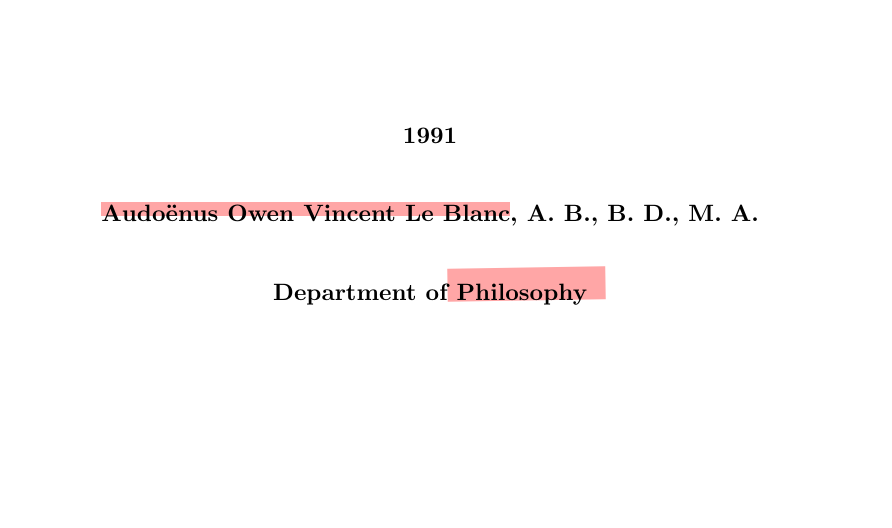
The term Doctor of Philosophy has become quite misleading. In the case of Owen, the first man to combine GNU and Linux (in 1992), his thesis was completed in "the Faculty of Arts" a year earlier (1991):
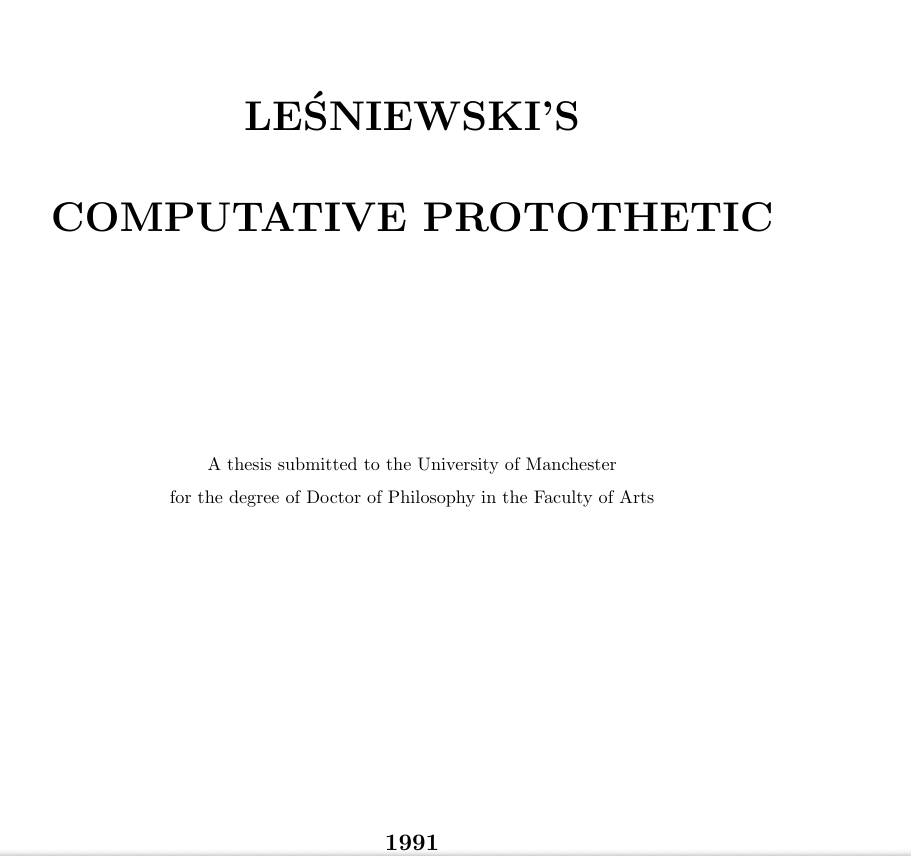
Scroll down a bit:
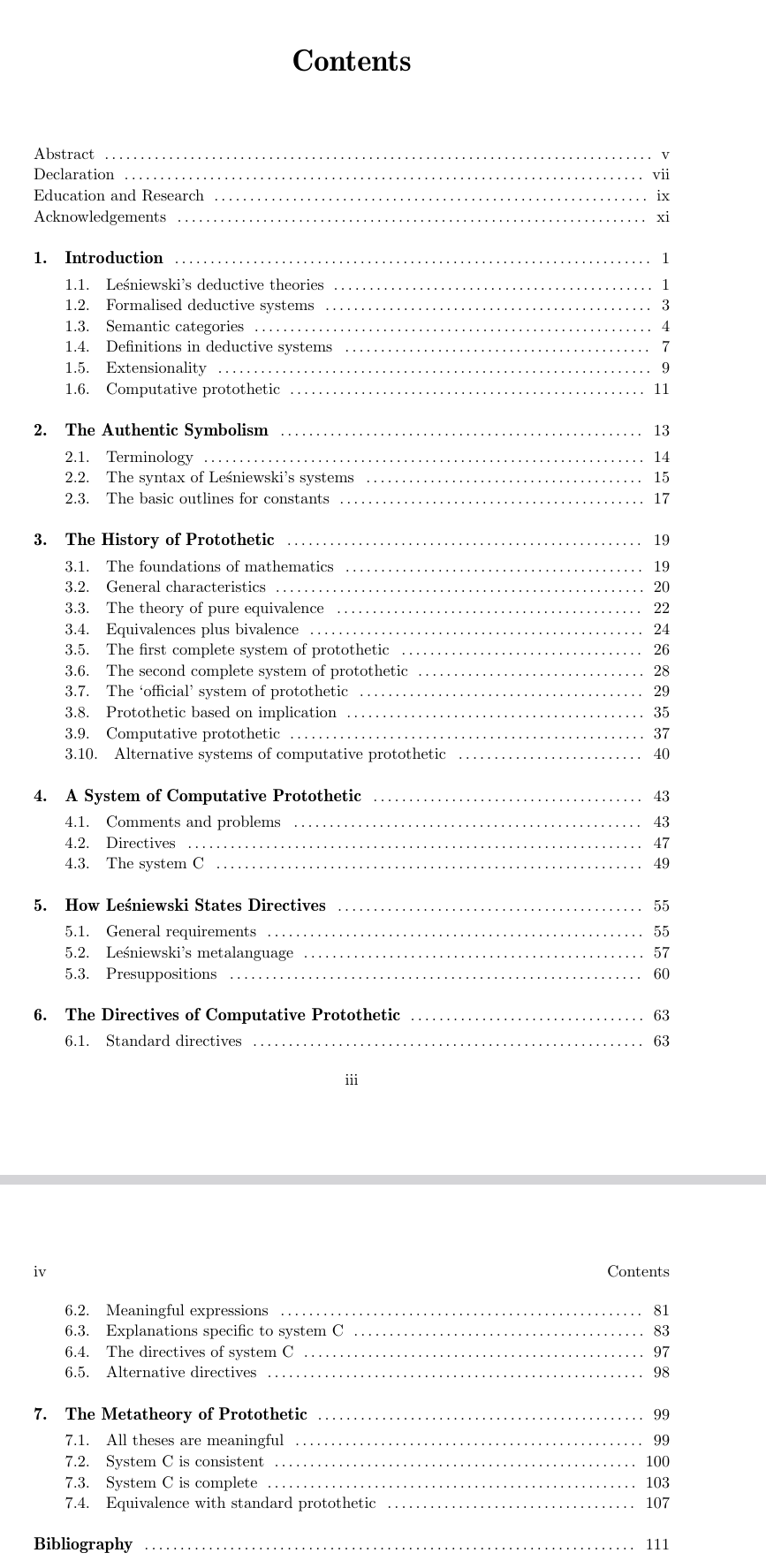
System C mentioned a lot:
The abstract:
Abstract of thesis submitted by A. O. V. Le Blanc for the Degree of Doctor of Philosphy, and entitled Le´sniewski’s Computative Protothetic. Submitted January, 1991.The logician StanisÃlaw Le´sniewski devoted most of his academic life to the development of a system of foundations of mathematics, which consists of three deductive theories: protothetic, ontology, and mereology. Protothetic is the most general of these theories, logically prior to the others; it has been described by its creator as a unique extension of the classical ‘theory of deduction’ or ‘propositional calculus’, though this theory differs from more usual versions in many respects. The ‘standard’ system of protothetic is developed by a rule of procedure corresponding to the traditional style of development incorporating substitution and detachment, but including directives for definition and extensionality.
Le´sniewski also developed systems of protothetic whose rule of procedure does not contain directives for substitution or detachment, and whose style of development has been described as ‘computative’ or as involving ‘automatic verification’. The directives may be said to resemble Peirce’s zero/one verification method, though they are extended to allow verification and rejection of expressions containing variables in all semantic categories, and having various numbers of possible ‘values’. Only an informal summary of Le´sniewski’s work on these systems survives.
This thesis examines computative protothetic historically, informally, and formally. It contains a set of directives for a system of computative protothetic which is as close as possible to the lost directives of Le´sniewski’s own systems.
Owen was a "proper" philosophy doctor, even based on his prior record as outlined in page 9 of his thesis.
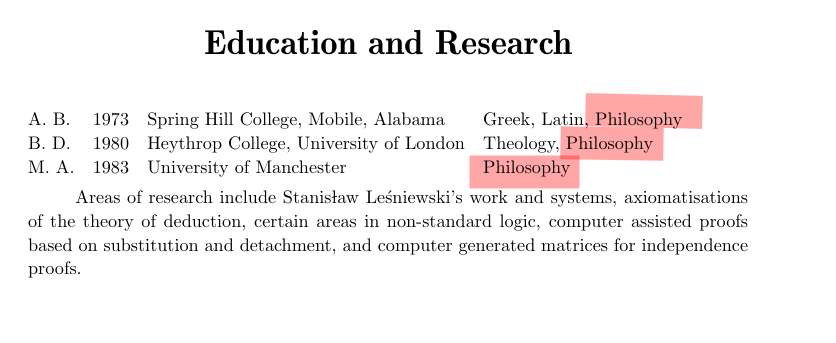
So sometimes a Ph.D. is really about philosophy (same for D.Phil.). Usually, however, it is not. As Wikipedia puts it, "[i]n the context of the Doctor of Philosophy and other similarly titled degrees, the term "philosophy" does not refer to the field or academic discipline of philosophy, but is used in a broader sense in accordance with its original Greek meaning, which is "love of wisdom"."
In many cases, the acronym became a misnomer.
Owen, a former colleague of mine, was a "proper" Ph.D. because the "Ph" meant something and it wasn't about water/liquid acidity. █