
TECHRIGHTS will soon present more and more evidence of dysfunction at Battistelli's Office, which is turning from hero to zero in just a few years because of Battistelli's misguided policies that severely damage patent quality and basically attack resistors at the cost of their human (and labour) rights.
"Over 80% of determinations end up against Battistelli, based on the latest round of decisions.""Judgements 3694 and 3699 actually show the problem with ILO," wrote a person in response to this. "We have one administrator who was harassed and sacked for displeasing Battistelli... he got less than a month salary in damages. We have a problem with the internal appeal committee which composition is lacking, the office can redo the work. Consequence? Personal must wait another 4-6 years for a decision. The judgements are victories... but Pyrrhic ones. "
We decided to reproduce the text below and add some highlights to it. We don't know who T. C. (the complainant) is, as there's nobody with the initial T. C. among the signatories here, so either the person is not in SUEPO/Central Staff Committee or is no longer at the EPO (after the infamous purges).
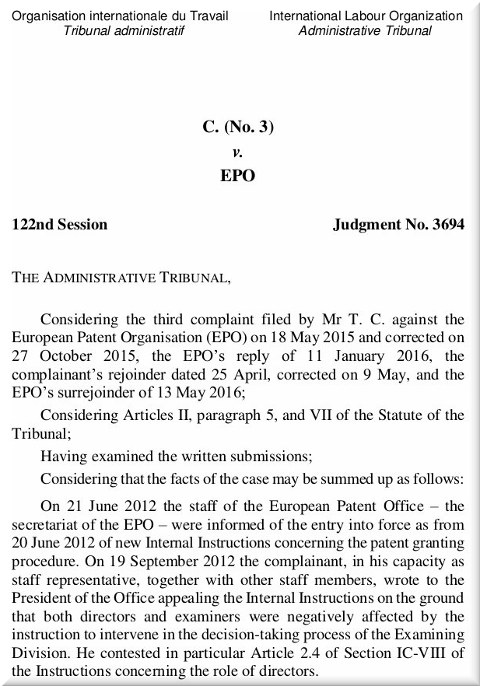
Organisation internationale du Travail Tribunal administratif
International Labour Organization Administrative Tribunal
C. (No. 3) v. EPO
122nd Session
Judgment No. 3694
THE ADMINISTRATIVE TRIBUNAL ,
Considering the third complaint filed by Mr T. C. against the European Patent Organisation (EPO) on 18 May 2015 and corrected on 27 October 2015, the EPO’s reply of 11 January 2016, the complainant’s rejoinder dated 25 April, corrected on 9 May, and the EPO’s surrejoinder of 13 May 2016;
Considering Articles II, paragraph 5, and VII of the Statute of the Tribunal;
Having examined the written submissions;
Considering that the facts of the case may be summed up as follows:
On 21 June 2012 the staff of the European Patent Office – the secretariat of the EPO – were informed of the entry into force as from 20 June 2012 of new Internal Instructions concerning the patent granting procedure. On 19 September 2012 the complainant, in his capacity as staff representative, together with other staff members, wrote to the President of the Office appealing the Internal Instructions on the ground that both directors and examiners were negatively affected by the instruction to intervene in the decision-taking process of the Examining Division. He contested in particular Article 2.4 of Section IC-VIII of the Instructions concerning the role of directors.
The Chairman of the Appeals Committee decided that his appeal would be dealt with in a summary procedure, pursuant to Article 9 of the Implementing Rules for Articles 106 to 113 of the Service Regulations for permanent employees of the Office. In its opinion of 16 December 2014 the Appeals Committee, composed of the Chairman and the two members appointed by the President of the Office (the two members who should normally be appointed by the Staff Committee had not been appointed), recommended rejecting the appeal as manifestly irreceivable as the complainant was challenging a general decision which did not directly and immediately affect him or the staff whose rights he sought to protect.
By a letter of 18 February 2015 the complainant was informed that the Vice-President of Directorate-General 4, acting with delegation of power from the President, had decided to endorse the Appeals Committee’s recommendation. That is the decision the complainant impugns before the Tribunal.
The complainant asks the Tribunal to declare both the opinion of the Appeals Committee and the impugned decision null and void. He asks the Tribunal to refer the appeal back to the Appeals Committee and to order it to “treat the appeal newly ab initio and in a new [...] composition”, without any of the members having taken part so far in the procedure. He also claims 50,000 euros in moral damages, plus costs. As “auxiliary requests”, he asks the Tribunal to order the EPO to declare that “interventions in the tasks vested to the Examining Divisions and Opposition Divisions by the [European Patent Convention], in particular any tasks of examination, are illegal”, and to require directors to withhold from actions that are ultra vires. He also asks the Tribunal to order the EPO to withdraw Article 2.4 of Section IC-VIII of the contested Internal Instructions, or subsidiarily that the EPO makes “available said Section to the public for example by publishing it in the official journal of the EPO”. He further claims moral damages in the amount of 100 euros for each director and examiner to whom the Internal Instructions apply.
In his rejoinder he modifies some of his claims and asks the Tribunal not to refer his case to the Appeals Committee, but to treat the case “newly from the beginning” and grant him an oral hearing. He also
asks to be given “another possibility for a rejoinder for providing evidence which could not have been submitted in the appeals procedure before the [Appeals Committee], as it did not treat the case substantially”.
The EPO was instructed by the President of the Tribunal to confine its submissions to the issue of the composition of the Appeals Committee. The EPO argues that the decision of the Appeals Committee to pursue its activity in a reduced composition was legal and legitimate.
CONSIDERATIONS
1. The complainant filed an appeal with the President of the Office on 19 September 2012 against the Internal Instructions on the patent granting procedure, contesting in particular Article 2.4 of Section IC-VIII of the Instructions concerning the role of directors. He was informed on 15 October 2014 that his appeal would be dealt with in a summary procedure, without hearing the parties, pursuant to Article 9 of the Implementing Rules for Articles 106 to 113 of the Service Regulations. The Appeals Committee was composed of the Chairman and the two members appointed by the President, as at that time the Staff Committee had not appointed the two members and two alternates as provided for in Article 111 of the Service Regulations and Article 5 of the Implementing Rules for Articles 106 to 113 of the Service Regulations. In the present complaint the complainant impugns the decision of the Vice-President of Directorate-General 4, acting with delegation of power from the President, to endorse the Appeals Committee’s recommendation to reject his appeal as manifestly irreceivable. The EPO was requested by the Tribunal to limit its reply to the issue of the composition of the Appeals Committee.
2. The complainant asks the Tribunal to set aside the impugned decision endorsing the Appeals Committee’s opinion, refer the appeal back to the Appeals Committee with a new composition and award the complainant moral damages and costs. The complainant also makes an auxiliary request that the EPO be ordered to withdraw Article 2.4 of Section IC-VIII of the Internal Instructions. He presented new claims
in his rejoinder, asking the Tribunal not to refer his case to the Appeals Committee but to examine it on the merits. However, the EPO was instructed to confine its submissions to the issue of the composition of the Appeals Committee. Consequently, these claims will not be considered.
As to the complainant’s request for oral proceedings, the Tribunal notes that the parties have presented their case extensively and comprehensively in their written submissions, which are sufficient to enable the Tribunal to reach a reasoned and informed decision on the only issue that must be determined at this stage. The request for oral proceedings is therefore rejected.
3. The grounds for complaint are that the Appeals Committee was improperly composed, as it did not include two members appointed by the Staff Committee, and that the Appeals Committee unlawfully applied the summary procedure retroactively, infringing the complainant’s right to be heard. In his rejoinder the complainant contested the merits of the Internal Instructions.
4. In its opinion dated 16 December 2014, the Appeals Committee recommended rejecting the appeal as irreceivable and held that the complainant could not appeal instructions which did not directly and immediately affect him or the staff whose rights he wished to protect as a member of the staff representation. The Appeals Committee attached to its opinion a “Decision on the composition of the Appeals Committee” in which it noted inter alia that the Chairman and the two members appointed by the President had decided to sit in a reduced composition because the Central Staff Committee, elected in June 2014, had not fulfilled its obligation under Article 36(2) of the Service Regulations and Article 5(4) of the Implementing Rules to Articles 106 to 113 of the Service Regulations to appoint its members to the Appeals Committee, which the Staff Committee was supposed to do by 1 October 2014 at the latest according to Article 17(1) of Administrative Council’s decision CA/D 2/14. Despite numerous written requests, this was not done. It further stated that “[w]ith a view to the non-appointment of members by the Central Staff Committee, the Appeals Committee in its aforementioned composition decided to nonetheless continue dealing with appeals.
Considering its ongoing responsibility to provide a means of legal redress, the Appeals Committee [felt] obliged, in the interest of the entire staff of the EPO, to continue hearing and deliberating appeals brought before it. The Appeals Committee [did] its utmost to shorten the length of proceedings and therefore [found] it legally unacceptable to suspend its work for an unknown duration.” The Appeals Committee cited Judgments 1838, under 16 and 17, 1767, under 12 and 13, and 1565, under 8, noting that the Tribunal had held that the refusal of staff representatives to participate in the work of a consultative committee neither disqualified that committee nor invalidated its recommendations, and that the refusal of the staff representatives to participate may not result in a veto right. The Appeals Committee, in its reduced composition, thus decided to continue to sit in order to hear appeals until a better solution could be found.
5. The Central Staff Committee, in a letter dated 3 October 2014, informed the President that appointing nominees to the Appeals Committee was “for the moment, [...] neither appropriate nor desirable”. It went on inter alia to “challenge the legality of changing the rules mid-term, with the specific purpose of causing replacement of the members nominated by the Staff Representation before their mandate expire[d]”; “challenge the legality of asymmetric appointments”; and to note “severe dysfunction in the way the [Appeals Committee’s] work is managed and the cases handled”. It also mentioned other issues of contention and requested a meeting with the President to discuss those issues.
6. The Tribunal notes that none of the cases cited by the Appeals Committee dealt with the composition of an internal appeal body. It also observes that considering the quasi-judicial functions of the Appeals Committee, its composition is fundamental and changing it changes the body itself. While it is true that the fundamental functions of that body must not be paralysed, it is also true that the body itself cannot be changed through a changed composition. The balance sought to be achieved by the composition of this body, which includes members appointed by the Administration and the staff representation, is a fundamental guarantee of its impartiality. That balanced composition is an essential feature
underpinning its existence. Without it, it is not the Appeals Committee. The case will therefore be sent back to the EPO so that the Appeals Committee, composed in accordance with the applicable rules, may examine the appeal. In the specific circumstances of this case, no award of moral damages will be made. The question of costs shall be reserved.
DECISION
For the above reasons,
1. The case is sent back to the EPO so that the Appeals Committee, composed in accordance with the applicable rules, may examine the appeal.
2. The claim for moral damages is dismissed.
3. The question of costs is reserved.
In witness of this judgment, adopted on 19 June 2016, Mr Giuseppe Barbagallo, Vice-President of the Tribunal, Mr Michael F. Moore, Judge, and Sir Hugh A. Rawlins, Judge, sign below, as do I, Andrew Butler, Deputy Registrar.
Delivered in public in Geneva on 6 July 2016.
GIUSEPPE B ARBAGALLO MICHAEL F. MOORE HUGH A. RAWLINS ANDREW BUTLER