Doing More With Less
Taking emacs everywhere
There are things that an excessively class-conscious and ads-filled society (drowning in advertising) does not want to hear others say. It's "bad for business". It'll "wreck the economy".
It probably still paints oneself as a "Luddite" and it sounds like a cliche. When I was with my sister in London she wore a shirt that said in big writings, "LESS IS MORE". I believe the first time I heard that I was a teenager and when I was about 20 I fell in love with the saying, "newer is not always better" (that was the motto of the OldVersions site, if I remember correctly). How true!
I still use very old laptops (some are over a decade old and still work fine) and I enjoy some of the simplest things in life, including jogging and feeding animals (they will soon lose more of their habitat around here).
Hardware and lifestyle aside, consider software. The programs that I use by far the most are text editors. I read the news mostly in KATE, the plain text editor of KDE (I had used KWrite until about 20 years ago). I don't need photos and some fancy bloat to follow the news and I seldom need to see faces of people to know the substance of the news. Less material? Good. So I can focus on what matters more and move fast, accordingly.
Such is life.
When we dumped WordPress 3 years ago we didn't change the workflow much because I didn't really type anything into WordPress. I always use a text editor and eventually graft the text (typed into that editor) into nano or WordPress or Drupal or whatever. I don't want bloated interfaces and I came to realise that the more advanced the computer user, the more likely he or she is to use vim or emacs with macros and various extensions.
Encouraging people to think in terms like simplicity - not bloat and complexity like "assistants" or slop producers (not limited to LLMs) - would go a long way in dictating ideas, vocabularies, narratives that can take us where we want to go. Andy speaks about this in his latest fine article, which my wife truly enjoyed because it focuses on thinking - a primacy of concepts rather than bells and whistles.
Using non-tech or "real-life" metaphors can help us convince other people to adhere to simplicity. No "smart" phones, no "smart" homes...
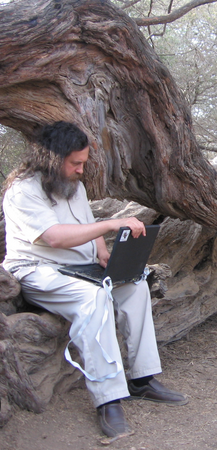
A lot of the current mess was foreseen decades ago by a man who turns 73 next week and will be giving a talk in Bern tomorrow. Living on shoestring budget, he still has leverage. He is an "influencer" not for money but for impact. Influence gives him some power to change the world. For what? Not ego, but in order to change the world he will not change himself; he wants the world to better suit himself and his long-cherished values. That's true activism.
The more complex tools a person adopts (e.g. "Smart" Cars"), the more complicated life will get. The full costs are not immediately visible. █