
Bonum Certa Men Certa

Bilski Case Analyses: Good News, Bad News

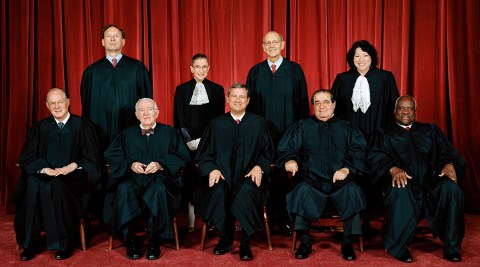
Supreme Court US, 2009


Summary: The Supreme Court of the United States (SCOTUS) provides ruling on the Bilski case; we take a preliminary look at the apparent outcome, with particular emphasis on the impact when it comes to software

YESTERDAY evening we posted the full text of the SCOTUS ruling regarding Bilski and added some immediate commentary. We assume that the huge number of analyses have been read by now and since we are not lawyers, we cannot offer anything too valuable or novel. Instead, here is a rundown encompassing some more coverage and opinions.


Over the weekend, just before this decision came, we found some of the following articles that are relevant to the subject:

i. Decision about the Second Amendment Case to be Ruled Today

After the decision of U.S. Supreme Court to regulate the Second Amendment case, Carl Bindenagel revealed the court’s record on earlier gun rights cases.


ii. Supreme Court Finale

Tom Goldstein of scotusblog.com believes that the Constitution will win out, but isn't sure how far the Court will go in terms of raising questions about firearms regulations.

That will be an important part of today's decision.

Three other cases will be decided today on student religious organizations on college campuses, a major case on software patents and whether a key part of the Sarbanes-Oxley (post Enron) law is constitutional.


iii. Will The Supreme Court Clean Up the Patent Mess?

I did my original patent posts in 2008, shortly after the Federal Circuit heard oral arguments in In Re Bilski, a case involving a "business method" patent. There was a growing consensus that the patent system was broken, and high expectations that the court would use it as an opportunity to reform the rules for patent eligibility. The decision was released later in the year, and it did just that, overturning the extremely permissive standard for patentability that had applied for the preceding decade.

The case is now before the Supreme Court, which is due to hand down its decison on Monday. Virtually everyone expects the high to affirm the Federal Circuit's rejection of Mr. Bilski's patent, but as always the important question is what's in the accompanying opinion. A narrow holding could simply rule out the most egregiously abstract business method patents (Mr. Bilski's "invention" consisted entirely of mental steps) while leaving the bulk of software and business method patents untouched. But if the Supreme Court is feeling more ambitious, it may try to draw a new line that invalidates many existing business method and maybe even deal with the sotware controversy.


iv. Patent Litigation Weekly: With Bilski, the Waiting Is the Hardest Part

Patent Watchtroll, a rude lawyer who has been lobbying for software patents, wrote about it and he seems to be supporting his position by warping/faking the oppositions' point of view or avoiding the mainstream opinion and instead asking a student. The headline says "Programmers Perspective", not "Programmer's Perspective" (making it seem like a talk on behalf of many). As the first comment says: "im calling you out, your a patent lawyer trying to support your position as a “programmer” using the pseudonym “andrew cole”"

There are other legal types who crave positive perspectives on monopoly (that's what a patent is). It is abundantly clear that lawyers are ruining science through the patent system, which to them is a form of tax on science.

Patently-O, which mostly attracts the legal types (with bias), ran this Bilski poll just before the decision arrived. When the decision finally came it correctly stated that:

The result is that the scope of patentable subject matter is certainly narrowed from its 1998 high-water-mark.


Yes, this is true and that's good news. Here is another take:

Supreme Court Rules Narrowly In Bilski; Business Method & Software Patents Survive


As I expected it appears that the Supreme Court has ruled somewhat narrowly in the Bilski case (pdf), which many had hoped would end the scourge of business method and software patents. Instead, the court effectively punted the issue. Technically it affirmed the overall decision from the Federal Circuit that Bilski's specific patent was invalid for being way too broad, but much more importantly for everyone else, it rolled back the Federal Circuit's "machine-or-transformation" test, which many believed effectively ruled out pure software patents. Instead, the court said that the courts "should not read into the patent laws limitations and condi-tions which the legislature has not expressed." In other words, business method and software patents survive.


The good news is that the "Supreme Court Throws Out Bilski Patent," as Ciaran/Slashdot summarised it.

ciaran_o_riordan writes "The US Supreme Court has finally decided the Bilski case (PDF). We've known that Bilski's patent would get thrown out; that was clear from the open mockery from the judges during last November's hearing. The big question is, since rejecting a particular patent requires providing a general test and explaining why this patent fails that test, how broad will their test be? Will it try to kill the plague of software patents? And is their test designed well enough to stand up to the army of patent lawyers who'll be making a science (and a career) of minimizing and circumventing it? The judges have created a new test, so this will take some reading before any degree of victory can be declared. The important part is pages 5-16 of the PDF, which is the majority opinion. The End Software Patents campaign is already analyzing the decision, and collecting other analyses. Some background is available at Late-comers guide: What is Bilski anyway?"


An interesting but forgotten fact is that Ginsburg attended the Bilski hearing despite her husband's death the prior day. This was pointed out by Groklaw, which offers an extensive summary (news survey) and links to coverage excepting news sources.

Anti-IBM lobbyist Florian Müller says that "the US Supreme Court accepts only one way to limit software patentability: new legislation from Congress [...] Only a decision to grant a patent on the Bilski application could have been any less restrictive"

Müller mass-mailed journalists (as usual) to spread his point of view. He wrote:

Please feel free to use in your reporting on the Bilski decision any of these comments. I'm the author of the FOSS Patents blog (and founder and former director of the NoSoftwarePatents campaign) on the Bilski decision and what it means for the patentability of software.

Here are a few select quotes, and further below the URL of my posting and the complete text.

"Unfortunately, the Supreme Court delivered an opinion that doesn't help the cause of partial or complete abolition of software patents at all."

"[T]he court's majority position is about the most liberal reasoning that it could have been. Only a decision to uphold the Bilski patent could have been any less restrictive.

"Simply put, the Supreme Court's decision does not do away with even one software patent that already exists, nor does it raise the bar for the future."

"The decision announced today makes it clear that a majority of the Supreme Court wanted to give the abolition of even only a small percentage of all software patents the widest berth possible."

"This US decision is even more disappointing when taking into account the global trend." [then mentions political process in New Zealand and court decision in Germany]

"The position that software patents should be abolished isn't nearly as popular among judges and politicians as it is in the free and open source software community."

The upcoming Defensive Patent License (DPL) is recommended at the end of the blog posting.

Here's the URL and the full text:

http://fosspatents.blogspot.com/2010/06/bilski-decision-major-disappointment.html


We still urge Müller to stop mass-mailing journalists. If you find the quotes above in some news articles, you'll know why. He tries using shortcuts to get his point heard and inject his name into articles (which he later cites with pride). We especially oppose his illusion that IBM is the root of all evil.

"I mentioned Microsoft in the same lobbying contexts as IBM," he told us separately, "on EU patent reform and today the reference to New Zealand. Plus I link in the righthand column to a slashdot op-ed that mentions Steve Ballmer.

"I also think(not at PC, writing this on phone, can't check) in a posting that I don't like their lobbying for software patents. Maybe the one on LinuxTag."

“Hopes and Dreams of "IP Sucks" Crowd Shattered - Cheers!”
      --ACT, Microsoft lobbyist
That hardly changes anything. In his book he wrote about Microsoft's lobbyists, but now he's just ignoring them for the most part (or ignoring their ties). But anyway, let's get back to In Re Bilski

Müller showed us that Microsoft lobbying group ACT is "jubilant over SCOTUS decision" (he didn't mention the Microsoft connection)

ACT wrote: "#SCOTUS Upholds Software Patents. Hopes and Dreams of "IP Sucks" Crowd Shattered - Cheers! - ACT Blog - http://bit.ly/dkzLay #bilski"

One reader showed us that ACT's Mike Sax (seen here) has just had an article published about him in Standaard. He admits being supported by Microsoft (while evidently pretending to serve small businesses).

Het dunbevolkte Oregon met zijn wilde natuur en wouden is niet meteen de meest voor de handliggende locatie voor een technologiebedrijf. Maar Sax is niet van plan te verhuizen. 'Het zegt veel over technologie dat je niet vanuit een metropool hoeft te werken om toch succesvol te zijn. Idealiter heb je dan ook werknemers die op afstand werken en die daardoor een hoge levenskwaliteit behalen omdat ze in kleine steden wonen, dicht bij hun familie, zonder dat ze hun carrière moeten opgeven.' Een betoog dat niet toevallig aansluit bij dat van de Association for Competitive Technology (ACT), een organisatie die Sax in 1998 oprichtte en die streeft voor de belangen van kleinere technologiebedrijven -al zijn ook grotere ondernemingen zoals Oracle en Microsoft steunend lid. Het is voor ACT dat Sax opnieuw Brussel bezoekt, om bij Europarlementsleden te pleiten voor een geharmoniseerde privacy- en arbeidswetgeving en een Europees patent.


The last sentence says that Sax is visiting Brussels again, pushing for MEPs to call for the back door to software patents ('harmonisation' or 'European patent'). Who are they kidding? They are Microsoft's lobbyists and they push for software patents in Europe. Is Müller paying attention at all? Nope. His blog post about the Bilski decision is a defeatist one and it's titled "Bilski decision a major disappointment: doesn't invalidate even one software patent"

The Supreme Court of the United States (SCOTUS) has finally handed down its opinion in re Bilski, a business method patent case.


Here is more from Patently-O:

Although Bilski's claims were held unpatentably abstract, the Supreme Court has re-affirmed that the door to patent eligibility should remain broad and open.


The FFII writes that "Bilski's business patent [is] rejected by the Supreme Court but no MoT-Test for the rest of US" (machine-or-transformation test).

We've been sent a lot of E-mail following this milestone decision and one of them sought publication that related to the MoT-Test:

I know you've been actively following the Bilski case on TechRights. In the wake of this morning's decision, I wanted to pass on some commentary from Barbara Rogan, the Chief Legal Counsel for LogLogic. Barbara has been closely monitoring the decision due to its implications on the tech industry and startups. While the Supreme Court's decision affirms the Federal Court's ruling, it also raises a number of other questions in the area of process patents.

Barbara's commentary below:

What’s Still To Be Decided:

What is a Machine?
  • The Supreme Court agrees with the Federal Circuit that merely using an abstract idea in “a particular technological environment” or by adding “insignificant postsolution [sic] activity” does not transform an otherwise unpatentable invention into a patentable invention.
    • In Bilski, the Federal Circuit ruled that the connection of the process to a machine or apparatus must be more than just “insignificant extra-solution activity” meaning that the machine must be more than a “throw-in” to make the process patentable.


    • In its brief to the Supreme Court, the Respondents argue that using a general purpose machine (i.e. a calculator or a telephone) would not be sufficient for to turn an otherwise non-patentable process into a patentable process.
  • In Yahoo!’s Amicus Curiae brief, Yahoo! Worries that with the Machine or Transformation, processes which are carried out over the Internet (a general purpose series of machines) may fail this test, thus leaving out from patent protection all Internet based processes.


  • Yahoo!’s concern is not theoretical. While the Bilski case was pending in the Supreme Court, the District Court in Northern California in Cybersource Corporation v. Retail Decisions, used the Machine or Transformation Test to find that the defendant’s motion for summary judgment in a patent infringement suit should be granted because the patent was likely on unpatentable subject matter. The process patent in question was an Internet based process patent.
    • In light of Bilski decision, it would seem that the District Court should re-examine its ruling as the Supreme Court indicated the Machine or Transformation test is NOT the exclusive test for determining process invention patentability.
  • Another question that is open and needs to be decided is whether programming a general purpose machine to do a specific task is sufficient to overcome the requirement that the machine not contribute in an “insignificant extra-solution activity” manner.


What is “Transformation” in the Digital Age?
  • The meaning of transformation as it applies to digital information has yet to be decided. In oral arguments, Justice Sotomayor suggests that electronic signals may be a “substance” which would differentiate it from a pure process completed outside of a computer. Based on this reasoning, a viable argument could be made that the electronic processes transform the information from one type or state into another type or state. This would free digital technology patents from the need to be tied to a machine for the purposes of obtaining a patent.
What inventions might be still be patentable if they fail the Machine or Transformation Test?


Justice Stevens tried to do that right thing, but upon his retirement there is generally a feeling that he didn't have enough power to counter his peers and knock out software patents.

In April, the Supreme Court's most senior justice, John Paul Stevens, announced his retirement. Since then, hundreds of articles have been written about his career and his legacy. While most articles focus on "hot button" issues such as flag burning, terrorism, and affirmative action, Stevens's tech policy record has largely been ignored.

When Justice Stevens joined the court, many of the technologies we now take for granted—the PC, packet-switched networks, home video recording—were in their infancy. During his 35-year tenure on the bench, Stevens penned decisions that laid the foundation for the tremendous innovations that followed in each of these areas.

[...]

The high court took a renewed interest in patent issues when John Roberts was elevated to Chief Justice, but the court hasn't squarely addressed the software patent issue. The closest they came was in today's Bilski decision, in which the majority handed down a narrow ruling that invalidated the specific patent at issue in the case but declined to articulate a clear standard for patent eligibility.


It is possible to see Stevens' portions in this ruling. The following Bilski analysis highlights a portion that says: "But this fact does not mean that unforeseen innovations such as computer programs are always unpatentable" (covered in [1, 2, 3]). The bottom line is -- as Stephen Shankland put it -- the Supreme Court sidesteps software patent issue. But it doesn't make it a loss for software freedom; it just leaves the USPTO in a limbo.

Recent Techrights' Posts

Links 06/07/2026: Artists Reject Slop (or Even de Facto Bribes to Market/Endorse Slop)
Links for the day
The Media Needs to Speak of Slop as a Climate Issue Like It Did With Bitcoin
But the slop industry keeps paying the media to play along with the hype
XBox is Practically 'Dead Man Walking' at This Point
writings on the wall
 
Confirmed: Microsoft Layoffs Come in Two Waves, Just Like Last Summer
To us, what stands out is the admission from Microsoft that there are two (or more) waves
In Praise of the UK's Stance on Free Speech (but Some Reservations)
At the moment there is a healthy discussion going on with the objective of disrupting attacks on British press
Exposing Corruption at the European Patent Office (EPO), a Call for More Whistleblowers
We predict that, provided enough whistleblowers speak out, António "the unready" won't even finish his current term
Leaving Our Pets for Several Days
This week our pets will be worried that "mommy and daddy" are away
Dating Trees and Dating 'Apps'
several high-profile stories in the news about scandals in "dating apps"
DW Documentary About Julian Assange Turns 2
It was released just days after Assange had turned 53 and about two weeks after he had left the UK
Independent Media is the Only Form of Legitimate Media
Independent media is, indeed, what we need to demand more of
The Story of the European Patent Office (EPO) Wagging the Dog (EU)
The aim of the series is to properly inform the world - not just Europeans - how Europe's second-largest institution is run [...] How did a corporate hub of monopolies become so detached from the Rule of Law?
GNU/Linux Up to New High in Libya, Windows Down to All-Time Low
GNU/Linux touches 5% there, based on statCounter
SLAPP Censorship - Part 129 Out of 200: Iranian Tactics
Hunger for revenge compels people to do overzealous, irrational things
Quiet Week
Many in the US are still enjoying an extended weekend
IBM's Fall
IBM's fate is closely connected to that of the Free software movement because of the salaries
Social Dialogue at the European Patent Office (EPO) is Dead, the Strikes and Work Stoppage-Like Actions Carry on
What next for the EPO?
Over at Tux Machines...
GNU/Linux news for the past day
IRC Proceedings: Sunday, July 05, 2026
IRC logs for Sunday, July 05, 2026
Links 05/07/2026: Shadows of the Upper Peninsula and 2026 Old Computer Challenge
Links for the day
Not Everything Should be Electric
technology has become detrimental to society
Gemini Links 05/07/2026: Eye of the Beholder and Baldur’s Gate 3 and Alhena 5.6.5
Links for the day
GNU/Linux Market Share is Already High
GNU/Linux has fast become and is still becoming mainstream in recent years
The 9-Step IBM Algorithm: Gaming Wall Street While Shedding Off Staff and Bribing the Mainstream Media to Play Along
Any time IBM preaches manners (e.g. CoC) to the community remember that IBM works closely with and flatters the dictator
They Could Never Kill the Ideas of Richard Stallman (RMS), But They Are Still Trying
Killing an idea is harder than killing a person and killing a person is illegal
Only Germany Objected to Salary Adjustment (Reduction) Procedure of "Team Campinos"
"flash report on the Administrative Council of 30 June and 1 July 2026"
A "Never Slop" Policy in Quibble
"every change in the repository must be made by a human"
Series on GNU/Linux in Japan
This series can last a week or longer
75% of All the Patents Last Year Were Software
The corporate media has more or less ceased to discuss this matter
At Microsoft "the Morale of Developers is at an All-time Low"
Numerous reports today say that after at least 5 studios got marked for shutdown (mothballing) by Microsoft there are rumours about Obsidian as well
Links 05/07/2026: Data Breaches, Heat Waves, and Weinstein Rape Conviction Upheld
Links for the day
Confidentiality at Risk With Slop 'Coding'
People who continue to cheer for slop aren't just misguided fanbis and fangurls
False Narratives of Slop "Efficiency" as Debt Climbs
false stories about slop
July 8 as "D-Day" for Microsoft, Mass Layoffs Planned
Microsoft's grip on the market has slipped for a long time
GNU/Linux Leaps to 6% in Thailand
Can we expect 10% by year's end?
SLAPP Censorship - Part 128 Out of 200: Making Laws Work for Britain, Not Oversensitive Americans Looking for 'Revenge' by Lawfare
The SLAPPs are intended to protect corporations (employers like Microsoft)
EC Looking for Input on Digital Networks Act Until Next Month
New initiative
Over at Tux Machines...
GNU/Linux news for the past day
IRC Proceedings: Saturday, July 04, 2026
IRC logs for Saturday, July 04, 2026
Gemini Links 05/07/2026: Ragebaited and Removing Lines in Emacs
Links for the day
Links 05/07/2026: "Tesla Slams Into Crowded Cafe" and "ChatGPT [Turned] Into a Sociopath"
Links for the day
BRICS and Windows: All-Time Lows
Expect many more Microsoft layoffs in years to come
Do No Evil, Do Not DDoS
Sites that attract DDoS attacks because of their message are sites that are difficult to debunk or debate
France is Winning the Race Against Windows
France instructs, then orders, government agencies to adopt GNU/Linux
Not 2.5% and Not 2.5 Billion Dollars for "Hey Hi"; 2 Waves of Microsoft Layoffs Rumoured This Month, July 8th, Then July 22nd (Just Before 'Results')
People there join unions, knowing they will be terminated silently or otherwise
Microsoft Double Trouble With Slop
What does Microsoft even sell at this point?
Based on US Government Sites, GNU/Linux Has Reached About 8% "Market Share" in Desktops/Laptops
Culled to exclude mobile platforms, GNU/Linux would likely be above 8%
TheLayoff.com is Deleting Comments About IBM Offshoring
Meanwhile, rage-baiting Internet trolls and sometimes trolls who paste in LLM slop are immune from censorship
American Independence Needs Independent Media
The American regime's hostility towards media is an international problem
Techrights Was Always a Community Platform
Techrights is about whistleblowers
Phenomenal Growth for GNU/Linux in Afghanistan
This is impressive because for many years it was registered at near 0%
Daniel Pocock Pursuing Complaint in the United States Against Software in the Public Interest (SPI) et al
It seems like the only people who don't support him are those whom he criticises
Gemini Links 04/07/2026: Busy Squirrel, Independence Day Celebrations, PalmOS Programming
Links for the day
Canonical/Ubuntu is Breaking CP (cp) to Help Microsoft Turn Coreutils Into Proprietary Software for Windows
What we could do reliably in the 1970s (before GNU) we cannot do in 2026?
Brett Wilson LLP is Downsizing, Apparently Closing Down the Oversized and Overpriced Office
Address changed 13 hours ago
Free Software Has No Kings or CEOs
The kingdom is a cross-border phenomenon, so national flags and other such symbolism overlook the core problem [...] Free Software can help lead us out of the current imbalances
The United States Lost Freedom of Speech
independence refers to a condition, not an activity
IBM Replacing the People Who Built IBM With Cheaper and Younger Staff, According to IBM Insiders
This is a very common sentiment in IBM
For USA 250 Microsoft is Messing With Our Minds (2.50%) to Distract From Mass Layoffs
The slopfarms contribute to this noise
"Defective by Design" Turns 20
DBD is still as relevant as ever (probably more relevant than ever before)
A Bicycle for the Feeble Mind, or How Computers Got Worse for Productivity (Intentionally)
Many of us still adopt and champion the "workstation" mentality
Links 04/07/2026: Microsoft Tax Haven (Evasion) Tactics, Tobacco Bans, and More
Links for the day
Links 04/07/2026: 2026 Old Computer Challenge and Trying Gopher
Links for the day
SLAPP Censorship - Part 127 Out of 200: Lawsuits by Americans Filed in the UK a Burden on British Taxpayers, No Way to Recover the Funds When Americans Lose Their Cases
Are Garrett and Graveley 'pulling a 4Chan'?
Links 04/07/2026: USMCA (Covering Software Patents) Might Not be Renewed, Slop Bros Try to Pay Weird Al to Endorse Their Scheme
Links for the day
Over at Tux Machines...
GNU/Linux news for the past day
IRC Proceedings: Friday, July 03, 2026
IRC logs for Friday, July 03, 2026