
Bonum Certa Men Certa

The Latest Lies About the Unitary Patent (UPC) and CIPO's Participation in Those

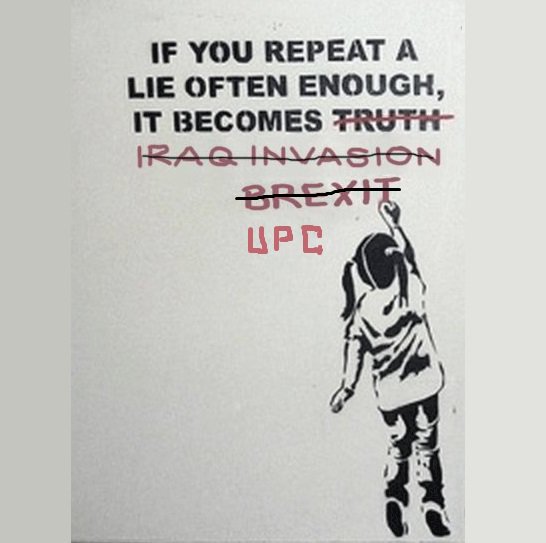
They got CETA, but they won't get UPC

UPC truth


Summary: Team UPC continues to overplay its chances, conveniently ignoring simple facts as well as the Rule of Law

THE EPO is quiet. So is SUEPO, the staff union of the EPO, whose Web site has not been updated for a while. On the UPC front, however, spin continues. Left unchallenged, some people out there might even believe it. Team UPC extravagantly lies, exaggerates, and places too much emphasis on perceived positives. Everything else is discarded, ignored, or ridiculed.

As we noted earlier this week, there's UPC propaganda coming to Canada pretty soon. We can't help but wonder, why would anyone actually pay to be lied to by Team Battistelli about the UPC in Montreal (Canada)? Maybe to make contacts/connections? A few days ago CIPO wrote: "Only 2 days left to register to the #Montreal roadshow with @EPOorg on Unitary #Patent & Unified Patent Court!"

That's just basically Battistelli's right-hand liar. She'll be spreading the usual lies there. They will have the audience believe that the UPC is coming very soon. Bristows is doing the same thing this week, with staff pretty much repeating themselves regarding Scotland (never mind the reality of Brexit).

IAM's chief editor also did his thing earlier this week. The UK-based IAM is perfectly happy that the EPO's declining patent quality (which IAM helps Battistelli deny) brings its beloved patent trolls to Europe. Joff Wild speaks of the UPC again, joined by the term "BigTech" with the usual whipping boy being "Google". Here are some portions:

And that brings me to patents. As everyone in the IP market knows, over recent year Europe has emerged as a much more important part of the equation for patent owners seeking to assert their rights. For multiple reasons – including the perceived quality of EPO-granted assets, speed to get a decision, the relatively low cost of litigating, the expertise of courts and, crucially, the availability of injunctions – the worsening environment for rights holders in the US is driving more companies to try courts in Germany, the UK and other European jurisdictions. Should the Unified Patent Court ever become a reality that process is likely to accelerate.

[...]

Where that leaves lobbying efforts that seek to water down or eliminate the UPC injunction regime, for example, remains to be seen. My guess is that as long as BigTech identifiably campaigns as BigTech it is unlikely to get much traction. Instead, what it needs are examples of small European companies falling foul of abusive patent litigants – the kinds of stories that it has always been possible to dig out in the US. The problem is that in Europe these are tough to find – precisely because the system is not troll-friendly. Getting around that may be a challenge that even the expertise of Silicon Valley’s best paid public relations advisers and lobbyists will struggle to meet.


Again, notice the term "BigTech". The patent trolls' sites (or patent maximalists) are openly demonising technology companies, e.g. those that protect PTAB. It makes it abundantly clear that they, the patent radicals, are against technology. We shall revisit the subject later this week.

The matter of fact is, UPC is a failed project. Even some insiders are willing to admit it now. The Boards of Appeal (BoA) need to stay and regulate patent quality, just like PTAB does at the USPTO. After Battistelli sent BoA judges to exile (as punishment, or simply to warn them) the EPO has the nerve to talk as if everything is fine and dandy. Earlier this week it wrote: "Oral proceedings at the new Boards of Appeal site are planned to start on 9 October" (but without independence for judges).

With Jesper Kongstad leaving in just over a week (end of this month), it remains to be seen if BoA has a future. If the UPC fails, which seems increasingly likely, many hirings will be needed for BoA (not UPC). Can the new (actually old) building in Haar facilitate growth? The only new building is in Rijswijk and Dutch media wrote about it some days ago. If there is something interesting in this Dutch article, it would be worth knowing. We try to keep abreast of the facts ahead of the 'grand' opening.

For those who are wondering where the UPC stands, not much has changed since we last wrote about it. Yesterday IP Kat summarised it as follows: "It has been confirmed that the complainant who filed the constitutional complaint against the ratification of the UPC Agreement in Germany was the attorney Ingve Stjerna. Stjerna has long been a vocal critic of the Unified Patent Court, and the complaint reflects some of his earlier criticisms."

Looking at some of the latest comments at IP Kat, people now debate whether the UPC is "an EU institution" (it most certainly is) and therefore the UPC (which explicitly requires "UK" amid Brexit) is dead by definition.

Here is a comment about that, relaying the question to the CJEU:

If it is not an EU institution, then I do not understand why in the the preamble of the UPCA the following is said:

RECALLING the primacy of Union law, which includes the TEU, the TFEU, the Charter of Fundamental Rights of the European Union, the general principles of Union law as developed by the Court of Justice of the European Union, and in particular the right to an effective remedy before a tribunal and a fair and public hearing within a reasonable time by an independent and impartial tribunal, the case law of the Court of Justice of the European Union and secondary Union law;

Furthermore Art 1 of the UPCA states: The Unified Patent Court shall be a court common to the Contracting Member States and thus subject to the same obligations under Union law as any national court of the Contracting Member States.

If I understand well, the TEU and TFEU should thus be clearly applicable. Or did I miss something?

Divisions of the UPC can bring forward prejudicial questions to the CJEU, but the the text governing the UPCA cannot be submitted to the CJEU. I fail to understand the logic behind such a position.

Could somebody explain.


They then went off on a CJEU tangent.

One person said about the UPC, "how can the provisions of that Agreement be used to “harmonise” patent law" (they can't).

Here's the comment in full:

It’s not that hard to understand, given the limits of the jurisdiction of the CJEU.

In essence, the CJEU can only review the legality of EU Treaties and the (legislative) acts of EU bodies. The UPCA is not an EU Treaty or legislative act, as it is instead an international agreement (that just so happens to be exclusively between EU Member States).

However, this is not to say that the CJEU will have no teeth when it comes to the effects of the UPCA. That is, pursuant to Article 258 or 259 TFEU, the CJEU will be able to assess whether the Member States that are party to the UPCA are fulfilling their obligations under the EU Treaties. Unfortunately for the public, however, such actions can only be commenced either by the Commission or another Member State.

This effectively means that a challenge by Spain (under Article 259 TFEU) might be the only hope of sorting out whether the actions of the UPC (or the Participating Member States) are compliant with EU law.

It remains to be seen which grounds could be raised by Spain under Article 259 TFEU. However, Article 118 (attributing the European Union with exclusivity regarding the creation of uniform IP rights) is an interesting possibility.

In C-146/13, the CJEU held that:
Notwithstanding the fact that the contested regulation contains no list of the acts against which an EPUE provides protection, that protection remains uniform in so far as, regardless of the precise extent of the substantive protection conferred by an EPUE by virtue of the national law which is applicable, under Article 7 of the contested regulation, that protection will apply, for that EPUE, in the territory of all the participating Member States in which that patent has unitary effect”.

In other words, the CJEU held that Art. 118 TFEU was not contravened because EU law (the UP Regulation) has been used to achieve (partial) harmonisation, through the designation of a single, national law.

However, this would appear to mean that failure of the UPC to apply a single, national law (as determined under Art. 7 of the UP Regulation) would therefore not only contravene the Member States’ obligations under the UP Regulation but also their obligations under Art. 118 TFEU.

This puts an interesting “spin” on the law of infringement to be used under the UPP, doesn’t it?

For a start, it would appear that the UPC would only be able to refer to the infringement provisions in the UPCA to the extent that those provisions are fully incorporated into the national law selected under Arts. 5(3) and 7 of the UP Regulation. This means that the UPC, as well as all patent attorneys, will need to become experts on the extent to which this is true in each of the relevant Member States... and also what the significance might be of seemingly contradictory / non-identical provisions in national laws.

On the other hand, it would also seem to force the UPC to issue judgements for “traditional” (not opted out) EPs on a country-by-country basis. This is because the UP Regulation does not contain any provisions on the law to be applied to “traditional” EPs... meaning that there is no basis under EU law for the law of infringement for those EPs to be “harmonised”. Also, attempts by the Member States to “go it alone” with harmonisation of the law with respect to such EPs may well contravene the provisions of Art. 118 TFEU.

To put it another way, as the UPCA is not part of EU law, how can the provisions of that Agreement be used to “harmonise” patent law (for UPs or not opted out EPs) within the EU without infringing Art. 118 TFEU?


Spain was then brought up too. "Spain could think about a further challenge the legality of Regulation 1257/2012," said the following comment.


Alternatively, Spain could think about a further challenge the legality of Regulation 1257/2012.

As previously mentioned, the impermissible, retroactive effect of Article 5(3) might be one ground for such a challenge. This is because that Article applies new / different laws (of infringement) to pre-existing patents and patent applications, as well as to acts committed prior to entry into force of the UPP. That hardly seems compliant with the principle of legitimate expectations!

Another, very interesting possibility might be alleged contravention of Article 18 TFEU (“any discrimination on grounds of nationality shall be prohibited”) by Article 5(3) of the UP Regulation.

Understanding this ground requires a little thought.

Firstly, Art. 5(3) states that the applicable law of infringement is determined by Art. 7. Secondly, the primary factor to be considered under Art. 7(1)(a) is residence / place of business. For many individual and corporate applicants, their residence / place of business will be the same as (ie equivalent to, or a surrogate for) their nationality.

Thus, the UP Regulation requires the selection of a single, national law based upon a criterion that, for many applicants, will be a surrogate for their nationality.

The final step is to realise that the national laws of infringement are not harmonised. Thus, inventors / applicants that have identical claims, but that have different nationalities, would have different laws of infringement applied to those claims (and hence potentially different results from litigation).

It really is hard to understand how this could possibly be compliant with Article 18 TFEU!


The next comment said:

If it is an EU institution why would it need its own dedicated Protocol on Privileges and Immunities ? Surely it would be covered by the EU PPI ?


Regarding the situation in Germany and the CJEU, one person said that "here we are back to the other complaints before the German Constitutional Court."

We are ahead of interesting times, and it might be possible that the CJEU considers the UPCA not in accordance with EU law. In view of the sometimes political nature of the CJEU's decisions, I doubt that it would blow up the whole system, but it could severely harm it.

In the same vein, there is a further question which could be tricky as well. If an opposition is launched against a UP, can the opposition division be composed of nationals of non EU member states?

This becomes particularly critical if the EP has only been validated as a UP.

One could consider that since the EPO regains competence by virtue of an opposition, then the composition of the OD is irrelevant.

On the other hand, one could also consider that having become, at least in some member states of the EPC which are also members of the UPC, an asset according to EU law, its fate can only be decided by nationals of member states of the EU.

If the patent is revoked, then there is no revision possible. And here we are back to the other complaints before the German Constitutional Court.

This question was raised at the latest conference on the UPC in July in Munich, and has up to now not received a reply.


More on CJEU:

"the sometimes political nature of the CJEU decisions"? Are you suggesting that the CJEU might not demonstrate complete independence from the executives of the Member States and/or the executive arms of the EU?

If there is a (perception of) lack of independence, then perhaps it is high time that someone took a close look at the conditions of appointment of the judges of the CJEU, in order to see how well the CJEU fares regarding internationally recognised "best practice" for achieving judicial independence. ;-)


Speaking of "political decisions," the next comment talked about Spain again:

I do not want to claim that all decisions of the CJEU are more of political than strictly judicial nature. It is a minority of decisions, but the manner in which the CJEU has dismissed the second complaint of Spain against the UPC is an example to me of more political decisions.

Any reason not to consider Spain's complaint were good to dismiss the claims. Some of the questions were however quite specific.

In decisions on the correct application of directives it is certainly not politic. Plenty of those have been published and commented on this blog.


The bottom line is, for those lacking the time or background to read all the above, there are multiple aspects and levels that act as barriers to UPC, ranging from central to pertinent (e.g. Spain, UK, Germany and even Poland). Don't be misled by EPO staff whose job is to lie about the UPC. No doubt the Canadian press (and maybe European press as well) will soon publish some lies about the UPC. The EPO has a sick habit of paying the media for puff pieces, including patently untrue statements.

Recent Techrights' Posts

Links 16/05/2026: Climate Issues, Free Speech, and Monopolies/Monopsonies
Links for the day
 
Links 16/05/2026: Cuba Plunges Into Darkness (Energy Wasted by Nonsense), Googlebooks as Slop Nonsense (Energy Waste and Time Wasted)
Links for the day
Gemini Links 16/05/2026: Retreat and Devuan Manuals
Links for the day
SLAPP Censorship - Part 78 Out of 200: Slandering Me for Saying the Truth About Graveley and Garrett's Abuse of Processes, Stacking Dockets
These are the sorts of things British taxpayers ought to talk about
"AI" Became a New Name or Placeholder for Debt
Because they will only ever lose money for this thing with "tokens" or "potential"
"Microsoft Goodwill and Intangible Assets" Down Two Years in a Row, According to Microsoft
Microsoft cannot sell these, so what is their real relevance?
Over at Tux Machines...
GNU/Linux news for the past day
IRC Proceedings: Friday, May 15, 2026
IRC logs for Friday, May 15, 2026
IBM: Shares Down 30%, Mass Layoffs, IBM Says "Goodwill" Grew by 10% to Over a Third of the Company's Total "Worth"
According to IBM
Microsoft LinkedIn Layoffs "Very Likely Higher" Than 1,000 People
Microsoft is bleeding
The Corrupt Lecture the Non-Corrupt - Part XXIV - Luis Berenguer Giménez at the EPO (European Patent Office) Became the Punchline of EPO Staff
"the fact that Luis was caught with cocaine causes laughter. The use of cocaine in itself is not the real shocking bit."
IBM Keeps Culling Essential Linux, Fedora, GNOME, and GTK Staff
Over a month ago IBM laid off over 400 Red Hat engineers
Cisco Cuts Nearly 4,000 Jobs Because of Debt, Nothing to Do With Slop
The media keeps talking about revenue, not profits
Gemini Links 15/05/2026: UDP Game Forwarding Over SSH, Avoiding LLMs, and Alhena 5.5.9
Links for the day
Links 15/05/2026: Electric Company Shuns Entire Town to Prioritise Only Data Centres, Saudi Arabia and U.A.E. Carried Out Secret Attacks in Iran
Links for the day
LLM Slop is Not Reliable, Constitutes No Process of 'Thinking'; There's No Thought Process at All, No Grasp or Understanding, Let Alone Context
Lies have become the "business model" [...] More people ought to talk about it and explain to other people what LLMs really are
Not a Security Expert If You Cannot Manage to Keep Online a Simple Two-User Mastodon Instance Somebody Else Built
From uptime of ~99% to maybe 80%
Microsoft Has All the Symptoms of a Dying Company (Mass Layoffs of the People Who Built the Company)
the company's debt is going through the ceiling
Focus is Important, Focus is Everything
We are still running 6 multi-part series in tandem
For Effective 'Finlandisation' (Not Digital Sovereignty) to Be Replaced by Autonomy Finland Needs to Think Like GNU (Software Freedom), Not Linux (Openwashing Source, Plus LLM Slop and Killswitches)
What is 'Finlandisation'?
Guest Post on False Marketing and PR Blitzes by Anthropic
A lot of people my age are just tired of the nonsense
Links 15/05/2026: UK antitrust regulator is officially investigating Microsoft Office, Anthropic’s Fraudulent Lies About Mythoslop Don't Withstand Scrutiny
Links for the day
IBM's Kyndryl in Trouble: Mass Layoffs, Payroll Problems, Buybacks (in Company Whose Debt is Almost Twice Its Total Value), and Soon $9 Per Share (Down Over 80%)
Kyndryl is done. Stick a fork in it.
ICYMI: GNU/Linux Did Not Start in Finland
If we're honest/true to ourselves, we need to recognise history for what it is, not what some corporations (like GAFAM) want it to be
IBM is Googlebombing the Media With Fake Numbers to Promote Fake Technology
a classic example of why much of today's media cannot be trusted (anymore)
Up to 10,000 Microsoft Layoffs in a Couple of Months
Many ways to skin a cat
Truth Hurts. People Hurt by Truth Aren't Entitled to Compensation.
Family members aren't exempt
SLAPP Censorship - Part 77 Out of 200: They Never Knew How to Handle Women (Except to Attack Them)
The case against us was really quite simple
Update on Sirius Open Source in 2026 (When Your Former Employer Commits Crimes and Nobody is Held Accountable)
I did not envision myself spending several years (even 4 years after leaving that company) challenging the system for tolerating and even covering up corruption
Codecs and Software Patents - Part VII - Entering Phase II, the Battle Against Companies That Normalise Taxed (by Patents on Mathematics) Codecs
In the next few part we'll deal with the impact on Free software, including the GNU Project
The Corrupt Lecture the Non-Corrupt - Part XXIII - Cocaine Use at the EPO's Top-Level Management "Adds Up" and Worsens Things "Over Time"
"cocaine use knocks the IQ down permanently a tiny bit with each use. Over time that adds up."
Gemini Links 15/05/2026: Slop Fatigue and Banning LLM Use
Links for the day
Over at Tux Machines...
GNU/Linux news for the past day
IRC Proceedings: Thursday, May 14, 2026
IRC logs for Thursday, May 14, 2026
Links 14/05/2026: Health Science, Cheeto Meets Pooh, and Facebook Staff Loathing the CEO
Links for the day
Gemini Links 14/05/2026: Early Morning Practice and Number to Roman Numeral Converter
Links for the day
FSF Advertises the Father of Software Freedom Giving a Talk in Germany (a Digital Sovereignty Interest Hub, Sponsor of Free Software)
Free Software vs malware and the need for reverse engineering
Cybershow (UK) Shaping Up to be a Neat and Very Large Gemini Capsule
If only more platforms did the same, plenty of energy would be spared, "old" machines would be totally suitable (even with 20 tabs open), as we'd focus on substance, not bells and whistles
SLAPP Censorship - Part 76 Out of 200: The Problem With the United Kingdom Allowing Americans to File Lawsuits by Proxy (Relayed by "Hired Guns")
Solicitors in UK warned not to act as ‘hired guns’ to silence critics of super-rich
When Microsoft's LinkedIn Goes Offline All Your Fake Friends/Connections and Manufactured 'Status' Will be Gone
Many people quit social control media because they recognise it for what it truly is
Major Setback for IBM in the Courtroom, the Demolition of IBM is Proving Costly
Kyndryl is a sign of how IBM ("mother ship") is run and where IBM is heading
Links 14/05/2026: Willful Ignorance and Mass Layoffs at Microsoft
Links for the day
Gemini Links 14/05/2026: Rewatching V for Vendetta, JPEG XL, and Platform Migrations
Links for the day
The Corrupt Lecture the Non-Corrupt - Part XXII - What the Science Says About Cocaine in the Workplace (EPO President, Mr. Campinos, Please Take Note)
What the science says
European Patent Office (EPO) President, Mr. Campinos, Ignoring Its Staff While Protecting His Friends
the President is covering up cocaine use while ignoring his own workers
Slop Cannot Replace Everybody (the Story of Perl and Universities)
Quantity where abundance exists is without merit; quality is what people opt for as they have limited time and patience
Over at Tux Machines...
GNU/Linux news for the past day
IRC Proceedings: Wednesday, May 13, 2026
IRC logs for Wednesday, May 13, 2026