
Judge Bryson on IPRs
WHILE the EPO marginalises its very own appeal boards (BoA), the US is augmenting the role (and workload) of its appeal board, called PTAB (shorthand). We assume that readers of ours already know (more or less) what PTAB is and what it does because we wrote over 100 articles about it.
"In spite of all the anti-PTAB rhetoric, the courts certainly support its decisions."The patent microcosm is not happy about PTAB. The patent microcosm wants to actively destroy PTAB while refraining from giving the impression that it's really that crude and self-serving. They like to speak 'on behalf' of companies and so-called 'inventors' even though companies that actually make stuff strongly support PTAB. This cannot be stressed strongly enough. As we shall show in a moment, there's an intentionally-misleading lobby which attempts to frame this as a power struggle between one industry and another (e.g. pharmaceutical versus technology), but it's based on a fictional storyline. It's clever, shrewd spin, but anyone who has followed these things for a number of years understands that it's pure mythology.
Jason Rantanen, a patents booster, recently put some numbers together. Yesterday or the day before that he presented some figures, based on numbers that he had studied. These figures, by our interpretation, show very high affirmation rates from a Federal court. PTAB is widely supported by the highest court below the Supreme Court -- a court which has confirmed low patent quality in US, essentially siding with PTAB about 80% of the time.
As if turns out, the forum for this presentation was "The Power of the PTAB" -- an event we mentioned the other day. It was almost like an echo chamber and it's not hard to guess who was absent from this event. To quote Rantanen:
I’m presenting some data from the Compendium of Federal Circuit Decisions later today at Chicago-Kent’s terrific conference on The Power of the PTAB. Below are a few of the graphs I’ll be showing, along with a bonus graph involving Federal Circuit review of inter partes review proceedings. All data is through October 17, 2017.
This first graph shows the distribution of dispute types in opinions and Rule 36 summary affirmances that arise from the USPTO. Unsurprisingly, most of the growth in these decisions comes from appeals in IPRs. More surprising to me was that a substantial chunk of the growth from 2014-16 came from appeals from inter partes reexamaminations. Those will drop off as the last reexaminations work through the system.
Since this case raised the same issues as Aqua, the Federal Circuit had been sitting on the en banc petition for the past year awaiting outcome of that case.
I’ll note here that the decision by the Federal Circuit was unanimous. Although many of the judges disagreed with the Aqua decision, they all now regard it as the law and binding precedent of the court.
"The patent 'industry' pretends that without lots of patents innovation would suddenly stop. It's a lie."A lot of support for PTAB is nowadays being expressed by Computer & Communications Industry Association (CCIA), which represents many technology firms. A couple of days ago CCIA helped show that the copyright monopoly (oligarchs who don't make music but exploit musicians) had been lying. The monopoly often pressures technology companies (e.g. for censorship), claiming that their business will die otherwise and musicians will starve. In reality, however, there's this:
A technology association-backed report released this week shows strong growth in revenues for the music industry over the past 5 to 10 years, driven by digital music. The data counters the current European copyright reform concern over a “value gap” for the music industry, the Computer & Communications Industry Association (CCIA) said.
"They are trying to claim that PTAB will obstruct access to medicine or something along those lines (we have seen similar propaganda -- along those same lines -- in relation to Lexmark)."As it turns out, even Josh Landau from the CCIA slams Rana Foroohar for her disgusting propaganda in the FT, which has received money from Battistelli. Such propaganda later on propagates and gets cited by patent fanatics like IAM as 'proof' of things that aren't true. They are trying to claim that PTAB will obstruct access to medicine or something along those lines (we have seen similar propaganda -- along those same lines -- in relation to Lexmark).
Here are some passages from Landau's very detailed response (he is a good writer on these issues):
On Monday, the Financial Times published an article by Rana Foroohar. While there are a lot of flaws in the article, one particularly pernicious myth shows up—the myth that patent trolls aren’t really a problem. Purporting to look at patent reform as a battle between the tech industry and pharmaceutical manufacturers, the FT article gives the impression that patent trolls aren’t an issue.
Unfortunately, Ms. Foroohar relied on bad data in order to come to that conclusion.
The Trolls Under The Bridge Aren’t A Myth
In particular, Ms. Foroohar’s article focuses on three numbers. First, she states that the total number of defendants is largely unchanged before and after the America Invents Act (AIA). This is accurate. Second, she notes that a 2013 GAO report stated that patent trolls only filed 20% of lawsuits. This is also accurate.
She also quotes a 2013 report from the White House that states that patent trolls brought 66% of all patent lawsuits. She claims that this statistic is wrong and implies that it shows the tech industry had influenced the Obama Administration with fake statistics.
There’s only one problem. That 66% statistic? It’s also completely accurate.
I can hear you already—how could trolls only file 20% of lawsuits, and also file 66% of lawsuits? Those can’t both be right, can they?
[...]
The AIA Has Helped
While the number of patent defendants was approximately steady immediately before and after the AIA, and has remained roughly flat since then, this doesn’t mean the AIA didn’t have an impact. The fact that the number of patent defendants has remained roughly static or slightly declined since the AIA’s passage, despite the long-term trend of several decades of increase identified by Prof. Sag, shows that the AIA has helped reduce patent litigation. And the cost-effectiveness of the AIA’s IPR procedure has helped reduce the costs related to the litigation that does occur.
But Ms. Foroohar claims that the AIA wasn’t necessary in the first place. Based on her flawed analysis of statistics you can’t compare directly, Ms. Foroohar concludes that “patent trolls are an overblown issue.” She implies that the entire problem is a mythical narrative that tech companies have simply made up.
Hundreds of millions of dollars spent defending against baseless NPE lawsuits doesn’t seem mythical. And 66% of all patent litigation coming from companies that make nothing and do nothing but file lawsuits doesn’t seem like an overblown problem at all.
While the tribe may succeed in their motion at the PTAB, Congress itself could weigh in and render this whole debate moot. Tribal sovereign immunity can be limited by congressional action. And Sen. Claire McCaskill, D-Mo., has introduced a bill (S. 1948) that would eliminate tribal sovereign immunity to inter partes review. As a result of her bill, the Saint Regis Mohawk Tribe has accused Sen. McCaskill of a double standard. Specifically, the tribe accuses her of targeting Native Americans and ignoring the universities that have claimed state sovereign immunity in order to obtain dismissal of IPRs.
The tribe’s criticism is either disingenuous or simply ill-informed. It’s well-understood that Congress can abrogate tribal sovereign immunity if it wishes to. But Congress can’t abrogate state sovereign immunity with respect to patents as a whole. They already tried. Congress’ attempt even remains in the statutes, codified at 35 U.S.C. €§ 271(h). But in a case called Florida Pre-Paid, the U.S. Supreme Court determined that Eleventh Amendment sovereign immunity, as possessed by the states, generally cannot be abrogated by Congress, and specifically not with respect to patent law. At most, they might be able to do something like conditioning future federal research funding on waiving sovereign immunity with respect to patent challenges.
But tribal immunity, the kind asserted by the Saint Regis Mohawk Tribe in the Allergan IPR, doesn’t stem from the Eleventh Amendment. Congress can (and should) act here, in order to avoid a world in which tribes sell their sovereignty to the highest bidder. And drug manufacturers should be seriously considering whether they want to adopt this kind of legal maneuver.
After all, it’s hard to hold yourself out as a respectable pharmaceutical manufacturer when you’re imitating the legal tactics of payday lenders.
"Tribal sovereign immunity has actually received a lot more attention than we ever anticipated."Even patent maximalists such as Managing IP have belatedly written about the judge's decision, which was very long (almost 200 pages long). To quote the summary:
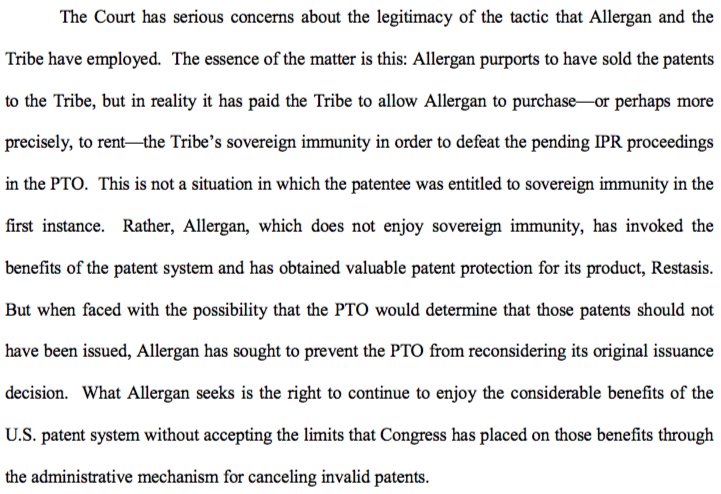
Judge Bryson in the Eastern District of Texas has noted “serious concerns” about Allergan transferring patents to the Saint Regis Mohawk Tribe to benefit from sovereign immunity but joined the tribe to litigation against Mylan and Teva – “Allergan’s tactic, if successful, could spell the end of the PTO’s IPR program”
It had been a bad three months for Allergan, Inc. The drug maker’s stock price had fallen over 20 percent, as the company faced two legal challenges to the patents on its blockbuster drug, Restasis. Then, on 16 October, Allergan lost one of those challenges. A US court found the patents invalid. Allergan vowed to appeal, thus maintaining its monopoly on the drug until a final court determination, which could be over a year away. But Allergan’s monopoly could collapse far sooner, if the company were to lose the second challenge to the patents, before the USPTO. Such a loss was probable, as the agency had already found a “reasonable likelihood” that prior art invalidated the patents on Restasis. So back in September, Allergan employed an innovative legal strategy: The company gave its patents to a Native American tribe, and the tribe claimed its sovereign immunity prevented the USPTO from reviewing the patents’ validity. If this strategy were to succeed, it will do far more than just boost Allergan’s bottom line. The new strategy will increase the power of patent owners, help patent trolls, and dramatically alter the US patent system.
The St. Regis Mohawk Tribe has filed patent lawsuits against Amazon (PDF) and Microsoft, using patents it acquired from a company called SRC Labs, according to reports in Reuters and CNBC.
SRC Labs, a holding company, is a co-plaintiff in today's lawsuit. The lawsuits against Amazon and Microsoft are the second and third lawsuits filed by patent-holding companies working together with Native American tribes. Patent-holding companies, sometimes derided in the tech industry as "patent trolls," produce no goods or services and make their revenue from filing lawsuits.
In the meantime, though, some lawyers have come up with a truly sneaky, and truly awful "work around" that they've basically now productized. After a decision by the PTAB earlier this year to refuse to even hear an IPR request involving a patent held by the University of Florida after the University (a part of the state of Florida) argued "sovereign immunity", lawyers realized that anyone could get out of the IPR process if they just "sold" their patent to a government entity who could claim sovereign immunity. From there is was only a few logical leaps to realize that Native American nations could claim such sovereign immunity. Hence, the deal to "sell" Allergan's patents to the St. Regis Mohawk Tribe.
Basically everyone recognizes this is a sham sale. The St. Regis Mohawk Tribe has no interest in this patent. Or the other patents its now "buying." It just gets some cash, which the original patent holder finds worth paying because it helps them avoid the IPR process. Everything gets "licensed" back to the original patent holder anyway, so the actual transaction is quite clear: patent holders paying Native American tribes solely to avoid a review by the patent office of their sketchy patents.
When the Allergan deal became public, lots of people grew concerned. It seemed like such a naked attempt to game the system. The House Oversight Committee began investigating the issue, noting its serious concerns with what was happening.
[...]
Of course, this is not stopping others from following in Allergan's footsteps. Just days after that court ruling, the very same "Mohawk Tribe" had magically teamed up with a company called SRC Labs, and filed a patent infringement case against Amazon and Microsoft. SRC Labs, if you're wondering, appears to be the estate of Seymour Cray, the founder of Cray Inc. (who was just involved in another important case unrelated to all of this). And, this is not the only such case.
It's hard to see this loophole lasting very long. Hopefully the IPR process survives the various challenges its facing, but on top of that, hopefully the PTAB and/or the courts, shut down this obvious gamesmanship for patent holders to avoid accountability.