
Bonum Certa Men Certa

Journalism 101: Do Not Believe Anything That Benoît Battistelli and the EPO's Management Say (Also Don't Fall for the UPC Hype)

Battistelli's Ministry of Truth is no reliable source of information

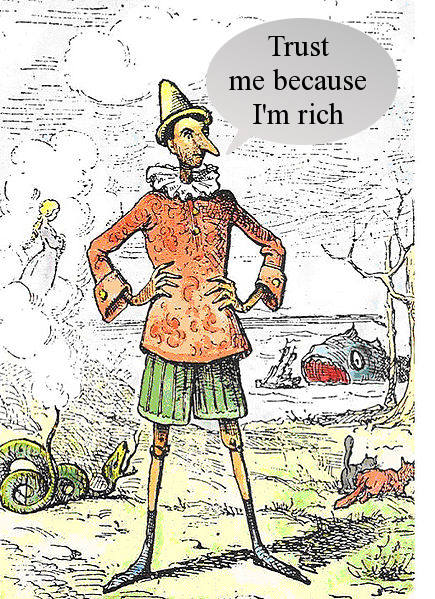
Pinocchio


Summary: A survey/review (or an overview) of recent articles about the EPO and why they're wrong (mostly because they parrot the official lies from Battistelli's department)

THE Battistelli campaign (or coup d'état) recently entered a new phase. A year ago we noted that the EPO had begun deliberately lying both to journalists and to staff. It's inexcusable and it causes irreparable damage to the EPO both as a service and as an employer (or prospective employer). Battistelli appears to have become a man without accountability; he's liable to nobody, except Sarkozy perhaps. What a joke the EPO has become under this man's so-called 'leadership'. Even IP-centric circles lost respect for him, but they have to keep pretending that he's President even when the staff pretty much disowned him and Board 28 views him as a liability. How this man managed to maintain his position might one day become the subject of some incredible book! Eponia is an autocrat's fantasy land.


Today we would like to counter or respond to several reports we saw. Some of them are so shallow that one starts to wonder if the EPO directly paid for them (we already know that the EPO pays publications to print out puff pieces).

Façade of Independence


A couple of months ago we wrote about how Battistelli (in part) would be appointing another one of his cronies, in order for this crony to be framed as "independence" for the appeal boards. Earlier this week we found this article titled "EPO seeks to allay independence fears with new appointment"; problem is, they don't mention who makes this appointment and why it's merely an illusion of independence, as explicitly pointed out by AMBA. To quote this report:

The European Patent Office is seeking to appoint a president of its boards of appeal, a newly created post aimed at addressing longstanding independence concerns.

In a notice published on its website, the EPO said the appointment would ‘foster autonomy and efficiency’ at the appeal boards, which are responsible for hearing appeals against examination decisions.

Under the European Patent Convention, the framework that instituted the European Patent Office, the 28 boards of appeal are supposed to be independent from the rest of the office and only answer to the EPO’s supervisory body the Administrative Council.

But in 2014, their autonomy was thrown into doubt when EPO president Benoit Battistelli (pictured) placed a ‘house ban’ on the then head of the enlarged board of appeal.


Those who have paid close enough attention know that by various means Battistelli is crushing these boards while merely maintaining the illusion that he is not doing so (maybe because of the EPC).

Repeating EPO sound bites like "foster autonomy and efficiency" is a disservice to truth. It's the repetition of lies. We're not sure why the Law Gazette decided to issue such a shallow piece while neglecting to highlight the other side of the story -- the side which is not merely lying to save face.

Façade of Patent Quality


Patent quality will certainly be a big topic in the Administrative Council's next meeting which is only a month away (based on document we saw), so Battistelli and his cronies have begun lying about it and planting puff pieces in the media (whether by collusion or by finding 'useful idiots' who would play along for free we are not sure).

This new article, like many others, compared EPO to the USPTO, quite frankly as usual. It's not as though the USPTO has high patent quality. "This is part of what the US Patent and Trademark Office (USPTO) and European Patent Office (EPO) have to consider in order to determine" who will sink to the bottom of the barrel and accept widely-rejected patent applications. We heard theories about how Battistelli was trying to attract really bad applications by lowering the acceptance bar. That would be a terrible mistake which drains or squeezes out everything that's left of the EPO's 40+-year reputation.

James Nurton, the favourite poodle of Battistelli (doing so-called 'interviews' to prepare puff pieces with him), repeats the EPO's lies this week. It's not journalism but churnalism and it does nothing to highlight the terrible patent quality we have been hearing about and writing about. Low patent quality might be fine for attorneys in the short term (more business), but what happens to society as a whole?

Yesterday we found this new article about the "English approach to obviousness" of patents and the comments were revealing. To quote both of them:

For some time it has seemed to me that the UK courts' approach to obviousness makes little overall commercial sense. Obviousness is a difficult, fairly subjective question, based on a number of legal fictions. The UK court approach leads to massive expense in terms of gathering evidence to try to definitively demonstrate points that are not real but are wrapped up in the legal fictions.

So is the current UK approach in fact causing massive expense to arrive at a fairly artificial, one might say arbitrary result?

It seems that the current approach leaves little certainty and it is hard to advise (especially without all the evidence that the current approach seems to demand) - as this case/blog suggests.

To me adopting, say (or whisper..) an EPO style approach might make more sense. Yes justice might be rougher. But it would be much easier to know the likely outcome, and the cost of litigation could be massively reduced.

Wouldn't better certainty, reasonable cost and a likelihood of a reasonable result (most of the time) be attractive to business?


Hear him, hear him. well said Herr Faulkner.

Given that, for determination of obviousness objectively, the addressee is the hypothetical skilled person, it is well to set up his or her hypothetical task to match. The EPO PSA rubric does that. The skilled person is given the objective technical problem (OTP), and required to scroll through the state of the art for a hint or suggestion how to crack it. Isn't that what real researchers do, in real life?

As to the OTP, that is determined by Applicant. Full faith and credit for what the application as filed states to be the technical field and the technical problem solved by the invention. Nothing fairer, than that, or simpler to explain to the patent litigation community.


When granting a patent an office (or examiners) doesn't need to consider business needs of the applicant and his/her lawyer but rather the inventiveness. Battistelli, being a business type rather than a scientist, is turning the Office into a production line. Examiners don't benefit from it, specialist patent judges (like those at the boards) certainly don't benefit from it, and the whole spirit/principles that made the EPO a world leader become just history.

It's truly a problem that Battistelli and his loyalists now frequently resort to lying (to the public and staff) about what they do. It's costly in the long run because trust is eroded and applicants will sooner or later find out that the EPO is just an expensive (overpriced) rubberstamping exercise/operation. Battistelli will soon find out that his chronic lying needs to stop. Even when he and his cronies say the truth people won't believe the EPO anymore.

"They don't care about costs," one insider told us. "Obviously Battistelli is ready to reach his goals by any means necessary. SUEPO dismissal=collateral damage [...] Someone should tell IAM that there are also dodgy social studies initiated by the EPO to mislead the press and politicians ;)" (comment regarding the upcoming ‘Social Conference’).

"We shall see if IAM has the integrity to engage in journalism when the EPO lies about the social climate," I told them, after IAM slagged off Professor Bessen, saying: "Someone should tell Mr Bessen there are academics who'll take cash to produce dodgy studies for corporates seeking to change patent laws ;-)" (says the site that takes money from the EPO's PR agency that receives over a million Euros per year from the EPO).

"For what it's worth," the insider added, "they don't have the guts to object King Battistelli and his thugs. Fear of repercussions?"

He or she later explained: "Distraction form actual problems and distortion of the truth and the facts is Battistelli's footprint and tactics in this dirty game!"

"As a former EPO examiner, and current practicing attorney, I had to bite my tongue not to scream a nasty expletive when I read that."
      --Anonymous
Battistelli is trying to appeal to US businesses by rubberstamping almost everything while his friends at IAM propagate his talking points, namely: "Battistelli told the audience that this was “a clear sign that there is a growing interest from you in the EPO and the European innovation market”. To help manage that growing interest the EPO has appointed its first attaché to the US, hiring Albert Keyack who previously served as the USPTO’s attaché for South America."

We wrote about Keyack before [1, 2] and explained why it's rather alarming. Quality control before Battistelli was reasonably OK, but EPO insiders tell us they're mortified at how sharp a decline they're seeing. We shall cover this in depth another day. Battistelli basically exploits the image created or defended by his predecessors while shifting policy in the opposite direction.

"The European Patent Office (EPO) has argued that Berkeley's initial, provisional application does not adequately describe the invention because it fails to mention the importance of certain DNA sequences, called PAM sequences," according to this new article from Nature. It's an article about patents on life and the outline/outset says:

Geneticist George Church has pioneered methods for sequencing and altering genomes. He has been called a founding father of synthetic biology, and is probably the world’s leading authority on efforts to resurrect the extinct woolly mammoth.

Now, a battle over who owns the patent rights to a revolutionary gene-editing technique could hinge, in part, on whether Church’s scientific skill could be considered ‘ordinary’.

Such are the arcane and often bizarre issues the US Patent and Trademark Office (USPTO) must consider in the fight over CRISPR–Cas9 gene editing. But the proceedings, which could drag out for years, have taken an ugly turn from scientific minutiae to accusations of impropriety. “There seem to be a number of allegations of bad actors and bad faith,” says Jacob Sherkow, a legal scholar at New York Law School in New York City. “It’s aggressive.”


Once upon a time it was really hard to be granted an EPO patent, but now it's somewhat of a joke (even to insiders who are patent examiners). They're rightly concerned because a shoddy (rushed) job would cost them their job in the long run.

"Well, the UPC Preparatory Committee is the very core of Team UPC and it's basically a bunch of self-serving propagandists and lobbyists.""As a former EPO examiner," wrote this one person the other say, "and current practicing attorney, I had to bite my tongue not to scream" (at EPO lies).

The specific part which angered this person was: "Alfred Spigarelli, European Patent Office (EPO), disagreed with the trade-off premise, and stated that at the EPO, a focus on quality results in productivity."

Complete nonsense. A symptom of what the EPO has become under Battistelli.

Façade of UPC as Inevitable


Based on this tweet from yesterday, CIPA and the EPO will soon converge in London (we're guessing to push and lobby some more for the UPC after Brexit, among other things). We previously explained the role of CIPA in all this, including the push for the UPC.

Here come some alarmists from Team UPC. Cohen & Gresser LLP say "Brain Drain? How Brexit may affect intellectual property rights in Europe" (hardly a problem as long as the UK has its own office, UK-IPO).

Another new article asks (in the headline), "Where Next For Patents In Europe?"

It's actually UPC promotion by proxy (embedded in the article), as for patents in Europe the British people can still use the EPO, albeit the EPO hardly hired any Brits anymore (maybe they don't even bother applying, as we showed last month). Here is what the article says:

An experienced patent lawyer, commenting on the basis of anonymity, believes the UK patent landscape has changed decisively post Brexit: “The Unified Patent Court [in the UK] and Unitary Patent [in the UK] will almost certainly now not go ahead. There is some talk of them still happening, with various permutations being suggested, but I think it is unlikely as it would be politically odd to sign up to a European court with such wide powers so soon after the vote”.

Alexander Ramsay, Chairman of the UPC Preparatory Committee is slightly more optimistic “For the time being the United Kingdom remains a Member State of the European Union and a Signatory State of the Unified Patent Court Agreement and an integral player in its preparation”. However he concedes, the referendum result raises questions “…in particular as regards its possible impact on the UK participation and on the UK ratification of the Agreement”.


"They built their portfolio or career on the premise that the UPC would become a reality, so they're pushing for it by all means possible, even if everyone but Team UPC antagonises the UPC (most people know nothing about it, but they would be harmed by it)."Well, the UPC Preparatory Committee is the very core of Team UPC and it's basically a bunch of self-serving propagandists and lobbyists. They built their portfolio or career on the premise that the UPC would become a reality, so they're pushing for it by all means possible, even if everyone but Team UPC antagonises the UPC (most people know nothing about it, but they would be harmed by it).

The "consequences of Brexit on the UPC amongst many in the patent community (especially by the EPO) is naïve at best," says the following new comment, which also notes that any "attempt [to] proceed with UPC also ignores a critical voice which is that of the user". Here is the comment in full:

I agree with the previous post. Unfortunately the reaction to the consequences of Brexit on the UPC amongst many in the patent community (especially by the EPO) is naïve at best and wilfully blind at worse. To be clear UK participation in the UPC is dead, and the UPC itself is seriously wounded -perhaps fatally so. UPC will not happen any time soon. I appreciate this is frustrating given it came so close. But it does not serve the interests of UK based applicants or those who desire UK patents to pretend otherwise and to do so is in danger of making a bad situation much worse. I comment as a passionate European and patent attorney who has worked in house for many multi-national patentees. I have spent many years living in the EU as a UK ex Pat. After recently returning to live in the UK, I was bitterly disappointed by Brexit, which I believe will be a disaster. However UK ratifying the UPC notwithstanding the June result (even if possible) would simply play into the hands of those who voted to leave as it would be an illustration of elitist arrogance which rather makes their point for them. UPC won’t happen with the UK as the political obstacles to UK participation in UPC are insurmountable. The patent community just doesn’t have the political clout to persuade the UK government to take the political risks and use up their limited political capital in Europe by doing so. For the UK to attempt proceed with UPC also ignores a critical voice which is that of the user. The UPC was always a solution looking for a problem. Even before Brexit, despite the EPO propaganda, I did not sense a large push for industry to use the UPC, who were largely ambivalent at best. Indeed the risk of pan EU injunctions was as much a potential huge downside for EU industry from UPC as it was an opportunity. The present post grant arrangements have largely worked well for 40 years. As a very low proportion of EU patents are ever litigated, I always felt UPC was a post grant tail wagging a pre-grant dog. The UPC has always been a political not economic project based on questionable assumptions and statistics from EPO, and did not properly reflect what industry or most users wanted. The critical risk from Brexit (and for that matter the UPC) is prolonged uncertainty. For the UK to ratify UPC now will merely heap yet more legal uncertainty on top of a massive post Brexit legal black hole. Who is to say that any fudge that allows UK to join UPC, however cleverly thought through, would be confirmed by the CJEU, given their intense suspicion of the whole endeavour? Why would any applicant take the risk of obtaining UPC patents, if their UK patent rights may be at risk at some unknown point in the future? For UK to ratify UPC now could drive applicants who desire UK protection away from the EPO to file direct at the UKIPO. It may even put at risk EU patents outside the UK thus making the UPC even less attractive for all users. Worse case it might deter all applicants from using the EPO at all, if they are forced into a system based on legally shaky foundations. The only sensible option is to pause, wait until the UK leaves the EU and then introduce a revised UPC to cover the remaining EU states who still wish it. Of course a UPC without the UK is less attractive to applicants and a disaster for the UK patent profession. It means no UK based court. But that is one of the very many unfortunate consequences of a poor decision to leave the EU. Revision of the UPC agreement may indeed open up debate that will question the merits of the UPC at all – no bad thing given the rushed and poor quality debate in the EU parliament. However the UK is on our way out, that is no longer our concern and we can have no say on this. Again this is the harsh reality of what leaving the EU means, a lack of influence of UK stakeholders in EU affairs. But to follow the UPC to the bitter end without pause could seriously weaken a supranational patent granting system in Europe that has worked effectively and served applicants well for many years.


Dr Ingve Björn Stjerna, a longtime antagonist of the UPC, has a new paper about the UPC in light (or shadow) of Brexit. His summary says: "The majority vote of the British electorate in favor of leaving the European Union has delivered a serious blow to the European patent reform. The usual protagonists nonetheless immediately started advocating for an instant ratification of the Agreement on a Unified Patent Court (“UPCA”) by the UK, now even deeming possible the participation of a non-EU member which so far, due to CJEU opinion 1/09, was held to be excluded by the same people. When looking at the situation from a less biased perspective, a UPCA with the UK may only be possible after a structural revision of the Agreement."

In our next post we shall tackle some more of the EPO's lies.

Recent Techrights' Posts

What Matters is Software Freedom, Not the Brands
The important thing is to speak about Software Freedom
Wikileaks is About to Turn 20
~2 days ago it turned 19.5
The Cloud of Smoke
Will 2026 be the year that "The Cloud" openly confesses the risks it brings about?
SLAPP Censorship - Part 36 Out of 200: Claim KB-2024-003529 in a Nutshell (Microsoft Employee Does Terrible Things, Then Sues the Reporter in Another Continent)
It commences with more of an overview
Gemini Links 06/04/2026: Solar Panel Story and Centralisation
Links for the day
"Free Speech, Free Press": What the World Needs to Improve
Darkness breeds corruption
IBM prioritises a "lot of smoke and hype and use of trending buzzwords"
IBM can pretend all it wants things are fine
GAFAM Paying the Price for Pursuing US Military Money (Taxpayers' Money as 'Stimulus' With Strings Attached)
The "cloud" in cloud computing is a cloud of smoke
Observing Slop's Demise
If energy becomes more scarce, then one rare/side perk (or upside) will be slop companies screaming for lifeboats
Links 06/04/2026: Crackers Breached the European Commission, Why "Old Way of Campaigning Won’t Cut It Anymore"
Links for the day
Enron Versus NVIDIA (the Cost of Circular Financing, or Funding Your Own Customers to Buy Your Products) - “The Inventory Paradox” or “The Vibe Revenue Admission”
Round-tripping (finance)
You Know "The Economy" is Fake When 6 Months After Oracle Says Debt-Saddled 'Open' 'AI' (Slop) Will Pay It $300,000,000,000 Oracle Says It Must Lay Off 30,000 Workers at 6AM
Oracle is in deep debt, which increased at a pace of almost 4 billion dollars per month lately
Free Software Will Outlive GAFAM
GAFAM is overhyped
Techrights Was Further Decentralised Three Years Ago
In 2020 we began working on IPFS stuff
The Military Attacks on Dubai Internet City as Reminder That GAFAM Isn't Safe (Disregard the "Nobody Gets Fired for Buying GAFAM" Mindset)
These are all realistic and foreseeable scenarios that GAFAM sceptics have long warned about
The Wars Aren't Ending, Now We See GAFAM Facilities Being Bombed
This is becoming a tech issue
Links 06/04/2026: Turning 34, Throwing Things Away, and Printing in GNU/Linux
Links for the day
Links 06/04/2026: Ex-Microsoft Engineer Explains Why Azure Fails, Germany Prepares for War
Links for the day
EPO "Cocaine Communication Manager" - Part XI - EPO Strike Enters Its Second Week, EPO Sheds Off Qualified Staff to Make Way for Nepotists
More than six months ago the "Cocaine Communication Manager" got arrested for cocaine use
Another Microsoft Outlook Downtime
Microsoft has sloppy code, it's not something suitable for mission-critical things
Week 2 of April IBM Layoffs Accelerate Based on Rumours
"Heard about Layoff at IBM"
Over at Tux Machines...
GNU/Linux news for the past day
IRC Proceedings: Sunday, April 05, 2026
IRC logs for Sunday, April 05, 2026
Culture of Harassment Inside Microsoft, Says Former Director at Microsoft
listen to Microsoft insiders
Drone Strikes on Amazon (GAFAM) Datacentres Highlight Azure's Miniscule Share
Azure is failing
SLAPP Censorship - Part 35 Out of 200: How to Make ~10,000 Pound Sterling (13,220.50 United States Dollars) by Copy-Pasting and Editing 10 Pages
Today it's Easter Sunday, so we'll keep this part relatively short
Gemini Links 05/04/2026: Artemis II Mission Tracker, Meditation on Copyright, Alhena 5.5.5, "Gemini as the Final Frontier of Human Cognition"
Links for the day
Microsoft Windows Falls to All-Time Low of ~60% in Switzerland, GNU/Linux Among Top Gainers
What will it take for mainstream media (not just geeks' site) to cover it?
Mainstream Media on "Practical Survivalism"
Suffice to say, panic buying begets more panic and price surges
Cloud Computing as a Cloud of Smoke (Your Hosting Provider is a "Legitimate" Military Target)
When a French datacentre went up in flames people joked that the "cloud" meant a cloud of smoke
Andreas Tille Congratulates Sruthi Chandran Before the Election for Debian Project Leader (DPL) is Even Over
Andreas Tille, the current Debian Project Leader (DPL) who has been in this role for nearly 24 months
When You Try to Change the World for the Better and Somehow They Find a Way to Say You Are the Villain
Don't be a fool. Don't fall for inversions of narratives.
Slop Was a Flop and Energy Crisis Will be Slop's Final Blow
Today we see no slopfarms in Google News
Links 05/04/2026: "Taiwanese Airlines to Hike Fuel Surcharges 157%" and Openly Racist Voter Suppression Starts in the US
Links for the day
Gemini Links 05/04/2026: Playing with Hyprland and Migrating Antenna Filters
Links for the day
Links 05/04/2026: "Confidential Computing" as Proprietary Bundle of False Promises and "The Web Is an Antitrust Wedge"
Links for the day
Over at Tux Machines...
GNU/Linux news for the past day
IRC Proceedings: Saturday, April 04, 2026
IRC logs for Saturday, April 04, 2026
SLAPP Censorship - Part 34 Out of 200: The Necessity of Transparency, Illuminating Garrett's and Graveley's 'Tag-Team' Act, Misusing the British Docket (From Far Away in America) in Efforts to Hide Bad Behaviour
Transparency is paramount
Red Tape at Red Hat (IBM)
Now the guiding principles are the whims and moods of people who peddle buzzwords to manipulate IBM's share prices
The So-called 'AI' (Slop) Companies Will Have the Plug Pulled
It can vastly accelerate this bubble's implosion
Dr. Andy Farnell on a "Technology Plan B"
based around Free software
Windows Lows Across the Mediterranean
Judging by this month's data from statCounter
The Future of the Net is 'in Space'
Gemini Protocol is growing and GemText remains the same, so it's made to endure
Linux Foundation Profits From Scams, Fraud, and Grifting
Don't be misled by the name "Linux Foundation"
Too Hard for IBM to Keep Everybody Silent About How the Company Has Gone South
IBM is busy trying to keep disgruntled or ex workers silent using NDAs
Microsoft Transmits Malware and Back Doors to GNU/Linux Servers, Media Points the Finger at Everyone But Microsoft's Servers
Is Microsoft too poor to vet and check what it hosts and transmits?
Gemini Links 04/04/2026: "Fuzz Guy", "Reusing Old Computers with Arch Linux and DWM", and Bubble v10.0 Released
Links for the day
Links 04/04/2026: eBay Scam, "Music Publishers’ X Copyright Lawsuit Officially on Pause"
Links for the day
Links 04/04/2026: Social Control Media Verdict and Bans, Whistleblower (Axel Rietschin) Explains How "Microsoft Vaporized a Trillion Dollars"
Links for the day
Reaching the End/Event Horizon of LLM Slop
Are we moving towards a post-LLMs world?
Over at Tux Machines...
GNU/Linux news for the past day
IRC Proceedings: Friday, April 03, 2026
IRC logs for Friday, April 03, 2026
Gemini Links 04/04/2026: STXGE and Computer Relationships
Links for the day