
Compelling Examiners at the European Patent Office to Fake "Growth" (in Patent Monopolies) Using Slop and Sloppy Processes
Yesterday SUEPO Munich (staff union of the EPO in Munich) circulated a "[g]uide to production pressure at a time of industrial actions," knowing many members are striking all year.
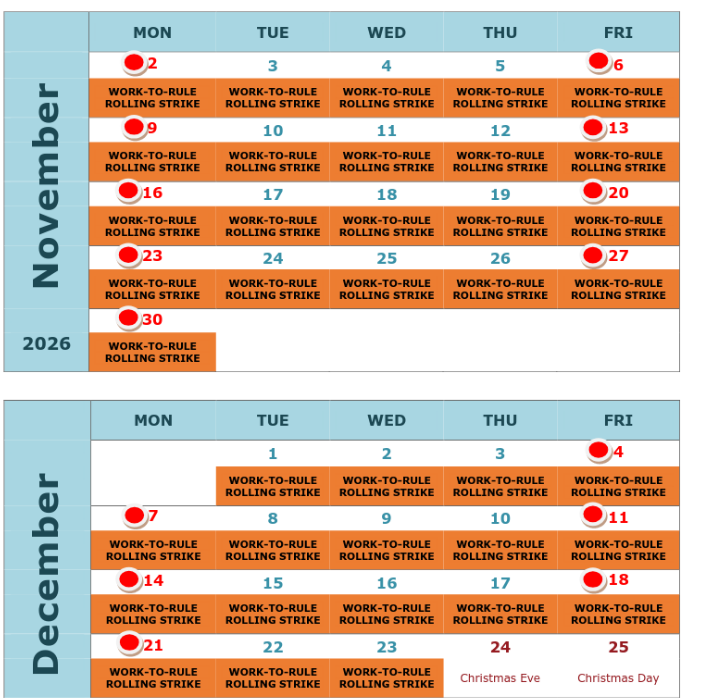
"At a time of ongoing social unrest and industrial actions to stop the erosion of salaries," SUEPO Munich wrote, "pensions and other benefits, management should prioritize maintaining constructive and meaningful dialogue. Instead, some line managers are expecting staff to catch-up ever increasing production targets and to accept a long-term loss of purchasing power. Should your line managers be inviting you to individual meetings, you can find some recommendations in this updated guide."
The agenda of management is likely illegal and the methods likewise.
We thought it would be worth reproducing the above guide:
INTERNATIONALE GEWERKSCHAFT IM EUROPÄISCHEN PATENTAMT
STAFF UNION OF THE EUROPEAN PATENT OFFICE
UNION SYNDICALE DE L'OFFICE EUROPEEN DES BREVETSOrtssektion München
Local section Munich
Section locale de Munich27 October 2026
su26027mp – 0.2.1/0.2.2Guide to production pressure during industrial actions (Updated)
What is happening?
As the year draws to a close, management is increasingly putting pressure on individual examiners to increase production. Staff representatives have reported a worrying pattern in DG1 in which discussions about production can escalate into criticism of both quantity and quality, additional coaching, involvement of HR and directors, and warnings of possible consequences.
At the same time, the Office is approximately 16,500 products behind the production plan. At this stage of the year, this shortfall cannot realistically be recovered. This raises a fundamental question: what is the purpose of intensifying pressure on individual staff members when the overall production shortfall can no longer be made up?
The production gap is an organisational problem. It cannot simply be transferred to individual examiners through additional meetings, arbitrary demands or pressure to work faster without considering the complexity of their files and the quality standards expected by the Office.
Furthermore, the industrial dispute remains unresolved. The legitimate concerns raised by staff concerning salary adjustment, increased pensions contribution and actual cost for the Presidents’ re-election for a third consecutive mandate have not been satisfactorily resolved. Increasing pressure on individual staff members does nothing to address these underlying issues. It only damages morale, trust in the organisation, health and ultimately the quality of the Office's work.
We understand that:
● Colleagues report being asked to increase production without sufficient consideration of the composition and complexity of their files.
● Production concerns is followed by criticism of quality, proposal for additional coaching and increasingly senior management involvement.
● Colleagues report warnings of possible consequences, creating particular anxiety for staff on fixed-term 5 years contracts.
● The industrial dispute remains unresolved with the significant effect of ca. 16,500 products behind plan.
● Additional pressure on individual staff members does not address the underlying concerns about salary adjustment, increased pension contributions (pensions are overfunded at 120,5%1) and the cost of re-election for the third consecutive term of the president.
The purpose of this guide is to help colleagues respond if they are called to meetings about production or quality.
Recommendations for being “behind in production” when confronted in a meeting:
You are entitled to:
● An objective and fair assessment of your work
● Clear production criteria and an explanation of how your performance is assessed
● Appropriate consideration of file complexity, workload allocation and additional duties
● Respectful and professional treatment
● Realistic expectations that do not disregard quality objectives or the legal basis of the EPC
However, if HR or the Director becomes involved, or if formal consequences are mentioned, you should clarify the nature of the procedure and consider seeking advice from your Staff Representation (mnstcom@epo.org) or SUEPO (munich@suepo.org).
In case your line manager asks “Why are you behind in production?”
1. Clarify the nature of the discussion
“Could you please clarify whether this is an informal discussion about workload and production or part of a formal performance-management procedure?”
2. Request objective benchmarks
“Could you please clarify which benchmark is being applied and how my individual file complexity, additional duties and available production time have been taken into account?”
Management regularly reminds the staff when they deny steps or bonuses, that performance is not measured by quantity alone. It is measured ‘holistically’. Therefore, you are producing in line with the objective benchmarks: legal certainty, quality and clarity of reasoning, The complexity and composition of the files, long-term robustness of decisions etc. You would like to be provided with these benchmarks to assess your situation.
3. Put the production figures into context
“I would suggest assessing the development of my production over the year rather than relying on an isolated figure or a simple comparison with the annual target. The figures should be considered in context, including fluctuations over time, workload allocation and the nature of the files handled and not to forget a whole year of unresolved unrest and Industrial Actions in the office.”
___
1 CA/84/26, page 5
4. Ask about the purpose of catch-up demands
“I understand the importance of the Office's production objectives. However, given the overall shortfall of approximately 16,500 products and the limited time remaining in the year, could you please clarify the operational objective of the proposed catch up plan in my production and how the expected result has been calculated?”
5. Case complexity
“My current workload includes files requiring substantial legal analysis and careful consideration. These cases require time to ensure that the resulting work is legally sound as expected by the EPO KPI’s. I would ask that the complexity and composition of my workload be taken into account when assessing my production.”
6. Quality focus
“I remain committed to delivering legally sound and high-quality work. Increasing speed beyond a reasonable level may increase the risk of errors, inadequate reasoning and subsequent rework. Production should therefore be assessed in terms of both quantity and quality.”
7. Available tools and working methods
“Could you please clarify what changes in working methods, tools, resources or workload allocation underpin the expected increase in production?
Am I required to personally pay for AI model subscription(s) in order to catch up with the top down provided plan?
It would be helpful to understand how the additional output is expected to be achieved while maintaining the required quality standards, with the tools provided by the Office.”
8. Health issues versus high production targets
“I am concerned that the current expectations may not be sustainable in the longer term. I want to continue delivering work to the required standard, but this requires realistic planning and working conditions that allow me to do so.”
If health issues affect your work, follow the applicable procedures and seek appropriate support at OHS or your general practitioner. You do not need to disclose unnecessary medical details in a production discussion.
9. Do not accept the assumption that experience automatically means higher output
If you are told that your grade, salary or experience means you should produce more:
“I recognise the experience I bring to my work. However, production also depends on the composition and complexity of the files. With experience increase so does the file complexity and the tasks assigned. The time required to complete them therefore requires proper re-balancing.
Experience can contribute to efficiency, but it does not make every file equally straightforward or justify an arbitrary increase in output.
I would therefore ask that my performance be assessed on objective and relevant criteria.
Since it was a top down plan, without involving my personal possibilities, could you please clarify which benchmark is being applied and whether it takes into account my personal situation, the case complexity and additional duties.”
10. Additional duties
‘‘In addition to my core production tasks, I have undertaken other assigned responsibilities, including (opposition, classification, projects, training sessions, missions and other duties). These commitments affect the time available for production and should be taken into account when assessing my output.”
11. If asked ‘Why do you not simply catch up with production?”
‘‘I am willing to discuss realistic workload planning and priorities. However, any catch-up target needs to be based on the work involved, its complexity, the time available and the tools provided by the office. Given the overall production shortfall, I would appreciate clarification of what additional individual output is realistically expected from me to achieve.”
12. If told ‘Your quality is too low”
‘‘Could you please identify the specific actions and quality criteria concerned and explain the reasons for the assessment? I would like to understand the precise issues so that they can be addressed objectively.”
If AI tools have been used to identify possible errors, you may ask how the identified issues have been verified. An automated flag should not, by itself, be treated as proof of an actual error.
13. If coaching or senior management involvement is proposed
“I am willing to consider constructive support. Could you please clarify its objectives, how progress will be assessed, and whether this is developmental assistance or part of a formal performance- management procedure?”
If HR or the Director is involved, or possible formal consequences are mentioned, consider contacting your Staff Representation (mnstcom@epo.org) or SUEPO (munich@suepo.org) promptly.
14. If you are asked to commit to catching up
If you are asked to promise a substantial increase in output by a particular date:
“I am prepared to discuss realistic priorities and workload planning. However, the assumptions for the results at the start of the year have drastically changed during the year (ex: new AI tools to learn and work on, no paper work allowed anymore, nine months of continuous Industrial Actions, etc.) therefore, it would be unprofessional and irresponsible from me to commit now, in reaching the initial targets when the parameters have changed.\
Furthermore, it was a top down plan, without involving my personal possibilities.
In view of the above, can you (TM/Dir) confirm that the amended current new expected production demands are based on an adjusted initial benchmark? What exactly is now being taken into account to reduce the initial assumptions of production?
If you cannot provide me with the above, I cannot responsibly commit to reaching the demanded production without understanding the assumptions behind the target, the work involved and the implications for quality.”Do not promise results simply to bring an uncomfortable meeting to an end.
15. If asked “Do you participate in Industrial Actions, such as work-to-rule and strikes?”
“I am solidary with my colleagues for the benefit of all staff, including my manager(s). Strike absences are visible to the TMs. The rest of the question has been answered above”.
Questions about participation in industrial action should be handled in light of the applicable rules (Judgment 4330), the Industrial action plan and your individual circumstances. You may wish to seek advice from your Staff Representation or SUEPO about your rights and obligations before responding.
What you do not need to do
● You do not need to apologise automatically for a production shortfall before its causes have been examined.
● You do not need to accept vague or undefined criticism without asking for specific examples and objective criteria.
● You do not need to accept an assessment that ignores relevant differences in workload, case complexity or assigned duties.
● You do not need to commit automatically to unrealistic increases in output or arbitrary catch- up deadlines.
● You should not feel compelled to sacrifice quality or sustainable working practices simply to increase numerical output.
● You do not need to assume that every production meeting is disciplinary, but you should clarify the situation if its purpose is unclear.
● You may wish to seek advice from your Staff Representation or SUEPO about your rights and obligations before responding.
If you are asked to acknowledge a document, distinguish between confirming receipt and agreeing with its contents. If you are uncertain about the implications of signing, ask for time to seek advice.
Conclusion
As the year draws to a close, the overall production gap can no longer realistically be recovered within the remaining period of the year. Meanwhile, the industrial dispute remains unresolved.
In this context, additional pressure on individual staff members raises legitimate questions about its purpose, proportionality and effectiveness. Staff should not be made to feel personally responsible for an overall Industrial action and production shortfall.
SUEPO Munich
Dare I predict these industrial actions will carry on next year? And that as Campinos struggles to secure a reappointment he will become increasingly combative?
The EPO cannot retain or recruit suitably experienced examiners if it's a "numbers game" and smart people are forced to use slop. █