
--Miguel de Icaza
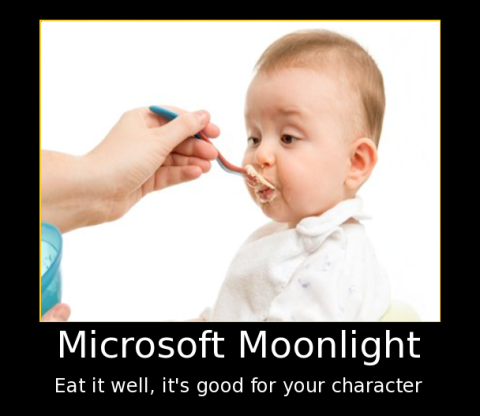
AT the beginning of last year we posted an article about the bad experience installing Moonlight, which requires the troublesome Mono. Have all issues been resolved since then? Well, based on this batch of USENET postings from yesterday, the answer would be "No" and it may have actually gotten worse. To quote the messages in sequence:
Ubuntu 10.04 Lucid - Silverlight clone to view Microsoft content hoses Firefox
From: High Plains Thumper Date: Sunday 02 May 2010 23:52:51 Groups: comp.os.linux.advocacy
Last night I upgraded from Ubuntu 9.10 to 10.04.€ € About 2 GB were downloaded, then started setup this morning.€ € I started at bedtime, and didn't want to wait the hour to hour and a half for the download.
This morning, I let it go through the usual upgrade setup, which took about an hour.€ € (I decided to upgrade rather than install anew.)
So far, everything is working fine, in spite of the Wintroll Chicken Little's claiming the sky is faling.
I did hit one glitch though.€ € Fortunately, I have Seamonkey as a backup browser.
Firefox would start up, but never got to the open screen stage.€ € So I opened GNOME Terminal 2.29.6 (command mode for Windows people).€ € I got the following error message:
"Attempting to load the system libmoon Segmentation fault"
I did a Google search in Seamonkey and found this:
[quote] Firefox Segmentation fault libmoon Ubuntu > “firefox” package > Bugs > Bug #563036 This bug affects 6 people
Bug Description Binary package hint: firefox Either firefox will crash on the home page, or it will crash soon after.
When I run firefox from the console the output i get is :
Attempting to load the system libmoon Segmentation fault (core dumped)
Jonatan Schroeder€ € wrote on 2010-04-17:
#2 I had the same problem, uninstalling the libmoon package solved the problem for me. As far as I know, this means that you don't get access moonlight/silverlight web pages, but there aren't as many who use it. [/quote]
https://bugs.launchpad.net/ubuntu/+source/firefox/+bug/563036
So, I opened Synaptic Package Manager.€ € Did a search on "libmoon":
[quote] Package: libmoon Installed Version: 2.2-0buntu1 Latest Version: 2.2-0buntu1 Description: Free Software clone of Silverlight 2.0 - unstable runtime library [/quote]
I right clicked on the green coloured status square (green meaning that it is installed), selected "Uninstall Completely".
Then clicked on "Apply" in Synamptic.€ € Up comes the following dialogue:
[quote] Apply the following changes?
- To be removed € € € € moonlight-plugin-core € € € € moonlight-plugin-mozilla
- To be completely removed (including configuration files) € € € € libmoon [/quote]
I cliked on [Apply], and it uninstalled it.
Now Firefox works.
I find it rather amusing that it is a stupid little plug-in to view Microsoft only Silverlight content, which fortunately only affects a few websites.
Is it a problem created by Microsoft?€ € I don't know.€ € But it was rather ironic that it would be a plug-in to watch Microsoft content.
Other than that, everything seems to be working fine so far in Ubuntu 10.04.
I noticed f-spot also installed which means hundreds of mono crap€ libs must have also gone into that limited 700Mb liveCD to remove other freedom software packages. This fsck up is not going to work forever.
Its probable Ubuntu is being readied to be sacrificed to micoshfat for money.
Fedora has dropped mono claptrap.
I think it is in Canaonical's best interest to tell the mono camp to fork off and fork off early like fedora did.
Canaonical as does many companies have come thus far with open source and free code and the good will of freedom developers as well as free developers. By incorporating patent troll steaming pile of crap that mono is, it is mistaken if it thinks there is some magic pot of gold at the end of a micoshaft rainbow. As novel found out, there isn't. Its some tossed off remnant of a morsel that might keep you alive for a few days. But your developers and supporters flee.
The way to avoid all this rubbish is to grow organically. Not grow too fast and resize a little if needs be. Knock at every door for preload and show off your rock solid product which is the Ubuntu distro for new products like smartbooks and smartphones. If you poison it with something like mono inside it, if I'm going to be a big customer I want to know that its not patent troll encumbered with mono. I won't want it. At the very least, I would want something that had been split and supported and fully developed in that split format where there are no patent troll encumberances.
I'm not surprised, because in over 30 years of using Microsoft products, or products that relied on working with Microsoft products, I've had nothing but trouble with Microsoft products. € Fortunately for the last 13 years, I've had no trouble because I don't€ € have to do anything with Microsoft products. € That includes Mono etc.
Oh, I had another glitch, a minor one, and that was mounting the XP WinNT partition.€ € I haven't gotten that fixed yet, but I think it is because I need an optional package.€ € Again, it is a Microsoft feature.€ € I am a little vague because it is a while since I enabled it, I can't remember the specific name of the package and the previous Ubuntu releases just updated these extensions.
I'd use the XP partition when mounted in read only mode.€ € Reason for that is for relative safety, because I am uncertain of what little devious act that may have been perpetrated by Microsoft, to detect a non-Microsoft OS wrote to it.€ € Did they do something devious?€ € I am not saying that.€ € But given the history of the company and its anticompetitive acts, it would not surprise me if they did.
This is a little long winded, but a good explanation would be unreasonable without it.€ € I am grateful for the Internet sources to reveal the truth, which previously would have been harder to obtain.
It took Microsoft nearly fines of $2 billion US from the EU to get them to release information on their networking, which they had made sufficient changes to, that others could not successfully reverse engineer.€ € I gather that it is possible, the reason why something as simple as server - client communication had becomes so borked with "gotcha code":
[quote] In contrast to the RPFJ, a meaningful remedy must account for the fact that Microsoft manipulates interface information in a variety of ways to preclude competition. Although too numerous to recount, Microsoft's tactics include:
€ € € € € * "Secret Interfaces" - Microsoft does not publish all the interfaces it uses and does not publish all the interface information that others need to develop products that interoperate with Microsoft software.
€ € € € € * "Crippled Interfaces" - For some functions, Microsoft publishes information about an interface that is inferior to the interface that Microsoft itself uses to accomplish a function, or publishes incomplete information about an interface.
€ € € € € * "Kick Me Interfaces" - Sometimes, Microsoft publishes information about an interface that Microsoft uses to perform a function, but it "marks" non-Microsoft software in a way that assures the interface will operate in an inferior way. Microsoft can "mark" competitors software through tagging, signing, encrypted passwords, or by noting the absence of such features.
€ € € € € * "Moving Interfaces" - If, by some means, a third party has been able to obtain adequate interface information that Microsoft doesn't want it to have, Microsoft will simply move the interface. For example, Novell successfully figured out how to enable its directory services software to interoperate with Windows NT. To counter Novell's success, in Windows 2000 Microsoft broke up and moved the computer files containing the interface information used by Novell and marked, or signed, information required for the interfaces so that Novell could neither use Microsoft's interface information nor replace it.
The typical result of such tactics is that Microsoft makes competing products appear inferior to Microsoft's products. Microsoft's actions may make a competing product appear slower, require more memory, or perform with limited functionality. These tactics also enable Microsoft to persuade customers to buy Microsoft's inferior and/or more expensive products simply to avoid Microsoft's roadblocks.(15)
15. Perhaps most remarkable, is the arrogance with which Microsoft exploits its anticompetitive efforts to impede interoperability. Microsoft, for example, repeatedly issues marketing materials that criticize products offered by Novell and other competitors for technical problems cause by Microsoft's refusal to allow effective interoperability with Windows.
Thus, in 1998, Microsoft's Website criticized Novell's directory services product, NDS for NT, because "[i]t is not integrated with the operating system." Further, Microsoft proclaimed that Windows NT is "successful," because " customers have found that Windows NT Server suits most of their needs now and they are confident that Microsoft will deliver on other functionality that they need in the near future. Such is the case with directory services." In other words, in 1998, Microsoft admitted that it did not yet offer a competitive directory services middleware product, but it aggressively discouraged customers from using Novell's product based on interoperability limitations created by Microsoft and its "promise" of improving its software sometime in the future. See NDS for NT: Increases Complexity and Cost Without Adding Value, available at http://www.strom.com/awards/98a.html (visited Jan. 13, 2002) (republication of paper appearing on Microsoft's website until Jan. 22, 1998). Four years later, Microsoft's Active Directory is still generally regarded as inferior to Novell's eDirectory, yet continues to increase market share at Novell's expense as a result of Microsoft's anticompetitive acts. See, e.g., Products of the Year, Network Magazine (May 7, 2000), available at http://www.networkmagazine.com/article/NMG20010413S0005 (visited Jan. 15, 2002). [/quote]
http://www.usdoj.gov/atr/cases/ms_tuncom/major/mtc-00029523.htm
AFAIK, most recent example of borked code is the requirement that a Microsoft server be a primary domain controller, else SMB/CIF would not work:
[quote] J. Microsoft’s Campaign Against Rival Server Operating Systems
€ € € “Sun, Oracle and Netscape are all pushing a new model of [almost] centralized computing. They all acknowledge that Microsoft holds tremendous sway over the desktop platform, so they all want to quickly strip as much value and spending as possible off the desktop and onto the server where they can charge premium prices and push their own platform offerings.”
€ € € - Aaron Contorer, Microsoft C++ General Manager [107]
€ € € What we are trying to do is use our server control to do new protocols and lock out Sun and Oracle specifically”
€ € € - Bill Gates, Microsoft [108]
In the mid to late 1990s, computer networks were growing in speed and Microsoft sensed a threat to its core operating system monopoly from more centralized, server-based computing. Determined to head off any potential competition, Microsoft decided that it needed to add server operating systems to the “moat” surrounding its Windows operating system monopoly. [109]
To gain inroads into this market, Microsoft embraced industry standards for file-and-print sharing, user management, and identity verification so that its products would be compatible with the then-prominent Unix server operating systems. [110]
But as Microsoft’s server systems started to gain a foothold in the market, Microsoft quietly started to “extend” support for industry standard protocols in its Windows operating system so that Windows clients would have a better experience when connected to Microsoft’s servers. [111]
Eventually, by changing its Windows personal computer operating system so that Windows computers could not fully connect to any server that did not use Microsoft’s proprietary extensions unless the users installed special software on their machines, Microsoft established and reinforced its dominance in the work group server operating system market,112 where Microsoft maintains a share of approximately 77%. [113]
Microsoft’s conduct eventually drew scrutiny from the European Commission, which condemned Microsoft’s refusal to release information that would allow other server operating systems to connect to personal computers running Microsoft’s Windows operating system. [114]
In a 2004 decision, the European Commission found that if Microsoft succeeded in eliminating other server operating systems as competitive threats, then innovation would be severely limited. [115]
And, in fact, after releasing Windows Server 2003 to lukewarm reviews, [116]
Microsoft failed to release a new server version of Windows until 2008. [117]
Even then, many reviewers noted that, despite aggressive marketing to small- and midsize-business users and a special edition of the server operating system just for these users, Microsoft had done very little to address their needs, and instead had essentially re-packaged a scaled-down version of an existing enterprise-level product. [118]
107. EC Decision, supra note 52, ۦ 771.
108. EC CFI Judgment, ۦ 771.
109. A server operating system is an operating system for a server, a device that performs services for connected personal computers as part of a client-server architecture. In contrast, a client (or desktop) operating system serves only a personal computer.
110. See Microsoft Corp., Windows NT and UNIX Interoperability, Oct. 1, 1997, http://www.microsoft.com/technet/archive/winntas/deploy/ntunxint.mspx?mfr=true.
111. See EC Decision, supra note 52, €¶€¶ 176–301.
112. See id. €¶€¶ 236–301.
113. See IDC Workload Tracker 2007 (Worldwide Server Operating System Market Shares -- Based on the IDC Server Workload Models in 2000 and 2007).
114. See EC Decision, supra note 52, €¶€¶ 781–82.
115. See id.€¶ 725 (“Microsoft’s research and development efforts are indeed spurred by the innovative steps its competitors take in the work group server operating system market. Were such competitors to disappear, this would diminish Microsoft’s incentives to innovate.”).
116. See Gregg Keizer, Microsoft Windows Server 2003: Experts Advise Caution, CHANNELWEB NETWORK, Apr. 19, 2003, http://www.crn.com/it-channel/18822436 (weighing the pros and cons of migrating to Windows Server 2003 and noting that many companies may want to “hold tight” rather than migrate).
117. See Steven Warren, Should You Upgrade to Windows Server 2008?, TECHREPUBLIC, Oct. 15, 2007, http://blogs.techrepublic.com.com/datacenter/?p=209.
118. See Jason Brooks, A Head Full of Windows Server 2008, EWEEK, Nov. 9, 2007, http://blogs.eweek.com/brooks/content/windows/a_head_full_of_windows_server_2008.html (“Microsoft’s newly minted Windows Essential Business Server offers a very compelling answer to the question, ‘How can a midsize business consume all the same sorts of Microsoft core server products that a large enterprise might consume?’ … [A]n excellent answer to the wrong question.”). [/quote]
From:
A History of Anticompetitive Behavior and Consumer Harm European Committee for Interoperable Systems March 31, 2009 Pages 18 & 19
http://www.ecis.eu/documents/Finalversion_Consumerchoicepaper.pdf
It doesn't take 6,000 pages of documentation so that simple clients and servers communicate, unless of course it has "weasel code", IMHO.€ € IIRC, even the Perkin-Elmer PenNET OSI protocol was only one three ring binder.€ It contained all the information to create and modify code between PC's and mainframe.
Thus, I think of a need for a new paradigm that regards open protocols and fair access to computer resources, which allow other vendor products besides Microsoft to freely communicate and work together.€ € Microsoft has a history of breaking that openness, to ensure its continued existence as the desktop monopoly.
You may remember back in October of last year that Microsoft publicly warned Xbox users who were using 3rd party memory cards for their Xbox that it was about to break those cards, and that users should, instead, transfer data to Microsoft's own cards. Datel, a maker of third party cards apparently sued Microsoft, claiming antitrust violations in this move, and Eric Goldman points us to the news that a magistrate judge has rejected Microsoft's request to dismiss most parts of the lawsuit.
[...]
Oh, and we should note that Microsoft just recently decided to target the very same Datel in a patent infringement lawsuit. Gee, I wonder why they picked Datel... Must be part of Microsoft's belief in showing how "important [a] role IP plays in ensuring a healthy and vibrant IT ecosystem." That, or the belief in punishing companies who sue you for antitrust with more legal fees.