
"SIPO is an atrocious patent office which unfortunately reaffirms the view/perception that China makes low-quality things."In our view and our long-term assessment, the world's worst patents are being issued in China (SIPO), where even software patents are explicitly and unequivocally allowed (unlike the USPTO where such patents were born).
SIPO is an atrocious patent office which unfortunately reaffirms the view/perception that China makes low-quality things. Earlier today the EPO said that "SIPO [had] changed how often and when it publishes its patents. Read here more about the change..."
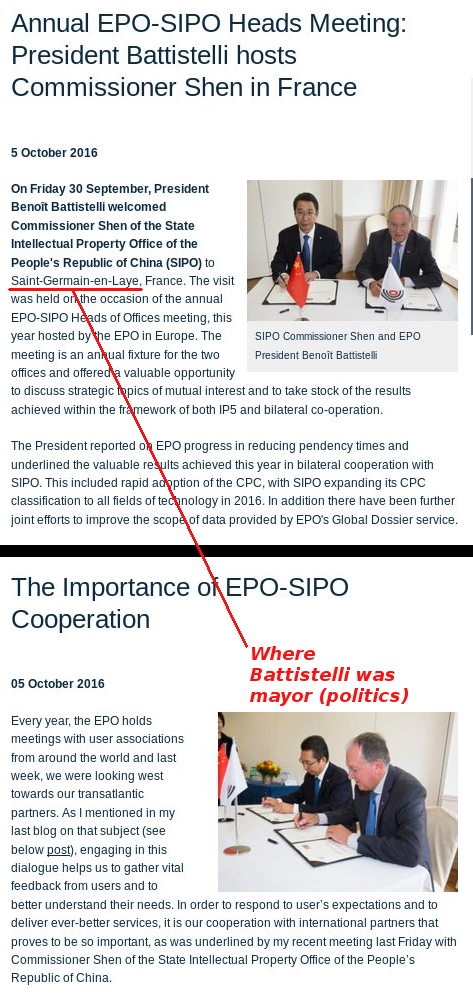
"Battistelli aspires for what we called "SIPO Europe" just under a year ago."As EPO workers ought to know, Battistelli is close to SIPO -- to the point of inviting Chinese officials to his home town in France (for professional work). Battistelli aspires for what we called "SIPO Europe" just under a year ago.
According to this blog post from three days ago, the "Spanish Supreme Court clarifies that “problem & solution approach” is not legal doctrine" (which is a big deal).
To quote:
For many years, Spanish Courts have considered the “problem & solution approach” developed by the European Patent Office (“EPO”) to be a very useful tool for the purpose of trying to make an objective assessment of inventive activity. Unlike in other jurisdictions such as Germany, in Spain this method has become the natural instrument used by the Courts to examine inventive activity. Its use in judicial decisions, including those emanating from the Supreme Court, is so frequent that in a recent case, one of the parties alleged that it had become legal doctrine. In particular, that party, in an appeal filed before the Supreme Court, alleged that in its judgment of 29 December 2014, the Court of Appeal of Navarre had infringed this legal doctrine because it had failed to apply the “problem & solution approach.”
[...]
All in all, the main teaching of this judgment is that although the “problem & solution approach” is a very valuable method, other methodologies may be used.
Thanks for that Report, which I read with a sinking feeling in my stomach, that panellists are creating unnecessary difficulties and misunderstandings and (as usual) making a scapegoat out of the EPO's "Problem and Solution Approach". Why is this ever the case, I wonder.
My point is that what disclosure you need to include in the original patent filing for Europe is not what the Panel Chair said it was.
The reaction from the USA, that such drafting imperatives (stating "the problem") are incompatible with drafting for the USA, might be right. But, gentle readers, what if "stating the problem" is not actually required?
The way I see it, the EPO explores obviousness by toggling between the technical features recited in the claim and the technical effects they deliver. In his definitive book on drafting in Europe and the USA, Professor Paul Cole equates patentability with "A difference, that makes a difference". If I may state it in other words "A new combination of technical features that delivers a technical effect". What one needs in the original application, therefore, is not only a disclosure of the features but also of the effects delivered by that specific combination of technical features. No more than that.
Do the courts of the USA punish drafters and patent owners for saying in the application as filed what effects one gets with the claimed feature combination? I suspect not. But if they do, it is not helping to achieve the aims of the patents clause of the Constitution of the USA, to "promote the progress" of Useful Arts ie technology.
Amirite? Or do you disagree with me? Will other readers comment, please.
Agreed re the "no more than that". Also I thought a technical effect canhelp in the US too (Enfish) or did I misunderstand?
A US view of Paul Cole's Fundamentals of Patent Drafting (I haven't seen one?) and whether US practice has since moved on/changed would be helpful. I believe a copy of the book is still given by CIPA to students joining the patents profession in the UK.
It occurs to me that some readers might retort, in reply to my posting above, that EPC Rule 42 "Content of the Description" makes it mandatory to recite "the problem" in the application as filed. I have two thoughts on that.
First, when was a patent application ever refused by the EPO, or an issued patent ever revoked, for the reason that the application as filed failed to disclose "the problem"?
Second, if you read the text of Rule 42, after reading my posting above, and with knowledge of the EPO's Problem and Solution Approach to the analysis of obviousness, you can discern the beautiful clarity and simplicity of the EPC's substantive law of patentability, how it optimises, in a First to File context, the promotion by the patent system of progress in the useful arts.
 Reference: