
Gemini Links 16/10/2026: Dogs, Slop, and Blogging

-
Gemini* and Gopher
-
Personal/Opinions
-
sweet and strong
I make a potion
sweet and strong
add herb and spice
and stir it twice
chant tender words
-
A good gig
I went to see Graham Gouldman (of 10cc fame) on his 'Heart Full of Songs' tour tonight, and I'm glad I did. 10cc are much more my wife's thing than mine, and I only went because she wanted to, but honestly -- I enjoyed it enormously. Much more than I expected.
-
Equations for a paper towel roll
-
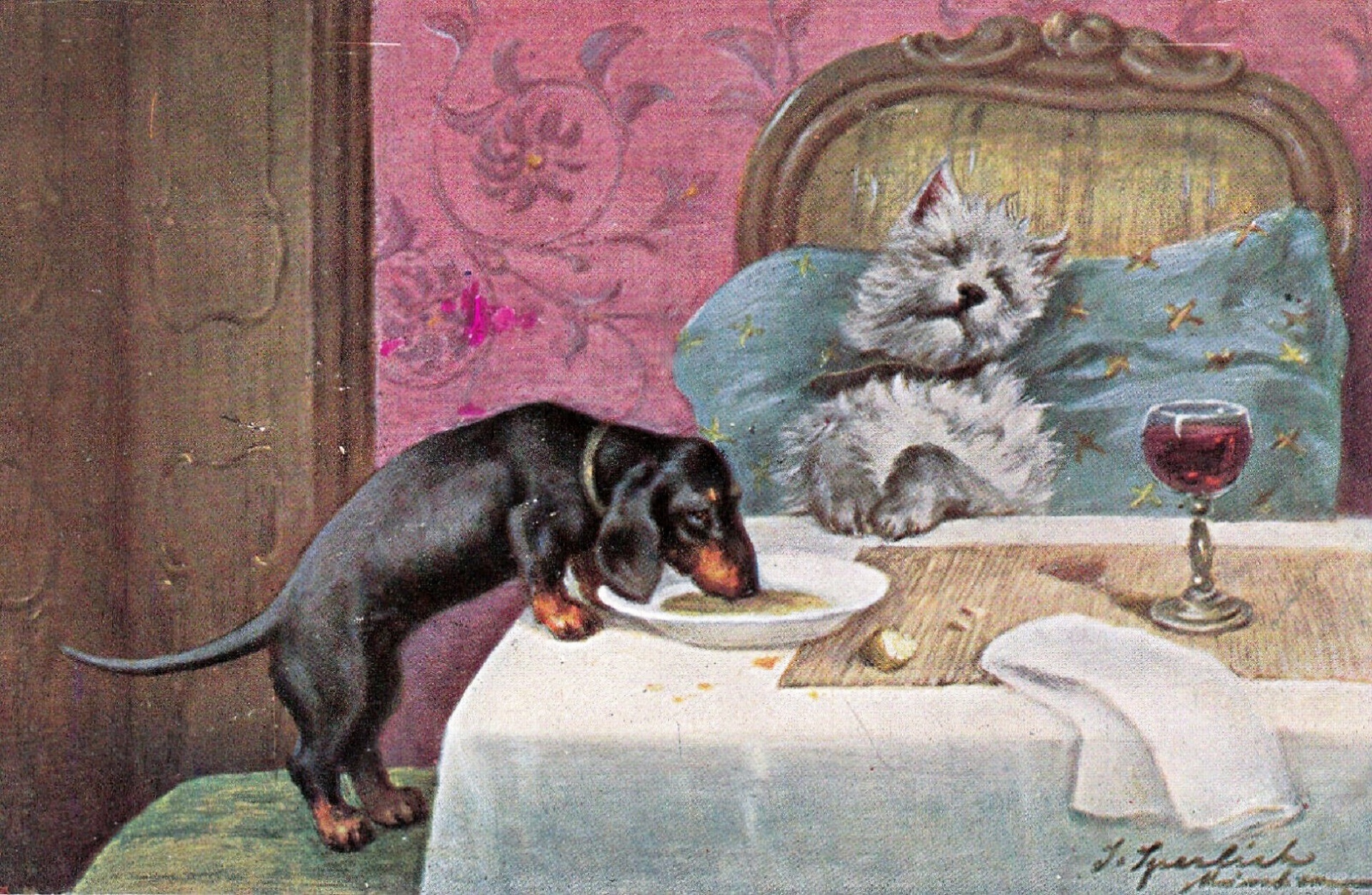
Thinking About Dogs
Our rescue dog, Luka, is a very traumatised soul. He spent eight years living in a shelter, with no home comforts, in the harsh Bosnian climate. He is a constantly anxious boy. Over the course of three years, we have managed to calm him down, to make him into a happy dog, who has a home and is bonded with my wife, Helen (and, to some much lesser extent, me). People have remarked on what a different dog he is, now. He is sociable. He is bouncy and happy. He goes to training classes and does well there, as well as having a whale of a time.
But he still gets extremely frightened in certain situations. One of these, for example, is when there are fireworks. These send him cowering and hiding in fear. He hates them. The other example, and the one around which this post will centre, is when the doorbell goes. This can actually be a knock at the door, the doorbell ringing, or somebody just walking up to the house from outside. Our other dog, Robyn, makes this worse by encouraging Luka. But when this happens, he goes into a total, overexcited, barking frenzy that is a combination of fear, anxiety, and excitement all rolled into one. Normally, when this happens, I can calm him down by throwing some treats so he can play the “find-it” game, or getting him to sit and thereby redirecting his attention into a positive training model.
-
-
Technology and Free Software
-
Things I have made (KC IDMS in place, Lower Decks conference, and quote in ResearchProfessional)
First, the Knowledge Commons identity management system was changed yesterday. This has been the result of an extremely lengthy period of work. Months and months of programming have gone into this to make it right. The changeover itself took seven hours yesterday and was physically and mentally exhausting for me, as I was doing it immediately after my skin graft surgery and because I have chronic norovirus and am receiving IV feeding in hospital for this. This is all quite a gruelling regime! However, it seems to have worked out. People are reporting success, we can see people logging in, and, overall, the bugs that we now have to fix are not major. Hurrah!
-
Claude Code can consume, transmit, and compromise your .env files even if you tell it not to
My colleague Ian discovered the other day that, alarmingly, even if you tell Claude code not ever to read your.env files, it may still do so and send the result back to its servers, thereby compromising your local development secrets. Ian is using Claude via cursor, but his AGENTS.md file specifically instructed Claude not to read this file. It did so anyway.
The “12 Factor App” paradigm tells us that we must store configuration in the environment. But when developing locally, this means that we need some way of bootstrapping the environment… and .env files are the most common way to do this. Whack your config in a .env file, then, just before the app loads, load the file into the container environment.
-
reverse
I'm generally against the use of AI, from the energy hungry resource, to alienating people, creating more content that we could ever need to numb our society even further.
In the recent days, I've seen an interesting reversal of power. AI in the hands of programmer reverse engineering the world.
-
Solar MiniServer Part 4 - Software & Operations
Hardware and assembly are done. Now the software goes on top. Because a solar powered server can lose power at any moment without warning, much of this is about fault tolerance: a read only base system, a separate data partition, and at the end a lean Gemini server called Agate. The final piece is a simple battery monitor with a script that pulls the ripcord in time, before the power runs out completely.
-
How to get a blocked USB stack and dead microphone working again on Linux
I have been having an intermittent problem where my microphone just drops out arbitrarily on Linux and I can’t access it anymore. It turns out that this was actually due to a dodgy USB hub inside the motherboard of my computer.
-
How to use YubiKey for authentication and sudo on Ubuntu 24.04
I have had two YubiKeys for years. They are very cool devices. I used to store my keys themselves on the YubiKey, and perhaps I’ll go back to doing that. But 1Password has me covered for now. What I did realise while moving to a new PC is that there is no concise guide to how to set up YubiKey on a recent Ubuntu Linux setup. I am on Ubuntu 24.04, using the Gnome desktop environment (this might be significant) and here’s what I did. This gives me passwordless sudo with a touch of the YubiKey and the ability to use the YubiKey in polkit popups (when permission is requested). If you remove the YubiKey key while that prompt is visible, it will fall back to asking for a password.
-
My self-hosted infrastructure with Incus OS
For the last seven months, I spent a good part of my (small amount of) free time rebuilding my self-hosting infrastructure at home. I wanted something secure, fully automated, that updates itself and that I can rebuild from scratch if something goes wrong. Most of the ideas come from my work on infrastructures following SecNumCloud (a French security standard for cloud providers) and, to a lesser extent, ISO 27001, I wanted to see how far I could apply the same principles at home.
In this blog post, I will explain how my personal infrastructure works, how all the pieces fit together, and why I think each security layer is useful. This is not a step by step guide, I will not go deep into code, the goal is to show the architecture and the reasons behind it.
-
Researchers Turn Paper, Bio-Oil Byproducts Into Strong, Stiff Carbon Fiber
Researchers at Iowa State University have come up with a way to turn low-value byproducts from the production of paper and bio-oil into valuable carbon fiber — avoiding the usual use of pricey petroleum-based precursors and their environmental impact.
"We’re taking lignin, considered a low-value byproduct of the paper and pulp industry, and aqueous bio-oil, also considered to be a low-value product," explains Xianglan Bai, professor of mechanical engineering and associate director of Iowa State's Bioeconomy Institute, "and putting them together to come up with a high-value product. This is where chemistry and materials science beautifully meet."
-
Internet/Gemini
-
Too much publishing...
It turns out that there is a very long genealogy of saying that there is too much work/scholarship, or too many books, published. I was having an email conversation with Jan Erik Frantsvåg, who is an absolute legend in the scholarly communications world, because of his work on the Tromsø Munin Conferences every year, and he asked about this question. On this subject, I really recommend reading Blair, Ann, Too Much to Know: Managing Scholarly Information before the Modern Age (Yale University Press, 2010), which traces the story well (and from which all of this post is derived; I am not professing any novelty, here).
-
The Necessary Pain Involved in Blogging (if you want your work to be preserved beyond your lifespan)
I am thinking a lot these days about my own mortality. That’s not because I am obsessed with death or anything of the sort. It’s more that my health problems are accumulating and I do not know how long my body is going to hold out against them. It might be that I can clear all my current infections. But it turns out that norovirus, which I have had for four months, can be life threatening in the case of immunocompromised patients. Hence I keep thinking: what if it happens? What will the world look like after I am gone? The answer is probably not very different, but with some localized effects on those who care for me. But what about all that I have written, not just in formal academic publications, but on this blog, where I believe that there is matter worth persisting?
Blogging in this context, though, has become a painful and laborious exercise for every post. First, I must write good metadata, including generating a DOI using Martin Fenner’s commonmeta tool. For aesthetic purposes, I must also find a freely licensed image that somehow ties in with the post. This image must then be scaled to the correct size for open graph sharing on social media. I then write the post itself in markdown, which is the most enjoyable part of the whole process. I never use AI to write my blog posts. The act of writing and thinking in public is important to me and is not something that I wish to delegate to a machine or in any way to demean by removing this human connection. That said, I do sometimes dictate the posts because my hands are not in great shape. And this uses machine learning technologies to transcribe my voice. When ready I publish the post. I still get great satisfaction from the instantaneous nature of this publishing form. I just press go and it’s out there. Nobody can tell me not to publish it.
-
-
-
* Gemini (Primer) links can be opened using Gemini software. It's like the World Wide Web but a lot lighter.
Image source: Dachshund eating sleeping dogs food