John Alty on UPC (former head of Office/delegation, now "Director General for trade policy, Department for International Trade, UK," according to his Twitter profile)
Summary: We examine the latest strands of lies from Team UPC, notably the claims that "clarification" is needed regarding the British government's position and that the UPC can go on without the UK
THE European Patent Office (EPO) still hasn't issued a statement about the UK's position on UPC. It has been almost a month! António Campinos spoke about this to IAM and in some Managing IP event, but his words aren't the official statement; they're rambles full of lies and inaccuracies, as we noted early in the month. His master won't be happy; no UPC job would likely mean retirement (still, better than prison).
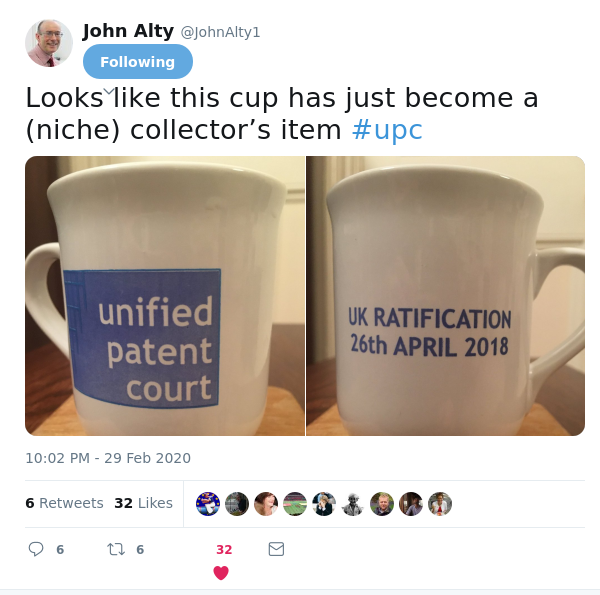
This long article is an outline of the past week's observations and developments, which are perhaps best summarised by Alty's tweet at the top. He's not some random person; remember the role he played in the UK's patent policy. He was at times receptive to the EPO's critics, as was his deputy. They're both gone on. They moved on.
Benjamin Henrion
reminded himself that "the EPO does not respect the 'rule of law' principle, it cannot be sued for maladministration. 4 constitutional complaints in Germany are pending on this, where examiners prefered [sic] to watch the World Cup of Football in South Africa instead of doing their job..."
The key point here is that there are constitutional complaints in the FCC that do not involve the UPC but are indirectly connected to the complaint against it. The judges (or Justices) can easily see the lack of justice at the EPO and there's plenty of evidence that judges lack independence (they state so openly). We've long argued that the EPO should not have diplomatic immunity anymore. It breeds a lot of corruption and crime. Time to end the impunity by taking away immunity. It's
well overdue.
Henrion separately
took note of the "RUMOUR [that] UK is discussing to leave the EPO as well. EPO is undemocratic, out of control, and corrupt by NPOs. So 'taking back control' makes sense. Apparently under US trade pressure, which has criticized the UK staying in the UPC as well..."
I have been hearing similar things, from
several directions, but there has been no concrete evidence; so the rumour does not have strong feet, other than some
circumstantial stuff and rambles from IAM.
Over the past week we've taken stock of various anonymous comments; just about all of them are pessimistic about the UPC, unlike blog posts and articles composed (almost always) by Team UPC. There's a battle between fiction and reality (or common sense).
Henrion
found this page which says: "Opening the UPCA to accession by 3rd countries would render the Agreement incompatible with the Treaties. Threat to EU law autonomy and EU control over the conditions of innovation and its legal protection within the Internal Market."
The UPC/A is illegal and unconstitutional. There's a good and very legitimate reason why the FCC sat on the complaint for nearly 3 years, knowing it would die on its own in due course (typical German approach to save face, letting time run out).
Let's examine some of the wishful thinking, which can be split into two categories; one says that UPC will carry on without the UK (impossibility) and another strand focuses on Germany and the FCC. We're still finding
far too many lies about UPC in the corporate media. The law firms literally lie without shame.
As recently as this weekend we saw
here in Mondaq a piece which insinuates
all that's at stake is British participation. We deplore this piece because surely Richard Kempner, George Tebbutt and David Brown (Haseltine Lake Kempner LLP) are aware that if UPC is "not for the UK" (as they put it), then it is not for anybody because UK is mandatory; it's right there in the UPCA's text!
Here's what they wrote:
The UK government has just now made it clear that the UK will not be taking part in the Unified Patent Court (UPC) or Unitary Patent (UP) system. This is a volte face on its previously publicised position, but comes as no great surprise. The UK ratified the UPC Agreement in April 2018 under Theresa May's government, a commitment that would mean the UK would continue to be subject to some EU law and the jurisdiction of the Court of Justice of the European Union (CJEU), if participation were to continue post-Brexit. However, the current Government confirmed last week that the UK will not be taking part in the UPC or UP in any form, perhaps reflecting its desire to avoid ceding power in any sphere, no matter how limited, to the CJEU.
What does this mean for the future of the UP/UPC?
Plans to implement the combined package of the UP and the UPC systems have been stalled for some time. A constitutional challenge to the UPC Agreement in Germany has held up its implementation, because the UPC Agreement must be passed by the three biggest countries in patent number (Germany, France and the UK), before the UPC can be introduced. The UP will also not be introduced until the UPC is up and running.
No UK, no UPC. Period. Over.
AJ Park's Sam Pearson and Christine Egan (it's a firm of overzealous patent maximalists who push software patents in New Zealand and Australia) also give the illusion UPC can happen without the UK (that's obviously wrong), in effect repeating the chorus of the cult we collectively call "Team UPC". They have
promoted in Lexology their
piece which says:
The UK government has confirmed that, post-Brexit, the UK will not be part of the Unified Patent Court (UPC) or Unitary Patent (UP) system.
BACKGROUND
Currently, after the grant of a European patent, it becomes what is essentially a ‘bundle of national patents’. Obtaining these national patents is subject to varying translation requirements to validate the European patent in each of the European states of interest, and maintaining the separate patents requires paying separate renewal fees in each country. Patent infringement and revocation proceedings are also conducted at the national level, which sometimes leads to multiple lawsuits regarding the same European patent in different countries, and which sometimes leads to different results.
The proposed UP sought to replace the current system with a single patent right, removing the need for separate post-grant validation. It promised significant savings in translation costs and renewal fees, especially for patent holders who choose to validate in more than a handful of countries. The UP was to be governed by a uniform patent court litigation system, the UPC, which would issue a single court ruling that would then be applicable in all of the EU countries. The idea of the UPC was to harmonise EU law and avoid a patentee having to litigate the same European patent in multiple EU territories.
It's not going to happen anymore. There's even further fragmentation right now due to the pandemic, but that's another story.
Found in Mondaq a few days ago was
another piece parroting a similar set of talking points. One cannot participate in something that does not exist and will never exist. But law firms are still chasing the shadow of the dead, publishing articles with headlines like
"UK Will No Longer Seek To Participate In Unitary Patent And UPC" (a more accurate headline would imply that therefore UPC is dead in the water). To quote:
The UK Government has confirmed the UK will no longer seek to be part of the proposed unitary patent (UP) or Unified Patent Court (UPC) systems. Given the UPC's alignment with the CJEU, this is not entirely surprising for the UK in a post-Brexit world.
Although it will be unwelcome news for many, the certainty of this new stance may mean the UP and UPC can again pick up momentum, subject to the ongoing legal challenge in Germany and re-working of the agreements without the UK's participation.
Should the UP and UPC agreements be ratified as per the current proposals, UK business will still be able to use the Unified Patent Court and unitary patent to protect their inventions within the contracting EU countries. However, in the UK, businesses will only have the option of protecting their inventions using national patents (including patents available from the non-EU European Patent Office) and UK courts.
UK business will still be open to litigation within the Unified Patent Court based on actions they undertake within the contracting EU countries if they infringe existing rights.
Will? It does not even exist and never will exist.
Watch
this shallow puff piece from WIPR, nowadays an EPO mouthpiece. It was promoted with
this tweet that said: "A UK parliamentary committee has asked the government to clarify its position on the Unified Patent Court (UPC), after reports that the UK will no longer seek to participate in the project."
They pretend it is about "clarification", but we'll get to that lie in a moment. This same lie was promoted by "Kluwer Patent blogger"
right here (Team UPC, obviously), only to be met with hostile comments like the first one that stated: "I can also understand that the UK legal profession might not want to lose the opportunity for UK legal traditions to influence the development of case law of a potential UPC."
Here's the full comment:
I must confess to being a little perplexed by some of the oral evidence given to the EU Justice Sub-Committee on 10 March.
I can understand that the UK legal profession does not want to lose the influence (and, let’s be honest, the income) that it might gain by the UK’s participation in the UPC. I can also understand that the UK legal profession might not want to lose the opportunity for UK legal traditions to influence the development of case law of a potential UPC. What I struggle to understand, however, are all of the other arguments advanced for the UK’s continued participation in the UPC.
The suggestion from Mr Alexander that SMEs will somehow lose out is, frankly, not supported by the evidence. To the contrary, the fees and rules of procedure of the UPC appear to be specifically designed NOT to be “SME-friendly”.
However, more troubling than this is Mr Alexander’s suggestion that the UK’s participation in the UPC would only require the UK to sign up to a tiny amount of EU law. Unless I have missed something, this is pure conjecture that really should not have been presented as if it were an accepted fact.
Even the superficial (masquerading as “in-depth”) analysis commissioned by the EU parliament’s JURI committee spotted that there is no tried-and-tested legal mechanism that can be invoked to facilitate the UK’s continued participation in the UPC:
“Maintaining the UK within the UPCA would need innovative legal solutions, as the UPC is an international court applying EU law – and the reason for Brexit was all about not applying EU law any more.”
In other words, nobody knows what it will take to persuade the CJEU to accept the participation of a non-EU Member State in a court that applies EU law. Indeed, based upon Opinion 1/09, it appears that the CJEU would most likely view such participation as being a total non-starter.
I must also beg to differ with the suggestion that the CJEU would likely only have a relatively limited role in resolving disputes before the UPC.
Firstly, the CJEU might need to answer fundamental questions relating to the UPC itself… such as whether the UPC Agreement is compatible with EU law, or whether the set-up of the court means that it is NOT a court common to EU Member States (and so is not able to make preliminary references to the CJEU).
Secondly, the CJEU would be responsible for interpreting provisions such as Article 5(3) of Regulation 1257/2012. That is, they would need to make sense of a provision that, as confirmed by the CJEU in C-146/13, applies NATIONAL law(s) of infringement to cases involving unitary patents. This will not be straightforward, not least because of difficulties in determining how to resolve apparent conflicts between different (national and/or international) laws in the country whose laws are to be applied.
Finally, even if and when those fundamental questions are resolved, the CJEU might then need to consider other tricky questions, such as whether the UPC would be competent to handle SPC disputes in respect of the UK … bearing in mind that, from 2021 onwards, laws governing SPCs and marketing authorizations in the UK will diverge from corresponding EU laws.
I do not exclude the possibility that all of the legal issues outlined above can be resolved in a manner that permits the UK’s (post-2020) participation in the UPC. It is just that I cannot identify, nor have I ever seen or heard, any persuasive legal arguments that would make me confident of such an outcome.
Against this background, the decision of the UK government not to seek to participate in the UPC appears to me to be perfectly consistent with the UK’s red lines with respect to EU law and the CJEU. I therefore suspect that no amount of lobbying from the legal profession will change that decision. Indeed, it is possible that continuing lobbying efforts on the UPC now could backfire in the long term. Thus, much as the UK legal profession seems to be in the early stages of grief with respect to the UPC (mostly denial, but also anger, bargaining and depression), I think that it is perhaps time to start moving towards acceptance.
Pretty much all the comments are like that. People know they're being lied to and they strike back with facts. This is very encouraging to see. Eventually Team UPC might just shut up, fearing the public embarrassment they constantly face. The use or misuse of generic pseudonyms (like "Kluwer Patent blogger") is due to their fear of backlash. They know that they lie, but they don't want to be held personally accountable for these lies.
To her credit, Dr. Hughes from AstraZeneca's "legal" (as in lawsuits) team isn't shy to put her name on her piece. She also has a Twitter account where she
writes tweets like: "Lords subcommittee hear from @JuliaFlorence8 and Daniel Alexander QC of 8 New Square on the UK's withdrawal from UPC @LordsEUCom" (linking to her
article).
"This ‘hearing’ was a total and complete farce," I told her, and it "says a lot about our political system. Please see explanation in"
this article we published the same day as the farcical hearing. Dr. Hughes never responded and they have again deleted a comment that I posted in their blog,
which is typical. Rose Hughes has a background in law, but maybe free speech would take another degree. These people don't tolerate dissent,
unlike the former and original "Kats" (they have
all left).
Henrion
wrote: "Boris will have to cross his no-CJEU redline if he ploys to the wishes of the patent litigation trolling industry. The House of Lords have only invited the litigation industry up to now, how come the other industries were not invited?"
Henrion also
quoted: "EU Justice Sub-Committee Lord Morris of Aberavon writes to Minister after the UK’s withdrawal from the Unified Patent Court system was reported in the media #upc #uk https://committees.parliament.uk/download/file/?url=%2Fpublications%2F276%2Fdocuments%2F1156&slug=lmtoasunifiedpatentcourtagreement100320pdf [
...] UPC in UK: House of Lords wants Boris confirmation that the UK will leave..."
The comments are, as usual, better than the posts (Team UPC). Rose Hughes
added: "UPDATE: The EU Justice Sub-Committee has written to the IP minister asking for clarification of the Government's position on the UPC https://committees.parliament.uk/committee/339/eu-justice-subcommittee/news/145496/clarity-sought-on-governments-patent-court-position/" (no, it's not about "clarification").
As
noted here and in the comments:
Patent-eligibility of software is not covered by any EU law so fortunately it would not be possible to have any CJEU judgments or referrals on that.
Daniel Alexander was referring specifically to the Biotech directive 98/44/EC not to patent eligibility generally. That directive may be complex but it is definitely niche. I would think that by IPC code, it could only theoretically be applied to a very tiny percentage of patents. It has been in force for 22 years (during which there will have been many thousands of patent cases) with barely any CJEU referrals -the Brustle case (stem cells), clarification of Brustle and Monsanto (non extracted DNA).
Henrion selctively
quoted some more comments, e.g. "all non-British IP lawyers and patent attorneys will take care that access to the UPC will be barred for UK citizens one way or the other." http://ipkitten.blogspot.com/2020/03/house-of-lords-eu-subcommittee-is-uk.html … #upc #uk [
...] "That the CJEU will limit itself to only deal with questions not linked to substantive patent law is a hope of many UPC proponents, but nothing is less sure. If the CJEU thinks fit to decide differently than the EPO, it will do." http://ipkitten.blogspot.com/2020/03/house-of-lords-eu-subcommittee-is-uk.html?showComment=1583942528364#c1068020909440043935 … [
...] EU-wide iPhone ban via the UPC: "There were also concerns that innovation in the software sector may be stifled by EU wide injunctions." http://ipkitten.blogspot.com/2020/03/house-of-lords-eu-subcommittee-is-uk.html …"
It seems to have become widely accepted that UPC is neither desirable nor likely to ever materialise.
What do the most fervent Team UPC people say? Well, Rich Pinckney, who
chose to quote another liar over a week ago,
wrote this: (also
tweeted)
The UK parliament’s House of Lords EU Justice Sub-Committee has reported today here that its Chair, Lord Morris of Aberavon, has written to the IP Minister, Amanda Solloway, asking whether she can confirm recent media reports that the “UK will not be seeking involvement” in the Unified Patent Court (UPC) and unitary patent. The letter was written yesterday, following the Sub-Committee’s meeting in the morning – see House of Lords committee examines effect of UK not participating in UPC. The Sub-Committee notes that the government has not yet made an official statement on its position.
They keep using false narratives like "clarity", "clarify", and "clarification" (as if there's something they don't understand rather than choose not to accept). This same lie can be seen
here (from
Managing IP). Max says: "EU Justice Sub-Committee writes to @ASollowayUK seeking clarity on UK's position on the #UPC. Committee says government "has yet to make an official public statement on the matter." https://committees.parliament.uk/committee/339/eu-justice-subcommittee/news/145496/clarity-sought-on-governments-patent-court-position/ …"
Terms such as "seeking clarity" are also misused by the anti-Section 101 lobby, or pro-software patents lobby of Coons, Kappos and others. They don't want "clarity"; they combat the law and the general public for litigation (a money hoard).
It has meanwhile emerged, as per
this image/tweet of Kirsten Fiedler, Policy Advisor to an MEP (image with the word "algorithms"), that the "The EU seems to be thinking about intellectual property protections for #algorithms - an action plan has been announced in the industrial strategy: https://ec.europa.eu/info/sites/info/files/communication-eu-industrial-strategy-march-2020_en.pdf"
The replies include
strongly-worded tweets like: "Corrupt money-driven EPO is already patenting algos, recycling their funky 'technical effect' https://www.epo.org/law-practice/legal-texts/html/caselaw/2016/e/clr_i_d_9_1_8.htm … [
...] Germany will continue to be a patent troll paradise due to its bifurcated system, as the UPC might allow as well http://www.fosspatents.com/2020/03/german-patent-litigators-comment-on.html … #upc #germany #trolls"
The original Web pages are more gently worded. The EPO has been run by people who flagrantly break laws for about a decade. If the EU facilitates this rather than stop this (of if it does not intervene), it too will go the way of the dodo. The UPC is an EU system and the EU cannot just throw its hands in the air, saying it has nothing to do with the EPO's dirty affairs. Remember that many of today's EPO managers came from an EU agency, the EUIPO. It's actually a scandal in its own right; the recruitment process is profoundly corrupt and SUEPO has begun speaking about it. This is very much an EU issue and there are UPC 'journal' papers about it [1].
⬆
Related/contextual items from the news:
-
Tensions between the EU’s legal order and the international investment law regime are not exclusive to the Brexit era, but they certainly gained momentum in the aftermath of this referendum. By incautiously declaring that the UK will remain a party to the Unified Patent System regardless of Brexit, the British government arguably shaped (il)legitimate expectations on the part of investors who aimed at exploiting their intellectual property rights in the UK while benefitting from the judicial protection of the forthcoming Unified Patent Court as much as of the European institutions (and market) as a whole. Indeed, not only the System itself will undergo a process of major rebalancing after London’s departure from the EU, but more importantly, the UK will most probably be unable to retain its membership in the System after the actual delivery of Brexit. These complications trigger a wide spectrum of fundamental dilemmas investing the definition and scope of concepts such as unilateral declaration, indirect expropriation, reasonable expectation, estoppel, and public policy exception, under both EU law and international investment law. It is therefore essential to explore these intersections as to anticipate possible scenarios in the event of both domestic court and international arbitral claims lodged by patent investors pre- and post-Brexit, having due regard for competition concerns on the side of the EU, yet referring to recent Canadian case law which opened the gate to investor-State claims in the field of intellectual property.
