
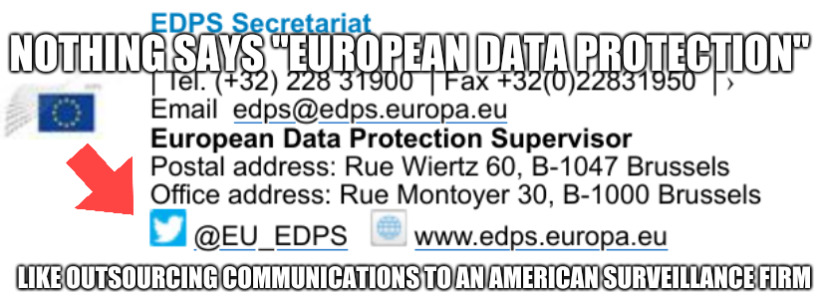
The European Data Protection Supervisor (EDPS) isn't actually doing anything; in a sense, it's very much complicit (by inaction and outright refusal to enforce the law against the EPO, even when presented with clear evidence of violations)
WE previously wrote about the European Data Protection Supervisor (EDPS) ignoring EPO privacy abuses. The Central Staff Committee (CSC) of the EPO has just brought up the subject, about a week after a meeting with António Campinos and his "Mafia" (people who flagrantly break the law while looting the institution). The CSC is circulating a 5-page "Report on the GCC meeting of 2 June 2021,", which it says showed "[s]ome light but strong shadow (data protection, pensions)..."
"Actions and policy-making will always be done unilaterally by the "Mafia" while merely pretending there was "consultation"...""The new framework deviates in many points from the Data Protection Regulation EU-2018/1725," the CSC notes regarding the Data Protection Framework of the EPO under the Strategic Plan 2023. "While we recognise that data protection has improved somewhat," the representatives of the staff say, "it is still a long way to go to achieve the level of protection afforded to employees (and pensioners) in the EU institutions." The EPO has, in effect, outsourced itself to Microsoft and the NSA.
The CSC continues: "The main problems are, in particular, that the framework expressly calls into question the fundamental rights of natural persons in certain cases, that the President of the Office is both the controller and the appointing authority for the members of the supposedly independent Data Protection Board (DPB) and that the DPB cannot make binding opinions. The framework also makes the rules for the internal means of redress de facto stricter than the rules for the Appeals Committee in Title VIII of the Service Regulations (Settlement of disputes). For these reasons, we abstained on the document. For more details, please see our full opinion, annexed to the report."
Then there's the part about attack on pensions and pensioners: "Under “Any other Business”, we addressed on-site vaccination in the EPO as well as the announced review of the New Pension Scheme / Salary Savings Plan (NPS/SSP). The pension schemes are supposed to provide long-term security for staff and the Office alike. The fact that the Office intends to revise them just in highly turbulent times is disquieting. We will keep you informed as soon as more details emerge."
In any case, here's the full report (below), reproduced as simplified HTML for the European public to see:
Zentraler Personalausschuss Central Staff Committee Le Comité Central du Personnel
Munich, 10.06.2021 sc21077cp
GCC meeting on 2 June 2021 – Some light but strong shadow1
The meeting lasted one hour and there was only one document on the official agenda: the so-called modernisation of the Data Protection Framework of the EPO under the Strategic Plan 2023.
Modernisation of the Data Protection Framework of the EPO - for consultation
The Data Protection Officer introduced the document with the usual EPO buzzwords and jargon. We put a few questions. When asked why data protection at the EPO should be weaker than in the EU institutions, she answered that this was due to the very specific institutional set-up of the EPO.
In our view, this does not explain the many deviations from the Data Protection Regulation EU-2018/1725. While we recognise that data protection has improved somewhat, it is still a long way to go to achieve the level of protection afforded to employees (and pensioners) in the EU institutions. For this reason, we abstained on the document. For more details, please see our full opinion, annexed.
Any other Business
We decided to limit the discussion on the document for consultation to be able to accommodate two further important topics in the one-hour meeting, which we could not deal with in our previous meeting with the President on 19 May2.
On-site vaccination in the EPO Director HR Customer Engagement [sic] told us that they were busy preparing to start on-site vaccination in Germany (Munich and Berlin) after the third week of June3, following the offer by the German authorities but depending heavily on the availability of vaccines. For The Hague, staff will have to wait for similar initiatives from their local authorities.
Review of the New Pension Scheme/ Salary Savings Plan (NPS/ SSP) The Administration downplayed the importance of this review but nevertheless identified legal certainty of the scheme (e.g. taxation of the lump sum) as an issue to be tackled. Adjustments based on actuarial considerations are also to be expected. Some “convergence” with the “old” pension scheme was also mentioned. We will define principles to improve the scheme and we invite you to send us any idea you think is important.
_____ 1 Freely adapted from Johann Wolfgang von Goethe: “Wo viel Licht ist, ist starker Schatten.” 2 See our report on our meeting with the President on 19 May 2021 3 See also the announcement of 1 June: “Coronavirus measures: caution urged”
Conclusion: Some light but strong shadow
We welcome the intention to start on-site vaccination wherever possible. However, the pension schemes are supposed to provide long-term security for staff and the Office alike. The fact that the Office intends to revise them just in highly turbulent times is disquieting. We will keep you informed as soon as more details emerge.
The Central Staff Committee
Annex: opinion of the CSC members of the GCC on GCC/DOC 5/2021 (Data Protection Framework)
Opinion of the CSC members of the GCC on GCC/DOC 5/2021 (CA/26/21 and CA/26/21 Add.1): Modernisation of the Data Protection Framework of the European Patent Office under the Strategic Plan 2023
The CSC members of the GCC give the following opinion on document GCC/DOC 5/2021. The EPO intends to modernise the Data Protection Framework as part of its Strategic Plan 2023. It states that it will pursue an approach that creates long-term value, not only in terms of financial sustainability, but also in terms of environmental and social sustainability.
The CSC members of the GCC recognise that the standard of the proposed framework arguably positions the EPO slightly higher than some other International Organisations in terms of data protection... but far lower than the Data Protection Rules implemented at the EU institutions, bodies & agencies and in the EU members states. This certainly does not put our rules “on par with the data protection standards of other international organisations, and in particular the EU data protection regime applicable to EU institutions and in most EPC contracting states”.
The consultation process A concrete draft proposal of the intended modernisation was presented to the Staff Representation for the first time on 7 May 2021, with an invitation to comment. Document GCC/DOC 5/2021 was made available to GCC members on 17 May. The consultation was therefore insufficient on such a long and complex document.
Comparison with the EU-GDPR We welcome the commitment to data minimisation, which is the best way of protecting personal data, and the intention to harmonise the framework with the practices and standards of International Organisations and Institutions. However, the President deliberately chooses to go for a modernisation that deviates from the EU-GDPR.
The main differences between the EPO framework and the Data Protection Regulation EU-2018/1725 are the following:
● The GDPR emphasises the protection of the fundamental rights and freedoms of natural persons, and in particular their right to privacy with respect to the processing of personal data. At the EPO, the “compelling legitimate interest” of the EPO may override the interests or the fundamental rights and freedoms of the natural persons1. This provision in the Service Regulations calls into question the declaration that the Office would adhere to general legal principles, including human rights2. The Implementing Rules (IR) contain other similar mentions. ● In the GDPR, the European Data Protection Supervisor (EDPS) is appointed by the European Parliament and the Council. The same decide on renewal of their term. At the EPO, the corresponding Data Protection Board (DPB; a chair and two members) is appointed by the President of the Office3. The Data Protection Officer is also appointed by the President of the Office. As a result, all the persons and bodies capable of providing
_____ 1 Article 1b(5) ServRegs 2 CA/PV 55, CA/104/94, point 66, and Communiqué No. 257 3 Article 48 (IR)
some checks and balances are appointed by the same person, the controller / President of the Office. In addition, the DPO and the DPB are de facto not independent since the President of the Office decides on the renewal of their term of office. ● In the GDPR, the EDPS has a wide range of powers to ensure and monitor the consistent enforcement of data protection rules, including investigative and corrective powers and including imposition of administrative fines on EU institutions and bodies. At the EPO, the corresponding DPB has only oversight and advisory functions, i.e. it merely gives opinions and advices with no binding effect4. ● As regards legal challenges, the EDPS makes binding decisions. At the EPO, the DPB merely gives opinions, where a data subject makes use of the means of redress available5. Again, this opinion is not binding and the President of the Office may deviate from it, provided he/she gives reasons in writing6. For the reform of the internal appeal procedure in June 2017, the Administrative Council opted for a formulation intended to make it as difficult as possible for the President to deviate7. The new framework should be as close as possible to making DPB opinions binding on the President. ● At the EPO, the time limit for requesting a review of the processing of personal data by the controller is three months from the day on which the data subject was informed or otherwise became aware of the processing of personal data allegedly infringing his or her rights8. This time limit is far too short, especially since the decision might be a “covert” one and the relevant day could be open to debate. This will likely make many requests for review and complaints irreceivable. A two-year period like in EU institutions would be a reasonable compromise as regards legal certainty. ● In the GDPR, the EDPS and the Court of Justice are available to any natural person. At the EPO, natural persons not being EPO staff or EPO former staff (e.g. patent applicants, patent attorneys, visitors, members of the delegations in the Administrative Council) must have recourse to ad hoc arbitration in an official language chosen by an arbitration tribunal in The Hague, excluding any other national or international jurisdiction*. This may be better than the current situation, but it is a very unusual provision. It is therefore far from satisfactory.
The Rules of Procedure (CA/26/21 Add. 1) For reasons of autonomy and independence, the Rules of Procedure of the DPB should be adopted by the DPB itself, not by the President of the Office. In addition, contrary to the procedure before the internal Appeals Committee, the new framework excludes hearings before the DPB when it examines complaints10. This limits further the prospect of a fair “trial”.
_____ 4 Article 47 IR 5 Article 47(3)b IR 6 Article 50(4) IR 7 Article 110(4) ServRegs 8 Article 49(1) IR 9 Articles 50(8), 52(1) and 52(7) IR 10 Article 9(2) Rules of Procedure of the DPB
Open questions Some aspects were not dealt with and the relevant information is missing for a complete consultation:
● The document impinges on the functioning of the Boards of Appeal Unit. The advice of the Presidium in accordance with Rule 12b(3)(d) EPC is still outstanding, so that the influence on the (perceived) independence of the Boards is not yet known. ● The policy of informing / seeking consent for natural persons not covered by Article 1 ServRegs needs to be determined and clearly communicated to them. Otherwise the Office would mislead them if they would think that they fall under the EU-GDPR. This could affect the Office’s reputation.
The six-month transition period (July-December 2021) should be used to clarify the latter open question as well as further open questions. The Staff Representation is ready to contribute.
Conclusion The Office deliberately chooses not to follow the EU-GDPR, which can be considered the “gold standard”. Even taking into account the institutional set-up of the Organisation11, the new framework could have been closer to the EU-GDPR. The main problems are, in particular, that the framework expressly calls into question the fundamental rights of natural persons in certain cases, that the President of the Office is both the controller and the appointing authority for the members of the DPB and that the DPB cannot make binding opinions. The framework also makes the rules for the internal means of redress de facto stricter than the rules for the Appeals Committee in Title VIII of the Service Regulations (Settlement of disputes).
The new framework will require re-evaluation in a few years, hopefully with a view to coming closer to the EU-GDPR.
Based on the foregoing, the CSC members of the GCC abstain on the document.
_____ 11 E.g. Article 10 EPC