
EditorsAbout the SiteComes vs. MicrosoftUsing This Web SiteSite ArchivesCredibility IndexOOXMLOpenDocumentPatentsNovellNews DigestSite NewsRSS

02.25.08

The GPLv3 Not Strict Enough (Should Be Stricter), According to Samba

Posted in DRM, Finance, Free/Libre Software, GNU/Linux, GPL, Kernel, Microsoft, Samba at 4:20 am by Dr. Roy Schestowitz

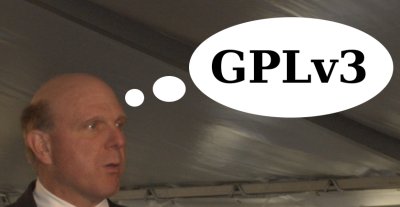
Steve Ballmer scared of GPLv3

While Microsoft and its various proxies, including secretly-hired academics and lobbying arms (CompTIA, ACT, etc.), are on an aggressive crusade against GPLv3, the very same arguments which they try to use as a weapon against GPLv3 are actually a desirable trait. But it does not quite stop there. The GPLv3 is being characterised by Microsoft too strict, but then again Microsoft has always hated (read: feared) the GNU GPL, so it’s bound to find any excuse that suits it.

According to the father of Samba, the GPLv3 hasn’t a weakness which is being too strict. Quite the contrary in fact. Andrew “Tridge” Tridgell wants the GPL to become more restrictive and go harder against DRM — a sentiment that surely Linus Torvalds can subscribe to. In fact, a couple of weeks ago in Australia, Torvalds expressed on numerous occasions his disdain of DRM.

From the new article:

“Some people complain a lot about the anti-DRM provisions, and I would have liked to see those actually be even stronger than they are. Because currently they’ve got some limitations in there that limits some of the anti-DRM provisions of GPLv3 to only being applicable to consumer products. Which means it leaves out, for example, some Samba appliances.

“I’d like to see a future version of the GPL perhaps going a little bit stronger than that and applying it to the non-consumer/enterprise appliances as well” said Tridgell.

We received some mail from Palamida, which is probably one of GPLv3′s best friends in the sense that it ushers its increasing adoption and hands over an invaluable advocacy tool. Someone from the company asked us to address a particular topic:

“Sometime it’d be great to hear your recipe for open source coupled with capitalism, or whether you feel there IS a place for open source in a profit making business (because we’re finding that open source code makes up 50% of code in ALL apps).”

It’s probably important to distinguish between Open Source (in the OSI sense) and Free software (in the GPL sense). To address this question, if in capitalism your capita is physical (i.e. not something intangible like knowledge), then things are simple. They used to be simple.

“Consider Tim Berners-Lee’s motives for creating an open pool of information and ask yourself whether money is ever made on the Web.”Then, as we advanced, the man-made ambition was to (re)define ownership of information, of folklore, rather than to commoditise it. Open Source is a more reciprocal process that revolves around the assumption that information can be exchanged easily and bring benefit to everybody.

Consider Tim Berners-Lee’s motives for creating an open pool of information and ask yourself whether money is ever made on the Web. The problem may emerge when people refuse to give back, to make returns (patches, money, advice). And that’s completely separate from the issues of censorship and net neutrality (tiering and classes).

The transition in transportation means that physical containments of information (such as shrink-wrapped software) are no longer needed. This makes it an unnecessary barrier. It is really a philosophical question that hardly fits this Web site, but it seems to related to the issues that we find with software patents. In the case of Microsoft, not only does it insist on maintaining copyrights of code (which is perfectly acceptable), but it wishes to also own methods (never mind the actual implementation) and protocols, i.e. communication at the end points. That’s what last Thursday’s racketeering announcement was all about.

So, the short answer to that question is that open source is not incompatible with capitalism. That is just a Microsoft smear repeated over and over and over again (repetition does not make validity). Seeking to make profits by hindering communication, however, is a sin. The founding fathers of the United States saw the need to share ideas and something so organic simply must not be owned by an individual. If lobbyists that are paid to further promote greed actually achieve something in Congress, it does not mean they are correct. After all, these are man-made laws.

There is no such thing as an “intellectual property”. Let’s call it what it is: "intellectual monopoly". It’s a fence. Development (so-called innovation) and profit can be sustained and even thrive without intellectual monopolies. No monopoly has ever done any good to progress. Progress is not to be judged only by currencies.

Share this post: These icons link to social bookmarking sites where readers can share and discover new web pages.
  • Digg
  • del.icio.us
  • Reddit
  • co.mments
  • DZone
  • email
  • Google Bookmarks
  • LinkedIn
  • NewsVine
  • Print
  • Technorati
  • TwitThis
  • Facebook

If you liked this post, consider subscribing to the RSS feed or join us now at the IRC channels.

Pages that cross-reference this one

What Else is New


  1. The FRAND Apple-Microsoft Conspiracy Attempts to Destroy Android/Linux, Ban Imports

    How Microsoft and Apple are using patents in bulk (sometimes acquired in unison, e.g. from Novell and Nortel) to artificially lower market saturation of the Android operating system or drive costs up


  2. Gates Foundation: Buying Influence for Bill's Ego and Bill's Profit

    New examples of power being acquired and investments (i.e. for profit) being funnelled into the beneficiaries


  3. Bill Gates Enters Financial Centres With His Goons Becoming US Budget Chief, Top Bankers

    How Bill Gates' staff is entering positions of financial power, indirectly giving Gates power over US (national and international) finance


  4. IBM Ignores Small Companies' Interests, Denies Patent Scope is a Problem, Focusing on Its Own Problems (Trolls) Instead

    How David Kappos and IBM (his longtime employer) continue to ignore the obvious problem which kills small businesses and everyone is complaining about


  5. The New York Times Publishes Factually-Flawed Patent Propaganda Benefiting Microsoft and Apple

    Eamonn Fingleton is rewriting history in the US' top newspaper, insinuating that patents contributed to the rise of software duopolists


  6. Software Patents Eligibility Likely to be Decided by SCOTUS

    Analyses suggest that an escalation by appeal to SCOTUS is likely to be the next stage in 'Bilski 2.0'


  7. Does Bill Gates Try to Flush GNU/Linux Down the Toilet in Kerala?

    Renting Microsoft software rather than using Free (as in freedom, or libre) software?


  8. Links 21/5/2013: Handbrake Turns 0.9.9, NetBSD 6.1

    Links for the day


  9. Links 20/5/2013: First Salifish Smartphone, Mageia 3 Released

    Links for the day


  10. Microsoft Corruption (Illegal Tenders) Stopped by European Court

    Microsoft cannot bypass public tenders, based on a ruling from a court of law in Europe


  11. Not Satire: Microsoft Wants to Show the World How Security is Done

    Software security 'standard' to be led by the company which made insecurity an acceptable engineering practice?


  12. Microsoft is Struggling to Maintain Industry 'Standards'

    With Microsoft's common carrier and browser share down considerably Microsoft finds itself increasingly irrelevant and it tries subversive means of making another comeback


  13. Microsoft Entryism and Bribery Get the Microsoft Way Implemented

    A recollection of very dirty tactics from Microsoft, which uses money to oppress, overthrow, and even hijack its opposition


  14. Patent Policy Laundering in the European Union and New Zealand

    How the so-called 'free' trade agreements help spread patent policy which favours software patents


  15. Ongoing Focus on Patent Litigation and Patent Trolls Reduces Focus on Software Patents

    The problem with increased focus on the players that use software patents litigiously and the litigation itself


  16. Andrew Y. Schroeder Shows That Patent Lawyers Are Sociopaths

    Bully and law misuser is trying to get his way with foul language, intimidation, and sheer lack of professionalism


  17. IBM-backed Book on 'Open Innovation'

    OpenForum Europe (OFE), which helps IBM's turf wars in Europe, releases a new book filled with its talking point


  18. Joseph E. Stiglitz Criticises the Patent System

    More critical words about the patent system and the way it is harming lives


  19. Senator Schumer Should Focus on Software Patents, Leaving Patent Trolls (Side Effect) Aside

    Reform in the USPTO and the US courts should focus on patent scope and not patent holders


  20. Links 20/5/2013: Plenty of Linux News, Google/Android Announcements

    Links for the day


  21. IRC Proceedings: May 12th, 2013-May 18th, 2013

    IRC logs for May 12th, 2013 (and subsequent days until May 18th, 2013)


  22. Microsoft Spin Regarding Skype Spying Does Not Withstand Scrutiny

    Microsoft's response to allegations that Skype is spying on all users is full of holes


  23. MPEG-LA Ruined the Licence of WebM, Made it Less Freedom-Respecting

    The Microsoft-, Nokia-, and Apple-backed patent troll appears to have ruined the freedom assured by Google's multimedia format, which was previously made free only after public pressure


  24. Microsoft-controlled Nokia is Lobbying to Enable Bans on Android Imports (Linux Phones as a Whole in Danger)

    Nokia is shown lobbying for embargoes while it is also suing -- with limited success -- Android handsets makers


  25. Courtroom and New Book Recognise That Software Patents Correspond to Mathematics and Mathematics Abused in Court

    Important observations about the nature of computer-implemented 'inventions', or software patents


  26. The Reality Distortion Field of Patent Lawyers Helps Impede Abolition of Software Patents

    How widespread coverage and talking points from the tiny minority which is patent lawyers have contributed to biased and at times utterly distorted reporting on the subject of software patents around the world


  27. Eugene Kaspersky Says Patents Harm Innovation

    Some more criticism of the patent system and software patents in particular, courtesy of Eugene Kaspersky


  28. UEFI Restricted Boot Good for Microsoft Agenda, Not for Security

    News and analysis of UEFI 'secure boot' (lockdown), including the new role played by the Microsoft-funded SUSE


  29. Anniversaries

    Sites that deal with patents and with FUD as well as their respective ages


  30. EFF, Newegg, and the Canadian Patent System All Take a Stance Against Software Patents

    Hostility towards the practice of patenting software is seen in a nonprofit organisation, a corporation, and a government branch responsible for patenting


RSS 64x64RSS Feed: subscribe to the RSS feed for regular updates

Home iconSite Wiki: You can improve this site by helping the extension of the site's content

Chat iconIRC Channel: Come and chat with us in real time

Recent Posts