
THE previous post (titled "Computer History Development Timeline") was put there for a reason. It precedes yet another case of the MSBBC (occupied by many former Microsoft employees [1, 2, 3, 4, 5, 6]) rewriting history in a most shameful way that made one of our readers very upset. He wrote a detailed analysis of this new programme.
Who pioneered the WEB
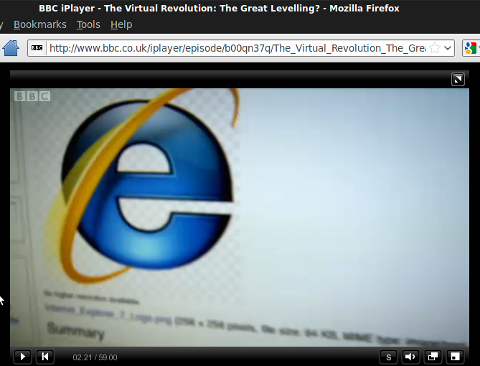
Well, according to the BBC, it was Tim Berners-Lee, (0:39) "the man who Invented the web" and Bill Gates. While the former did actually do something amazingly inventive, Bill Gates contribution is less clear. At (2:12) a giant Internet Explorer logo pops up, totally filling the screen. I would have thought a mention of Mozilla and NCSA would have been a more appropriate place to start.
(2:44) "In this series, I'll be meeting all the pioneers, and key players. Everybody from Google to Facebook, Twitter to Amazon. The people who helped bring about this seemingly unstopable leveling of power, culture and values, that's having such an impact on all our daily lives "
Of the above, only Google could be described as a pioneers.
(3:04) And cut to our second 'web pioneer', guess who, Bill Gates of Microsoft for an authoritative description of the impact of the Web. This from the man who missed the boat, at least three times, the Web, online commerce and Search technology.
"Well, the Web is how mankind communicates nowadays"
They then immediately cut to Steve Wozniak of Apple, a true pioneer of the desktop revolution and the Internet.
"It's like the Internet is like a brain, it's the smartest Brain in the world"
In case you don't get it yet, in priority of who contributed the most, Berners-Lee followed by Bill Gates followed by Steve Wozniak.
(3:15) A flash of the Wikipedia site as Al Gore pops up, "it is an empowering tool that has more potential than any other human civilisation has ever developed"
OK, Al Gore, while not actually inventing the Internet, did actually help to vote in funding. Something the video could have mentioned here. The whole thing suffers from this, light and fluffy sound-bytes and lacking in dept.
(3:22) Next up Mark Zuckerberg, the co-founder of Facebook. Let's give him his due, the concept of a social network is creative. But a pioneer of the Web, come on, you can not be serious here.
Yet some more words of wisdom from Bill Gates:
"The world is going to keep getting more and more open. There's going to be more information available about... about everything"
Apart from Steve Wozniak and Tim Berners-Lee, no one else mentioned up to now has done any real pioneering. Unless I missed it?
(3:28) A big shot of the Google logo and cross fade to Stephen Fry
"This as astounding technology and we should just take a moment to celebrate the power and the reach that it gives us"
From section 31:32, a big mention of 'piracy', but absolutely *no* mention of Torvalds or the Open Source contribution. It's as if history has been erased!!
(3:40) "This is the story of the Web."
Problem is, no it isn't.
[fast forward]
(10:58) Images of hippy drugged out types from the sixties. According to the video, the 'Web' was inspired by counter-culture, hippy idealistic, libertarianism and then goes on to link this to the "free software" movement. While managing to not once mention Open Source and the people making money from it. I don't believe it!
(11:07) "The leveling ambitions of the online world can be traced back to the counter-culture of the nineteen sixties and the epicenter of this hippy idealism, San Francisco"
(11:18) a shot of a street sign "ASHBURY - 1500 - HAIGHT". Wasn't that where Charles Manson used hang out?
(11:25) Cut to an old Alan Wicker documentary: "No one knows what's happening in San Francisco. But this is where it's at, traditional home of the wayout. Today, Mecca of happy hippies who are cracking the smooth silhouette of American materialism with that ultimate weapon - with love.
(11:45) "Amidst the ferment a particular strand of a philosophy known as libertarianism began to take root. It was a mix of both left and right wing ideas and rejected state control, the legal system and censorship. While emphasising the importance of individual free will"
All the while the narrator is saying this, there are close-ups of hippy types smoking what appears to be joints. What a co-incidence, isn't it?
(12:03) "And while the counter-cultural dream would fade away in the real world, in the nineteen seventies it found an unlikely place where these ideals would flourish. Previously had been the preserve of governments, the military and large corporations. But now for the first time, smaller cheaper models began to put the technology in the hands of the people. And something remarkable happened, this counter cultural libertarianism found a new home on what was the early Internet"
(12:42) Cut to Andrew Keen, author of "The Cult of the Amateur". Not a fan of the new technology.
"The most concrete legacy of the counter-culture is the Internet. The values, the organisation, the rebellion, the resistance to authority were all encapsulated in the Internet"
[fast forward]
"In this world before the Web, if you went online, you were walled into small corners of cyberspace. To create the Web as we now know it would take someone to write a common language that would link the data stored on computers around the planet. A man who would invert the World Wide Web"
(23:46) "I invented the web just because I needed it, really. Because it was so frustrating and didn't exist," says Tim Berners-Lee
[fast forward]
(27:55) A quote from Bill Gates
"The dream that everybody wanted to be connected, you know that goes way-way back. It's about letting people share information"
Curiously enough in his book "the road ahead", the Internet is given scant mention. And according to the Wikipedia entry on Windows. Consumer versions of Windows were originally designed without a network connection and Windows NT and its successors were not initially designed with Internet security in mind.
(29:14) "The Web is more than just an empowering tool, it's deliberately structured in a way that resists authority... The Web was designed to give all users equal access. You don't need permission to visit web sites or create one. And when you are on the Web, there are no governments generating rules and regulations. There is no center and no controlling authority. It's the ultimate leveling.
"What we had was the development of the Wide World Web was a technological solution built at CERN that meshed with the hippy dream. Little wonder then that the Web was set on a collision course with conventional notions of social order and hierarchy"
(30:06) "The revolutionary thing is that it let people be very free. It constrained them as little as possible. It allows you to publish what ever you like. It allows you to publish it in any format. But the really important thing was it could be done on a server without asking anybody else, without having to register..." [Lee]
(30:22) "For most of Western history you had an authority framework that was vertical. God on top and you on the bottom and Dad and the Pope and the King somewhere in that great white column. And suddenly authority as a technical matter and as a political matter was horizontal"
(30:45) "I mean when you listen to people like Berners-Lee and all the rest of the crowd. They idealise this notion, for the first time in human history, we've created something without a center, it can't be controlled. Well the reason we created it was because these people were opposed to the notion of hierarchy and authority. So it wasn't an accident, they created their idealogical wet dream" [Andrew Keen]
(31:12) "And there was one final thing that turned the Web into a kind of kryptonite threatening to subvert society and the twentieth century economic model. It was given away for free"
(31:32) "Tim Berners-Lee is someone who invented something of unbelievable power. But has turned his back on any kind of profiting from it. think we should celebrate not just his ingenuity but the World Wide Web worked because he opened it up, because it was free for all to use. It's true Open Source in that sense and he should be daily thanked by everybody who gets any pleasure or profit out of the World Wide Web for that supreme act of generosity, selflessness and idealism" [Stephen Fry]
[fast forward]
(32:22) "But the very success of the Web would rouse a giant. The idea that it was a creative space where all could participate equally would quickly be confronted by a very different model that say the Web as a place to buy and sell rather than to share"
Notice the implication that only Microsoft spotted the commercial possibilities of the Web and notice also how the argument is presented as a division between Microsoft and the commercial Web versus drug toking libertarians.
[fast forward]
(33:00) "The year was 1975 Pink Floyd was on the radio, Jaws was at the Cinema and the Vietnam war had just finished. But it was also the year that a young Harvard dropout named Bill Gates arrived in Albuquerque New Mexico. Gates had come to New Mexico to work for a small company called MITS. And thirty years ago some of MITS biggest customers were amateur rocket enthusiasts... MITS soon moved on to more sophistic electronics creating the earliest affordable home computer the ALTAIR 8800. Helping to set in train the revolution that would lead to the wired world of today"
A better candidate for when it all began would be 1972 when Robert Kahn successfully demonstrated the ARPANET, the precursor to the Internet. Electronic mail or e-mail was also introduced in that year.
(34:18) "The personal computer was the template on which the web had to be created. You had to have millions of these common machines in order for it to make any sense"
Except Berners-Lee of CERN created it on a NEXT machine and used it to connect physicists (IIRC). Why is there no mention of Apple in any of this?
(34:32) "Bill Gates was developing BASIC, a programming language for the ALTAIR. He saw the potential to make big money from software at a time when most personal computer users were hobbyists who gave it away for free"
Except most software was 'free' at the time, when you bought the hardware you got a copy of the source as well. And it's ironic he would later complain about piracy as the Altair Basic was based on Decus BASIC the source of which Gates had obtained from a DEC users group.
http://63.249.85.132/open_source_license.htm
[fast forward]
(35:11) "When he found out that hobbyists from the homebrew club in California, were making pirated copies he was furious"
You won't believe it, they then cut to Steve Wozniak, admitting that they pirated the ALTAIR software at his homebrew club.
(35:22) "Well we had a copy, one copy of the tape our club library had bought, purchased. And one member of the club took that tape and borrowed it for two weeks and when he came back he brought back like four copies and we got a letter from Bill Gates all upset, you know copyright, you're copying software and you shouldn't. Because basically you know, hey you have to pay for what you use" [Steve Wozniak]
I wonder if the WOZ realized he was in an anti-piracy commercial for Microsoft?
(35:43) "When we started Microsoft, some people were copying the BASIC tape. I said in a letter, hey we'll write more software if more people pay us. Something should be free and something should be payed for"
This from Bill "show me the source" Gates ? How much royalties did Microsoft pay BASIC?
(35:57) "Twenty years later Bill Gates and Microsoft would return to stage this battle online. The software for the Wide World Web had been given away for free. Because Tim Berners-Lee like earlier pioneers believed the online world should be about an ideal of sharing. For Bill Gates and others like him it was simply the biggest business opportunity of the century"
A bit of a distortion, especially coming from a journalist with ten years' experience. The software is licensed and sold. There are various provisors that restrict you from imposing onerous conditions on your customers. There are a number of licenses that allow you no not have to pass on your own source code.
(36:24) Another shot of the Internet Explorer logo... with MSN in the top right corner.
(36:39) Another logo, 'Microsoft on the Web'
(36:40) Another shot of Internet Explorer, with a voice over mentioning business. No shots of any Redmonites smoking tokes ;)
"Before the Web, the Internet was administrated by a public body and businesses was banned.This was only overturned in 1994. And these two opposing ideologies would slug it out and battle for the soul of the online world"
Erroneously giving the impression that Microsoft and "Internet Explorer" had something to do with opening the Internet up to the commercial sector... Microsoft saves the Internet from the hippies. And I thought the Internet Service Providers (ISPs) had something to do with commercialising the Internet. At least I remember working for some at the time.
(37:06) "The most significant conflict began in 1995, when Microsoft launched "Internet Explorer", and set out to beat all competition. They effectively forced computer manufacturers to sell machines with it pre-installed. From nowhere Microsoft ended up with more then ninety percent of the market"
They did a lot more than that, you should take a look at the comes documents on Groklaw.
http://www.groklaw.net/staticpages/index.php?page=2007021720190018
(37:51) "But the legal battle wasn't just about Microsoft. It was about two completely different ideas of what the Web should be"
The following over a screenshot of Netscape, but viewed in the Internet Explorer :)
(38:00) "I think right from the beginning there are kinda two competing views about the Web playing out which still play out now. One is that the Web is this home for collaboration, for sharing for allowing information to be free. For people being able to create thing together on 'open platforms' and sharing ideas. And that's embedded in the kind of hippy geek culture of homebrew computer club, right at the start of this in nineteen seventies (1970) And then there is another, which is the kind of Bill Gates/Microsoft corporate view, wait a minute, how do you pay the mortgage"
(38:32) And cut to a humongous START logo.
Still no mention of the Apple, IBM, or Compaq, who made a bundle out of the IBM PC. Remember if IBM had managed to prevent the clone market, there would be no Compaq or Microsoft!
While the below is spoken a big 'START DISCOVERING' appears on screen followed by (38:49) a big 'MICROSOFT Where do you want to go today' followed by a big 'START LEARNING' followed by the Windows XP desktop. All Microsoft copyrighted symbols. Talk about unsublimated advertising :)
(38:43) "A legal ruling meant Microsoft had its wings clipped. But the commercial ideology it represented was in the ascendant. And in this the era of the dot com boom it seemed the Web was ripe for business exploitation. But soon would shift once more"
(38:59) "As Internet Explorer popularised the Web, bringing millions online. People began to learn what the web could do for better or worse"
Excuse me, Internet Explorer didn't populerise the Web. The Web popularized browsers. Namely Mozilla Netscape. Reason being that 'Internet Explorer' didn't exist at the time. As neither did a Windows IP stack.
Twenty years on from the invention of the World Wide Web, Dr Aleks Krotoski looks at how it is reshaping almost every aspect of our lives. Joined by some of the web's biggest names - including the founders of Facebook, Twitter, Amazon, Apple and Microsoft, and the web's inventor - she explores how far the web has lived up to its early promise.
In the first in this four-part series, Aleks charts the extraordinary rise of blogs, Wikipedia and YouTube
Where's Paul Allen in all of this, is he even given a mention?
Comments
Needs Sunlight
2010-02-04 16:09:43
Vint Cerf, Paul Vixie, and many, many others need a mention.
If computer security is brought up, then contemporaries like Theo DeRaadt and Bruce Schneier need the spotlight. However, the father of Internet security was Eugene 'spaf' Spafford. http://homes.cerias.purdue.edu/~tripunit/spaf-analogies.html
Roy Schestowitz
2010-02-04 16:23:01
Myfraudsoft
2010-02-04 17:42:49
"Currently BBC iPlayer TV programmes are available to play in the UK only, but all BBC iPlayer Radio programmes are available to you. Why?
If you are in the UK and see this message please read this advice.
Go to Radio channels home page"
Dennis Murczak
2010-02-04 18:06:09
"Currently BBC iPlayer TV programmes are available to play in the UK only, but all BBC iPlayer Radio programmes are available to you. Why?
If you are in the UK and see this message please read this advice.
Go to Radio channels home page"
Roy Schestowitz
2010-02-04 18:10:00
Myfraudsoft
2010-02-04 18:01:11
(Back then MSN was supposed to be MS's own global network, not yet another ISP).
uberVU - social comments
2010-02-06 02:07:14
This post was mentioned on Twitter by glynmoody: Really glad I didn't waste my time watching"The Virtual Revolution" - http://bit.ly/abEVyf but hey, it's the BBC, what do you expect, facts?...