
Bonum Certa Men Certa

The EPO’s Overseer/Overseen Collusion — Part XXXXVI: An Erosion of Fundamental Rights Protection?

Series parts:

  1. The EPO's Overseer/Overseen Collusion — Part I: Let the Sunshine In!
  2. The EPO’s Overseer/Overseen Collusion — Part II: A “Unanimous” Endorsement?
  3. The EPO’s Overseer/Overseen Collusion — Part III: Three Missing Votes
  4. The EPO’s Overseer/Overseen Collusion — Part IV: The Founding States
  5. The EPO’s Overseer/Overseen Collusion — Part V: Germany Says “Ja”
  6. an earlier part of this series
  7. The EPO’s Overseer/Overseen Collusion — Part VII: Luxembourgish Laxity
  8. The EPO’s Overseer/Overseen Collusion — Part VIII: Perfidious Albion and Pusillanimous Hibernia
  9. The EPO’s Overseer/Overseen Collusion — Part IX: More Holes Than Swiss Cheese
  10. The EPO’s Overseer/Overseen Collusion — Part X: Introducing the Controversial Christian Bock
  11. The EPO’s Overseer/Overseen Collusion — Part XI: “General Bock” - Battistelli's Swiss Apprentice?
  12. The EPO’s Overseer/Overseen Collusion — Part XII: The French Connection
  13. The EPO’s Overseer/Overseen Collusion — Part XIII: Battistelli's Iberian Facilitators - Spain
  14. The EPO’s Overseer/Overseen Collusion — Part XIV: Battistelli's Iberian Facilitators - Portugal
  15. The EPO’s Overseer/Overseen Collusion — Part XV: Et Tu Felix Austria…
  16. The EPO’s Overseer/Overseen Collusion — Part XVI: The Demise of the Austrian Double-Dipper
  17. The EPO’s Overseer/Overseen Collusion — Part XVII: The Non-Monolithic Nordic Bloc
  18. The EPO’s Overseer/Overseen Collusion — Part XVIII: Helsinki's Accord
  19. The EPO’s Overseer/Overseen Collusion — Part IXX: The Baltic States
  20. The EPO’s Overseer/Overseen Collusion — Part XX: The Visegrád Group
  21. The EPO’s Overseer/Overseen Collusion — Part XXI: The Balkan League – The Doyen and His “Protégée”
  22. The EPO’s Overseer/Overseen Collusion — Part XXII: The Balkan League - North Macedonia and Albania
  23. The EPO’s Overseer/Overseen Collusion — Part XXIII: The Balkan League - Bulgaria
  24. The EPO’s Overseer/Overseen Collusion — Part XXIV: The Balkan League - Romania
  25. The EPO’s Overseer/Overseen Collusion — Part XXV: The Balkan League - Fresh Blood or Same Old, Same Old?
  26. The EPO’s Overseer/Overseen Collusion — Part XXVI: A Trojan Horse on the Budget and Finance Committee
  27. The EPO’s Overseer/Overseen Collusion — Part XXVII: Cypriot Complicity
  28. The EPO’s Overseer/Overseen Collusion — Part XXVIII: Benoît and António's Loyal “Habibi”
  29. The EPO’s Overseer/Overseen Collusion — Part IXXX: The EPOnian Micro-States - Monaco and Malta
  30. The EPO’s Overseer/Overseen Collusion — Part XXX: San Marino and the Perfidious Betrayal of Liberty
  31. The EPO’s Overseer/Overseen Collusion — Part XXXI: The Abstentionists
  32. The EPO’s Overseer/Overseen Collusion — Part XXXII: “Plucky Little Belgium”?
  33. The EPO’s Overseer/Overseen Collusion — Part XXXIII: Swedish Scepticism
  34. The EPO’s Overseer/Overseen Collusion — Part XXXIV: An “Extremely Dubious” Proposal
  35. The EPO’s Overseer/Overseen Collusion — Part XXXV: Slovakian Scruples
  36. The EPO’s Overseer/Overseen Collusion — Part XXXVI: Serbian Sour Grapes
  37. The EPO’s Overseer/Overseen Collusion — Part XXXVII: Stubbornly Independent Slovenia
  38. The EPO’s Overseer/Overseen Collusion — Part XXXVIII: Ensnared in the Tentacles of the SAZAS Octopus
  39. The EPO’s Overseer/Overseen Collusion — Part XXXIX: On the Slippery Slope to Capture
  40. The EPO’s Overseer/Overseen Collusion — Part XXXX: The Idiosyncratic Italians
  41. The EPO’s Overseer/Overseen Collusion — Part XXXXI: Public Service or Self-Service?
  42. The EPO’s Overseer/Overseen Collusion — Part XXXXII: A Parcel of Rogues?
  43. The EPO’s Overseer/Overseen Collusion — Part XXXXIII: A Legal No-Man's Land
  44. The EPO’s Overseer/Overseen Collusion — Part XXXXIV: Immunity = Impunity?
  45. The EPO’s Overseer/Overseen Collusion — Part XXXXV: In the Shadow of “Waite and Kennedy”
  46. YOU ARE HERE ☞ An Erosion of Fundamental Rights Protection?


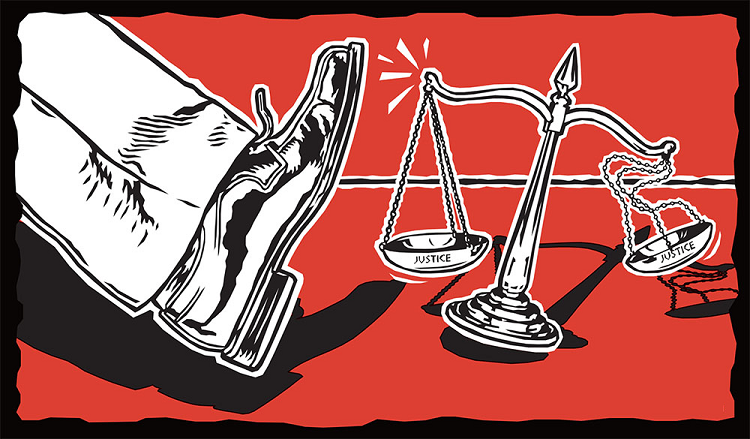
Kicking Fundamental Rights
Recent judgments of the European Court of Human Rights appear to have eroded the obligation of ECHR states to protect fundamental rights in cases where the alleged violations involve an international organisation.


Summary: What the European Court of Human Rights means to EPO workers in light of more recent developments, especially 5 years ago (Supreme Court of the Netherlands)

In the last part we saw how the European Court of Human Rights (ECtHR) has ruled that states which are signatories of the European Convention on Human Rights (ECHR) have a responsibility to ensure that their membership of international organisations does not lead to a breach of their ECHR obligations.


"...it has become evident that the overriding priority of the Court is to protect the autonomy of international organisations at the expense of the fundamental rights of their staff (and other individuals adversely affected by the acts of such organisations)."In other words, ECHR signatory states must ensure that adequate provision is made for an "equivalent protection" of fundamental rights inside any international organisation which they join.

This has implications for the internal justice systems of international organisations on which staff are obliged to rely for legal redress, because of their lack of access to national courts.

According to the "Waite and Kennedy v. Germany" judgment, such internal justice systems must provide staff of an international organisation with "reasonable alternative means to protect effectively their rights under the [European] Convention [on Human Rights]".

However, following the delivery of ECtHR judgments in the cases of Klausecker v. Germany (application no. 415/07) and Perez v. Germany [PDF] (no. 15521/08) in January 2015, it has become evident that the overriding priority of the Court is to protect the autonomy of international organisations at the expense of the fundamental rights of their staff (and other individuals adversely affected by the acts of such organisations).

"There was now a distinct possibility that international organisations and their member states could get away with applying a different and less rigorous standard of human rights protection to the acts and omissions of an international organisation."The Klausecker and Perez judgments prompted the legal scholar Anne-Marie Thévenot-Werner to express concern about an erosion of the obligation of states to protect the fundamental rights enshrined in the ECHR.

In an article published in the legal journal Revue de droit allemande in 2015 Thévenot-Werner acknowledged that the ECtHR had formally reaffirmed its case law requiring the provision of "reasonable alternative means" for the protection of fundamental rights inside international organisations.

However, at the same time the Court signalled that it would not hold a state to account for a breach of the ECHR involving an international organisation unless the protection available via the organisation's internal justice system was shown to be “manifestly deficient”.

Thévenot-Werner warned that the approach taken by the Court in these cases risked creating a loophole with respect to the protection of fundamental rights enshrined in the ECHR.

"It deserves to be emphasised at this point that these are matters which are not merely of academic and theoretical interest."There was now a distinct possibility that international organisations and their member states could get away with applying a different and less rigorous standard of human rights protection to the acts and omissions of an international organisation. In such situations, states would only be called to account if it could be established to the satisfaction of the Court that the level of protection available was “manifestly deficient”.

The risk of such an erosion of legal protection exists even in the case of organisations where all participating states are signatories to the ECHR (which is the case for the EPO).

It deserves to be emphasised at this point that these are matters which are not merely of academic and theoretical interest.

The saga of Benoît Battistelli's "Strike Regulations" at the EPO provides a striking illustration of their practical significance for the staff of international organisations.

"The Gerechtshof judgment showed that at least some judges in the Netherlands were serious about setting limits to the “immunity” enjoyed by an international organisation in order to prevent abuses involving clear-cut violations of fundamental rights."As noted in an earlier part of this series, Battistelli's controversial "Strike Regulations" were one of a long litany of grievances which the EPO staff union SUEPO attempted to litigate before the national justice system in the Netherlands.

During the litigation procedure, the Gerechtshof den Haag (Appeal Court of The Hague) decided that breaches of fundamental rights by EPO management were so severe that they justified lifting the organisation’s immunity from jurisdiction.

This lead to a judgment, delivered on 17 February 2015, in which the Gerechtshof ordered the EPO [PDF] to rescind several amendments to the organisation’s staff regulations, including the undue restrictions on industrial actions imposed by the impugned “Strike Regulations”.

In addition to this, the EPO was ordered by the court to uphold the rule-of-law and social dialogue standards in line with the European Convention on Human Rights and ILO Conventions No. 87, on the right to organise in trade unions, and No. 98 on the right to collective bargaining. [PDF]

The Gerechtshof judgment showed that at least some judges in the Netherlands were serious about setting limits to the “immunity” enjoyed by an international organisation in order to prevent abuses involving clear-cut violations of fundamental rights.

The European Public Service Union (EPSU) reported on the judgment under the headline "European Patent Office does not live in a Dutch no man's land".

"The problem with the Gerechtshof judgment was that it set a worrying precedent which had political ramifications going far beyond the EPO."Unfortunately, both SUEPO's legal victory and EPSU's optimism turned out to be short-lived.

Less than two years later, the Gerechtshof judgment was set aside, thereby confirming what many had long suspected: the European Patent Office does indeed live in a Dutch no man's land!
Gerechtshof den Haag
An independent judicial review of violations of fundamental rights by the EPO carried out by the Gerechtshof den Haag led to a short-lived lifting of the organisation's immunity in February 2015. This was overruled in January 2017 when the Supreme Court proclaimed that Dutch courts had "no jurisdiction in the EPO dispute".


The problem with the Gerechtshof judgment was that it set a worrying precedent which had political ramifications going far beyond the EPO.

"The Hoge Raad attempted to justify its findings on the basis that the fundamental rights of EPO staff "were sufficiently protected by the internal dispute settlement procedure provided for by EPOrg"."It was a veritable thorn in the flesh not only for Battistelli and his clique at the EPO, but also for the Dutch government which reaps significant economic benefits from the country's status as a host to a large number of international organisations.

This led to the Dutch government joining forces with Team Battistelli in support of an application for “cassation” of the judgment.

Finally, on January 2017, the Hoge Raad (Supreme Court of the Netherlands) issued a ruling to the effect that Dutch courts had no jurisdiction in the EPO dispute:

"According to the European Court of Human Rights (ECtHR), granting jurisdictional immunity to an international organisation constitutes a limitation of the right of access to a court as referred to in article 6 of the Convention for the Protection of Human Rights and Fundamental Freedom Rights (ECHR). This limitation is acceptable provided that litigants have a reasonable alternative means of protecting their rights effectively.

The Supreme Court found that such alternative means exist. The rights of VEOB [the Netherlands branch of SUEPO] and SUEPO are sufficiently protected by the internal dispute settlement procedure provided for by EPOrg, under which individual employees and staff representatives can ultimately take their complaint to the Administrative Tribunal of the International Labour Organization in Geneva. According to the Supreme Court, this means that the essence of their right of access to a court has not been impaired."


The Hoge Raad attempted to justify its findings on the basis that the fundamental rights of EPO staff "were sufficiently protected by the internal dispute settlement procedure provided for by EPOrg".

But is this really the case?

"In the upcoming parts, we will take a closer look at the EPO's internal justice system and the role which it played in "Strike Regulations" affair."Not everybody would agree. Indeed, many would argue that the facts tell a very different story and that the judgment delivered by the Hoge Raad in January 2017 was driven by political expediency and a misplaced desire to tell the Dutch government and the EPO what they wanted to hear rather than what they needed to hear.

In the upcoming parts, we will take a closer look at the EPO's internal justice system and the role which it played in "Strike Regulations" affair.

In particular, we will see how a former judge of the European Court of Human Rights played a bizarre and incongruous role in prolonging the suppression of the fundamental right to "freedom of association" at the EPO.

Recent Techrights' Posts

Links 03/02/2026: "Distraction is a Sin" and Fake "Encryption" (Surveillance With Good Marketing)
Links for the day
 
You Know Your Company is Dead or Basically a Pyramid Scheme When Jim Cramer Keeps Promoting Its Stock
How much does IBM pay for "puff pieces" or "fluff" about QC?
Red Hat (Under IBM) Works for Microsoft (Proprietary Software) and Slop
Yesterday Red Hat's official site, redhat.com, published exactly 5 new blog posts
IBM is Dying (More Layoffs), Red Hat Will Continue to Suffer From the Acquisition
Financial engineering
Colombia Adopting GNU/Linux Even Faster (at Microsoft's and Apple's Expense)
Do politics play any role in this?
An Effort to Tackle Slavery in 'Open Source' Clothing
"a civil rights lawsuit to examine the concerns of censored developers in the free, open source software ecosystem"
$15 billion lawsuit: Ubuntu, Google & Debian crowdfunding campaign launch
Reprinted with permission from Daniel Pocock
The Solicitors Regulation Authority (SRA) Delusion - Part II - Why We Need to Expose the SRA to More Daylight, Public Scrutiny
SRA is neither effective nor regulated
400-Page US Federal Court Against Abuses by Google, Microsoft and Front Groups That Abuse Volunteers for American Corporations
There are 386 pages in total (in the US claim)
Corporate Influence Never Impacted Us
There's no reason to assume we'll ever "sell out"
Growth of GNU/Linux in Cuba
Right now a lot of the world drafts or already implements a GAFAM exit plan
A Day After EPO Strikes an Escalation to Heads of Delegations to the Administrative Council
They rely on the European media playing along, helping them to hide major blunders, even crimes
Over at Tux Machines...
GNU/Linux news for the past day
IRC Proceedings: Monday, February 02, 2026
IRC logs for Monday, February 02, 2026
Gemini Links 03/02/2026: Stargazing, Development Boards, and Tcl/Tk Slop
Links for the day
Microsoft Lost 20% of Its Money in the Past 6 Months
Microsoft is hiding what's really happening while mocking critics
Great News, IBM 'Gained' Almost 10% in "Goodwill" Value After Firing Tens of Thousands in 2025
"goodwill" will be inflated despite IBM staff getting sick of IBM
Americans Move to GNU/Linux
some of the biggest American populations
I Still Like Drawing and Various Other Arts (They Help My Activism and Journalism), Slop is an Enemy of Creative People
Recognise that slop isn't intelligence; it's a generational excuse for plagiarism and privatisation of not only the Commons but also proprietary knowledge (without authorisation)
Carmen-Lisandrette Maris (Mission:Libre) Explains to Adolescents and Young Adults How Free Software Improves Privacy
Based on what we've seen and read, Mission:Libre has a solid grasp of Software Freedom
Chatbots Didn't Do Any Good for Microsoft
Google "AI" = search + copypasta
Links 02/02/2026: Cultural Cleansing by China and 'Living Behind Firewalls" in Iran
Links for the day
GNU/Linux Measured at More Than 4% in Russia
growing adoption of GNU/Linux in Russia
Gemini Links 02/02/2026: Stages of Age, Workflows, and Counting Capsules
Links for the day
Oracle's Debt Rose Over 20 Billion Dollars in Just 3 Months
Is "hey hi" becoming a synonym for debt?
Oligarchs' 'Speech Zones' Are Not the "Public Square"
The apologists of social control media, including press that got "addicted" to such fake "media", are helping dictators and oligarchs grab the public attention away from the real press
IBM Misleads and Gaslights Investors With Slop Sold as "AI" (the Business is Waning, Mass Layoffs Continue)
People who do this are dishonest. They should not be put in charge.
Links 02/02/2026: 'Melania' a Horror Movie "Will They Inherit Our Blogs?"
Links for the day
Doing More Detailed Series (Long-Form Works)
Long readings or book-like reading binges are only possible when parts are suitably labeled (name and numbers) if not interlinked
Mobbing at the European Patent Office (EPO) - Part II - Racism, Cocaine Use and White-Collar Corruption
When you hire people illegally, to work for cocaine users and keep quite about the cocaine use, what will be the impact on the reputation of an institution?
A Can of WORMS - Part II - Darkening the Name of RMS, Associating It With Crime
Beware projection tactics
Submit Your Suggestions for EU's Embrace of Software Freedom by Tomorrow
Time to leave GAFAM (US) hegemony behind
Slopless Weekend
This is not sustainable
Over at Tux Machines...
GNU/Linux news for the past day
IRC Proceedings: Sunday, February 01, 2026
IRC logs for Sunday, February 01, 2026
Gemini Links 01/02/2026: Fossil Heating Installations and Some FOSDEM Coverage
Links for the day
The State of Memory Leaks in GNU/Linux
The issue won't be solved by adding more memory
Links 01/02/2026: Nvidia's Jensen Talks Down Microsoft 'Open' 'Hey Hi' and Britain's Starmer Makes Friends With China, Japan
Links for the day
Why Microsoft Accenture Has So Many Layoffs in Recent Years
The debt of Accenture doubled a year ago
Links 01/02/2026: Public TV Gutted by Cheeto, Billionaires Fund a Cheeto Propaganda Movie in 'Documentary' Clothing
Links for the day
The New Site ("New Techrights", SSG Since 2023) Exceeds the Old Site in Requests
The "New Techrights" gets about twice as many requests as the "old" (WordPress) "Techrights", the site of 2006-2023
20 Years Ago
Some time soon all this slop frenzy will become like yesterday's "blockchain" or "metaverse"
Gemini Links 01/02/2026: Zdzisław Beksiński and Disconnected Git Workflow
Links for the day
Talks About Nadella's Microsoft Exit After Chatter About Tim Crook Leaving Apple (Years Ahead of Retirement Age)
Mass layoffs and record debt do not represent a company's health.
We Still Cover the Same Problems We Spoke of 20 Years Ago
We're not easily seduced by "novelty" (new things), we try to judge them critically
Patents Standing in the Way
They also cause environmental harm
Over at Tux Machines...
GNU/Linux news for the past day
IRC Proceedings: Saturday, January 31, 2026
IRC logs for Saturday, January 31, 2026
IBM, a Microsoft Company
Microsoft and IBM as a pair go a long way back