

Bonum Certa Men Certa

The EPO’s Overseer/Overseen Collusion — Part XXXXV: In the Shadow of “Waite and Kennedy”

Series parts:

  1. The EPO's Overseer/Overseen Collusion — Part I: Let the Sunshine In!
  2. The EPO’s Overseer/Overseen Collusion — Part II: A “Unanimous” Endorsement?
  3. The EPO’s Overseer/Overseen Collusion — Part III: Three Missing Votes
  4. The EPO’s Overseer/Overseen Collusion — Part IV: The Founding States
  5. The EPO’s Overseer/Overseen Collusion — Part V: Germany Says “Ja”
  6. The EPO’s Overseer/Overseen Collusion — Part VI: A Distinct Lack of Dutch Courage
  7. The EPO’s Overseer/Overseen Collusion — Part VII: Luxembourgish Laxity
  8. The EPO’s Overseer/Overseen Collusion — Part VIII: Perfidious Albion and Pusillanimous Hibernia
  9. The EPO’s Overseer/Overseen Collusion — Part IX: More Holes Than Swiss Cheese
  10. The EPO’s Overseer/Overseen Collusion — Part X: Introducing the Controversial Christian Bock
  11. The EPO’s Overseer/Overseen Collusion — Part XI: “General Bock” - Battistelli's Swiss Apprentice?
  12. The EPO’s Overseer/Overseen Collusion — Part XII: The French Connection
  13. The EPO’s Overseer/Overseen Collusion — Part XIII: Battistelli's Iberian Facilitators - Spain
  14. The EPO’s Overseer/Overseen Collusion — Part XIV: Battistelli's Iberian Facilitators - Portugal
  15. The EPO’s Overseer/Overseen Collusion — Part XV: Et Tu Felix Austria…
  16. The EPO’s Overseer/Overseen Collusion — Part XVI: The Demise of the Austrian Double-Dipper
  17. The EPO’s Overseer/Overseen Collusion — Part XVII: The Non-Monolithic Nordic Bloc
  18. The EPO’s Overseer/Overseen Collusion — Part XVIII: Helsinki's Accord
  19. The EPO’s Overseer/Overseen Collusion — Part IXX: The Baltic States
  20. The EPO’s Overseer/Overseen Collusion — Part XX: The Visegrád Group
  21. The EPO’s Overseer/Overseen Collusion — Part XXI: The Balkan League – The Doyen and His “Protégée”
  22. The EPO’s Overseer/Overseen Collusion — Part XXII: The Balkan League - North Macedonia and Albania
  23. The EPO’s Overseer/Overseen Collusion — Part XXIII: The Balkan League - Bulgaria
  24. The EPO’s Overseer/Overseen Collusion — Part XXIV: The Balkan League - Romania
  25. The EPO’s Overseer/Overseen Collusion — Part XXV: The Balkan League - Fresh Blood or Same Old, Same Old?
  26. The EPO’s Overseer/Overseen Collusion — Part XXVI: A Trojan Horse on the Budget and Finance Committee
  27. The EPO’s Overseer/Overseen Collusion — Part XXVII: Cypriot Complicity
  28. The EPO’s Overseer/Overseen Collusion — Part XXVIII: Benoît and António's Loyal “Habibi”
  29. The EPO’s Overseer/Overseen Collusion — Part IXXX: The EPOnian Micro-States - Monaco and Malta
  30. The EPO’s Overseer/Overseen Collusion — Part XXX: San Marino and the Perfidious Betrayal of Liberty
  31. The EPO’s Overseer/Overseen Collusion — Part XXXI: The Abstentionists
  32. The EPO’s Overseer/Overseen Collusion — Part XXXII: “Plucky Little Belgium”?
  33. The EPO’s Overseer/Overseen Collusion — Part XXXIII: Swedish Scepticism
  34. The EPO’s Overseer/Overseen Collusion — Part XXXIV: An “Extremely Dubious” Proposal
  35. The EPO’s Overseer/Overseen Collusion — Part XXXV: Slovakian Scruples
  36. The EPO’s Overseer/Overseen Collusion — Part XXXVI: Serbian Sour Grapes
  37. The EPO’s Overseer/Overseen Collusion — Part XXXVII: Stubbornly Independent Slovenia
  38. The EPO’s Overseer/Overseen Collusion — Part XXXVIII: Ensnared in the Tentacles of the SAZAS Octopus
  39. The EPO’s Overseer/Overseen Collusion — Part XXXIX: On the Slippery Slope to Capture
  40. The EPO’s Overseer/Overseen Collusion — Part XXXX: The Idiosyncratic Italians
  41. The EPO’s Overseer/Overseen Collusion — Part XXXXI: Public Service or Self-Service?
  42. The EPO’s Overseer/Overseen Collusion — Part XXXXII: A Parcel of Rogues?
  43. The EPO’s Overseer/Overseen Collusion — Part XXXXIII: A Legal No-Man's Land
  44. The EPO’s Overseer/Overseen Collusion — Part XXXXIV: Immunity = Impunity?
  45. YOU ARE HERE ☞ In the Shadow of “Waite and Kennedy”


Court House
Everybody is entitled to their day in court.
Well, maybe not, if you happen to work for an international organisation.


Summary: The EPO's immunity is troublesome for a plethora of reasons; this sort of problem has long been recognised in a broader context

As we mentioned in the last part, the immunities accorded to international organisations mean that their staff are precluded from pursuing their grievances before national courts of law.


Instead, staff are obliged to have recourse to internal dispute resolution mechanisms involving opaque procedures, whose compliance with the most basic requirements of due process is often open to question.

"The risk of a "denial of justice" arises because - unlike employees in the national domain - staff of an international organisation have no access to a domestic court of law in the case of a dispute with their employer."The internal means of redress provided by an international organisation is usually supplemented by a final possibility of judicial review before an international tribunal such as the ILOAT in Geneva.

These parallel legal systems have developed because of a general recognition that the immunity of an international organisation could be problematic from the rule of law perspective.

The risk of a "denial of justice" arises because - unlike employees in the national domain - staff of an international organisation have no access to a domestic court of law in the case of a dispute with their employer.

As a workaround, an approach to dispute resolution has been developed which relies on what are called "internal justice systems".

"As a workaround, an approach to dispute resolution has been developed which relies on what are called "internal justice systems"."The legal scholar Anne-Marie Thévenot-Werner - a professor of law at the Sorbonne University in France - has written extensively on the topic, for example in an article entitled "The Right of Staff Members to a Tribunal as a Limit to the Jurisdictional Immunity of International Organisations in Europe" which was published in 2014.

In this article Thévenot-Werner explains how national courts in Europe have come to recognise that the immunity from national jurisdiction accorded to an international organisation cannot be considered absolute because this could lead to a "denial of justice".

Such immunity is contingent on the guarantee of an effective legal remedy being available to staff in the form of an internal dispute settlement mechanism which provides "equivalent protection" to that provided by a national legal system.

This principle is echoed in the case law of the European Court of Human Rights (ECtHR) which monitors compliance with the European Convention on Human Rights (ECHR).

"In this way - or so the theory goes - even when states transfer certain competences to international organisations, human rights supervisory bodies such as the ECtHR can continue to hold states to account for the use of those powers."The ECtHR has found that the ECHR does not exclude states from transferring competences to international organisations. However, states which are signatories of the ECHR have a responsibility to ensure that their human rights obligations will receive an "equivalent protection" within the context of those international organisations in which they participate.

In this way - or so the theory goes - even when states transfer certain competences to international organisations, human rights supervisory bodies such as the ECtHR can continue to hold states to account for the use of those powers.

The Court's position is based on the consideration that if the contracting states of the ECHR, were permitted to use their membership of an international organisation as an "excuse" for evading their responsibilities under the Convention this would lead to a "loophole" in human rights protection which would be incompatible with the object and purpose of the ECHR.

According to the Court's jurisprudence, the alternative means of legal process on which staff of international organisations are obliged to rely must provide "reasonable alternative means to protect effectively their rights under the [European] Convention [on Human Rights]".
ECHR
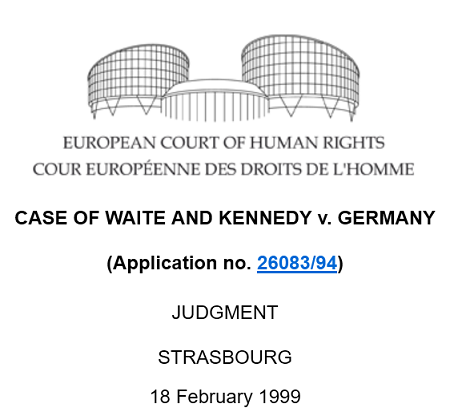
In its landmark judgment delivered in 1999 the ECtHR confirmed that international organisations are obliged to provide their staff with "reasonable alternative means" to protect their fundamental rights under the ECHR.


This was spelt out by the Court in the landmark judgments delivered in 1999 in the cases of "Waite and Kennedy v. Germany" and "Beer and Regan v. Germany".

Those judgments and their implications for international organisations are discussed in some detail in the article In the Shadow of Waite and Kennedy: The Jurisdictional Immunity of International Organisations, the individual's Right of Access to the Courts and Administrative Tribunals as Alternative Means of Dispute Settlement" published in 2004. This article was co-authored by August Reinisch, Professor of International and European Law at the University of Vienna, and Ulf Andreas Weber, a practicing attorney in Berlin specializing in employment law focusing on staff disputes in international organizations.

All of this sounds fine in theory.

"...some subsequent judgments of the ECtHR delivered in 2015 indicate that the Court is extremely reluctant to pursue alleged breaches of fundamental rights involving international organisations."However, in practice, the internal dispute resolution mechanisms of international organisations are rarely fit for purpose and this often leads to a de facto denial of justice.

Moreover, as we shall see in the next part, some subsequent judgments of the ECtHR delivered in 2015 indicate that the Court is extremely reluctant to pursue alleged breaches of fundamental rights involving international organisations.

Recent Techrights' Posts

Gemini Links 11/07/2026: Old Computer challenge, Poems, Antenna, and More
Links for the day
 
Over a Week After Microsoft Discontinued Some XBox Models It Apparently Exits Some Markets Altogether
We seem to be witnessing the end of XBox
Links 11/07/2026: "Trademark wars of Influencer Culture", Xinuos Uses Copyrights Versus UNIX
Links for the day
North America: GNU/Linux Measured at 10%
To better understand what contributes to the gains
Following Corrections and Adjustments statCounter Sees GNU/Linux at 7.1%, an All-Time High
There is a lot of layoffs at Microsoft this month
Over at Tux Machines...
GNU/Linux news for the past day
IRC Proceedings: Friday, July 10, 2026
IRC logs for Friday, July 10, 2026
Links 11/07/2026: Wednesday-Saturday News Catch-up
Links for the day
Prioritising High-Importance News
In order to fully catch up with news we'll not publish many new articles until next week
The Register MS: "AI" More Than 80 Times in One Article. But It's Not an Article, It's Sponsored Keyword-stuffed Page.
The Register MS is being paid to actively promoted this scheme
Over at Tux Machines...
GNU/Linux news for the past day
IRC Proceedings: Thursday, July 09, 2026
IRC logs for Thursday, July 09, 2026
Over at Tux Machines...
GNU/Linux news for the past day
IRC Proceedings: Wednesday, July 08, 2026
IRC logs for Wednesday, July 08, 2026
Over at Tux Machines...
GNU/Linux news for the past day