
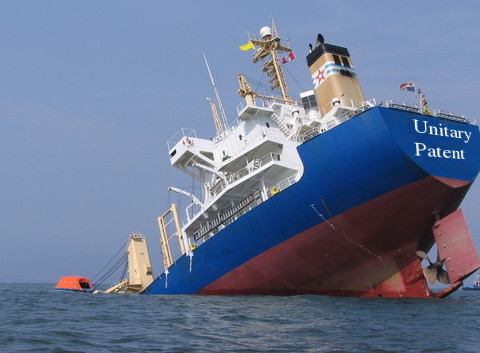
THE existential risk to the EPO (devaluation of patents) is no joking matter. It would severely harm Europe, more so than 'Brexit' has harmed Britain so far. One danger to the EPO is actually the UPC, which older rumours said Battistelli planned to jump ship to/for (moving to the UPC regime once it is created).
"Basically, no simply resolution exists right now."As Benjamin Henrion has just put it: "for the UPC, the ECJ stated it is not open to non-EU members."
Jesper Lund added: "In the unlikely event CJEU will allow this, the post-Brexit UK would be subject to EU patent law and CJEU as highest court, right?"
Basically, no simply resolution exists right now. It's more of a mess than it has ever been and it can take years for anything significant to happen (if it ever happens at all). People in IP Kat comments currently joke that the only way for the UPC to survive right now is for some large city in continental/central Europe to instantaneously rename itself "London".
Earlier today one particular comment noted that "amending the UPCA to enable a Non-MS-UK to be part of the UPC would be anything but a simple task."
To quote the whole comment:
Just had a flick through the UPCA and it strikes me as rather clear that amending the UPCA to enable a Non-MS-UK to be part of the UPC would be anything but a simple task. For example:
Art. 1: ..."The Unified Patent Court shall be a court common to the Contracting Member States and thus subject to --> the same obligations under Union law as any national court of the Contracting Member State --- " (emphasis added).
Art. 5: Contractual liability of the court is largely governed by EU regulations
Art. 23: Reference to Art. 258, 259 and 260 TFEU
Art. 31: International jurisdiction to be established in accordance with Regulation 1215/2015 or the Lugano convention
Also, I note that whether or not the UPC will go live as planned in 2017 not only depends on whether the UK ratifies, but also on France's and Germany's ratification. Why should those two burden the already complicated Brexit-negotiations with additional issues and potentially give the UK extra leverage?
Before even bothering to try to wrap my mind around the legal complexities involved here, I'll just say something: it is politically impossible. No British Parliament is going to ratify yet another European agreement, in the current mayhem, with MPs throwing things at each other and both parties effectively leaderless. And even when they regain some appearance of calm (if they ever do), they'll have to deal with a lot many far more pressing concerns than the UPCA: not just trade, but also the millions of EU citizens in Britain and Britain citizens in the EU, their access to benefits and healthcare, and their pensions.
Not to mention the fact that this vote has whetted the appetite of quite a few other populists across the continent who dream to wreck the whole European project.
So, and I say this as somebody who has himself invested also quite a lot of time and effort in preparing for the UPC: Forget it. It's over. This parrot is dead. It's an ex-parrot. I hope that, some time in the future, maybe in less than yet another forty years, there'll be a unified European (or EU) patent system. Maybe even, without the Cameron team's fear of the CJEU, it will have a simpler, more rational legal structure than the UPC came to have. But for the moment, I'll be happy if the EU still exists by 2020.
For the greater part, all communication tells me more or less the same. The European Patent Office (EPO) is not an EU organization. British patent attorneys will continue to be able to represent their clients at the EPO and granted European patent applications can still be validated in the UK. When it comes to the future of the eagerly awaited, however not yet existing, pan-European Unitary Patent and Unified Patent Court (UPC), the communication becomes less clear. And for good reasons. No one really knows what is going to happen.
Still, when reading through all the articles that reached my various display screens, I was a little bit surprised by how many European IP professionals consider it a serious option for the Unitary Patent and the UPC to start before the UK actually leaves the EU and with the UK as a temporarily participating member state. Some of them (e.g. this article by the prominent Dutch IP Lawyer Wouter Pors) even went so far as to suggest that it might be possible that the UK would continue to participate in the UPC after having left the EU.
Stop, stop, stop, all of you, please stop.
It's over. I repeat, it's over. The conversations in the legal community over the course of the last few days, in which lawyers are desperately trying to put sticky tape on the house of cards to prevent it from falling down, are not going to work.
Any system has to be palatable to industry, whether telecoms, mechanical, automotive, pharma, or SME. Even before Brexit, the whole thing was looking a bit wobbly (and hence creative lawyers were licking their lips for working out ingenious ways in which the system could be gamed).
But now, forget it.
This proposal from Prof. Tilmann may be reflective of what is going wrong in th EU, and why the situation is now as it is. There was a democratic decision by the UK to leave the EU. It was narrow, it was not to everybody's taste (also not mine, to be clear) - but it was a democratic decision that the UK should distance itself from the EU. We have to respect this decision, or else we would jeopardise our democratic fundament. Now advocating that the UK should nevertheless ratify an agreement which would connect it with the EU does not appear to be appropriate. It appears to be an attempt to undermine the result of the referendum. As far as I remember, nobody ever made similar suggestions to enable the participation of other non-EU countries like, say, Norway or Switzerland. I thought there were good reasons for that (CJECU opinion 1/09). Suddenly, all this does not appear to be valid any longer? This does not sound convincing. In my personal view, the UPC without the UK would be much less valuable. Therefore, the UPC should now be revised to reflect the new scenario. I fully understand the disappointment of all people who spent huge efforts to establish this agreement, but this is not a valid reason to disregard the outcome of a democratic referendum.
I am very sorry, but Prof. Tilmann cannot be taken seriously, his "expert" statements usually do nothing more than serving his very own interests, as some commentators have quite rightly indicated.
Readers may wish to have a look at Prof. Tilmann's past writings on opinion 1/09, some are freely avalable on the internet (e. g. EUCJ - Opinion 01/09 - Analysis and Consequences, www.eplawpatentblog.com/eplaw/2011/04/eucj-opinion-0109-analysis-and-consequences.html). Studying paragraphs 14, 15, 19, 22, 23 of said paper is very enlightening, also Prof. Tilmann's conclusions (paras. 24 and 25):
"24. This leads me to the following result of my Analysis: If the Agreement would be concluded by EU Member States only and if the two "sanctions" would be expressly regulated in the Agreement, the Court would not have objections against the centralised Patent Court (PC). 25. Therefore, I advocate that the Opinion of the EUCJ be adopted to the fullest extent and accordingly that the draft Agreement be amended in the following respects: a) restricting the membership of the Agreement to the EU Member States willing to participate in the Enhanced Cooperation on the Unitary Patent and (...)"
So is it only my understanding that Prof. Tilmann was in fact saying in his analysis of opinion 1/09 that participation in the UPCA should be limited to EU member states only?
To the informed observer, Prof. Tilmann's remarkable flexibilty in his positions on the UP/UPC issues is nothing new, he has repeatedly morphed in line with what was required to realize the project:
In the context of former Art. 6 to 8 of the Patent Regulation, some may remember that Prof. Tilmann first argued that the articles could not be removed without putting at risk Art. 118(1) TFEU as the Regulation's legal basis. Later, after the European Council had demanded the removal of these articles, he suddenly advocated for the exact opposite of his initial position, namely that a removal was perfectly legal and would not endanger the legal basis at all.
Some may also recollect that he held the position that the opt-out of an eligible patent from the jurisdiction of the UPC would leave the application of the UPCA unaffected, i. e. a national court dealing with an opted-out patent would have to apply the UPCA in the national proceedings. This even led the Preparatory Committee to issue a statement that it did not share this position (www.unified-patent-court.org/news/interpretative-note-%E2%80%93-consequences-application-article-83-upca).
Therefore, Prof. Tilmann's statements should certainly be taken with nothing but a grain of salt.
Professor Tilmann's paper is certainly interesting and he may (or may not) be correct in his proposition that the UK can be part of the UP and UPC.
However, as already stated, even if this could happen it should not happen.
I suspect that even staunch supporters of Remain (including myself) would agree that a problem with the EU is that it has (by stealth?) over the years moved from an economic union towards a political union. Consequently I assume that many Remainers object to laws originating from the EU Commission having effect in the UK and even they would agree that we are perfectly capable of making our own laws in the UK and don't need the EU to do it for us.
Since it is the courts who enforce the law and since the UP and UPC dictate which courts have jurisdiction it would be diametrically opposed to the spirit of the Referendum result to give courts in mainland EU countries jurisdiction over patent matters in the UK.
However much we as a profession (both in the UK and the rest of the EU) would like the UP/C to be effective in the UK, we should face up to the fact that it shouldn't happen.
Honestly, stop thinking about it. Just because there might be some "legal theoretical" ways to "fix" it, it's never going to happen.
The "Eastern District of Texas" argument is good to kill the treaty for good. Why should IT, ES (or DE and FR) go for something like that? Iurisdiction outside it's own iurisdiction?! EMA and other institutions are moving out of London and the UPC people dream of opening a new EU institution in London or having English judges deciding on cases under EU law?!
Even minor points are big for some countries: Why should English be the sole language of the procedings? Only Ireland would be an English speaking member. Spain and Italy won't like it nor will France or Germany...
Some people were paid very well for the last few years and now cling to their jobs and "mission".
So everybody go on and do something "useful".
There are many tragedies connected with Brexit (and the debate that preceded the vote), the likely demise of the UPC being one of the lesser ones. Nevertheless, one still has to feel for those who have put their heart and soul into bringing the UPC into being. It is not hard to understand that they do not want to see all of that time, effort, energy, cost and resources amounting to nothing more than a hill of beans. I think that I would feel the same in their shoes.
If Brexit does become a reality, then we will have gone backwards with regard to the goal of simplifying and reducing the costs of securing and/or enforcing patents across multiple European countries. However, that does not mean that we should get too disheartened. I'm sure that the UPC did not look all that appealing to SMEs. Further, the glaring (loop)holes in the legislation leave a lot to be desired, and would / will create a huge amount of uncertainty. Thus, we should perhaps not spend too much time mourning (or making what are likely to end up being futile attempts to prevent) the UPC's imminent demise, and instead focus our creative energies on constructing something new that could end up being better.
I shall provide the first idea: how about a "mutual recognition" system for court judgements? This could perhaps involve conducting full litigation in one jurisdiction and then having only "litigation light" in the jurisdictions where the judgement is to be recognised (e.g. where the fact-finding and expert evidence is taken from the first judgement, but where differences of fact and national law in the jurisdiction of the other court(s) are taken into account).
Such a system might not be optimal. However, combined with further efforts to reduce the cost of validation (e.g. based upon efforts made with machine translations and/or rules taken from the UPC regarding provision of a translation upon enforcement) it might represent a compromise with which we could all live for many years to come. If you cast your eyes back to what happened with the CPC, you will see that the EPC represents a very similar kind of compromise.
A creative solution, which requires everyone to co-operate and trust one another from the word go.
In the current climate, that is wishful thinking.
The UK will not ratify anything that will give jurisdiction on an important part of IP law to an EU body while it is negotiating to remove itself from jurisdiction of EU bodies. If it did so, it would have to be in the knowledge that that jurisdiction may return to the UK after two years. In the meantime, there would be the risk of British headlines about injunctions by brand new EU courts against UK small businesses or importers, which would play into isolationist hands, all the while the UK is trying to create a workable, amicable exit package. The UK will also not hand over its bargaining chips so easily. If it is a benefit to the EU that the UK participate in the new Package, then expect this to be a negotiating point between UK and rEU, not a done deal.
The UK's involvement in the Package is therefore likely to be deferred until the Brexit agreement is made, or until the political winds change. Therefore, the package also would likely be deferred.
As was made well above, the problems created by Brexit are not solely legal, but are also political, and the creative solution posed misses the political dimension.