
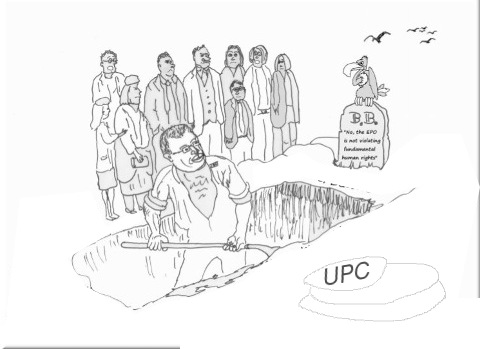
THE UNITARY PATENT is a subject we have been covering for many years, since before it was even known as anything "unitary" (words like "community", "EU" or "European" were more common a bunch of euphemisms at the time). The UPC is definitely not for the EU or for Europe. It is not for Europeans or even for EPO staff (who are typically European scientists); rather, UPC is for prosecutors/lawyers and for mega-corporations (their clients), billionaires and Battistelli, who is dangerously close to them (see his political affiliation and professional background). The UPC must be stopped and EPO examiners too should work hard to stop it. Nothing would upset Battistelli more because his interests are often the very opposite of EPO interests (for instance, systematically lowering the quality of patents).
UK industry has announced a position on Brexit at http://www.ipfederation.com/activities.php?news_id=133
"Without a guarantee of continued UK participation post-Brexit, the UK should not ratify the UPC at present."
Please note, IP Federation is not synonymous with UK industry [see the very short list of members] and the position does not appear to be unanimous even among that self-selected group.
The declared position is either extremely naive (on the part of those who believe there can be any guarantees in the present political climate), or extremely devious (on the part of those who never liked the whole idea anyway and rather hope it will just go away).
If the UK does not ratify now, the whole UPC/UP project may simply evaporate. The benefit to that part of UK industry that is not part of IP Federation's self-selected cabal will be lost.
Strange comments about the IP Federation. The IP Federation represents a significant part of British Industry. Not many SMEs I grant you, but significant nonetheless.
In any event, their position seems to me to be pretty sound. Why would anyone want a patent that may not be valid in one (or more) jurisdictions? That's exactly what those who insist on ill-conceived quick ratification are asking for. There are so many questions that cannot be easily answered and, for which, the answers may be challenged in future even if they are answered that certainty is required. The easiest way to be certain is to NOT ratify. Status Quo maintained. If the UPC system can be adapted to make it certain (unchallengable) that the UK is/can be clearly in or out then all well and good.
Patent law specialist Deborah Bould of Pinsent Masons, the law firm behind Out-Law.com, said that it would seem "politically unrealistic" to expect the UK to pass legislation giving effect to the UPC Agreement if its participation in the UPC and unitary patent system was not guaranteed to continue after the country leaves the EU.
Bould was commenting after Benoît Battistelli, president of the European Patent Office (EPO), suggested that if the UK ratified the UPC Agreement before leaving the EU it could be allowed to continue its participate in the new system after its exit from the trading bloc. He suggested, though, that continued participation post-Brexit would be subject to the outcome of negotiation between the UK and EU countries.
[...]
"The UK's participation in the new patent system is a major part of its attraction, and its involvement was a factor in the decision that London should host a branch of the Central Division of the UPC. That said, subject to a possible amendment of Article 89 of the UPC Agreement, the Agreement is worded in a way which makes it legally possible for the UPC framework to continue without UK involvement," he said.
Patents are granted for the UK by the Intellectual Property Office ("IPO") pursuant to the Patents Act 1977 and the European Patent Office ("EPO") pursuant to the EPC. There is not yet such a thing as an EU patent but there is an agreement to set up a Unified Patent Court ("the UPC agreement") and legislation to permit the EPO to grant patents for the territories of most of the member states of the EU including the UK, France and Germany to be known as unitary patents.
[...]
As Parliament has already enacted legislation to enable the Secretary of State to ratify the UPC Agreement and the statutory instrument giving effect to ratification has already been drafted (see The Draft Patents (European Patent with Unitary Effect and Unified Patent Court) Order 2016 10 March 2016) it is also possible that the unitary patent and Unified Patent Court will come into being before the UK leaves the EU. However, the UK would cease to be party to the UPC Agreement upon our departure since the Agreement is open only to EU member states.
[...]
The only intellectual property right affecting the software industry that would actually cease to apply to the UK upon our departure would be the EU trade mark. The courts in the UK that have been designated EU trade mark courts will lose their jurisdiction over EU trade mark matters. However, registrations under the Trade Marks Act 1994 would be unaffected and EU trade marks would continue to apply to the rest of the EU.
Good argument from Millipede. UK ratification improves the negotiating position of the UK, trying to squeeze a good "deal" out of the EU as it negotiates its exit. Who in the UK could be against that?
Further, UK ratification of the UPC is what everybody else is begging the UK to do. The work's been done already. A prime ministerial nod is all it now needs, I am told
Theresa May is a woman who does the right thing, rather than just court popularity. Just the right person needed now.
So Theresa, hold back on Art 50 by all means but, if you care about the UK's reputation in the world, screw your courage to the sticking place and get on and ratify the UPC. There is no reason not to, and every reason positively to do so.
But with time limited after Art 50 notification, might not it be to May's benefit to hold off on ratifying the UPC in return for some other concession? Joining and then (messily) leaving serves her no purpose but eases everyone else's interests so is a good bargaining tool. Why give it up a pawn for free straight off when you have bigger treaties to negotiate from weak positions?
It is amazing to see how members of the profession are hoping for a quick ratification of the UPC by the UK or are trying to find ways to keep the UK in the system in spite of the Brexit. Thinking of bringing back remaining non EU- member states in the UPC is simply laughable. EPLA is dead as dead can be.
Millipede’s contribution in this respect is revealing: - the UK will have the advantage of the London seat of the UPC; - the UK will have the advantage that once the system is started they will be considered indispensable for the continuation of the system (they are already deemed to be indispensable before the system has started), which will improve their negotiation position.
Having all the advantages but no inconvenient. That has been the UK attitude all along its participation to the EU. The presence of UK would certainly have been good for the system, but to come with the arrogance of being indispensable is going a trifle too far. Enough is enough!
The numerous attempts to salve the participation of UK at any rate is nothing more than a desperate attempt to try not losing the considerable personal profits the promoters of the UPC expected to make with the full UPC. It is clear that a UP without UK is much less interesting. But a Brexit is a Brexit.
Have those distinguished gentlemen thought of the mess their clients will be if the UK ratifies for latter leaving the agreement which is only be open to member states of the union? Probably yes, as it means more need for consultation, hence more fees. Cupidity has limits.
Does all those distinguish gentleman think that the UK parliament has nothing else to do than quickly ratify the UPC? Sneaking in some continued involvement with EU law in spite of the Brexit? I would like to see which explanation a MP will give to his constituency at the next elections if his constituency voted in favour of Brexit. As any MP wants to regain his seat, he would he be foolish enough to brave the opinion of his voters in this respect. A quick ratification is no more than wishful thinking.
Art 87(2) of the UPC Agreement provides that the Administrative Committee may amend this Agreement to bring it into line with an international treaty relating to patents or Union law. The amendments to the Agreement envisaged are of administrative nature, and said committee cannot take decisions which are of political nature. Amending Art 84 to sneak UK in is not in the competence of the Administrative Committee. Art 87(3) Agreement provides a protection mechanism should the Administrative Committee take decisions on a political level.
Instead of running after something which has gone, it would be wiser to put energy in saving what is left from the UP/UPC once UK has gone, but then to look at the matter with fresh eyes. The matter should be simplified and the influence of common law should be thrown overboard. After all, UK has left and the continent is not an area relying on common law.
If the UK is to ratify now, it will be a total mess later on. Just think of the unitary effect scope when the two years delay will lapse should no agreement be found ? Remember how Serbia and Montenegro separated ? Patentee had to register their former patent to the Montenegro IP office. One could expect that a unitary patent territorial scope be reduced when the UK formally leaves EU, but will it be. Then, hopefully some UK laws would provide for a similar registration at UK IPO (and what about Scotland if a Scottish IP Office is enacted at some point ?). Overall, the british parlement might spend the next two years just adapting all laws to the Brexit. No need to add special legislations for a short lived unitary patent. UK courts would not have juridiction on former unitary patent over the UPC countries territories. Conversely, UPC would not have jurisdiction for former unitary patents over the UK territories. What about pending actions before the UPC Court of first instance in the London section and in other UPC countries ? and before the Court of appeal in Luxembourg ? Think of the clause "as an object of property" if the first applicant is from UK: then, the unitary patent applicable law would change upon the UK leaving with German law applying in a number of instances. This might be bad news for international company having their UK subsidiary applying for EP patents. If the UK ratifies, it would be such a mess that no one (whether UK applicant or non-UK applicant) would ask for the unitary effect until the UK has formally left EU. Even EP patent bundles might be at risk unless you opt out. Fortunately, this will not happen because the German will not deposit their accession up until the UK has left EU. Germans are not likely to gamble the whole European patent system on Brexit issues. EU has to immunize itself from future inescapable UK laws and endless court actions up to the House of Lords. Just think of the SPCs legislation and the european first marketing authorization.
And there was me, thinking about the 1973 European Patent Convention, a beautifully simple and rigorous model law of patents that has since then swept the world and has been adopted, more or less verbatim, all over the world. It came out of a fusion of (mainly) German and English patent law principles. What a shame, that Europe is no longer a beacon to the rest of the world, about how to live together in harmony.
English common law fact-finding has a role to play, in keeping litigants honest. Discovery and cross-examination are the only effective tools to stop parties in court from trotting out a string of porkies. How sad then, that a mainland European can't wait to see the back of English common law fact-finding procedures.
Do all those promoters for a quick ratification will honestly advise their clients to go along with the UPC knowing well that the Brexit is looming and will have presently unknown consequences? Please let’s be serious and look a bit further than the end of one’s own purse strings.
One thing investors hate is uncertainty. A quick ratification is just promoting uncertainty. The hope of finding some legal trick to keep UK in the UPC, or even bringing in further non-EU members, is not to be taken seriously. What has to be envisaged is anything but a “minor” reform of the UPC agreement.
Should UK ratify, it still would need Germany to ratify for it to enter into force. Nothing more is certain. Do you think they are so stupid to give an ace away just to please the profession? Such an ace is as well a bargaining option, but for the other side. This fact seems have been forgotten.
Should the UPC start in 2017 with UK in it, the only direct effect would be a high rate of opt-out, probably near 100%. No sensible patent owner would embark on such an adventure. The UPC might be in force, but with no or very little effect. Has any of those vehement promoters of quick ratification ever thought of this?
Sorry for Max Drei and Millipede, Brexit is there, and that’s it. I have rarely seen so much cynicism and selfishness being expressed in this blog. As another blogger said, all the advantages but no inconvenient…
To paraphrase Max Drei: dear Angela do not ratify the UPC before the Brexit has taken place. Do not give this ace away to Teresa. It would just bring about a big mess.
Some of the suggestions here are laughable. A quick ratification from the UK to get the system up and running, with the option then of the UK leaving the system in due course (as per Millipede's "win-win")? I don't think so.
Someone seems to have forgotten that the UPC is not simply a playground for patent litigators, it is a venue for companies to resolve their disputes. No major patent holder is going to leave its patents in the system under these circumstances. Thus, if everyone opts out, the system is going to be (using the phrase used by a commentator on an earlier post) an ex-parrot from the day it is born.
Back to the drawing board I am afraid....
Let us hope that "Brexit means Brexit" is good old fashioned UK politics in which success is like rowing, staring fixed.in one direction while moving rapidly in the opposite.
Even if this is a vain hope: law is a servant, not a master, and given political will, much can be made possible.
I do not think that the "pro-UPC" commentators here are necessarily motivated (solely) by the thought of future profits. Remember, there will be many in the IP profession who will have invested considerable amounts of time and effort (as well as resources) in preparing the way for the advent of the UPC. Not wanting to see all of that go to waste is surely an understandable emotion, so let's not cast aspersions where none are really necessary.
Having said all of that, I have to say that I view the proposals for saving the UPC as akin to grasping at straws. Perhaps not completely hopeless, but not all that far from it.
It is certainly sad that yet another attempt at "harmonising" patent litigation in Europe looks set to be consigned to the waste bin of history. Nevertheless, at least from my perspective, there are some silver linings. Foremost amongst these is the possibility to re-open the issue of harmonisation of national patent laws. One of the biggest failings of the current UPC Agreement (and associated EU Regulations) is the fact that it leaves too many issues open with regard to applicable laws (for infringement and other matters). This can only lead to the kind of uncertainty that litigants so dislike.
From this perspective, those who are truly interested in a harmonised patent litigation system across Europe really ought to grasp with both hands the opportunity presented by Brexit (to properly address the issue of harmonisation of national laws). There will no doubt be political hurdles to overcome, but it is surely worthwhile taking on those challenges to secure a noble objective, namely the delivery of a robust and harmonised patent litigation system.
Is there anyone out there who is up for the challenge?
Lots of discussion on what companies will do - mainly from the point of those in the profession.
What drives companies' decisions? Money.
The unitary patent provides a significant value for money option whether the UK is inside or not.
The UPC provides significant extra power over having to separately litigate in each country.
Even if the UK has to leave on the worst possible terms [no membership of the UPC, no membership of the unitary patent]:- - does anyone believe the UK will not provide transitional provisions to ensure continued effect of unitary patents in the UK either by unilateral extension (unlikely) or deemed resumption of national effect of the European patent (more likely)? - does anyone believe the UK will not provide for suitable transitional provisions for cases underway at the UPC?
Contrary to the impression given by recent events in the UK, politicians are not blind to money either. Something that is good for industry (and cannot be characterised as tax dodging) attracts political attention. This applies whether it is the UK government seeking to assist UK industry by having the UPC (and particularly the UP) open as soon as possible - or the German government seeking to reduce costs for German companies doing business in the UK.
The money says ratify. Will the politicians listen?
Where there's a will, there's a way: and where there is wonga, there is will.
I have always been told that the UPC has been set up for the benefit of European Industry and especially it’s SME’s. UPC may be good for big industry in or outside Europe, but certainly not for European SME’s. The best proof of this is the idea to create an insurance in case of litigation for European SME’s, which by the way still needs to be put together.
It is interesting to see now that the prime beneficiary will be, inter alia, US SME’s. And for sure they will chose to be represented by UK lawyers and representatives for a large part. When this is not an incentive to push the UPC in UK for its own benefit, then nothing will ever be an incentive. As already said by another blogger, cupidity has limits.
I agree that the fears expressed towards the UPC remind one of the fears raised before the opening of the EPO. But this fear bears no relationship whatsoever with the Brexit. Please do not confuse the issues.
In any case, in view of the solid national traditions and the way some mock UPC trials proceeded, the biggest role will be for the Court of Appeal of the UPC in order to harmonise those different national approaches. In any local court with two judges from the same country this is bound to happen. Not in the Central division, but then with the Brexit why should there be a division in London? The answer is simply no. All the advantages and not any inconvenient……
One commenter said if there is a political will, there is a way: should the UPC have to be renegotiated, this does not mean that it will never be possible to come to an agreement. It could be strapped from all the wrong things which presently have been put in the agreement. But with the Brexit, UK does not have to put its nose in it.
There is a big difference between the EPC and the UPC. Does it need to be spelt out? One system gives pan-European rights in one swoop and the other takes them away.
I work for a mutlinational company, so luckily, our US comrades will received advice from within Europe that represents their interests.
I have to say, I find the tone of the introduction patronising and xenophobic. but then I'm English, so I'm in the European minority.
To be honest, do we not all overestimate the importance of the UPC in a Brexit scenario ?
If Brexit really happens, there is a long list of topics to be dealt with in negotiations and I sincerely doubt that the UPCA will be a "pawn" in this game.
There are thousands of issues more important to be negotiated. Law in general is just a part of those matters, IP is just a small part of the overall law package, patents a small part of the overall IP package and the UPCA just one part of the overall patent package.
I can understand that people having worked on this project for a good bit of their lives will stay optimistic.
But having already an EU project in IP, for which a solution needs to be found, i.e the EUIPO businesses, I sincerely doubt that anyone wishes to create another complicated "EU" project like the UPC with the UK leaving...
So a quick ratification is out of the question in my view...
But, of course the Ah-No Nyms point of view as a German patent attorney is of no relevance. Of relevance is the political will in UK and remaining Europe. And in view of the politicians taking the decisions the UPC is already a main topic. For instance a government conference with British industry and other relevant circles has already been scheduled for Thursday, 14th of July. Maybe the UPC or better the patent package will be a cornerstone for the future economic relationship between UK and EU to avoid more damages from the referendum outcome than absolutley necessary!
Did you talk to any VC? Any SME? Anybody outside Europe?
Our VCs wouldn't spent a dime with the UPC even with the UK on board.
Legal Security? Nope! - Does that mean we could loose the IP (=our investment) in ONE court that nobody knows how they are deciding (and by which exact rules)?!?
Really cheaper? Not unless you were suing in at least 2 countries.
Experinced Judges? No Brits, nobody who is or was employed at the EPO! Who shall fill in all the positions? In Europe nobody would want to have German judges sitting everywhere.
SPC? Don't even start!
True European? Nope, at least Britain, Switzerland and Spain are missing from the "imoportant" or "big" countries.
South Korean colleagues were already asking on how to file national again...
So what money wants to ratify? Which industry? Even Pharma was like "Well, we might test the sytem with one or two less important families".
If one wants to promote "European Patents" cut the annual fees! They are what is responsible for the biggest part of the costs.
The UPC is dead in the water and all (academic) discussions are just there for saving face (and not having to confess to themselves that all that money and time was wasted).
Trust me when I say that Pharm will not touch the UPC with a bargepole, irrespective of membership, location, or even tasty nibbles.
Those that say "we may test the system..." aren't really part of the decision-making processes. Hence why they spend their time hob-nobbing at conferences on the UPC.
Only a fool would put their pharma eggs in the UPC basket, irrespective of the quality of the judges.
Yes I have spoken to those outside the UK - and found the greatest interest outside Europe to be from the USA, particularly from CFOs of small to medium sized companies who want as big a portfolio as they can at the lowest price.
Lawyers tend to be cautious, but those who control the purse strings seem enthusiastic.
I started as an extreme sceptic on the UPC/UP package, simply because there is so much that is wrong with it. A better system could have been devised, but a better system might not have achieved the political impetus for agreement.
However, by talking to some of those who control the purse strings, I have become convinced that there is a real demand. Buy four, get perhaps 20 free, is a message that stirs the accountant's soul (if they have one).
I can second Meldrew's information. Most of the US companies are happy to exchange having to go to several separate European courts (all of these unknown to them) to one central European Court (also unknown to them). Also on a European level the interest for the unitary patent and the UPC is large and although some may choose to opt-out from the start, many will trust the experience of the UPC courts (which next to British and German judges will also have experienced French, Austrian and Dutch judges).
I further agree with Meldrew that indeed the UP and UPC system may have been better. But this was the best we could get it at this moment and along the way I have become convinced that it will be a workable system and better, much better than what we currently have.
The negativism towards the UP and UPC reminds of old times at the start of the EPC, when everybody was negative and wanted to keep with the old national system. Or, if you want a stronger comparison, at the time of the introcution of the car or the train or any technological development. People tend to be quite conformistic and don't want a change. I predict here, that if the system starts, after ten years everybody will say that it has been an enormous success.
Lastly, to come back to the above discussion on Brexit, or rather UPC-exit negotiations: to my opninion it is better to start the system as soon as possible and only when it is running discuss the exit of the UK. Otherwise we will run the risk that the whole UPC will be re-negotiated, which probably effectively will mean that it will be impossible again to come to an agreement.