
Sunday, March 8 is International Women's Day. The challenges that women face in their professional lives are one of the core themes of the day.
In computer science education, approximately thirty percent of students are female. This drops to ten percent in the workforce. In free software organizations, the representation of women is far worse: a little bit over one percent of Debian Developers are female. With the recent concerns about Outreachy internships, harassment and abuse, there couldn't be a better time to consider some of the hard facts and recent scandals that keep things this way.
Many free software organizations are now paying diversity bursaries to women to facilitate travel to free software events. Some organizations are also hosting female interns under programs like Outreachy. Debian funds are used to pay approximately four Outreachy interns each year, the overall cost being approximately $US25,000 per year. This has produced some odd side-effects. The Debian Social Contract, point 3, promises transparency yet attempts to question the problems of Outreachy on the debian-project mailing list have routinely been censored:
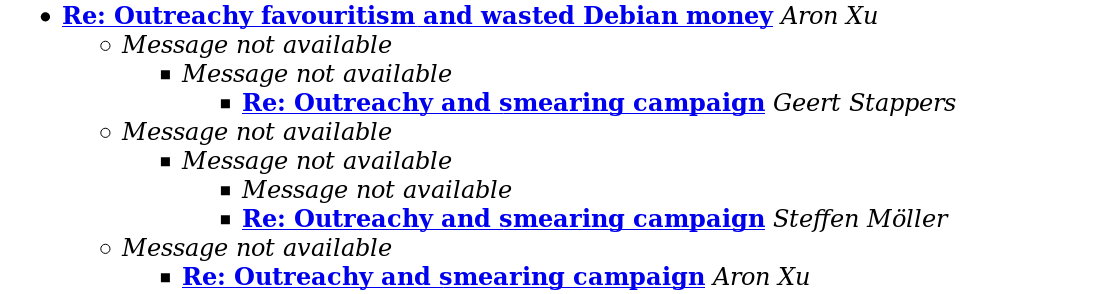
The missing messages have been captured elsewhere, here is one of them:
Subject: Re: Outreachy and smearing campaign
Date: Sat, 22 Feb 2020 16:31:41 +0000
From: Ken Starr <kenstarr@protonmail.com>
To: debian-project@lists.debian.org <debian-project@lists.debian.org>
––––––– Original Message –––––––
On Saturday, February 22, 2020 1:31 PM, Steffen Möller <steffen_moeller@gmx.de> wrote:
> @Debian, we should find ways to objectively discuss what has been
> brought up. For instance - Ken reporting on someone attending DebConf,
> finding a mentor and jointly sketching a project they want to work
> together - I mean, that is why we have DebConf in the first place -
> @Ken, this is a success story. I am not sure if Outreachy then needs to
> fund this any further, but from a Debian perspective - please do.
An Outreachy who was privileged to be in that discussion at DebConf has an unfair advantage over other candidates.
That is contrary to the values Outreachy claims to promote a level playing field.
Women suffer from these disadvantages and lack of networks. Outreachy promised to provide a fix for that. Debian has short-circuited the process. If posts are designed that way the Outreachy is redundant.
Nobody is claiming the woman did something bad. The candidates are not expected to understand everything about the integrity of this process. That is the mentors job. It must be the men. It's always the men and their money.
These appear to be legitimate concerns but they are dismissed as a smearing campaign. The person who added smearing campaign to the subject line is Ulrike Uhlig, a former recipient of Outreachy money herself. Why can't other volunteers ask questions about this money?
Up to 2017, the Google Summer of Code (GSoC) and Outreachy internships were paid at the same rate, $US5,500 per intern. Google cut the pay-out so that many students in developing countries get only half of the old rate. Outreachy payments are the same as before. This has created an arbitrage situation: as the work is done remotely, a talented male student may get more money if they help a female friend complete Outreachy. The male student usually completes all the work up to the mid-point payment. At this point, he can blackmail the woman: give me all of the mid-point payment or I don't help you finish the second half of Outreachy. Some women have approached mentors to ask for help in situations like this.
This is only one of many ways in which women are finding themselves under uncomfortable influence. While organizations like Debian have no limit on the number of male developers who can join through the normal process, a program like Outreachy encourages women to compete against each other for just two places in each round.
Some of the censored emails have raised the risk of a casting couch culture. It is not clear if those posts were derogatory or if they were being made in good faith. While any reference to casting couches is awkward, it is worth contemplating the question: do the women at an early stage of an IT career feel the same pressures as women at the early stage of an acting career in Hollywood? Wikipedia documents the economics of the casting couch:
According to economists Thomas Borcherding and Darren Filson, the high risk and returns in Hollywood cinema encourage the casting couch phenomenon. The possibility of high returns incentivizes unestablished actors to accept minimal wages in exchange for roles. With the exception of a few extremely talented actors, producers are unable to evaluate the aptitude of the vast majority of qualified actors due to uncertainty. As a result, some actors give sexual favors to producers to obtain a perceived advantage in the casting; the casting couch functions as a counterpayment that effectively reduces their wages. This creates a conflict of interest in which corrupt producers substitute aptitude (an unquantifiable variable) with sexual activity in their decision-making.
Can you spot the similarities? Outreachy is a program with high risk: every candidate has to risk many hours doing unpaid code contributions and other voluntary work on open source projects yet only two interns selected each round. We also see high returns: an Outreachy salary is more than triple the salary of a local job for women in a developing country.
Anybody involved in the administration of diversity funds would be wise to contemplate the similarities and risks: the pressure women feel to get started in either acting or computing, the difficulties that hiring managers face discerning whether or not a beginner will be successful.
This is only one of many problems observed in diversity programs.
Some smaller free software organizations offer us the opportunity to study these challenges under the microscope, just as a scientist might study bacteria in a petri dish.

Consider one of the local free software groups in a developing country. The organization has been credited with attracting a large number of female members and volunteers at their events.
Yet Debian Developers who attended their events discovered irregularities. The number of women applying to outside events or participating in technical activities was far lower than the number of women who appeared at the original conference. After follow-up discussions with some women, a few patterns were discovered.
First of all, the salaries for young women in the region are incredibly low. A female student may only earn €10 per day in a part time job. When a tech conference receives thousands of euros from sponsors in rich countries, they can use €200 to pay twenty young women to show up. As a bonus, these volunteers are offered meals and other opportunities.
As these payments seem trivial, sponsors were blind to the effect their money had on women. The free software community has had the wool pulled over their eyes. Of course, organisers would happily spend even another €500 like this if it brought in another 50 women and €5,000 of diversity funds and sponsorship. That is a one thousand percent return on investment. Who wouldn't take that bet?
Even worse, talented women who really did attend as volunteers, without any payment, were dismayed when they discovered that other volunteers were receiving payments.
This goes some of the way to explain why the women were not seen again. More observations were made by volunteers in Wikimedia Foundation and Debian: a very small group of three women applying for travel funding for external events. The same names repeated in grant applications submitted to multiple organizations. When a Debian Developer followed-up with other women from the region, he found that they were not being told about travel funds from larger organizations like Debian. Some had been ordered not to apply until the preferred women received a positive reply. In other words, local gatekeepers had created a power structure for themselves. The money from larger organizations like Debian was the enabler for this behaviour.
Further searches found that the women who were applying were listed on a company web site with the men. It appears they had been gathered together to submit cookie-cutter funding applications.
When one of the Debian Developers asked the Debian Project Leader, Chris Lamb, for support, he only encountered indifference and resentment. Absurdly, Lamb tried to replay the gatekeeper accusation against the very person who raised concerns. It turns out, the LibreOffice annual convention, LibOCon, was going to be hosted in the region and some developers didn't want to rock the boat, challenge local gatekeepers or demotivate those "high performers" who had a "track record" of getting women to events.

Not so long ago, a major German financial company organised an event in eastern Europe with additional women who didn't normally work there being invited to attend. The women had to wear colour-coded wrist bands. Women attending free software events on diversity bursaries are certainly not in the same profession: we include this extreme example to demonstrate men's willingness to use money to coerce and control women, to keep women on a lower tier.
Debian's constitution says we are volunteers, making us all equal. When women are offered a different pathway into Debian, as paid Outreachy interns, that is not equality: it places those women on a lower tier where men can control everything they do, for example, what they say and who they speak to. Rogue members of the Debian aristocracy are now actively using financial coercion, including the promise of Outreachy and travel grants, to force women to take sides in Debian politics.
When Susan Fowler blew the whistle on harassment at Uber, she described exactly the same phenomena in a blog post:
Over the course of her year at Uber, she was given negative performance reviews by another boss, who wanted to prevent her being promoted and thus keep her and other women on his team
Debian claims to be the Universal Operating System, however, there seems to be nothing more universal or timeless than the tendencies of men to control women.
Many organizations settle harassment claims from women by asking them to sign non-disclosure agreements. Several women violated those very agreements to blow the whistle on British fashion magnate Philip Green in 2018.
Yet the open source group in question took that a step further, imposing upon women to sign non-disclosure agreements at the moment of joining. These practices are conditioning women to be compliant and submissive, to maintain a code of silence, from the very first step in their professional lives. Once again, when this was raised with Lamb, the Debian Project Leader, he remained indifferent.
Women who received abuse through the private communication channels referred to by the NDA were afraid to seek help.
Lamb's failures to respond are reminiscent of the repeated failures of Uber leadership to support Fowler and other women who tried to seek solutions through internal channels.
The Debian Developer working in the region had personally witnessed multiple cases of harassment and abuse, with female volunteers in tears. The volunteer never received any support.
Free software organisations talk endlessly about community building. Yet some people take one look and call it by a different name: exploitation.
In one case identified on debian-project, a woman had volunteered for six years before being offered one of those insecure three-month Outreachy internships. If you divide the $5,500 Outreachy payment over six years, what is the real hourly rate this woman achieved? There is a big difference between the noise Debian makes about diversity and what open source is really willing to pay a woman.
Yet when the LibOCon organizers started to engage, they found exactly the same problems that Debian had ignored and it was clear to them that the problems were entirely local in the group. The Debian Developer who had witnessed problems before wasn't even there for LibOCon.
Lamb, on the other hand, had completely misread the problem or wanted to punish anybody who might speak up again, so together with the Debian Account Managers, Enrico Zini, Joerg Jaspert and Jonathan Wiltshire, he spread false accusations of harassment and abuse against the very volunteer who had asked for help. This was a sickening betrayal that continues to haunt Debian to this day.
Using a false accusation to smear a political opponent has all the ethical charm of Lance Armstrong winning the Tour de France seven times with doping.
It is particularly callous because real examples of harassment and abuse had taken place, yet those words were immediately stolen by Lamb and used as tools in his dirty political game, punishing somebody who queried the secret $300,000 from Google. By doing this, Lamb, and Debian, devalued the harrowing experiences of these women and the Debian Developer who had witnessed genuine abuse first-hand.
Lamb's dishonesty is laid bare in an encrypted email sent to the same Debian Developer by Arjen Kamphuis before he disappeared in August 2018:

I don't want to get caught up in internal politics but have noticed some strange events around [redacted/event]. Will have discusson about that with [redacted/group] and especially [redacted/name] who seems to put himself in positions of control in cases he should not.
Kamphuis names the same problem a Debian Developer had asked for support with, a local male organizer putting himself in positions of control over women.
If Wikimedia, LibreOffice (Document Foundation) and Kamphuis had all concluded the problem originated with the same person, how could Debian's leader spread false accusations about one of his own volunteers?
None of these people wanted this attention, but Lamb's decision to cultivate false accusations and roll it all up into a giant gaslighting experiment keeps forcing more and more details into the open. Out of respect, we've avoided including names wherever possible. Some of these people may well have changed their ways. Debian hasn't.
Debian's incumbent leader, Sam Hartman, has continued in much the same vein as Lamb. In another long, rambling email he attempts to blame a single volunteer for everything from harassment to climate change and the coronavirus. Nonetheless, the credibility of Hartman's email is easily refuted by picking out contradictions like these:
I've been talking about trying to find better ways to resolve conflicts in Debian since at least 2014.
...
The primary thing I'm doing my last few months as DPL is dealing with lawyers.
Lamb and Hartman both have a history of stonewalling volunteers, forcing conflict to remain bottled up until something breaks. Lawyers have a track record of sustaining conflict until their clients have fully spent their legal budget. Volunteers who speak up about the oppression of women are not harassing anybody, they are simply being good citizens. They should not feel the least bit intimidated by Hartman and his lawyers.
To get to the root of the harassment problem and Debian's appalling lack of women, we can learn a lot from the forced confession Dr Norbert Preining was blackmailed to write in 2019, in particular:
I also apologize for that fact that my communication style in the past has made others feel uncomfortable and was perceived as aggressive. I think that even during the heat of the systemd and coc discussions this was not appropriate, and I will do my best to use the same communication style I usually use on Debian TeX, that is friendly, open, and constructive.
If Dr Preining was observed using two different styles of communication for different communities, is that Dr Preining's fault? Or does this indicate that each organization has a different culture, in other words, there is something bad in Debian's culture that precipitates conflict and brings out the worst in people?
Women have a nose for this type of thing and it is no wonder they keep away from Debian. Observers may struggle to determine if the malicious accusations of harassment from rogue leaders have credibility or not (they don't) but nobody should be fooled to believe that Debian's long-standing failure to attract more than one percent women is due to any one person. This shocking statistic reflects a deep-rooted cultural problem. Asking women to fight over $5,500 Outreachy internships and blaming scapegoats are practices that only help preserve that culture and condemn Debian to being the type of organization where women will not take the risk of getting involved. ⬆