
EditorsAbout the SiteComes vs. MicrosoftUsing This Web SiteSite ArchivesCredibility IndexOOXMLOpenDocumentPatentsNovellNews DigestSite NewsRSS

10.14.08

ODF, New OpenOffice.org off to a Great Start, Despite Novell’s ‘Sabotage’ Attempts

Posted in Deception, Fork, Free/Libre Software, GNU/Linux, IBM, Java, Microsoft, Novell, Office Suites, Open XML, OpenDocument, OpenOffice, Review, Standard, SUN at 9:10 am by Dr. Roy Schestowitz

Downtime and Novell hecklers out of the way

The word “sabotage” is a bit strong, so we put it in scare quotes. But the word sabotage was previously used to describe Microsoft’s malicious interception of a big OSDL announcement [1, 2], the sabotage of PlayStation3 launch parties, and similar not-so-laudable conflicts throughout VMware’s big event [1, 2, 3]. There is a whole long history there and Novell is inheriting Microsoft’s tactics now [1, 2].

Ryan Paul sort of fell into Novell’s trap in his coverage of the release of OpenOffice.org 3.0. It does begin with some good bits though.

OOo supports several file formats, but uses OASIS’s OpenDocument Format (ODF) by default. ODF is rapidly gaining widespread acceptance and is also supported by Google Docs, Zoho, IBM’s Lotus Notes, and KDE’s KOffice project. ODF is increasingly being adopted as the preferred format by government agencies in many different countries. This trend has placed pressure on Microsoft, which has agreed to include native ODF support in future versions of Office.

Towards the end, it becomes rather clear that Novell — albeit through its programmers (well, companies are just people) — is trying to throw mud at this announcement in order to gain greater control over the project.

“There is a whole long history there and Novell is inheriting Microsoft’s tactics now.”The headline used by Ars Technica is deceiving because it’s based on the words of a senior Novell employee, whose message is disguised in a seemingly-innocent post about the success of OpenOffice.org. The gentle insults are piggybacking the limelight earned by Sun for a few days.

For clarification, see the other side of this debate. There is no “development stagnation.”

Why would Novell do this? And no, please don’t buy the “I’m just a hacker” defence — an excuse or exemption from “an uncontrolled community” that shelters Novell from many critics (same tactics are being used to defend Mono). It’s possibly done in order to give this illusion that CIOs cannot depend on OpenOffice.org or that “the future is not bright.” It’s a contamination of an important announcement and message at a very strategic time. This timing is not a coincidence and there was possibly a plan and preparation of this.

Either way, the timing of this actual release was good. This came at a good time for special reasons:

OpenOffice 3 launch timed perfectly but will Sun, IBM exploit opportunity?

[...]

As the global economic crisis dries up credit and whacks IT budgets, corporate chiefs and administrators are going to be more open to a Microsoft Office alternative that is more compatible with Microsoft Office.
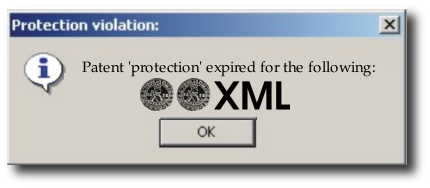
Novell wants to make more/most of the money from the project (support contracts) while at the same time ably adding some unwanted elements (and potential costs) to this hugely popular software. Novell/Microsoft use as an excuse Sun’s control, but it’s intended to increase their own control (Novell along with Microsoft) as they exaggerate existing and perceived issues in the process. It’s self serving, brutal, and dishonest. It’s about choking Sun, not just subverting Free software using patents, OOXML, and .NET (Sun is a JAVA company).

OOXML patent issue prompt

There is a rebuttal to the Novell FUD, which was posted in the GullFOSS blog. It draws some figures and concludes with the following:

OOo 3.0 was a Major Release and in it many general restructuring and refactoring was started. Also from now on the default file format is based on ODF 1.2 (the standard will be approved soon) instead of ODF 1.1 in OOo 2.x. All these changes could be done in a major step only, because of possible incompatibilities to the the 2.x code line.

This major release was a challenge for all release driver on OOo. Also the OOo teams for QA and L10N had many new things to organize, which didn’t exists on OOo 2.x code line or wasn’t a problem for that updates. Thanks to all the teams for their hard work.

The release was a success if demand is something to judge by, but enormous demand knocked down the key server (index to mirrors) at a most crucial of times. NBR has some more details on that:

One major hitch: intial interest in Open Office 3 was such that the openoffice.org download site crashed, unable to cope with the traffic (and as I write, half a day into the release, there are still “technical difficulties”).

As the world turns to cost savings and real standards like ODF, such demand needs to be expected and appropriate preparations made. As Bob Sutor indicates in his latest essay, the world is rapidly embracing ODF as a national standard. He presents a map of nations extracted from his presentation slides.

What always strikes me at such gatherings is the passion of those who have committed to adopting ODF. You get people who have decided for all the usual reasons that ODF makes sense for their use, or that of their department, or their agency, or their government. We’re seeing interesting and varying bottom up, top down, and middle out patterns of adoption in different parts of the world.

Any smart CIO (or small business) should invest in software which is controlled by customers and end users. Anything other than that, especially in schools, is a case of letting people become ‘addicted’ — as Bill Gates put it — to a particular vendor. Moreover, in the case of education, there is a chance and even a responsibility to teach children transferable skills using Free(dom) software. This can help them build their own economy (just watch Brazil go). All countries should do this and some already do.

Lastly, Ovum has this so-and-so analysis of argumentation involving document formats.

The debate on ODF versus OOXML continues to rage, with ISO offering to take on the maintenance of the ODF standard that is currently under the care of the standards body OASIS. This follows resignations from the Norwegian standards body, Standard Norge, with accusations that there were improprieties in the OOXML adoption vote.

Added below is some press coverage for a sense of completeness.

Release Coverage

Here is the press release.

Celebrated at a launch party in Paris today, and just in time for the eighth birthday of the project, the OpenOffice.org Community today announced the release of OpenOffice.org 3.0. The third major update of the leading productivity suite delivers significant enhancements and advanced, extensible, productivity tools for all users, including Mac users, as OpenOffice.org now runs natively on the Mac OS X platform.

Other coverage includes:

Heise: OpenOffice.org 3.0 Reviewed

OpenOffice.org is a free cross-platform office suite, originally developed as the proprietary StarOffice suite. It combined a word processor, spreadsheet, database and presentation tools and was available for Unix and Windows based systems. The StarOffice code was acquired by Sun Microsystems in 1999 and released under a LGPL/Sun licence in 2000. In 2005, OpenOffice.org’s licence became LGPL only, prompting greater adoption by the open source community and Linux distributions. Now, OpenOffice.org is about to release their third major version of what is the de facto standard in open source office productivity.

iTWire: OpenOffice 3.0 released, ready for download

Finally out of the beta and release candidate versions, Sun Microsystems’ OpenOffice.org 3.0 has been released for anyone to download and try for themselves. Here’s my “first look” at this brand new Office suite!

Linux.com: OpenOffice.org 3.0 is an incremental improvement

At least OpenOffice.org’s frumpy interface is familiar. And with all the changes in version 3.0, most users will probably discover at least half a dozen ways in which their office productivity is suddenly easier.

Ars Technica: OpenOffice.org 3.0 officially released

The new version offers some aesthetic enhancements and usability improvements, including a new icon set that makes the user interface cleaner and a convenient slider control for adjusting page zoom. OpenOffice.org 3.0 also has a new launcher interface, improved support for annotations, and a handful of other new features.

Examiner: Treat yourself to a suite alternative: OpenOffice.org 3.0

Your mileage will definitely vary, and how much it varies depends on just how you use these productivity applications. Although, given the fact that OpenOffice.org is one free 150MB-ish download away, it can’t hurt to give it a run in your own productivity environment.

IT Pro: OpenOffice 3.0 now available for download

New features in the word processing software ‘Writer’ include multilingual support, better zoom tools for editing, and the ability to edit web-based wiki documents. The spreadsheet, called ‘Calc’ now supports 1024 columns per sheet and a collaboration mode for multiple users, as well as a new equation solver. Graphics program ‘Draw’ can now manage images up to three square meters in size, while presentation software ‘Impress’ now has a table designer.

Web Monkey: OpenOffice 3.0 Embraces Microsoft File Formats and Adds Mac Support

Other changes include a “Start Center”, some new, more legible icons, and a zoom control in the status bar. On the whole the beta doesn’t look much different than previous versions, but each of OpenOffice’s apps have received some welcome new changes features like improved PDF creation throughout and a much better Notes tool in Writer, the OpenOffice word processor.
This last article wrongly claims that “OpenOffice 3.0 Embraces Microsoft File Formats.” It’s a common mistake that’s repeated in some other Web sites.

There will be many more articles, but most of the actual news is already out there for everyone to see.

A certain Novell hacker contacted us a couple of hours ago, so the contents of this post were changed slightly.

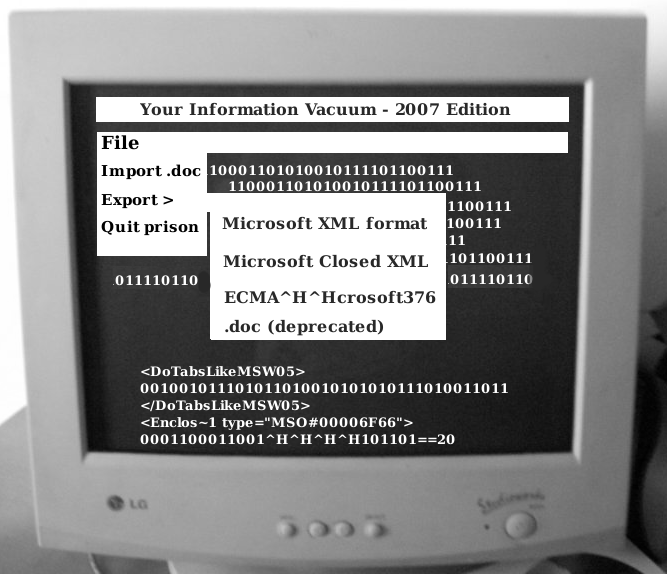
OOXML data vacuum

Share this post: These icons link to social bookmarking sites where readers can share and discover new web pages.
  • Digg
  • del.icio.us
  • Reddit
  • co.mments
  • DZone
  • email
  • Google Bookmarks
  • LinkedIn
  • NewsVine
  • Print
  • Technorati
  • TwitThis
  • Facebook

If you liked this post, consider subscribing to the RSS feed or join us now at the IRC channels.

Pages that cross-reference this one

2 Comments

  1. OO said,

    October 14, 2008 at 11:55 am

    Gravatar

    Roy, I have to wonder why you are supporting Sun in all of this. Sun added OOXML import filters to OpenOffice.org 3.0, just like the ones that Novell has added in go-oo. Sun also has a patent agreement with Microsoft that is virtually identical to the one that Novell has.

    Microsoft and Sun Microsystems Enter Broad Cooperation Agreement; Settle Outstanding Litigation
    http://www.microsoft.com/presspass/press/2004/apr04/04-02SunAgreementPR.mspx
    “The parties have agreed to a broad covenant not to sue with respect to all past patent infringement claims they may have against each other. The agreement also provides for potential future extensions of this type of covenant. The two companies have also agreed to embark on negotiations for a patent cross-license agreement between them.”

    OpenOffice: A legal Trojan horse–but for whom?
    http://news.zdnet.com/2100-3513_22-138515.html
    “Bishop reached his conclusion after an examination of a document called the Limited Patent Convenant and Stand-Still Agreement that was recently filed by Sun with the Securities and Exchange Commission (SEC). The document included previously undisclosed text from the legal agreements that codify Microsoft and Sun’s recently forged partnership — text that results in significant legal protection for customers of StarOffice, but that explicitly denies that same protection to users of OpenOffice.”

  2. Roy Schestowitz said,

    October 14, 2008 at 12:01 pm

    Gravatar

    This is ancient and the experience since it happened surely shows that interpretation as flawed to the point of being inverted.

    The more recent development revolves around the threats in May 2007 (from Microsoft against OpenOffice.org).

What Else is New


  1. Links - MSNokia Passes Blame, Bill Gates pushes GMOs, Open Access news


  2. Links 7/2/2012: Firefox 11 Enters Beta, Canonical Disappoints KDE

    Links for the day


  3. IRC Proceedings: February 6th, 2012

    IRC logs for February 6th, 2012


  4. IRC Proceedings: February 5th, 2012

    IRC logs for February 5th, 2012


  5. Links 6/2/2012: PCLinuxOS 2012.02 and Mint KDE Reviews

    Links for the day


  6. Bill Gates Indoctrinates Youth in the United States and India, Critics Speak Out

    Backlash against the Gates Crusade to brainwash the young minds all around the world


  7. Bill Gates Uses Symbolic 'Donation' to Force Taxpayers to Pay Microsoft (of Which He Holds Shares)

    The Gates Foundation goes lobbying for Microsoft again, this time in Vietnam


  8. Monopoly as Innovation?

    Challenging the old misconception that patents are beneficial to anything but few multinationals and their patent lawyers


  9. Links 5/2/2012: Lenovo in India, Netrunner 4.1 is Out

    Links for the day


  10. IRC Proceedings: February 4th, 2012

    IRC logs for February 4th, 2012


  11. OpenStack, Microsoft, Junk Patents, Microsoft Copyrights, and Oracle Copyrights

    Another look at the OpenStack situation, why Microsoft should not be allowed to enter, and more about patent and copyright complications


  12. Apple, Which Started Patent Wars, Gets What It Deserves

    Apple products get banned (for the time being) after Apple decided to attack Linux-supporting competitors and then received some blowback


  13. Unitary Patent and the Emergence of More Junk Patents

    The rise of the junk patents and what we are taught about them by the news, including some news about the unitary patent in Europe


  14. Backlash Against Bill Gates' Lobbying for Patented Life

    GMO, a robbery of the right of reproduction (and a potential health hazard), is promoted by Bill Gates for profit, whereupon critics strike back


  15. IRC Proceedings: February 3rd, 2012

    IRC logs for February 3rd, 2012


  16. Links 4/2/2012: Ubuntu 12.04 Alpha 2 Preview, ACTA Backlash in Europe

    Links for the day


  17. A Glimpse at Executives Who Left the Sinking Novell Ship

    A roundup of news about former Novell staff and where that staff is moving these days


  18. Novell Makes New Software for Microsoft Windows and Office

    PR spin from Novell and money-grabbing moves that promote proprietary software rather than Free/Open Source software


  19. Links 3/2/2012: BT Vision Goes for Linux, Linux 3.3 With Android

    Links for the day


  20. Debt in Attachmate

    The company that bought Novell has a poor outlook, financial issues, and little signs of expansion/renaissance


  21. Longtime SUSE Executive Holger Dyroff Moves on, SUSE in a Bad State

    Key people continue to leave SUSE and the distribution is left without a compelling sales pitch


  22. Groklaw Update on Android Patent Cases and Response to FUD From Microsoft Lobbyists

    A few updates of greater importance where the Linux situation is discussed in the context of Android and Novell


  23. IRC Proceedings: February 2nd, 2012

    IRC logs for February 2nd, 2012


  24. Links 2/2/2012: DEFT Linux 7, Mozilla Firefox 10

    Links for the day


  25. IRC Proceedings: February 1st, 2012

    IRC logs for February 1st, 2012


  26. IRC Proceedings: January 31st, 2012

    IRC logs for January 31st, 2012


  27. IRC Proceedings: January 30th, 2012

    IRC logs for January 30th, 2012


  28. Bill Gates is Hijacking Open Source While Attacking It Using Lobbyists, Patents, and Patent Trolls

    Response to reputation laundering from Wired Magazine, the latest nonsense from Microsoft's lobbyist Florian Müller, an update on Microsoft's trolling against Android, and a little more of Apple's


  29. The Gates Foundation is Still Hijacking the Voice of the Poor and Effectively Runs Paid Advertisements Inside 'News'

    Money still the vehicle by which opinions get heard, so Bill Gates exploits this for fame, power, and profit


  30. Bill Gates and Rupert Murdoch Liaise to Take Over Minds of Children

    The latest dangerous hijack of education systems and the role played by creepy plutocrats with control over the press


RSS 64x64RSS Feed: subscribe to the RSS feed for regular updates

Home iconSite Wiki: You can improve this site by helping the extension of the site's content

Chat iconIRC Channel: Come and chat with us in real time

Recent Posts