
EditorsAbout the SiteComes vs. MicrosoftUsing This Web SiteSite ArchivesCredibility IndexOOXMLOpenDocumentPatentsNovellNews DigestSite NewsRSS

03.05.10

Microsoft Brand Far from Respected (Says Fortune), Company’s Future May Resemble Sun’s Trajectory (Says BNET)

Posted in Free/Libre Software, GNU/Linux, Microsoft, Novell, Oracle, Red Hat, SUN, Virtualisation, VMware, Xen at 9:13 am by Dr. Roy Schestowitz

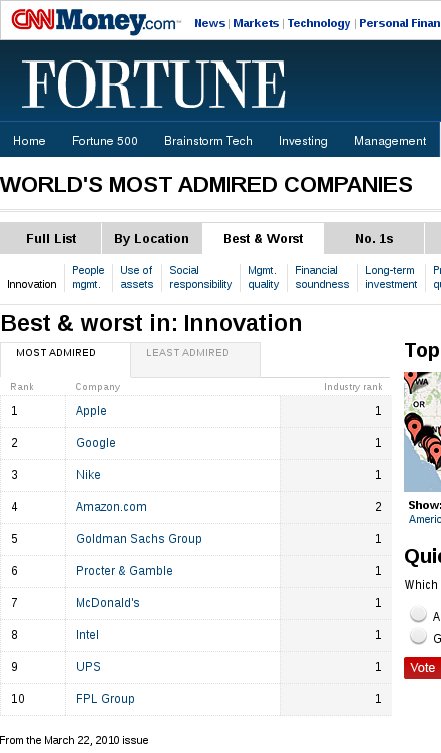
Fortune brands

Summary: Microsoft has issues evolving, its brand is falling down the ranks, its attempts to mimic open source mostly fail (despite media blitz), and Red Hat copes with Microsoft’s attempt to swallow virtualisation

MICROSOFT’S exacerbating financial performance (see analysis of the latest results in [1, 2, 3, 4]) may explain its increased racketeering (last example from yesterday). With ever-decreasing margins, Microsoft must find an alternative business model. So far, Microsoft has failed to mimic Google’s model (Microsoft loses over $2,000,000,000 per year in this area), so it decided to use regulators and lawsuits by proxy to hurt Google. Microsoft did the same thing to GNU/Linux by funding SCO, for example.

Microsoft’s control of the mainstream media usually prevents access to simple facts that are not hard to show and to defend. When some single firm from the UK hailed the Microsoft brand last month, nobody dares to question the data, the methods, and the population questioned. In fact, that single source was quoted extensively outside the UK in order to sell the impression that the Microsoft brand has power.

“When some single firm from the UK hailed the Microsoft brand last month, nobody dares to question the data, the methods, and the population questioned.”CNN/Fortune has just released a list of “The Most Admired Companies in the World”. Apple and Google top the list and Microsoft is not even in it (it is not among the worst brands, either). In any case, it is clear that Microsoft dropped sharply and this agrees with 3-4 similar surveys from 2008. They have all shown that Microsoft’s reputation was declining rapidly.

“Windows breeds fear and ignorance,” said this one blogger a couple of days ago. “And I put the blame squarely on Windows,” he added after explaining an experience with an indoctrinated individual. A few days ago we also cited a post from Jeremy Allison — one where he speaks about his days in Sun Microsystems. Here is an example of a company that was once so gigantic and formidable. Where is it today? It is in Oracle, which some notable people whom we cannot name just yet are about to leave (we received private communication about it).

“Sun Fell Prey to Open-Washing,” says BNET in the headline that continues: “Who’s Next? Microsoft?”

Here is a key part of the argument:

Openwashing is similar to greenwashing, in which a company markets itself as environmentally friendly but is actually faking it. A high tech firm openwashes itself when it makes noises about open software but is really interested in preserving its proprietary offerings and hampering free open systems practices.

So basically, BNET explains that excessive desire for control over developers cost Sun its existence. This agrees with what Jeremy Allison wrote and Bradley Kuhn wrote about that too.

Meanwhile, I’m less optimistic than Jeremy on the future of Oracle. I have paid attention to Oracle’s contributions to btrfs in light of recent events. Amusingly, btfs exists in no small part because ZFS was never licensed correctly and never turned into a truly community-oriented project. While the two projects don’t have identical goals, they are similar enough that it seems unlikely btrfs would exist if Sun had endeavored to become a real FLOSS contributor and shepherd ZFS into Linux upstream using normal Linux community processes. It’s thus strange to think that Oracle controls ZFS, even while it continues to contribute to btrfs, in a normal, upstream way (i.e., collaborating under the terms of GPLv2 with community developers and employees of other companies such as Red Hat, HP, Intel, Novell, and Fujitsu).

The moral of this story is that control over what developers could and could not do is what drove many people away and made Sun history. Microsoft is facing similar problems right now and it tries to ‘embrace’ (in “EEE” sense) the Free/open source arena in order to recapture developers. It’s not quite working.

A reader sent us this pointer to a Microsoft project yesterday. “Pay Microsoft more money to secure insecure Microsoft software” is how our reader described it. He said that “it’s released under an ‘open-source license’, except it only runs on Windows, the monoculture.” To quote from the project’s page: “U-Prove is an innovative cryptographic technology that enables the issuance and presentation of cryptographically protected claims in a manner that provides multi-party security: issuing organizations, users, and relying parties can protect themselves not just against outsider attacks but also against attacks originating from each other…”

If this is an example of “open source” at Microsoft, then it’s more or less a farce. Microsoft’s own ‘news’ site, MSN, has just published some promotion of the “Microsoft-seeded foundation”.

A Microsoft-seeded, open-source organizer picked a Headspring Systems project for its first non-Microsoft sponsored effort.

Yes, Microsoft is organising a bit of a press tour [1, 2] to promote the CodePlex Foundation [1, 2, 3, 4, 5, 6, 7], where Microsoft MVP Miguel de Icaza is on the board. Here is the ‘Microsoft press’ promoting a .NET obfuscator. That’s the type of stuff Microsoft calls “open source”. It’s all about Windows, .NET, Silver Lie, etc. And how typical it is for CIOL to be pimping (with links) Microsoft’s smears of Free software, under the confusing headline “Open source slowly gaining momentum in India”. Are they trying to pretend that Silver Lie is “open source” or just lump Microsoft in? Here is part of it:

Developers in India are not much aware about open source technologies and there aren’t much good development tools and support for them, says Joydip Kanjilal, ASP.NET professional at Microsoft, in conversation with CIOL.

In another new article, CIOL promotes a form of EDGI that goes under the *Spark banner [1, 2, 3, 4, 5]. CIOL is rewriting many press releases, as we pointed out before, but its shallow promotion of Microsoft requires some criticism too.

Another branch of the ‘Microsoft press’, namely the Microsoft Subnet at IDG, is doing some PR for Microsoft by saying that there is “much fanfare” over Red Hat support in Hyper-V (whose fanfare? Microsoft’s?).

With much fanfare, Microsoft first submitted said drivers to the Linux kernel way back in July (its first, and so far only, contribution to Linux, for obvious reason). Those drivers were already tested to work with Red Hat and, of course, SUSE. And in October, Red Hat and Microsoft announced that they were joining each other’s virtualization partnership programs, and validated that their products worked on each other’s virtual machines. So what took Microsoft so long to release these Red Hat drivers to the public?

People have other virtualisation options, they don’t need Microsoft’s proprietary one. Let’s not forget the GPL violation that’s associated with Microsoft’s offering [1, 2, 3].

Regarding the virtualisation arrangement Microsoft has with Red Hat, it is a subject that we summarised a year ago. Red Hat is now backing virtualisation research (yes, Free software conducts research too, contrary to myths).

Red Hat is funding a new research centre at Newcastle University that is looking into areas such as grid and cloud computing, virtualisation and middleware.

Among Red Hat’s competitors in this area there’s Microsoft, its ally Novell, and VMware, which is run by former Microsoft executives [1, 2, 3, 4]. Here is a new article on the subject:

Red Hat sees the virtualisation market developing into a three-way fight between itself, Microsoft and VMWare as the technology is increasingly taken up in the business space, Red Hat’s senior director of virtualisation, Navin Thadani, said today.

However, he said, the advantage would lie with the two operating system companies, adding that although Novell and Citrix had teamed up to contest the same space, they stood more of a chance in the desktop virtualisation arena.

A year ago we explained how Microsoft distorted the Linux and virtualisation markets. With former Microsoft employees running VMware, a Microsoft ally running Xen (Citrix), and another Microsoft ally seemingly trying to conquer KVM (that would be Novell), the pressure is on Red Hat, which arguably bought KVM’s parent company because of Microsoft’s disruptive moves.

“Microsoft is unique among proprietary software companies: they are the only ones who have actively tried to kill Open Source and Free Software. It’s not often someone wants to be your friend after trying to kill you for ten years, but such change is cause for suspicion.”

Bradley M. Kuhn (SFLC)

Share this post: These icons link to social bookmarking sites where readers can share and discover new web pages.
  • Digg
  • del.icio.us
  • Reddit
  • co.mments
  • DZone
  • email
  • Google Bookmarks
  • LinkedIn
  • NewsVine
  • Print
  • Technorati
  • TwitThis
  • Facebook

If you liked this post, consider subscribing to the RSS feed or join us now at the IRC channels.

Pages that cross-reference this one

7 Comments

  1. Needs Sunlight said,

    March 5, 2010 at 12:40 pm

    Gravatar

    Hey. Sun does not deserve that kind of disparagement. It’s a good company with good products and has in the past been a truly awesome company and greatly respected.

    Microsoft has always made garbage products which have been, at best, laughed at, along with the dweebs that peddle or apologize the One Microsoft Way. Sure it puts food on the table, but so does selling crack, that’s not an excuse for what the dweebs are doing to the country.

    Roy Schestowitz Reply:

    I was not disparaging Sun’s products, just their financial performance in recent years.

    Needs Sunlight Reply:

    Much of that appears to be the result of “The Slog” and is both self-fulfilling and self-perpetuating. Only a few of their own staff have fallen victim to the psyops. The rest comes from without.

    The talk of server consolidation is in no small part the result of the mess created by drifting away from Linux / Solaris (both open source) on SPARC (open architecture: http://www.opensparc.net/) Wintel can’t handle the work load. Go into a Windows shop’s server farm and you’ll see 3:1 or worse hardware to service ratio instead of 1:16 or so. Some places have almost one Wintel server per every two staff members. At a global level, a small country could be powered by that wasted electricity.

    Roy Schestowitz Reply:

    Yes, in many cases history shows that best products just rarely win.

    Robotron 2084 Reply:

    I’m amazed that you would defend a company consisting of individuals who in all likelihood have no awareness of your existence by using schoolyard insults towards their competitor. Calling people dweebs? How could this not be construed as ‘Trolling’?

    Granted, it’s not a whole lot different than a sports fan rooting for his favorite team while badmouthing their opponents, but it still seems far out of place.

    your_friend Reply:

    Sun had great technical prowess but it clung to non free models too long for the company’s own good. While we can and should admire the GPLing of Java, for example, this came about a decade too late. Open Solaris was a good start but plans were laid to make that the default Solaris as Sun was on the chopping block. Sun, like other Unix companies, suffered when they all reinvented non free wheels on top of Unix instead of sharing the work and distinguishing themselves in service and hardware alone. The technical excellence of their software was always doomed, in the long run, to free software imitation. It would have been better for them to have not wasted their resources and everone else’s resources that way. Freedom succeeds, survives and is largely slog proof.

    Roy Schestowitz Reply:

    Oracle has taken the Free software projects of Sun seriously enough so far, except GNOME accessibility.

What Else is New


  1. Links - Anti-Trust Roundups - Yahoo, Nokia, Barns and Nobel


  2. Links - MSNokia Passes Blame, Bill Gates pushes GMOs, Open Access news


  3. Links 7/2/2012: Firefox 11 Enters Beta, Canonical Disappoints KDE

    Links for the day


  4. IRC Proceedings: February 6th, 2012

    IRC logs for February 6th, 2012


  5. IRC Proceedings: February 5th, 2012

    IRC logs for February 5th, 2012


  6. Links 6/2/2012: PCLinuxOS 2012.02 and Mint KDE Reviews

    Links for the day


  7. Bill Gates Indoctrinates Youth in the United States and India, Critics Speak Out

    Backlash against the Gates Crusade to brainwash the young minds all around the world


  8. Bill Gates Uses Symbolic 'Donation' to Force Taxpayers to Pay Microsoft (of Which He Holds Shares)

    The Gates Foundation goes lobbying for Microsoft again, this time in Vietnam


  9. Monopoly as Innovation?

    Challenging the old misconception that patents are beneficial to anything but few multinationals and their patent lawyers


  10. Links 5/2/2012: Lenovo in India, Netrunner 4.1 is Out

    Links for the day


  11. IRC Proceedings: February 4th, 2012

    IRC logs for February 4th, 2012


  12. OpenStack, Microsoft, Junk Patents, Microsoft Copyrights, and Oracle Copyrights

    Another look at the OpenStack situation, why Microsoft should not be allowed to enter, and more about patent and copyright complications


  13. Apple, Which Started Patent Wars, Gets What It Deserves

    Apple products get banned (for the time being) after Apple decided to attack Linux-supporting competitors and then received some blowback


  14. Unitary Patent and the Emergence of More Junk Patents

    The rise of the junk patents and what we are taught about them by the news, including some news about the unitary patent in Europe


  15. Backlash Against Bill Gates' Lobbying for Patented Life

    GMO, a robbery of the right of reproduction (and a potential health hazard), is promoted by Bill Gates for profit, whereupon critics strike back


  16. IRC Proceedings: February 3rd, 2012

    IRC logs for February 3rd, 2012


  17. Links 4/2/2012: Ubuntu 12.04 Alpha 2 Preview, ACTA Backlash in Europe

    Links for the day


  18. A Glimpse at Executives Who Left the Sinking Novell Ship

    A roundup of news about former Novell staff and where that staff is moving these days


  19. Novell Makes New Software for Microsoft Windows and Office

    PR spin from Novell and money-grabbing moves that promote proprietary software rather than Free/Open Source software


  20. Links 3/2/2012: BT Vision Goes for Linux, Linux 3.3 With Android

    Links for the day


  21. Debt in Attachmate

    The company that bought Novell has a poor outlook, financial issues, and little signs of expansion/renaissance


  22. Longtime SUSE Executive Holger Dyroff Moves on, SUSE in a Bad State

    Key people continue to leave SUSE and the distribution is left without a compelling sales pitch


  23. Groklaw Update on Android Patent Cases and Response to FUD From Microsoft Lobbyists

    A few updates of greater importance where the Linux situation is discussed in the context of Android and Novell


  24. IRC Proceedings: February 2nd, 2012

    IRC logs for February 2nd, 2012


  25. Links 2/2/2012: DEFT Linux 7, Mozilla Firefox 10

    Links for the day


  26. IRC Proceedings: February 1st, 2012

    IRC logs for February 1st, 2012


  27. IRC Proceedings: January 31st, 2012

    IRC logs for January 31st, 2012


  28. IRC Proceedings: January 30th, 2012

    IRC logs for January 30th, 2012


  29. Bill Gates is Hijacking Open Source While Attacking It Using Lobbyists, Patents, and Patent Trolls

    Response to reputation laundering from Wired Magazine, the latest nonsense from Microsoft's lobbyist Florian Müller, an update on Microsoft's trolling against Android, and a little more of Apple's


  30. The Gates Foundation is Still Hijacking the Voice of the Poor and Effectively Runs Paid Advertisements Inside 'News'

    Money still the vehicle by which opinions get heard, so Bill Gates exploits this for fame, power, and profit


RSS 64x64RSS Feed: subscribe to the RSS feed for regular updates

Home iconSite Wiki: You can improve this site by helping the extension of the site's content

Chat iconIRC Channel: Come and chat with us in real time

Recent Posts