
Bonum Certa Men Certa

EPO and Microsoft Collude to Break the Law -- Part VI: A Not-so-safe Harbour

Previous parts:


Safe Harbour
Thanks to the efforts of Max Schrems, the Safe Harbour Agreement was invalidated in October 2015


Summary: Examining the so-called 'Safe Harbour' Agreement, which was neither safe nor a harbour

To ensure that the personal data of European citizens was protected in a manner complaint with EU data protection regulations after it had been transferred to the USA, deals such as the Safe Harbour Agreement and the EU-US Privacy Shield were drafted and implemented to address the shortcomings of nationwide data protection in the USA.


As it turned out, these agreements did not last very long. The Court of Justice of the EU (CJEU) overturned them both because in practice they did not live up to the agreed data protection standards.

These CJEU rulings were a slap in the face for the politicians in the European Parliament who had rubber-stamped the agreements despite warnings from data protection advocates.

The CJEU judgements also gave a clear indication that future agreements of this kind must deliver genuine data protection if they are to be upheld.

"On top of this, there is also the concern and suspicion that commercially lucrative data from the EU can (and will) be tapped on the American side."This effectively creates an impasse because US providers are subject to American legislation such as the PATRIOT Act, the USA FREEDOM Act, and the CLOUD Act, which are designed to ensure that US authorities and intelligence agencies have access to personal data of EU citizens.

On top of this, there is also the concern and suspicion that commercially lucrative data from the EU can (and will) be tapped on the American side.

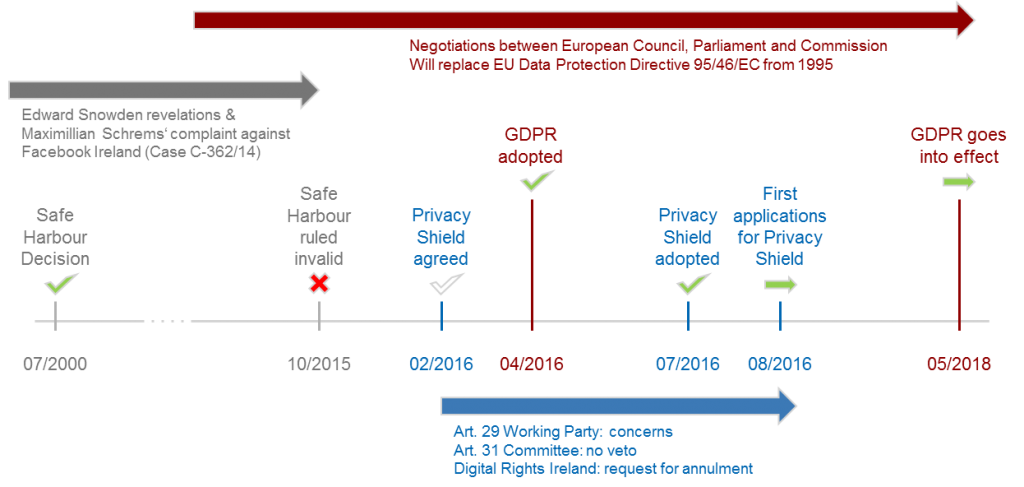
However, in July 2000, in the context of an examination of the adequacy of the protection of personal data transferred to other countries, the European Commission took the position that the "Safe Harbour" principles developed by the US were in compliance with Article 25 of the EU Data Protection Directive 95/56/EC and would provide "adequate protection" for the transfer of personal information from the EU to the US.

The European Commission thus gave approval for transfers of personal data to the US by means of executive decision no. 2000/520/EC, the so-called "Safe Harbour decision".

However, in 2013 this decision was called into question by the Snowden revelations.

The game was over on 6 October 2015 when the CJEU delivered its judgment in the case of Maximillian Schrems v Data Protection Commissioner.

"...in 2013 this decision was called into question by the Snowden revelations."In this judgment the Court invalidated the European Commission's Safe Harbour Decision, because "legislation permitting the public authorities to have access on a generalised basis to the content of electronic communications must be regarded as compromising the essence of the fundamental right to respect for private life".

Maximillian Schrems
Max Schrems in front of the office of the Irish Data Protection Commissioner in Dublin


This landmark judgment of the CJEU in data protection matters which is colloquially known as "Schrems I" was largely due to the efforts of one individual, the Austrian activist and author Maximilian "Max" Schrems who had initiated a legal action in his capacity as a Facebook user claiming that his Facebook data were insufficiently protected.

In essence Schrems argued that the Safe Harbor system would violate his fundamental right to privacy, data protection and the right to a fair trial under the Charter of Fundamental Rights of the European Union.

The striking down of the Safe Harbour Decision by the CJEU resulted in further talks between the EU Commission and the Obama Administration aimed at establishing "a renewed and sound framework for transatlantic data flows".

The outcome of these talks was a revised framework for regulating transatlantic exchanges of personal data which became known as the EU-US Privacy Shield.

"...the Privacy Shield turned out to be rather porous and it was also struck down by the CJEU in July 2020 in the context of a further legal challenge mounted by Max Schrems."The European Commission approved the Privacy Shield on 12 July 2016 and it entered into effect the same day.

However as we shall see in the next part, the Privacy Shield turned out to be rather porous and it was also struck down by the CJEU in July 2020 in the context of a further legal challenge mounted by Max Schrems.

Recent Techrights' Posts

Over at Tux Machines...
GNU/Linux news for the past day
IRC Proceedings: Friday, July 10, 2026
IRC logs for Friday, July 10, 2026
Links 11/07/2026: Wednesday-Saturday News Catch-up
Links for the day
Prioritising High-Importance News
In order to fully catch up with news we'll not publish many new articles until next week
The Register MS: "AI" More Than 80 Times in One Article. But It's Not an Article, It's Sponsored Keyword-stuffed Page.
The Register MS is being paid to actively promoted this scheme
Over at Tux Machines...
GNU/Linux news for the past day
IRC Proceedings: Thursday, July 09, 2026
IRC logs for Thursday, July 09, 2026
Over at Tux Machines...
GNU/Linux news for the past day
IRC Proceedings: Wednesday, July 08, 2026
IRC logs for Wednesday, July 08, 2026
Over at Tux Machines...
GNU/Linux news for the past day
IRC Proceedings: Tuesday, July 07, 2026
IRC logs for Tuesday, July 07, 2026
Links 07/07/2026: Microsoft Cuts Doom "id Software" and Turkey Detains Journalists
Links for the day
Gemini Links 07/07/2026: Old Computer Challenge (OCC) and Hardware Tests
Links for the day
A Break From the Routine
What matters is what whistleblowers keep feeding information to us
SLAPP Censorship - Part 132 Out of 200: When You Cannot Pay a Million Pounds (1,335,520.00 United States Dollar) to Lawyers But Have a Strong Community
Techrights compensates for its fiscal poverty with a wealth of community spirit