
Bonum Certa Men Certa

David Kappos Leaves as He Loses the Debate and Software Patents Lose Legitimacy Among Public Figures

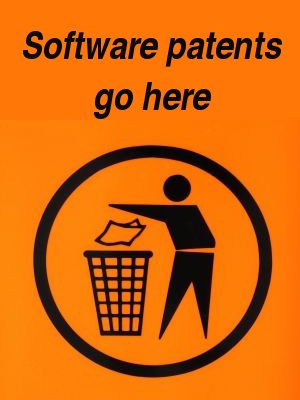
Keep clean


Summary: A roundup of software patents news, especially published opposition

SO days ago we learned that Kappos had decided to quit, just shortly after he was slammed by some media sites and especially blogs (people, not corporate press). Here is a blog in Murdoch's site speaking about the news, which is a PR disaster for the USPTO:


U.S. Patent and Trademark Office Director David Kappos, who oversaw the agency during the biggest change to the patent system in decades, will leave his post in January, according to a PTO spokesman.

During his three-and-a-half year tenure, Mr. Kappos was widely credited for making the agency more efficient.


Or conversely, he was criticised for creating more monopolies by lowering bars of entry. Here he is spreading IBM mythology about software patents this month. Even an IBM proponent, Pamela Jones, was upset by this. She wrote: "I don't believe a word of this is so. It's mythology. Software is not benefited by patents at all and it impedes innovation. It is toxic to Free and Open Source software, which is developed in a shared environment which is the opposite of what patents are about. Nor does the public benefit from patents on software, because they get less functionality than they otherwise could have. Patents benefit the incumbents. It's not the innovators who start throwing patents around, but rather it was Microsoft, Apple, Oracle and Nokia who started the war. Why? They don't want to have to compete with Android, and if they have to they want to make Android pay them to survive at all, meaning prices for the public will go up. And the level of "innovation" represented by the patents in this smartphone war is so low it's a joke. No one should be entitled to get money for such things as rounded corners or a bounceback function. It's stupid from beginning to end and while large companies like IBM or Microsoft may benefit by muscle-ing the new players, the public in no way benefits from companies having to rework their phones to try to avoid those stupid, too-broad patents on problems, as opposed to ways to address a problem, or on functionality that everyone knows how to do without any patents showing them how. I could go on, but this speech is proof to me that the USPTO will not improve and getting rid of software patents or the harm they cause is goal number one."

Eric Goldman, who now writes for Forbes blogs, also slammed software patents yesterday:

The U.S. patent system largely treats all innovations equally, but innovation often works quite differently in different industries. In particular, the software industry differs from other major innovative industries–such as computer hardware and biotech/pharmaceuticals–in several key ways, and those differences can create (and have created) significant friction for the patent system.

Software patents have also created big–and expensive–problems for companies throughout all sectors of our economy. Pretty much as soon as they get venture financing, start-up companies are getting approached by “patent trolls” with offers they can’t refuse: pay me now or pay your lawyer many times that amount to prove you don’t have to pay me. And large companies, especially in the smartphone industry, are paying literally billions of dollars to acquire patent portfolios to keep those portfolios from falling into the wrong hands and with the hope that large patent portfolios will fend off competitor threats (i.e., provide the company freedom to operate its business without interference from competitors’ patents).


The Atlantic shared this cartoon we promoted yesterday and it's introduced as follows:

The Best Cartoon You'll Ever Watch About Ending Software Patents


If there's one thing Schoolhouse Rock taught us all, it's that the easiest way to explain a dry topic to someone with a short attention span is to show them a cartoon. So kudos to George Mason University economist Alex Tabarrok and Idea Rocket Animation for putting together this delightful two-minute clip laying out the case against software patents, a by and large nerds-only conversation topic that deserves way more attention than it receives. The video's got Jeff Bezos, a club-wielding giant, Isaac Newton, a crashing airplane, and a surprisingly funny joke about licensing fees. Best yet, it's explained in language anyone -- even a Congressman -- could understand.

Just in case those two minutes are too long, though, here's Tabarrok's point in brief: Patents make sense for products, like pharmaceuticals, that are expensive to develop, but cheap to copy. That's because nobody would spend the money to create them if a competitor could just swoop in and steal their work. But software doesn't need that protection. It's less expensive to create and less disastrous if someone else imitates your work. Moreover, huge patent portfolios let companies keep competitors out of their market, which slows down innovation.


We recently learned from people who attended the event on software patents (seemingly stacked by people who are not programmers, as usual) how it went and Masnick published his contribution to this debate:


First off, I know that some patent system defenders took great offense to the idea that the event wasn't "balanced" with system supporters. Nearly every speaker presented an aspect of how the system was broken with suggestions to fix it. But I see this complaint as being misleading. There's this random belief out there that conference panels need to be "balanced" with "pro & con" and then let the panelists argue things out. I've argued against this in the past when setting up panels for other events, and with the events that we run, we've tried to avoid that concept as well. While just setting up pro vs. con can make for an entertaining session, it rarely leads to productive discussions that move the conversation forward. They just lead to people arguing past each other. A productive event is one in which people agree on a basic premise or problem and are then working towards possible responses. That's what this was. It was a conference for those who believe the system is broken. Given that assumption, the point of the event was to suggest possible solutions. There are plenty of events where patent system defenders and skeptics can argue against each other, but I can't think of another where people were able to dig in deep on possible fixes.

[...]

And, just to address this one point before one of our regular patent lawyer commenters tries to make it in the comments: there is an argument among patent system supporters that there is no such thing as a "software patent" and thus any argument that uses that term is meaningless. This is both slightly true and (more importantly) a distortion of the larger issue. As was discussed at the conference, there is a difference between software and hardware that can't be denied. One involves moving around bits. One doesn't. So it's not difficult to define software differently from hardware. The real problem is that if we did carve out software from patentability, it's likely that crafty patent lawyers would quickly figure out how to rewrite patent claims to make them broadly cover the same concepts in a way that could be seen as not being "software." Given all that, I think it's quite legitimate to discuss "patents that cover software" as "software patents," even while I agree that merely targeting "software patents" misses the larger problem.


All in all, a lot of opposition to software patents could be found lately.

Recent Techrights' Posts

SLAPP Censorship - Part 32 Out of 200: Garrett Made Spurious Requests (Later Withdrawn) the Same Week Someone He Later Spoke to by E-mail Sent Threats to Our Webhost
The "plot thickens" because there's a multi-party tag-team act, as confirmed by Garrett after he had sworn on the Bible
 
Links 04/04/2026: Social Control Media Verdict and Bans, Whistleblower (Axel Rietschin) Explains How "Microsoft Vaporized a Trillion Dollars"
Links for the day
Reaching the End/Event Horizon of LLM Slop
Are we moving towards a post-LLMs world?
Over at Tux Machines...
GNU/Linux news for the past day
IRC Proceedings: Friday, April 03, 2026
IRC logs for Friday, April 03, 2026
Gemini Links 04/04/2026: STXGE and Computer Relationships
Links for the day
SLAPP Censorship - Part 33 Out of 200: Garrett Sued by My Wife and I, Then His Microsoft Acquaintance Files Another Lawsuit and Our Webhost Receives Legal Threats Too
Today we also show how our solicitor Mark Lewis responded to it
Good Friday, Leaving IBM for Good
Even on holidays
Links 03/04/2026: Rejection of More Software Patents and Social Control Media in Several Continents
Links for the day
Malware in Proprietary Software - Latest Additions by Rob Musial
Original published yesterday in gnu.org
Visual Evidence/Documentation of IBM Dying Like the Dinosaurs
IBM has many of these giant white elephants lying around, with some getting demolished
Links 03/04/2026: USPTO’s Latest Greenwashing and Internet Blackouts Impact Journalists in War Zones
Links for the day
IBM is a Dying Company, Nowadays It Kills Red Hat With Slop
when your last day is a national holiday in IBM's country
"Independence Drives" and Community-Run Sites
Independence in reporting is a much-valued trait
When Charlatans Are Only Good at Losing Money and Storytelling (e.g. About Investment in Them)
Wait till a a barrel of oil costs $300
What Apple Fans Are Missing
Apple is a bad company
The "Pale Blue Dot" Moment Had Returned
To many people, the "bitter-sweet" observation of how small we are
Saudi Arabia Does Not Rely Much on Microsoft/Windows
Putting aside politics, this is good for Free software
Almost 12 Years of Exposing Corruption in Europe's Second-Largest Institution
The "unready" President is now an abandoned President
Easter Moon Mission and Its Reminder of IBM's Demise
A lot of NASA operations now rely on GNU/Linux
When Power is Scarce and GNU/Linux Has Power
In Cuba, GNU/Linux has long enjoyed high adoption rates
Don't Totally Dismiss the 'Survivalists'
'Survivalists' or similar terms are used to describe a particular mindset of people who prepare for some really awful scenarios
Over at Tux Machines...
GNU/Linux news for the past day
IRC Proceedings: Thursday, April 02, 2026
IRC logs for Thursday, April 02, 2026
A Much Better Use of Fuel Than Slop
Something positive for a change
Hoping for Peace
There are still many things to be enjoyed, including nature and kind people
Gemini Links 03/04/2026: "Slide Rule Triple Multiplication" and End of "Picture Pages"
Links for the day
Rumours of Microsoft Layoffs This Season
Just how much trouble is Microsoft in at this point?
GNU/Linux Measured at All-Time High in Sweden
Can 'influencers' have played a role
SLAPP Censorship - Part 31 Out of 200: Speaking About 20+ Years of Alleged Harassment/Defamation and High-Profile 'Targets' of Garrett
attempts were made to settle (in effect end the case) by the person who started the case almost half a dozen times along the way
In Asia, Windows is in Its Teens (Below 20%)
On a global scale, Windows is down to about 26%
GNU/Linux Becoming More Universal
It seems likely the end of Vista 10 coinciding with a sharp rise in memory prices (and now energy prices) will benefit GNU/Linux and therefore give us more to write about
Low Morale at IBM and Perception of Destructive Management
IBM is going nowhere, fast
Gemini Links 02/04/2026: Super Mario Galaxy Movie and New Antenna Instance
Links for the day
It Seems Like Google News Cracked Down on (Omitted, Delisted) a Lot of Slopfarms
There's no justification/point in spending so much energy just to plagiarise things poorly
Can Economies Like the American One Hang On?
The coming weeks will be "interesting" unless wars end
Steam Survey for Last Month Says 5.33% Use GNU/Linux
big leap for GNU/Linux
Links 02/04/2026: Science News, Energy Scarcity, Oil Sold in Yuan
Links for the day
Links 02/04/2026: Apple Turns 50, Efforts To Ban VPNs
Links for the day
Gemini Links 02/04/2026: Kubernetes With FreeBSD, OFFLFIRSOCH, and Great Circle Distance
Links for the day
Dr. Andy Farnell on Microsoft Silencing or Deplatforming Opposition in the UK and Elsewhere
Microsoft as a king or a kind of "religion" one cannot question
Over at Tux Machines...
GNU/Linux news for the past day
IRC Proceedings: Wednesday, April 01, 2026
IRC logs for Wednesday, April 01, 2026