
Response to Another New Hit Piece About Richard Stallman (RMS)
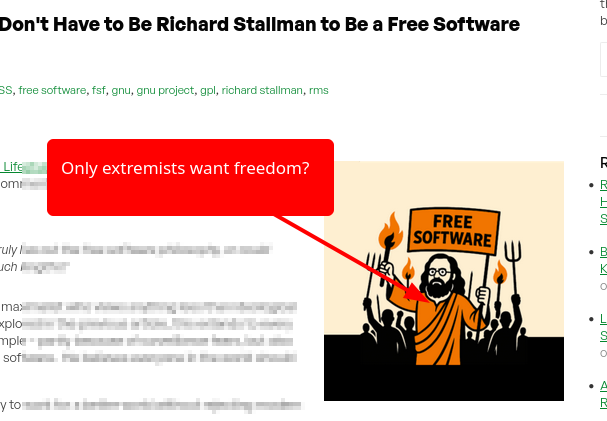
"No Comments", says the new "hit piece" foreshadowed last week. We said we'd likely do a rebuttal to it, just like we did last week, without linking to the "hit piece" itself. It's rather necessary, we think. We see similar smears floating about and tackling them can help not only RMS but anyone who thinks similarly about computers.
Let's respond line by line:
Our recent post, The Insanity of the Richard Stallman Lifestyle and the Psychology Behind It, has generated quite a bit of discussion on LowEndTalk, as well as a comment here on LowEndTalk.
Well, you made RMS seem like he had committed a crime. Did you not?
Calvyn Lee asked:
Do you think his extreme habits are necessary to truly live out the free software philosophy, or could someone be just as committed without going to such lengths?
Loaded question.
I think Richard Stallman’s answer to this is no. He’s a maximalist who views anything less than ideological purity as a complete betrayal of one’s views. As we explored in the previous article, this extends to every facet of his life. He doesn’t have a cell phone, for example – partly because of surveillance fears, but also because there’s no cell phone that runs on 100% free software. He believes everyone in the world should throw their cell phone away.
No, he explains why he himself does not have one.
But I think you can be a free software advocate and try to work for a better world without rejecting modern society.
Wait, "modern society" or just so-called 'modern' technology, such as "smart" things in the "smart" home?
Those are not the same thing.
To draw some parallels:You can drive a car and still be an environmentalist. If you’re somewhere and there’s no ready source of water except plastic bottles, you can buy one (and recycle it when you’re done) without self-labeling as a destroyer of the ecosystem.
You can be a capitalist without worshipping the market like a golden calf. Lots of people believe in free markets yet also support social safety nets.
There are hardcore vegans who won’t eat honey because it exploits bees, but there are plenty of pesco-vegetarians, too.
Those are bad analogies. If a high-profile environmentalist does take planes and drives a car, then environmentalists are likely to call him or her a hypocrite.
The same happens to people who protest greed or lead movements for animal rights.
For RMS, rejecting non-free things is similarly about setting an example.
Now starts some name-calling:
Stallman is a zealot.
Oh.
That’s not a personal insult – it’s a statement of style and conviction.
Not an insult.
For Stallman, there is no compromise, no gray area, no pragmatic exceptions. If your code isn’t under an FSF-approved license, you’re not part of the movement. If you use proprietary software, you’re sinning.
Sinning. Religious analogies again.
If you so much as install a driver with a binary blob, you’ve betrayed the cause. It’s a “if you’re not with us, you’re against us” mindset.
Not really. It's just that FSF does not endorse those distros.
And he’s wrong about that. Or at least, he’s wrong that everyone else needs to be that way too.
That's a matter of opinion.
You can believe in free software — passionately — without refusing to touch anything that doesn’t fit a rigid ideology. Just as faith without love is empty ritual, software freedom without practicality becomes self-defeating.
This is a celebration of compromising one's principles.
Purity is comforting because it’s simple. The real world, however, is not. And we make more progress with fewer Robespierres and more pragmatists.
No, "Purity" is not simple. And if it's a matter of leading by example, then it is about the legitimacy of one's message.
The best way to advocate for free software is to write some free software.
Which GNU does.
Linux dominates the modern datacenter because it’s free (in both senses), is high quality, and has attracted a robust ecosystem which all major software vendors plug into. Postgres continues to ascend because it’s free (in both senses), is high quality, and has attracted a robust ecosystem. Git, Python…the list goes on. Adobe Photoshop dominates that market because it’s the best product out there. If GIMP or another product was better than Photoshop, people would switch.
GIMP is part of GNU. And GNU comes from RMS.
That’s the way to make progress. Throwing your cell phone away, refusing to use DoorDash, or objecting to any video that isn’t encoded with Ogg Vorbis does nothing to push the free software agenda forward.
That's like telling a vegetarian to each "Some Meat".
The goal isn’t to worship the concept of freedom like an idol. The goal is to build a world where users have options, where software empowers instead of exploits, and where communities thrive outside corporate control. That mission doesn’t require ideological purity. It requires persistence, creativity, and inclusivity – the willingness to meet people where they are, not demand they first memorize the catechism of software freedom.
So this author likes to order food on "apps" and is seemingly insulted that some other people don't want to, at least out of principles.
You don’t have to be Stallman to care deeply about user rights, privacy, and transparency. You just have to believe that people deserve control over the tools they use, and be willing to act on it, even imperfectly.
The author gives it away and wants everyone else to do the same.
Some more name-calling:
The bottom line is that zealots start revolutions, but pragmatists build civilizations.
"Zealots".
Like George Washington?
At least that’s how I see it. How about you?
Nobody has commented. His message seems to be one of defeatism, but this time around he didn't throw lots of medical diagnoses at RMS like he did the other day. █
Related: They're Very Jealous of Richard Stallman and His Freedom (or Simple Lifestyle)