
European Patent Office (EPO) to "Eventually Eliminate the Tasks Performed by Formalities Officers"; EPO Run by People Without Experience in Patents
Last month: It's Not About What You Know, It's About Who You Know (and Stay Quiet About the Cocaine)
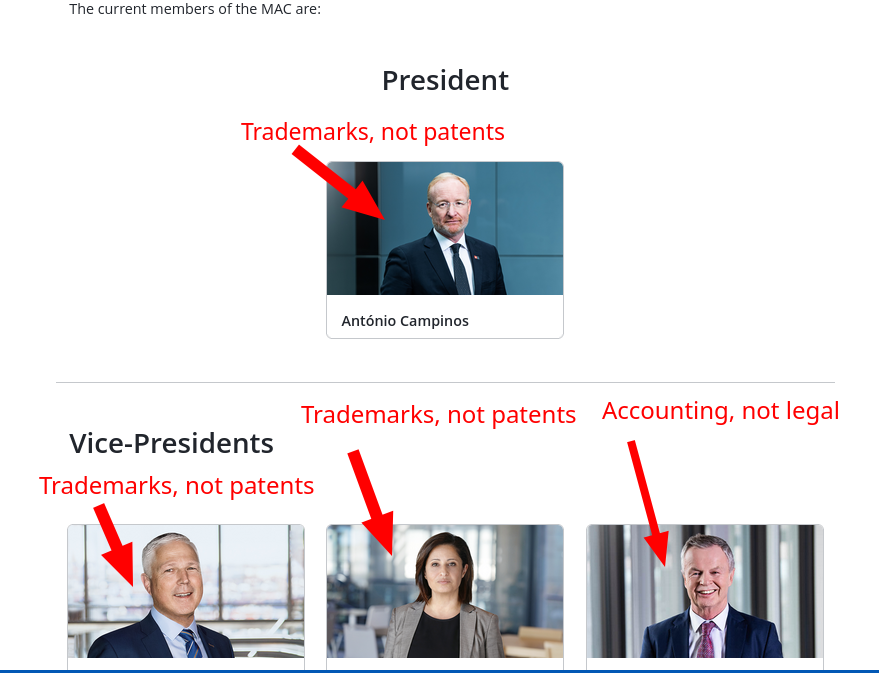
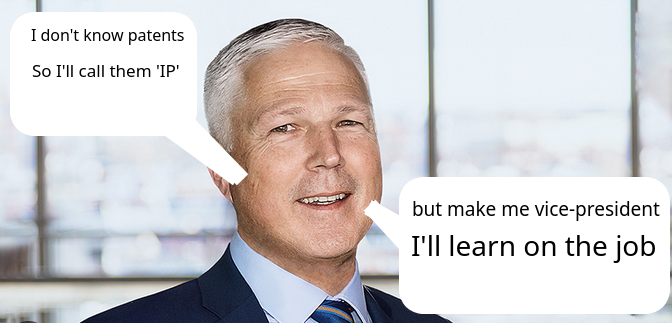
The EPO under Benoît Battistelli drove away a lot of the talented examiners; what's left is pathetic and it's now run by the pathetic António Campinos, who tries hard to cover up cocaine use while promoting illegal patents such as European software patents - i.e. patents which are both illegal and undesirable.
A few months ago we mentioned Formalities Officers at the EPO. This topic came coming up in recent years, e.g. in:
- Formalities Officers Team Managers at the European Patent Office Consider Stepping Down
- EPO as Tower of Babel (No Formality Officers)
- Fate of Formalities Officers (FOs) at the EPO
- Formalities Officers (FOs) at the EPO Are in Trouble, Reveals Internal Report
- European Patent Office Illegally Gutting and Outsourcing Its Functions, Acting Like an Above-the-Law Commercial Business (It Won't Stop at Formalities Officers (FOs) and Classification Slop at the EPO)
- SUEPO (the EPO's Staff Union): “EPO Will Let Highly Experienced Examiners and Formalities Officers Leave Without Any Possibility of Knowledge Transfer to New Recruits”
"Dear Colleagues," the Central Staff Committee wrote today. "Five months after the launch of the 41 posts outside DG1, and after 33 transfers, the staff representation polled the Formalities Officers (FO) and the picture is consistent. Change is affecting well-being. Commitment to the FO role remains high. Mobility is linked to development opportunities, not to rejection of the function. Reintegration arrangements lack clarity in practice. The FO community is not resisting transformation. Our colleagues ask for stability, clear career perspectives and reliable processes."
Here is the full paper:
Zentraler Personalausschuss
Central Staff Committee
Le Comité Central du Personnel
Munich, 09-03-2026
sc26022cpFormalities Officers survey: results and expectations
Dear colleagues,
In September 2025, the administration opened 41 posts outside DG1 for formalities officers. Colleagues were encouraged to explore new career paths, as the digital transformation and increasing automation of the patent granting process are expected to gradually reduce and eventually eliminate the tasks performed by Formalities Officers. 33 of the 41 posts were filled.
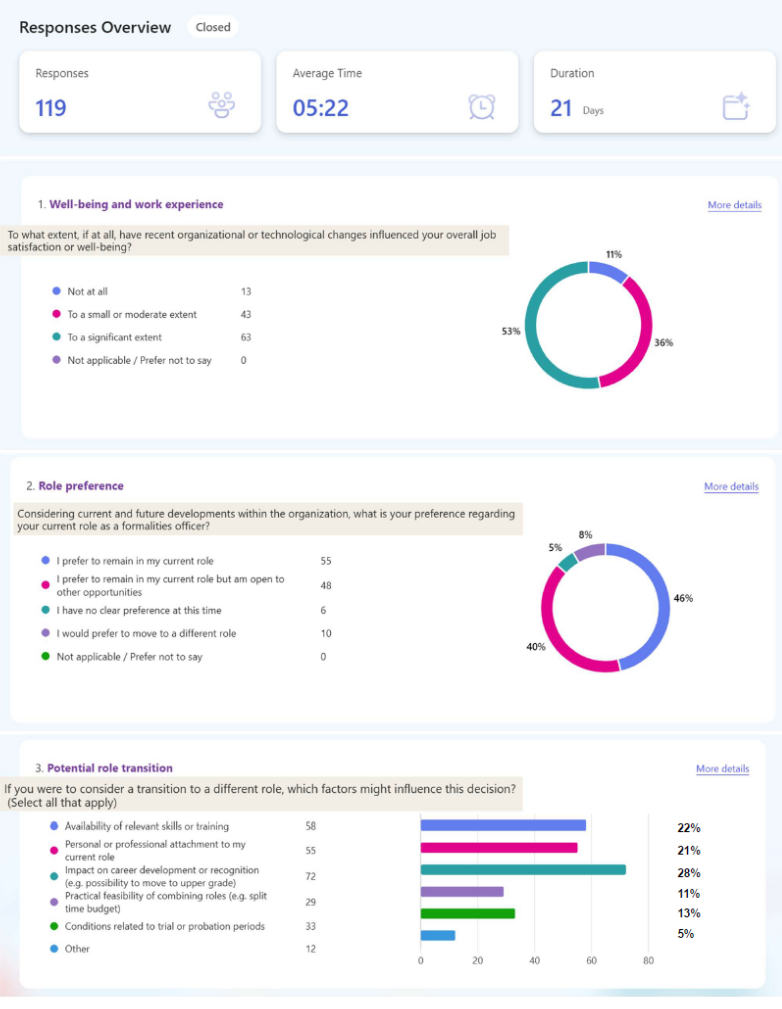
Five months later, staff representation launched a survey to understand how FOs experience these changes, what their role preference is today, and what would influence a potential move. 119 colleagues responded over 21 days and the results are clear.
Change is affecting well-being
89% report that recent organisational or technological changes have had an impact on their well- being. 53% indicate a significant one. This confirms again feedback that staff representation has already heard many times in the past years; the impact of the transformation is strongly felt and widespread. This does not indicate rejection, but it does show that the pace and accumulation of changes are creating pressure and uncertainty.Attachment to the role remains strong
86% wish to remain in their current role, fully or primarily. Only 8% clearly prefer to move elsewhere. Despite the opening of 41 posts and the ongoing transformation, the large majority of FOs remain committed to their function. The survey does not show disengagement from the role.Although this aspect was not formally measured in the survey, it is important to take this opportunity to emphasize that examiner colleagues continue to value their expertise and the contribution they make. Particularly when complex procedural or technical questions arise. In addition, the importance of human assistance and direct contact in the workplace remains highly appreciated. The sense of usefulness our FO colleagues still feel today is likely to contribute to their continued attachment to the role.
Mobility depends on career perspective
If considering a move, the main influencing factor is career development (28%), followed by access to relevant skills or training (22%) and attachment to the current role (21%). This indicates that mobility is considered when it offers credible progression and development. The key question for colleagues is whether change improves or limits professional prospects. Conditions linked to probation periods and practical feasibility also play a role, which highlights the need for clear and reliable transition processes.During the information sessions, the administration stated that moving to another role would not entail promotion to a higher job group. The underlying rationale for this principle has not been explained and appears to be more dogmatic than based on an articulated justification. This approach needs to be changed as it is a missed opportunity to offer FO colleagues a new path to career progression or appropriate recognition of their seniority and expertise.
Reintegration requires clarity
During the September presentations, the administration stated that colleagues who moved could return to DG1 if the probation period was not conclusive. This is an element that influenced the colleagues in taking the step to apply to a new job. Several colleagues in that situation now report that there is no clearly defined reintegration process in place. Instead of a structured and predictable procedure, they face uncertainty about decision making interlocutors, and timelines. In some cases, this leads to prolonged periods of uncertainty about one’s professional situation. Colleagues remain in roles, continuing to receive training and develop skills, while already knowing they do not intend to stay. Such situations create avoidable stress, introduce psychosocial risks, and undermine confidence in mobility.Introducing clearer reintegration pathways would help reduce uncertainty, support well-being and strengthen confidence in mobility as a predictable and safe option. The longer a colleague remains in this position, the greater the negative impact on their career progression in view of the next reward cycle. If mobility is encouraged, the reintegration procedure must be transparent and consistently applied.
Take away message for management
The results point to three concrete needs: manage the pace of change and acknowledge its impact on well-being; clarify the long-term perspective of the FO role; establish a formal reintegration framework for colleagues who move and may need to return. Transformation requires structure. Without it, uncertainty grows and trust is lost.
To FO colleagues
You have clearly expressed commitment to your role while identifying concrete concerns: the impact of continuous change, the need for clearer career perspectives, and the difficulties encountered when engaging in a reintegration request. You are not rejecting transformation. You are asking for greater predictability and reduced pressure, as well as recognition and reliable assurances where commitments have been made. Staff representation will convey this message clearly to senior management. The survey results will be presented not as general impressions, but as concrete signals that require concrete follow-up. Your attachment to the role will be explicitly brought to the highest level of discussion.The Central Staff Committee
Will colleagues go on strike for them? █