
EPO "Cocaine Communication Manager" - Part VI - Influx of Spaniards and Portuguese Workers (+77%) at Europe's Second-Largest Institution, Led by the 'Alicante Mafia'
In Part 4 of this series we said that at the EPO "Many Jobs Were Given to Spanish Employees for No Related Skills At All". There is now data supporting this assertion, new and complete data in fact. We'll come to that in a moment.
Well, one Spanish employee left. Luis Berenguer, who got busted with cocaine and hidden by his friend, the Portuguese and French (dual nationality) President, who had brought him from Spain where they worked together (it's a big club and it's all about connections). "It seems to be that Luis won't return to the communication/s department," we got told, since when that happens "it will attract a lot of 'fire' to the president Antonio, that everybody knows did Cocaine for years." (It's not limited to one person, he's no "rotten apple")
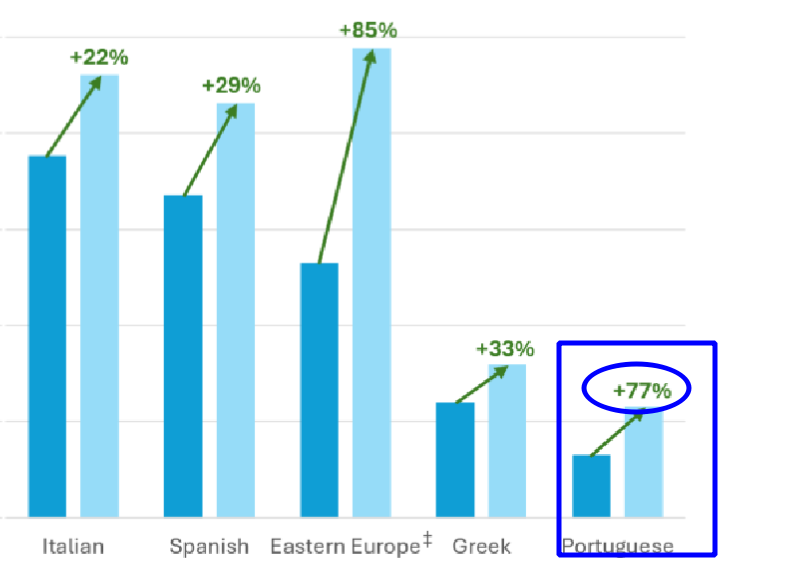
The following new publication, which is almost a week old already, says that there's a 29% increase in Spanish nationals at the EPO. Towards the end of last month, the elected staff representatives (not the union) circulated internal information. The Central Staff Committee (CSC) used an image to illustrate it visually. "Significant change in the nationality demographics of staff" as noted below. "Over the past two decades," they said, "successive reforms have steadily weakened the EPO employment package. Despite this, the Administration claims increased attractiveness based on unreliable indicators. Staff nationality data instead shows recruitment declining in higher-income countries and rising in lower-salary labour markets, indicating reduced competitiveness across member states. Only a clear response from staff via participation in the industrial actions can prevent further deterioration of conditions."
Here is the full publication:
Zentraler Personalausschuss
Central Staff Committee
Le Comité Central du Personnel
The Hague, 26-02-2026
sc26018cpHow has the deterioration of our employment conditions
impacted recruitmentOver the past two decades, successive reforms have steadily weakened the EPO employment package. Despite this, the Administration claims increased attractiveness based mainly on application numbers and low turnover, both known to be unreliable indicators in modern labour markets. Staff nationality data instead shows recruitment declining in higher-income countries and rising in lower-salary labour markets, indicating reduced competitiveness across member states. Only a clear response from staff can prevent further deterioration of conditions.
What has changed in the employment package?
Over the past 20 years, there has been a continuous stream of reforms that have significantly deteriorated the EPO employment package. These reforms have consistently been more detrimental to the majority of staff, although some have provided financial advantages to the senior managers responsible for designing and adopting them, suggesting a clear conflict of interest. The most significant and impactful changes are listed below.
In combination, these reforms have progressively reduced long-term remuneration, increased employment insecurity, and weakened family-related benefits, particularly for new recruits.
Office claims no impact on attractivity
Despite the substantial changes outlined above, the Office concludes that it has “proved to be more and more attractive”1, basing this primarily on higher application numbers and low turnover.
Application numbers, however, are a poor proxy for attractiveness. Across labour markets, applications have risen markedly in recent years2 as AI-assisted CV and cover-letter tools allow candidates to apply to large numbers of vacancies with minimal effort. Higher application counts therefore reflect a change in applicant behaviour, rather than a stronger preference for the EPO. Likewise, low turnover cannot be interpreted as satisfaction alone: the patent examiner role develops highly specialised skills with limited transferability outside the Organisation, naturally reducing outward mobility.
It is therefore striking that the Office bases its conclusion on such rudimentary indicators. A serious assessment of attractiveness would include the offer acceptance rate and analyse the reasons candidates decline offers. It would examine the quality of the applicant pool, including the proportion meeting qualification and nationality requirements. It would reference the recognised employer attractiveness rankings for STEM graduates and monitor changes over time. It would further assess the geographic coverage of recruitment across member states. As none of these analyses has been presented, the following section examines the last measure using data available to staff.
Significant change in origin of recruits
Over the past 15 years the nationality profile of EPO staff has undergone a structural shift. While Germany and France still together account for roughly 45% of staff and remain broadly stable, recruitment from the rest of Western Europe and the Nordic countries has fallen sharply, with the proportion of British staff falling by 42% and Dutch by one third. The proportion of Swiss staff has fallen by 38% to less than 0,8% of EPO staff, although Switzerland scores third in number of applications among EPC contracting states and lead country by patents per capita. On the other hand, Southern and Eastern European representation has risen significantly, with Eastern European staff showing the strongest growth, followed by Portuguese.
This shift reflects a change in relative attractiveness of employment at the EPO. The Office is increasingly drawing recruits from lower-salary labour markets while becoming less competitive in higher-income member states. In other words, the EPO is transitioning from a broadly pan- European employer to one whose recruitment base is progressively concentrated in countries where the purchasing-power advantage of EPO employment remains appealing. However, after moving to high-cost places of employment, arriving staff from such countries realise that they face the same financial issues as domestic staff.
If current employment conditions continue, the trend suggests a further narrowing of the recruitment pool, with potential long-term implications for diversity of experience, competition for talent, and the Office’s ability to attract highly specialised candidates from all member states. As a result, the EPO’s role as a protector of EU industry, including the vital network of SMEs, and guarantor of EU competitiveness is likely to be weakened.
As an international organisation, the EPO should be able to recruit from all of its member states, but that is not currently the case. One of the KPIs in the SP2028 is the modest objective of ensuring at least one staff member from every member state. Even this minimal benchmark has not been met: the Office currently represents only 35 nationalities, with Norway once again absent from the staff population.
Conclusion
The evidence contradicts the Office claim that the reforms have had no impact on the attractivity of the EPO. When observable developments are disregarded rather than addressed, trust in the Administration is damaged. Each reform has been presented as neutral or even beneficial for staff (!), yet the obvious cumulative effect has been a continuous erosion of the employment package. Without a clear response from staff, further measures will inevitably follow under the same narrative.
Your participation in the current strikes and work-to-rule actions is therefore necessary to demonstrate that the continuation of this process carries real consequences. We need to show that staff will not silently accept and continue to deliver products as if nothing has changed. All eyes are now on us: only a clear and collective response can bring about a change.
The Central Staff Committee


That sort of trend does not surprise us because EPO insiders - both past and present - noted it to us based on personal experience. Countries where salaries are low are finding EPO jobs more attractive (lucrativce compared to what they can find domestically), but this includes a lot from Spain and Portugal. The fact that Brits quit in droves was noted here nearly a decade ago. This even predates 'brexit'. Few applicants. █