
State of Slop About GNU/Linux
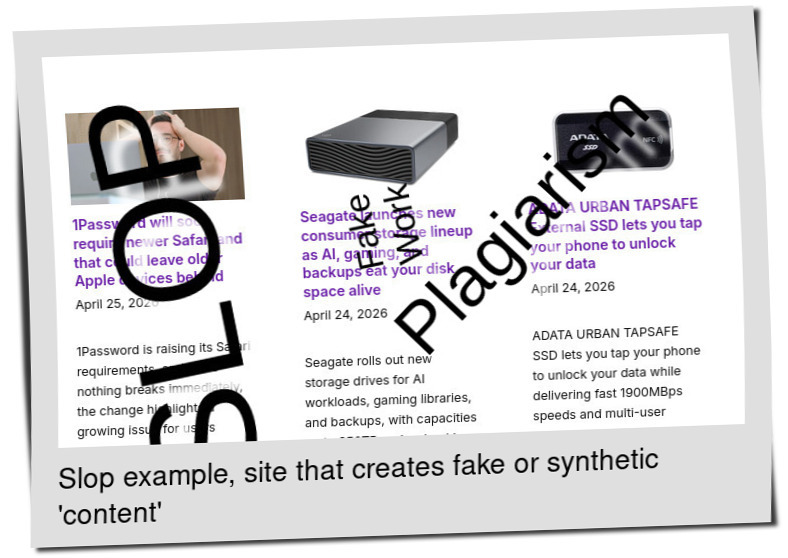
Almost every day, in direct RSS feeds but not in syndicators (planets, Google News, combined or chained-together RSS feeds etc.) there are some domains with "linux" in their names (domain names) that spew out LLM slop. We used to closely watch and routinely cover that. Now we just watch but mostly walk on by. Some of them cease operation completely, whereas others slow down as they realise this isn't the right thing to do. Their realisation (that nobody is really interested in the junk they put out there) is gradual, but the trajectory is always the same. Good luck naming even a single site that replaced human reporters with slop (LLM with bots or 'agents', to use the catchphrase du jour) and ended up doing well. Even well outside the areas of technology or GNU/Linux it's hard to come up with any "success story" worth naming. None.
Let's face it; slop never had any real potential, just an illusion of it (and paid-for hype to back that up). Microsoft, facing users' backlash (they call it "Microslop"), ended up openly admitting this was just "for entertainment" and should not be taken seriously. They've begun reversing (or rolling back) the interjecting of slop into things like user interfaces, seeing it was doing more harm than good.
Over the past week, just like the week before it, we possibly spotted Google News linking to a slopfarm once in two days, on average. It used to be about 10 per day, not 1 per 2 days. So they certainly changed the algorithms by delisting/deranking slopfarms.
We cannot quite envision Google admitting (just yet) that that a mistake was made. Or that slop just costs a lot of money, alienates publishers (worsening public sentiment towards Google), and promotes false claims. Google has leveraged slop as a plagiarism mechanism that keeps people "engaged" in Google, just like Facebook tries to keep users inside its "walled gardens". We hope more people, observing what's going on, will revert back to very old Web surfing habits, predating social control media and slop-promoting 'search' engines.
As for us, we've developed RSS reading software and mostly rely on RSS feeds.
How do we come up with story ideas?
One useful way to make important news available is, follow topics of interest, research them, then report. How to get things wrong: see what "the Web" says (e.g. social control media 'buzz'), then be reactionary about it. The latter typically adds no real value. It's easier for slopfarms to do a lot of the latter.
As the incentive to publish is reduced (competing with slop is no fun), the effort/money invested in stories goes down. That's one of the most powerful arguments against slop or the reason to shun all of it. █