
European Patent Office (EPO) Series: The Centre-Right "Social Democratic Party" in Portugal
Part 7
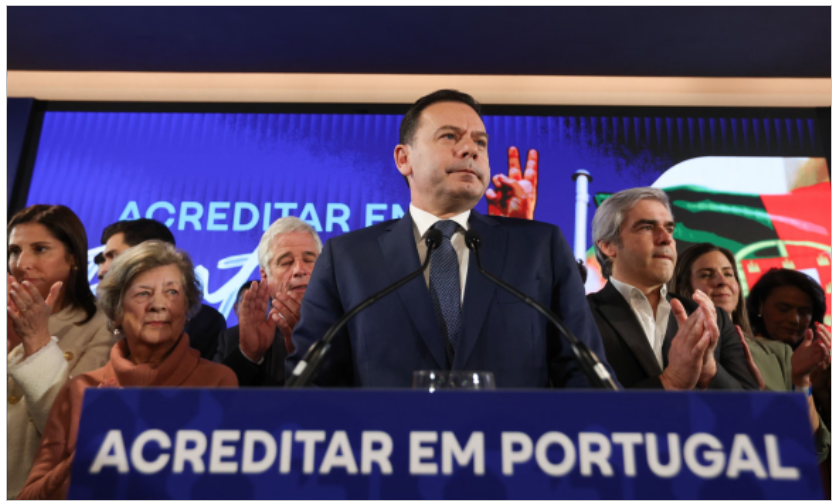
Luís Montenegro, leader of the center-right PSD, claims victory in the parliamentary election in Lisbon on 11th March 2024. The slogan "Acreditar em Portugal" means "Believe in Portugal".
In the last part we looked at the Portuguese Socialist Party (PS), the centre-left party with which António Costa is affiliated.
In this part we turn our attention to Costa's successor as Prime Minister of Portugal, namely Luís Montenegro, who is the leader of the Social Democratic Party or Partido Social Democrata (PSD).
For those unfamiliar with Portuguese politics the name of this party can be a bit confusing because it suggests that it is positioned on the centre-left of the political spectrum. However, in reality, it is the main centre-right, liberal-conservative party in Portugal. In the European Parliament the PSD is aligned with the centre-right European People's Party Group.
The PSD was founded in 1974, two weeks after the Carnation Revolution. Its original name was the Democratic People's Party or Partido Popular Democrático (PPD). The party adopted its current name in 1976. On ballot papers its official designation includes both names and it appears as: PPD/PSD.
In the years following the Carnation Revolution, the centre-right PSD consolidated its position as the main political rival of the centre-left PS. It managed to secure power on a number of occasions either governing alone with an absolute majority or as the main partner of a "Democratic Alliance" coalition with other centre-right parties.
The PSD politician who is most likely to be familiar to non-Portuguese readers is José Manuel Durão Barroso.
Barroso's initial engagement with politics started during his time as a law student in the 1970s just before the Carnation Revolution. Back in those days he was a prominent student leader of the Reorganised Movement of the Proletariat Party (MRPP), a Maoist organisation that split from the Soviet-oriented Portuguese Communist Party in 1970 and operated underground against the Estado Novo regime.
However, in the aftermath of the Carnation Revolution, as Portugal underwent a transition to a system of parliamentary democracy, the once radical Barroso gradually mellowed. By 1980 he had clearly come to the conclusion that his political future lay elsewhere and he jumped across the political divide to join the PSD.
Barroso eventually rose through the ranks of the PSD to become its leader and he headed a short-lived centre-right coalition government between 2002 and 2004. In July 2004 he was nominated as President of the European Commission, a position which he took up on 1st November 2004 and held until 31st October 2014. In that role, he was a leading proponent of the Treaty of Lisbon which was designed to introduce significant reforms in EU governance and which entered into force in December 2009.
After stepping down as President of the European Commission, Barroso attracted a lot of criticism for his decision to accept a plum job with Goldman Sachs International in 2016 shortly after expiry of the statutory 18-month cooling-off period associated with his former EU post. Quite an achievement for a former Maoist radical and aspiring champion of the Portuguese proletariat to be invited to join Goldman Sachs as a "non-executive chairman" and "advisor"!
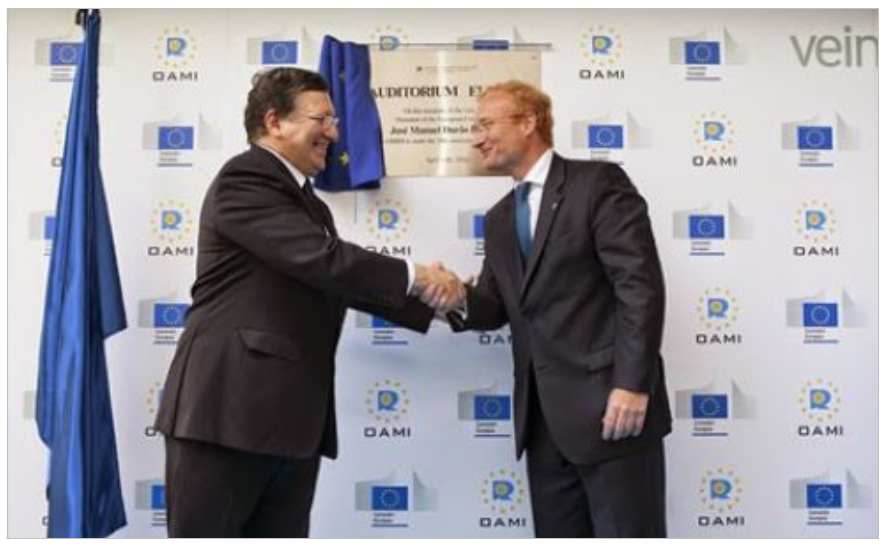
President of the European Commission, José Barroso (left), meeting with OHIM President António Campinos (right) during a visit to Alicante in 2014 to mark the 20th anniversary of the OHIM.
Turning now to more recent events, we recall that – as already mentioned in an earlier part of this series – an investigation known as "Operation Influencer" conducted by the Portuguese Public Prosecutor brought about the collapse of the centre-left PS-led government of António Costa in November 2023 and this led to a snap election some months later in March 2024.
In that election, the PSD-led "Democratic Alliance" won 80 of 230 seats, the PS won 78, and the emerging right-wing populist party Chega took 50, leaving several smaller groups to mop up the remainder.
No single bloc controlled a majority of seats and, in the end, Luís Montenegro took office as Prime Minister at the head of a centre-right minority government.
However, as we shall see in the next part, this minority government came to a premature end in March 2025 when Montenegro became embroiled in a conflict-of-interest controversy and lost a parliamentary vote of confidence. █
Previously:
"Lining up a viable replacement," an associate has said about Campinos, would be desirable, and "one who is not part of the corrupt gang, would be something for the wish list too."