Cory Doctorow, citing his EFF colleague, says what an Australian Commission has found regarding software patents. It's strongly against them. It's a subject which we covered here before [1, 2]. "The report," Doctorow writes, "which was commissioned in part to investigation the codification of fair use in Australian copyright law, condemns virtually the whole edifice of Australian IP law. It calls for shorter copyright terms, more flexibility for copyright users, stricter criteria for granting patents, tightened rules and shorter terms for software and business-method patents, and more."
"It seems as though each time there is evidence-based research into this subject the outcome says software patents are bad."The EFF's post says they "wrote about a discredited industry report that spread misinformation about the supposed costs of Australia adopting fair use into its copyright law. That document, commissioned by media and entertainment giants, had been written in anticipation of a recommendation for the adoption of fair use by the Australian Productivity Commission, a government agency tasked with improving Australia's capacity for production and innovation."
Further down it says: "Restricting the availability of patents for software and business method inventions, which are an impediment to further innovation. As regards software, the Commission notes that software development cycles of around 5 years are far shorter than the 20 year term of protection granted by patents, and that other incentives for software development (among them copyright) also exist."
It seems as though each time there is evidence-based research into this subject the outcome says software patents are bad. Europe came to the same conclusion a very long time ago, but the EPO conveniently (for its own gain) ignores the law. There is now a new software patents loophole in the EU, as Dr. Glyn Moody showed last month. Yesterday he had more to say about that:
A couple of weeks ago, I wrote about a disturbing aspect of the European Commission's proposed Digital Single Market: the fact that "ICT standardisation requires a balanced IPR [intellectual property rights] policy, based on FRAND licensing terms." That's a problem, because FRAND licensing is inherently incompatible with open source.
As well as generating a fair amount of interest here on Ars, the article seems to have provoked some discussions in the wider open source community, and inside the European Commission too. Given that interest, and the absolutely key nature of this issue, I thought it would be worth exploring it a little more deeply, not least because there have been some important developments in the last two weeks, including a way for Ars readers to help stop open source being locked out of EU standards.
First, it's probably a good idea to summarise why FRAND, which stands for "fair, reasonable, and non-discriminatory," is a problem for open source. Put at its simplest, licensing terms can be totally fair, quite reasonable, and absolutely non-discriminatory and yet impossible to implement in free software.
For example, a patentholder might think they are being super-kind by requiring a per-copy licence payment of just €0.001. And for traditional software, that might indeed be generous. But consider what happens with open source code, which by definition can be copied and shared freely as many times as you like. Since there is no way of knowing how many copies have been made, it's impossible to pay even that "reasonable" €0.001 per copy. The only licensing fee that works in this context is zero—and even then, it's not guaranteed that the licence will be compatible with free software. For example, there may be some other limitations on use, which aren't allowed for open source.
What is needed is not just "royalty-free" licensing, but "restriction-free."
[...]
The other case concerns the open source giant Red Hat, and how it settled a patent dispute with a company called Firestar. What is remarkable about this deal is that Red Hat not only acquired a licence for itself, it obtained it for everyone else in the open source community, upstream and downstream from Red Hat. In other words, it effectively took out a patent licence for the open source world.
Again, some have pointed to this as an example that proves that paying patent licences is perfectly compatible with open source; and once more, that's not true. First, this solution was only possible because Firestar agreed to provide this blanket licence for the open source community: the fact that it had never been done before shows how exceptional that was. For companies that offer FRAND licensing, there is no reason at all why they would have to follow Firestar's example.
"This is IAM doing its usual routine trying to urge companies -- even in China -- to pursue more and more patents/patenting obsession."It is not too shocking that lobbyists for software patents get their way in spite of what scientists and programmers are saying. The lobbyists never grow tired and they are backed by wealthy corporations like IBM. There is now a push for new taxes in the embedded Linux space (increasingly characterised using the silly buzzword, "IoT"). "If demand for connected devices does prove durable," IAM wrote, "then Chinese appliance makers could be big winners – and so could patent licensors. But the big Chinese players are likely not finished spending money to beef up their patent positions in the hopes of easing their royalty burdens." This is IAM doing its usual routine trying to urge companies -- even in China -- to pursue more and more patents/patenting obsession. In Europe they encourage companies to pursue patents even in domains that are out of reach, e.g. software, as in the US patent system it is growingly a challenge (inevitably, they cannot just snub the courts eternally). This new article from Robert Sachs says: "On May 4, the USPTO issued a new memorandum for patent examiners, “Formulating a Subject Matter Eligibility Rejection and Evaluating the Applicant's Response to a Subject Matter Eligibility Rejection” (“Examiner Instructions”) along with a new set of five example claims, this time in the life sciences and chemistry arts. The Examiner Instructions are a positive step forward in refining the examination process, but leave open many questions."
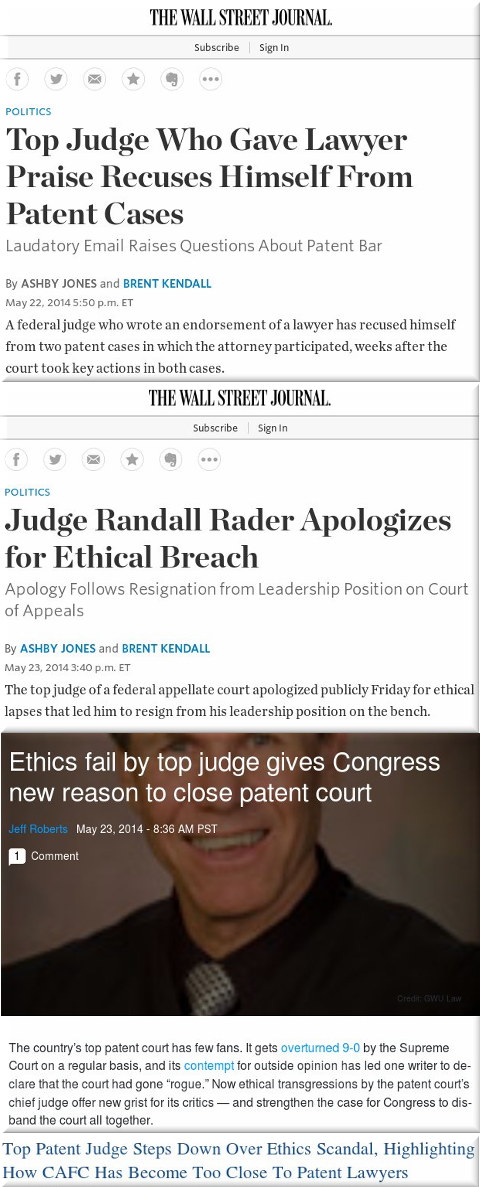
A notoriously corrupt court, CAFC, is where software patents came from in the first place (several decades ago) and it has just been brought up by Patently-O in relation to the Patent Act. "The Federal Circuit created the rule of automatic assignment through agreement without any basis in the Patent Act," Patently-O says and to quote some bits: "The core problem is that the court has ignored the Erie doctrine. Under the Supreme Court’s 1937 decision in Erie v. Tompkins, a federal court ruling on a matter of state law under its diversity jurisdiction must apply the law of the state from which the dispute arose. Which state law to apply is a matter of choice of law principles. What the federal court cannot do is create its own federal common law in lieu of the state statutory or common law. As the Court affirmed in Butner v. United States, 440 U.S. 48 (1979), the Erie doctrine applies to a court’s supplemental jurisdiction over state law claims attendant to a federal question. By creating its own federal common law of contracts, the Federal Circuit reveals a fundamental error in its understanding of the federal court system. [...] The case of conflicting patent assignments bears some similarity to the law on intangible future interests in creditor-debtor law. Both entail rights in property that has yet to come into being. The main lesson from creditor-debtor law, which is largely a matter of state law, is that many interests are implicated and therefore simple rules are not satisfactory. The Federal Circuit has arguably adopted too simple and misguided a rule in the Filmtec. The Supreme Court has confounded the error in the Stanford decision by ignoring the issue of automatic assignments. One way to correct course is by granting Shukh’s petition for certiori and restore the proper balance between federal patent law and state commercial law."
"We regret to say that a lot of laws, practices, policies etc. around patents are still corrosive and this is caused by systemic corruption."This may seem like an injustice because it is. A lot of patent law in the US is completely unhinged from sanity, evidence, facts, and justice. The other day we wrote about how NASA had hoarded a lot of patents; it should not have patents at all (taxpayers pay NASA to explore space, not to acquire patent monopolies) and it gets worse when NASA gives these to private hands and sells them to trolls. Yesterday we found 31 articles about NASA's latest patent PR, but not a single decent article which actually put claims to scrutiny and did an actual investigation [1, 2, 3, 4, 5, 6, 7, 8, 9, 10, 11, 12, 13, 14, 15, 16, 17, 18, 19, 20, 21, 22, 23, 24, 25, 26, 27, 28, 29, 30, 31].
We regret to say that a lot of laws, practices, policies etc. around patents are still corrosive and this is caused by systemic corruption. Many countries are negatively affected by this. ⬆