
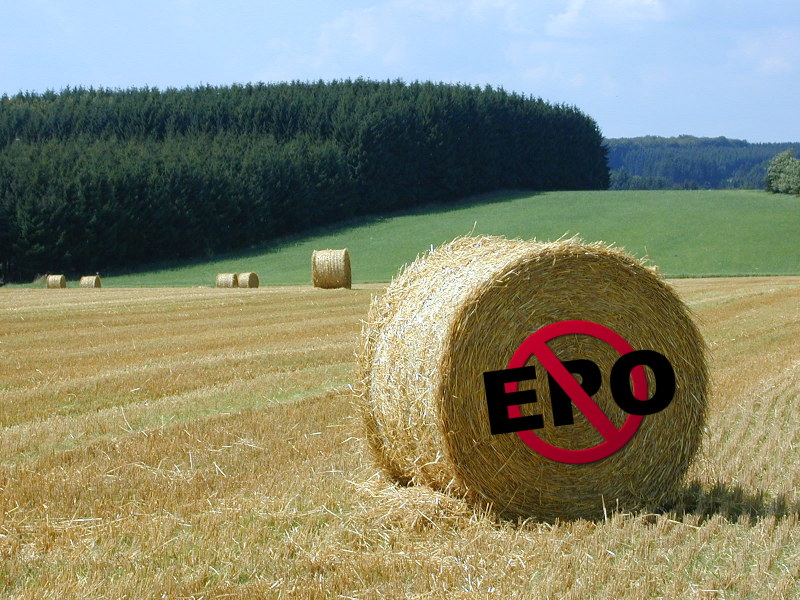
IT was described as a "crisis" in the media as recently as some days ago. Team Battistelli (or Team António Campinos) had an urgent meeting about it. People aren't happy. The public loses faith in this system. Examiners lose pride in their job.
"People aren't happy. The public loses faith in this system. Examiners lose pride in their job."What good are patents that courts basically reject? Those are only of limited/conditional use when exploited for extortion purposes (outside courts), typically by patent trolls that do this in bulk (several patents or thousands of threat targets, making the blackmail economic and efficient). Is this what Campinos wishes for Europe? Judging by those whom he chose to meet earlier this month in the United States, definitely!
A European Patent Office (EPO) critic and attorney Dr. Thorsten Bausch comments on the 'Teffgate' again -- arguably a very clear symptom of declining patent quality at the Office. To quote:
So the claim seems to pertain to the Ethiopian grain Eragrostis tef (also known under its common name Teff), characterized by a certain parameter, i.e. the “falling number of the grain at the moment of grinding”.
I have to say that claims of this type always make me quite curious, not to say suspicious. Two questions immediately spring to mind: (i) What is so special about this parameter, and (ii) how does one obtain a teff satisfying this parameter?
[...]
Wait a minute? A baking product “with acceptable quality” is supposed to have a falling number of at least 250? But isn’t this what the claim is supposed to cover? So does the claim cover all baking products made of Teff having an acceptable quality? It indeed seems so.
Now, the patent further discloses (in [0007]) that Teff has been cultivated for human consumption in mainly Ethiopia and Eritrea for more than 5000 years, and that it is traditionally used for preparing injera, a spongelike, gray pancake. This leaves only two possibilities: Either these people from Ethiopia and Eritrea never managed to produce a baking product (such as a pancake) with acceptable quality for the last 5000 years. Or there is perhaps something wrong with this patent claim.
What next, for goodness’ sake? Perhaps this:
What I claim is: Bottle of wine having a BS number of > 250.
Specification: Our insight is the surprising one, that high BS numbers deliver wine with a nicer taste. What do you do, if you want to increase the BS number? Store your bottle of wine in a cellar for a year or two, before you open it and drink it.
EPO Examiner: Novel. No mention in the state of the art of any such thing as a BS number. Therefore it did not form part of the state of the art. Inventive. The state of the art contains no hint or suggestion to select for drinking wines with a high BS number.
Come on EPO. You can do better than that.
"They're combining nature (marijuana) with all sort of paraphernalia to claim "inventions"."Shouldn't nature itself be "prior art" in the above case? Come on...
There's also the term "priority", which was mentioned yesterday by Preu Bohlig & Partner's Alexander Harguth. "In the judicial enforcement of patents claiming priority of a previous application," he started, alluding to a subject we covered the other day. These people are falling into that same old trap which we wrote about a decade ago in relation to the US. Just because something isn't documented in patent form doesn't mean it never existed. Many new marijuana patents in the US now exploit this patent gap, knowing that marijuana use was completely illegal and suddenly it's a "business opportunity". They're combining nature (marijuana) with all sort of paraphernalia to claim "inventions". Much like the above...
The "inventive step" here is a colonialist boot. A boot on the farmers' necks.
"So here we go back again to seed monopolies."The truth of the matter is that patents like the above contribute nothing to innovation, only to animosity; the EPO insults Africans by giving Europeans a patent monopoly over everything in Africa, even the source of food. These patent monopolies on seeds are promoting nothing but fury because patents like these are robbery -- not just of knowledge but also farming rights. And speaking of which, mind yesterday's article from IP Watch regarding RCEP -- a Trojan horse for software patents [1, 2] among other things. To quote: "The Regional Comprehensive Economic Partnership (RCEP) trade agreement under negotiation among Asia and Pacific nations must not include measures that would undercut countries’ ability to protect diverse local farming systems and sustainable plant genetic resources for food and agriculture, a range of Asian nongovernmental organisations argue. Groups in India, Malaysia and the Philippines this week specifically called for the RCEP not to include the high-level protections under the International Union for the Protection of New Varieties of Plants (UPOV)."
So here we go back again to seed monopolies. We wrote a lot about the subject in relation to Monsanto one decade ago. Over at IP Kat they have decided to write about this as well:
In its judgment, the Dutch Court of Hague held that the patents were invalid as none of the various features described in the claims [ripening characteristic, preferred range, mixing with flour from another crop] conferred inventiveness. See paragraph 4.24.
It also held that the claims on the patents combined or considered separately were obvious and lacked inventiveness. Accordingly, the court rejected the patent claims and held that no infringement could be made on invalid patents. See paragraph 4.24 of the judgment.
This report is one in a series of reports that have reached the Dutch newspapers and even the 8 o'clock news on the patent on teff.
The case that is reported here was indeed an infringement case between the Dutch patent holder and one of its competitors. However, in spite of the suggestion that is made in this report, the Ethiopian government has not played any role and/or has not had any influence on the outcome of this case.
Indeed the patent has been found invalid, because it was denied an inventive step. However, in spite of the suggestion in the report that this was on basis of lack of inventivity over the traditional knowledge of Ethiopia on the culturing and use of the teff grain, it was found to lack inventive step over a newsletter that was published by the patentees themselves prior to the priority date of the patent(s) in suit.
In the comment to the report, the author mentions that the patent would prevent Ethiopia to export teff flour to Europe. This is certainly not (completely) true. Initially the patent covered a subset of teff flour with specific characteristics (which would make it suitable for baking ‘modern’ baking products, such as bread), but during the court case that patent was voluntarily limited to a method for baking these baking products using this special selection of teff flour. It is thus incorrect to state that the patent would prevent people (in Europe) to make injera – the traditional Ethiopian bread. As a matter of fact, the production of injera was literally excluded from patent protection in the claims of the patent. Accordingly, there was no limitation to the Ethopians on exporting teff for the uses for which it was traditionally used.
Also the ‘claims’ from the Ethiopian government that they are fighting the validity of the patent before the Court of Arbitration in Paris are questionable. As a matter of fact, I am the patent attorney that has drafted and prosecuted the patent and the patentee, nor I as his legal representative, have never been informed about any action against the Dutch patent or any of its European equivalent patents other than in the presently reported court case (where the Ethiopian government was not involved).
Regarding the access and benefit of ‘traditional knowledge’ it should be stated that the patentees did negotiate an agreement with the Ethiopian government already in 2005. Please remember that such an action at that time was far from obligatory, since, although the Biodiversity Convention was already concluded at that time, there was not yet a thing like the Nagoya protocol, nor had Ethiopia any legislation regarding access to genetic resources. The suggestion that Ethiopia was not able to claim its benefits because of the bankruptcy of the company that originally closed the agreement also is not trustworthy, because there have been no benefits to share at all thus far. Maybe the Ethiopian government wants to share the losses due to the court decision with the patentees?
The suggestion from the author to have access and benefit-sharing agreements be notified to e.g. WIPO seems a nice suggestion, but is nowadays in principle already implemented through the Nagoya protocol, that already recognizes that a party that wants access to genetic resources should establish prior informed consent and should conclude an agreement on mutually accepted terms. Countries that have the Nagoya protocol implemented in their legislation then can provide the applicant with an internationally-recognized certificate.
All in all, I find it a pity that this case is misused to make unjustified propaganda. Especially, this is a pity, when not only local newspapers (that do not understand patents) make room for this propaganda, but when a respected and top IP-blog publishes a report like the current one.
Dear Mr Van Wezenbeek,
That some propaganda has been made about this case by people not having a clue about patents, and that journalists sometimes oversimplify matters to make them more palatable is not a surprise.
But this does not warrant your reply and its condemning tone. It is clear that traditional knowledge was not the source of the lack of inventive step. It was a publication by the applicants which was fatal. The problem with traditional knowledge is that is often not written down with all the certainty needed in the patent business.
On the other merely browsing through general literature about flour and baking, one get the feeling that the flour claimed was the mere result of trial and error. It appears to be a well-known fact that flour has better qualities when the grain is stored before milling. This is valid for lots of flours from different grains, and it cannot be surprising that it applied to teff grains.
But there is sometimes some justice. By wanting to sell stuff before having filed an application on it, is nothing new. It happens time and time. I wonder if they told their representative at the time that important information was disseminated beforehand
Following the so-called Tomato II and Broccoli II decisions rendered by the EPO's Enlarged Board of Appeal (EBA) in 2015, the politically delicate question of patentability of plant or animal varieties as well as essentially biological processes for the production of plants or animals has once again occupied the EPO, now with the uncomfortable implication that a Technical Board of Appeal of the EPO has revealed a conflict between two legal provisions within the framework of the EPC.
The Tomato II and Broccoli II decisions, G 2/12 and G 2/13, held that products derived from essentially biological processes may be patentable, even if the process used to obtain the product is essentially biological and hence not patentable. In particular, the EBA concluded that Article 53(b) EPC, excluding plant or animal varieties and essentially biological processes for the production of plants or animals from patentability, did not extend to plants or plant material or plant parts other than a plant variety.
"Patent maximalism does not make Europe stronger; it makes it weaker, except for patent lawyers."Really? SMEs? The EPO never cared about SMEs. It actively discriminated against SMEs. Moreover, a policy of patent maximalism harms SMEs the most as they're least capable of legal defense (due to tight budgets).
This leads us to the closing part, which is partly a cautionary tale. Yesterday Florian Müller wrote about yet more European Patents that may turn out to be bogus. In his own words, regarding Landgericht Mannheim:
The real showdown between Apple and Qualcomm will take place in San Diego starting April 15, with Apple stressing antitrust, FRAND and patent exhaustion arguments while Qualcomm seeks to emphasize various contracts it used to have or still has in place with Apple and its four contract manufacturers. But in addition to that one, infringement cases are pending in multiple jurisdictions (U.S., Germany, China) because Qualcomm hoped to gain leverage over Apple ahead of the San Diego trial. False hopes, as we know by now.
Today the Mannheim Regional Court (in German: Landgericht Mannheim) ordered a stay of the case in which Qualcomm is asserting the German part of its European patent EP3036768 on a "layout construction for addressing electromigration" against Apple. The infringement proceedings are stayed until a decision by the Federal Patent Court of Germany on Apple and Intel's nullity complaint (or any alternative resolution of the validity action). In their efforts to get that Qualcomm patent invalidated, Apple and Intel are represented by patent attorneys from Samson & Partner, for whom this order to stay the case is a victory, at least for the time being.
At the October trial (see my report), Presiding Judge Dr. Holger Kircher had already suggested that counsel for Qualcomm stipulate to a stay, given that Qualcomm was seeking to differentiate its amended claim (after the original claim turned out to be indefensible) through a claim limitation devoid of any technical substance. They added a chip layout element that has nothing whatsoever to do with the stated goal of the patent, which is to reduce electromigration. Four months earlier, Quinn Emanuel's Dr. Marcus Grosch had stipulated to a stay of another Mannheim case, but declined to do so again.
For nearly fifteen years, we've written about how patent trolls love East Texas, and spent years building an entire industry in some small Texas towns centered around patent trolling, and dragging companies from all over into east Texas to face lawsuits. Almost two years ago, we were pretty thrilled to see the Supreme Court slam the door on the most blatant jurisdiction shopping by patent trolls in the TC Heartland case. And while some of the East Texas judges have tried to come up with creative ways to reinterpret the Supreme Court's ruling, so far that hasn't worked that well.
Still, a key aspect of the TC Heartland case was that the proper venue was the judicial district where a company actually "resides," which the Supreme Court suggested is where the company was incorporated and not just where it sold products. However, in that appeals court ruling mentioned above, interpreting part of the TC Heartland ruling, the Federal Circuit noted that there "must be a physical place in the district" as one part of a larger test. For lots of companies, that's no big deal, but Apple (a company that faces more than its fair share of patent troll lawsuits) realized it had a problem: while it's certainly not incorporated or headquartered in East Texas, it does have retail stores there. Or did. The company is shutting those stores down to prevent trolls from using that retail presence to argue East Texas is an appropriate venue.