
EditorsAbout the SiteComes vs. MicrosoftUsing This Web SiteSite ArchivesCredibility IndexOOXMLOpenDocumentPatentsNovellNews DigestSite NewsRSS

03.13.10

Patents Roundup: Acacia, i4i, Tuxera, Monsanto, Apple, and Microsoft

Posted in Apple, GNU/Linux, Kernel, Microsoft, Novell, Patents, Red Hat, SUN at 12:02 pm by Dr. Roy Schestowitz

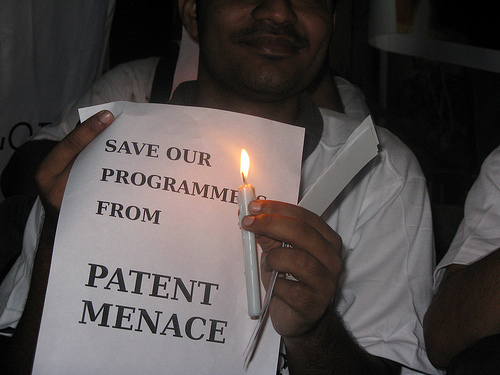
Software patents protest in India

Summary: Overview of news about software patents and slightly beyond that

THE ISSUE of software patents is having an impact on GNU/Linux more than ever before. Apple, Microsoft, and a few other companies use software patents against the freedom of software. This post is a collection of items that hopefully inform and explain where we stand.

Acacia

There is only one patent troll that directly challenged GNU/Linux by filing a lawsuit against a GNU/Linux vendor, based on a software patent claim. Acacia sued Red Hat and Novell shortly after it had hired from Microsoft and Law.com has an update on the case.

Already this month, Rader has dismissed one patent case against Google and Yahoo on summary judgment and trimmed back damages theories in a lawsuit against Red Hat and Novell. These are somewhat unusual rulings for the Eastern District of Texas, which historically has not killed as many patent cases on summary judgment as other venues.

[...]

• In IP Innovation v. Red Hat, another case also involving plaintiff IP Innovation, this time against Red Hat and Novell, Rader made a statement on the hot button issue of damages in patent cases. The judge questioned the plaintiff expert’s use of the “entire market value” rule, which calculates damages based on a percentage of total sales even if only a small feature of a product like a computer is infringing.

“Mr. Gemini’s current expert report improperly inflates both the royalty base and the royalty rate by relying on irrelevant or unreliable evidence and by failing to account for the economic realities of this claimed component as part of a larger system,” Rader wrote (.pdf).

Red Hat and Novell are being represented by Gibson, Dunn & Crutcher lawyers from San Francisco.

It is hard to tell if Microsoft was in touch with Acacia executives just before the lawsuit (there was a staff migration from Microsoft to Acacia), but as we showed many times before, the timing was interesting. The Acacia lawsuit was filed shortly after Ballmer had issued a patent threat to Red Hat.

i4i

“The Acacia lawsuit was filed shortly after Ballmer had issued a patent threat to Red Hat.”The i4i case [1, 2, 3, 4, 5, 6, 7, 8, 9, 10, 11, 12], which we last mentioned a short while ago, is repeatedly being lost by Microsoft. They just don’t give up, do they? It’s still a case to watch because it dealt a blow to OOXML.

Tuxera

For those who do not remember how Tuxera is connected to Microsoft, here is a Wiki page serving as reference. There is noteworthy news about Tuxera becoming an SD Association member. They hopefully won’t standardise only on Microsoft file systems that require money to be paid to Microsoft (for software patents).

Monsanto

One company that might be more malicious than Microsoft would have to be Monsanto. There are others too, but the nature of their malice is different (wars, poisoning, et cetera).

Monsanto officials are already inside the government (we have dozens of posts about Monsanto’s inter-personal relationships) and this new report from The New York Times indicates that the company’s patent franchise is still under scrutiny.

The price increases have not only irritated many farmers, they have caught the attention of the Obama administration. The Justice Department began an antitrust investigation of the seed industry last year, with an apparent focus on Monsanto, which controls much of the market for the expensive bioengineered traits that make crops resistant to insect pests and herbicides.

Glyn Moody, who refers to this post as his source, spots a comparison between Microsoft and Monsanto.

But the ones he chooses in contrast are pretty significant:

And the past:

Extractive. Over two decades, Microsoft has honed its extractive edge, coming up with cleverer and cleverer ways to extract profits from customers and suppliers. But Microsoft’s just a flea on Wall St’s elephant — who mastered extractive advantage by finding ways to, ultimately, extract trillions from you, me, and our grandkids. Extractive advantage asks: how can we transfer value from stakeholders to us, 10x or 100x better than our rivals?

Protective. Think Microsoft’s the master of 20th century advantage? Think again. Monsanto’s Round-up Ready strategy protects genetically modified crops with proprietary herbicide that crops need to flourish. The result? A protective advantage: Monsanto’s made sure that farmers are locked in to Monsanto as tightly as possible. Protective advantage asks: are buyers and suppliers locked in to dealing with us, 10x or 100x more tightly than to rivals?

Hmm, Microsoft and Monsanto, what a combination – and interestingly, it’s the latter that is singled out as clearly the worse of the two (which is why I am writing increasingly about the company and its activities.)

Monsanto is directly connected to Bill Gates [1, 2, 3, 4, 5, 6, 7, 8].

Apple and Microsoft

Moody also writes about Apple and Microsoft; specifically, he is referring to the secrets Sun’s former CEO is telling about this pair (already covered in [1, 2, 3, 4]).

What Schwartz’s wonderful anecdotes remind us is that every piece of software borrows from its predecessors, just as every artist learns from the artists that created before him or her. And that’s to be expected, because software is a combination of art and science, and both gain much of their power by building on what went before, and then sharing that for others to build on in their turn, for the wider benefit of everyone.

The insane fad for trying to stop that sharing, and to turn those ideas into some mythical “intellectual property” is now reaching its inevitable conclusion, as patent thickets everywhere mean companies spend more and more time and money defending themselves against patent lawsuits, and less time getting on with their main business. There is only one solution: get rid of patents completely, and let the companies that innovate obtain their rewards from *using* that innovation to become leaders, not from trying to stop others from following belatedly in their footsteps.

Brendan Scott, an Australian solicitor specialising in Free/Open Source software, responds to Moody in his blog.

In the context of free software patents are problematic. In the ideal world patents on software wouldn’t exist and there wouldn’t be a problem. However, they do exist. Moreover, part of the reason they exist is because of a variation of mutually assured destruction – many businesses believe they need to acquire patents in order to defend against other patents.* Jonathan Schwartz sets out some of the sad, tawdry circumstances in which this logic plays out here.

I think it is a non trivial problem to find wording which preserves just the defensive potential of patents (which, is actually their offensive potential limited to specific circumstances of exercise) while preserving freedom when licensing software. Some of the more detailed free software licences attempt this. It is, I think, a more difficult problem to craft such wording to apply to standards – because standards purport to be agreed by some collection of people, while freedom requires that everyone be permitted to pursue their own goals. Thus, any ‘promise’ or ‘covenant’** which is limited to an agreed specification must necessarily be inconsistent with freedom in a way qualitatively different to a patent clause in an open source licence. Moreover, any wording which applies to a particular version of a specification will be inconsistent with the evolution of that specification. In short, promises made in relation to specifications are likely to always be problematic (the best to hope for is a disclaimer – per W3C).

More information about Apple’s lawsuit (and some background) can be found in The Prior Art blog, which is a good resource.

So while its partner HTC may be the “perfect target” for a patent attack, this is clearly a proxy war with Google—a company that has made clear that it’s determined to push into the cell-phone market. That makes Apple’s gambit a truly risky one.

We recommend that our readers do not pay Apple any money from now on (and encourage others to do the same). There are alternatives to Apple in every area of computing and these alternatives are also much cheaper anyway. A former Novell/SUSE evangelist finds out where Macs just don’t work well (technically, as opposed to perception and visuals).

I have two MacBooks. One is from early 2007, the other from late 2009. Both have intermittent problems waking up from sleep often enough, and similarly enough, to indicate that the perfectionist culture rumored to drive Apple’s every move has its severe blind spots.

Vista 7 — like Vista where shots have just been fired — has its problems too. We wrote about this in the morning, quoting our reader Goblin who now adds: “Speak with a “average” user of Windows 7 after its been running for a few weeks. In my experience, there’s some unhappy people.” He also gives a couple of examples [1, 2] that say: “Since I upgraded my Acer Aspire 6930 from Vista to Windows 7 I have been having many issues…”

Another example says that “these are some of the problems faced by me on the operating system windows7″; is anybody surprised? We have warned about it since 2008 and large businesses refuse to consider this operating system, usually after extensive testing that they require and can afford to perform.

Share this post: These icons link to social bookmarking sites where readers can share and discover new web pages.
  • Digg
  • del.icio.us
  • Reddit
  • co.mments
  • DZone
  • email
  • Google Bookmarks
  • LinkedIn
  • NewsVine
  • Print
  • Technorati
  • TwitThis
  • Facebook

If you liked this post, consider subscribing to the RSS feed or join us now at the IRC channels.

Pages that cross-reference this one

What Else is New


  1. Links 22/5/2013: Debian GNU/Hurd, New Go Language Release

    Links for the day


  2. The FRAND Apple-Microsoft Conspiracy Attempts to Destroy Android/Linux, Ban Imports

    How Microsoft and Apple are using patents in bulk (sometimes acquired in unison, e.g. from Novell and Nortel) to artificially lower market saturation of the Android operating system or drive costs up


  3. Gates Foundation: Buying Influence for Bill's Ego and Bill's Profit

    New examples of power being acquired and investments (i.e. for profit) being funnelled into the beneficiaries


  4. Bill Gates Enters Financial Centres With His Goons Becoming US Budget Chief, Top Bankers

    How Bill Gates' staff is entering positions of financial power, indirectly giving Gates power over US (national and international) finance


  5. IBM Ignores Small Companies' Interests, Denies Patent Scope is a Problem, Focusing on Its Own Problems (Trolls) Instead

    How David Kappos and IBM (his longtime employer) continue to ignore the obvious problem which kills small businesses and everyone is complaining about


  6. The New York Times Publishes Factually-Flawed Patent Propaganda Benefiting Microsoft and Apple

    Eamonn Fingleton is rewriting history in the US' top newspaper, insinuating that patents contributed to the rise of software duopolists


  7. Software Patents Eligibility Likely to be Decided by SCOTUS

    Analyses suggest that an escalation by appeal to SCOTUS is likely to be the next stage in 'Bilski 2.0'


  8. Does Bill Gates Try to Flush GNU/Linux Down the Toilet in Kerala?

    Renting Microsoft software rather than using Free (as in freedom, or libre) software?


  9. Links 21/5/2013: Handbrake Turns 0.9.9, NetBSD 6.1

    Links for the day


  10. Links 20/5/2013: First Salifish Smartphone, Mageia 3 Released

    Links for the day


  11. Microsoft Corruption (Illegal Tenders) Stopped by European Court

    Microsoft cannot bypass public tenders, based on a ruling from a court of law in Europe


  12. Not Satire: Microsoft Wants to Show the World How Security is Done

    Software security 'standard' to be led by the company which made insecurity an acceptable engineering practice?


  13. Microsoft is Struggling to Maintain Industry 'Standards'

    With Microsoft's common carrier and browser share down considerably Microsoft finds itself increasingly irrelevant and it tries subversive means of making another comeback


  14. Microsoft Entryism and Bribery Get the Microsoft Way Implemented

    A recollection of very dirty tactics from Microsoft, which uses money to oppress, overthrow, and even hijack its opposition


  15. Patent Policy Laundering in the European Union and New Zealand

    How the so-called 'free' trade agreements help spread patent policy which favours software patents


  16. Ongoing Focus on Patent Litigation and Patent Trolls Reduces Focus on Software Patents

    The problem with increased focus on the players that use software patents litigiously and the litigation itself


  17. Andrew Y. Schroeder Shows That Patent Lawyers Are Sociopaths

    Bully and law misuser is trying to get his way with foul language, intimidation, and sheer lack of professionalism


  18. IBM-backed Book on 'Open Innovation'

    OpenForum Europe (OFE), which helps IBM's turf wars in Europe, releases a new book filled with its talking point


  19. Joseph E. Stiglitz Criticises the Patent System

    More critical words about the patent system and the way it is harming lives


  20. Senator Schumer Should Focus on Software Patents, Leaving Patent Trolls (Side Effect) Aside

    Reform in the USPTO and the US courts should focus on patent scope and not patent holders


  21. Links 20/5/2013: Plenty of Linux News, Google/Android Announcements

    Links for the day


  22. IRC Proceedings: May 12th, 2013-May 18th, 2013

    IRC logs for May 12th, 2013 (and subsequent days until May 18th, 2013)


  23. Microsoft Spin Regarding Skype Spying Does Not Withstand Scrutiny

    Microsoft's response to allegations that Skype is spying on all users is full of holes


  24. MPEG-LA Ruined the Licence of WebM, Made it Less Freedom-Respecting

    The Microsoft-, Nokia-, and Apple-backed patent troll appears to have ruined the freedom assured by Google's multimedia format, which was previously made free only after public pressure


  25. Microsoft-controlled Nokia is Lobbying to Enable Bans on Android Imports (Linux Phones as a Whole in Danger)

    Nokia is shown lobbying for embargoes while it is also suing -- with limited success -- Android handsets makers


  26. Courtroom and New Book Recognise That Software Patents Correspond to Mathematics and Mathematics Abused in Court

    Important observations about the nature of computer-implemented 'inventions', or software patents


  27. The Reality Distortion Field of Patent Lawyers Helps Impede Abolition of Software Patents

    How widespread coverage and talking points from the tiny minority which is patent lawyers have contributed to biased and at times utterly distorted reporting on the subject of software patents around the world


  28. Eugene Kaspersky Says Patents Harm Innovation

    Some more criticism of the patent system and software patents in particular, courtesy of Eugene Kaspersky


  29. UEFI Restricted Boot Good for Microsoft Agenda, Not for Security

    News and analysis of UEFI 'secure boot' (lockdown), including the new role played by the Microsoft-funded SUSE


  30. Anniversaries

    Sites that deal with patents and with FUD as well as their respective ages


RSS 64x64RSS Feed: subscribe to the RSS feed for regular updates

Home iconSite Wiki: You can improve this site by helping the extension of the site's content

Chat iconIRC Channel: Come and chat with us in real time

Recent Posts