
EditorsAbout the SiteComes vs. MicrosoftUsing This Web SiteSite ArchivesCredibility IndexOOXMLOpenDocumentPatentsNovellNews DigestSite NewsRSS

07.20.12

Red Hat Does Not Want to Defend Its Position on UEFI

Posted in GNU/Linux, Kernel, Novell, Red Hat at 10:36 am by Dr. Roy Schestowitz

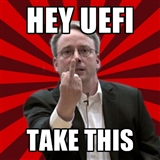
Linus on UEFI

Summary: Red Hat dodges questions about the consequences of its UEFI dealings with Microsoft

A few days ago we received a lot of press coverage for explaining the UEFI scheme of convicted monopolist Microsoft. One person wrote to get our attention and show how Fedora/Red Hat dodge a legitimate point of criticism. Here is the crux of it all:

When we ran our original report, we noted that Fedora did not mention once ARM or Windows RT. Obviously, Windows RT is the elephant in the room. While Windows 8 will have an off switch to Secure Boot, allowing anyone to bypass these operating system restrictions… Windows RT is quite the opposite.

Windows RT will only run operating systems that are signed by Microsoft. Microsoft, has refused to comment on if any operating systems other than Windows will be permitted to run. Including, Fedora. And, they’ve told OEMs to expect the worst.

Apologists for Microsoft, including people like Ed Bott and Paul Thurrott, have chastised PhoneNews.com directly for challenging Microsoft on this walled-garden position. Their position is that Microsoft is doing no different than Apple, and Apple has been allowed to lock down iOS without any reprisal from regulators, let alone consumers in general.

[...]

We followed up with Mr. Garrett, asking him if it was Microsoft, or Red Hat, that refused to entertain a signed version of Fedora for Windows RT. Unfortunately, Mr. Garrett declined to comment, directing us to Red Hat media relations.

After contacting Red Hat media relations multiple times, we were promised a clarification. Unfortunately, after repeated re-requests, Red Hat’s media relations department has become unresponsive. We will be happy to follow up if we do hear back from Red Hat, and will continue to ask them for an answer.

The burning question does remain though, did Microsoft tell Red Hat that it would be barred from offering Fedora on ARM-based Windows PCs? Or, did Fedora opt-out on their own, for some unknown reason? It is hard to remain independent, and not accuse Microsoft of the former.

There is little evidence to indicate that Red Hat would simply choose to not offer Fedora on ARM systems, and only on x86 machines. Fedora currently runs on a broad range of ARM systems and chipsets. All evidence points to Microsoft refusing to allow ARM signatures for Fedora, and Red Hat choosing a half-agreement for x86 PCs and tablets.

[...]

Regulators in the United States and European Union are taking another look at Windows RT. Sources report the primary reason being that, in general, consumers will not be able to differentiate between an ARM-based desktop and an Intel-based desktop computer.

If Microsoft accomplishes this two-processor approach, where x86-PCs will be allowed to run Linux, and ARM-PCs running Windows RT will not be allowed to run Linux, the results will likely be devastating to the Linux platform.

One thing Microsoft will achieve, if successful, is blocking users from migrating over to Android. Google has stated their intentions to unveil a unified Android-Chrome OS unification as a transcending operating system. Android 4.0, Ice Cream Sandwhich already makes significant improvements, aimed at making it a palatable desktop operating system.

PhoneNews.com can confirm that future versions of Android able to run native code on-par with Windows and OS X, and that the goal is a pressing matter inside Google. It’s only a matter of time before Android enters the desktop operating system wars. If Microsoft is successful, it will be difficult to tell which Windows 8 RT computers can be migrated to Android, and the task will likely be too difficult for the average user to accomplish on their own.

With ARM-based desktops only likely to increase, the only way to migrate a Windows RT machine to Android, will be to drag it to the Recycle Bin. And that’s the awful choice that Microsoft wants.

Microsoft must be very worried that manufacturers increasingly turn to Linux-powered operating systems (mostly Google’s), so it is trying some subversive means to hack the market. At Microsoft, a delusion prevails that Windows 95 hype can be reproduced for Vista 8. To quote the VAR Guy:

But 1995 was seventeen years ago — when Microsoft disrupted PC software rivals and Unix rivals, and defined the client-server age. Today, Microsoft is the market incumbent trying to find off cloud and on-premises rivals while the PC market delivers flat growth.

Microsoft is trying to subject ‘Linux companies’ to deals which favour Microsoft and in the process, in the case of Novell, it also polluted the kernel, Linux. It polluted OpenOffice.org as well, but that’s the subject of the next post. Staying on the subject of the kernel, Microsoft put "big boobs" it in. Here is some lengthy coverage about it:

Geeks are known to be obsessive about things. At times that tendency can go overboard, resulting in them looking rather silly and foolish.

A classic case came to light a few days ago when Red Hat developer Matthew Garrett blew a fuse over what he characterised as “male childish humour”.

Some background is needed: Garrett, once one of the more volatile developers in the Debian GNU/Linux project (he quit sometime back), has over the last few years taken up the cause of women in general. At times, his campaigning is on target; at others, like the instance that follows, he appears to be flailing at flies.

As usual, Network World spins with an apology from Microsoft (here it is being spun as an apology).

Red Hat oughtn’t come to depend on Microsoft. It doesn’t need to; Microsoft just doesn’t have the same leverage it once had. Red Hat made a mistake. It should have learned from Novell’s death.

“Booming Steve Ballmer, Gates’s number two, said the company had received an outpouring of mail from customers, much of it saying that the company was too arrogant.”

Barbarians Led by Bill Gates, a book composed
by the daughter of Microsoft’s PR mogul

Share this post: These icons link to social bookmarking sites where readers can share and discover new web pages.
  • Digg
  • del.icio.us
  • Reddit
  • co.mments
  • DZone
  • email
  • Google Bookmarks
  • LinkedIn
  • NewsVine
  • Print
  • Technorati
  • TwitThis
  • Facebook

If you liked this post, consider subscribing to the RSS feed or join us now at the IRC channels.

Pages that cross-reference this one

A Single Comment

  1. mcinsand said,

    July 20, 2012 at 11:32 am

    Gravatar

    Turning a weakness into a strength is one of MS’ classic anticompetitive judo skills. Windows’ megalithic architecture makes security impossible, so MS can use UEFI as an excuse to illegally tie OS to hardware. This has to be stopped, and the moves from Redhat and Ubuntu to legitimize this garbage does not help!

What Else is New


  1. Links 25/5/2013: Beaglebone Black (BBB), Tizen Comeback

    Links for the day


  2. Red Hat Pays Microsoft-Linked Patent Troll Again, Refuses to Provide Details

    Another attack on GNU/Linux results in payment to trolls and silence from Red Hat, which keeps the FOSS community in the dark


  3. Microsoft Brings the Notion of Buying Games to End, Consumer Rights Groups Should Sue

    Not only is XBox eliminating the notion of owning and controlling one's console; new XBox paradigm aims to reduce one's control over purchased games, reducing buyers to temporary, transient consumers


  4. Links 24/5/2013: Fedora ‘Pidora’, CIvil Rights Debated in the US

    Links for the day


  5. Bill Gates Still Getting Richer Through For-Profit Investments, Now Wants to Brainwash Children in Schools in Favour of His Investments

    Some of the latest strategies used by the world's richest man to protect his investments and amass yet more money, adding to an ever-growing wealth while pretending it's a charity


  6. Microsoft Entryism and Its Effects on Corporate and Public Policy

    An aspect of Microsoft culture that ought not be overlooked because of its profound effect on society (private and public)


  7. Red Hat Should Follow Google's and Twitter's Footsteps on Patents to Avoid Becoming the Next Novell

    Red Hat continues to ignore my plea to defang the software patents it is applying for, potentially making them weaponised like Novell's and Sun's patents (e.g. Java at Oracle) upon buyout or another major event


  8. CAFC Decision Still Overridden by Overzealous Patent Lawyers in the Press, The Guardian and Other Corporate Press (CBS and AFP Included) Still Guard the Establishment

    Analysis of a sceptical kind of corporate press coverage regarding software patents in the US; great examples of how Microsoft- and Gates-funded press outlets tend to get it all wrong on the facts, smearing digital freedom fighters


  9. Software Patents Debate Still Open in New Zealand and the US

    In spite of distraction attempts, the debate over software patents continues to stress that there is a real danger


  10. WebM is No Ogg, It is Not Freedom-Respecting Anymore, Even in Countries That Have No Software Patents

    Why Google needs to fix the licence of VP9, or simply stop pretending that it should be the only de facto standard for multimedia


  11. Microsoft Violates Google Licences

    The champion of 'IP' and licensing (extortion) is not much of a champion after all, based on new reports, not just a lot of old ones


  12. Skype Teaches Us That All Microsoft Software Should be Assumed Spyware Unless Proven Otherwise

    The broader implications of Microsoft adding spying 'features' to Skype


  13. Links 23/5/2013: Threat to Civil Rights in UK, KDE 4.11 LTS

    Links for the day


  14. Links 22/5/2013: Debian GNU/Hurd, New Go Language Release

    Links for the day


  15. The FRAND Apple-Microsoft Conspiracy Attempts to Destroy Android/Linux, Ban Imports

    How Microsoft and Apple are using patents in bulk (sometimes acquired in unison, e.g. from Novell and Nortel) to artificially lower market saturation of the Android operating system or drive costs up


  16. Gates Foundation: Buying Influence for Bill's Ego and Bill's Profit

    New examples of power being acquired and investments (i.e. for profit) being funnelled into the beneficiaries


  17. Bill Gates Enters Financial Centres With His Goons Becoming US Budget Chief, Top Bankers

    How Bill Gates' staff is entering positions of financial power, indirectly giving Gates power over US (national and international) finance


  18. IBM Ignores Small Companies' Interests, Denies Patent Scope is a Problem, Focusing on Its Own Problems (Trolls) Instead

    How David Kappos and IBM (his longtime employer) continue to ignore the obvious problem which kills small businesses and everyone is complaining about


  19. The New York Times Publishes Factually-Flawed Patent Propaganda Benefiting Microsoft and Apple

    Eamonn Fingleton is rewriting history in the US' top newspaper, insinuating that patents contributed to the rise of software duopolists


  20. Software Patents Eligibility Likely to be Decided by SCOTUS

    Analyses suggest that an escalation by appeal to SCOTUS is likely to be the next stage in 'Bilski 2.0'


  21. Does Bill Gates Try to Flush GNU/Linux Down the Toilet in Kerala?

    Renting Microsoft software rather than using Free (as in freedom, or libre) software?


  22. Links 21/5/2013: Handbrake Turns 0.9.9, NetBSD 6.1

    Links for the day


  23. Links 20/5/2013: First Salifish Smartphone, Mageia 3 Released

    Links for the day


  24. Microsoft Corruption (Illegal Tenders) Stopped by European Court

    Microsoft cannot bypass public tenders, based on a ruling from a court of law in Europe


  25. Not Satire: Microsoft Wants to Show the World How Security is Done

    Software security 'standard' to be led by the company which made insecurity an acceptable engineering practice?


  26. Microsoft is Struggling to Maintain Industry 'Standards'

    With Microsoft's common carrier and browser share down considerably Microsoft finds itself increasingly irrelevant and it tries subversive means of making another comeback


  27. Microsoft Entryism and Bribery Get the Microsoft Way Implemented

    A recollection of very dirty tactics from Microsoft, which uses money to oppress, overthrow, and even hijack its opposition


  28. Patent Policy Laundering in the European Union and New Zealand

    How the so-called 'free' trade agreements help spread patent policy which favours software patents


  29. Ongoing Focus on Patent Litigation and Patent Trolls Reduces Focus on Software Patents

    The problem with increased focus on the players that use software patents litigiously and the litigation itself


  30. Andrew Y. Schroeder Shows That Patent Lawyers Are Sociopaths

    Bully and law misuser is trying to get his way with foul language, intimidation, and sheer lack of professionalism


RSS 64x64RSS Feed: subscribe to the RSS feed for regular updates

Home iconSite Wiki: You can improve this site by helping the extension of the site's content

Chat iconIRC Channel: Come and chat with us in real time

Recent Posts