Summary: An outline of one week's news regarding software patents in the United States, with special emphasis placed on key foes and allies of GNU/Linux
The Lobby for Software Patents
THE USPTO can no longer grant software patents as routinely as it used to and some people are upset about it. These people, however, do not develop software.
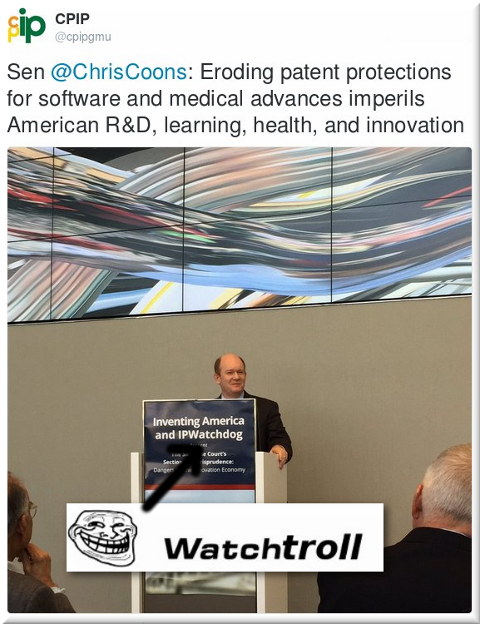
"Sen Chris Coons," according to
this tweet, says that "Eroding patent protections for software and medical advances imperils American R&D, learning, health, and innovation," but this coming from guy who never wrote a single line of code in his entire life does not mean much. Maybe he's just funded by some large company that is pursuing software patents (like IBM and Microsoft). Moreover, with Watchtroll branding on the podium (see the photo), we assume that Chris Coons came there to serve patent maximalists, who have grown quite loud recently. Benjamin Henrion
responded by saying that "software patents shifts R&D budgets to P&L." (patents and litigation)
We are troubled to see the voices of the patent microcosm growing even louder in the wake of Trump's election win. They want change and they want this change to harm software developers so that they can profit from (or tax) actual producers. IBM, we might add, is a growing part of the problem. Does IBM even realise to what degree it alienates the Free software development community by advocating software patents all the time? Does IBM truly realise that it aligns itself with patent extremists that insult judges and push for software patents based on self-serving lies? Does it care? Does IBM realise that by paying
the former Director of the USPTO it participates in institutional corruption? And again, does it care? By lobbying to annul the Supreme Court's decision and elevate less than a handful of
Appeals Court (CAFC) decisions these people reveal their true face and selfish interests, which happen to harm
every software developer around the world. It harms developers of
both proprietary
and Free/Open Source software.
CAFC on Software Patenting
Speaking of the Appeals Court, also published (albeit behind paywall) is
this article titled "Appeals Court Casts Doubts on Smartflash's Patent Win Over Apple" (we
mentioned this
before). "Two judges signaled the patents claim ineligible subject matter under Section 101 of the Patent Act," says the summary. This article is
mirrored here (also behind paywall). Section 101 certainly gets taken into account by CAFC, but
patent law firms like Finnegan continue pushing the envelop on lies that software patents still have teeth in the US. It's that usual cherry-picking of CAFC cases. Baker Botts LLP
has just done the same thing. Don't fall for it. In the vast majority of cases,
including in 2016, CAFC rules
against software patents and Section 101 remains very strong an argument against software patents. Watch this
new docket report that says:
The court denied defendant's motion for summary judgment of invalidity on the ground that plaintiffs’ call center telecommunications patents encompassed unpatentable subject matter because the motion obscured patents' complexity with reductionist simplicity.
The recurring theme here was covered in almost a hundred
Techrights articles. It definitely seems as though software patents aren't coming back any time soon (if ever), but the patent microcosm
sure is trying to accomplish that.
IBM and Conservative Think Tanks
Adam Mossoff, who works for a Conservative think tank and has a history of rather aggressive patent views (we covered these in [
1,
2,
3]), is trying to
shame Congress into pushing for reinstatement of software patents, based on misinformation. "Today," he summarised it, "Congress should save software again by expressly confirming that it is a patentable technological invention."
Nonsense.
If anything, software patents caused
a lot of damage. But then again, judging by Mossoff's paymaster, reliance on facts is almost a sin. Look where they stand on issues such as climate change.
"But this essential technology in our modern innovation economy is at risk,"
Henrion quotes him as saying, responding with "yeah copyright replaced by patent trolls..."
Another person
responded with "and look at the Patent Troll mess Software Patents has left us in..."
Exactly. Mossoff, as we pointed out here in the past, became a voice of patent trolls and the patent microcosm. He's not a software developer and he merely 'hijacks' the voice of those who are with a nonsensical headline like "Congress Saved Software in 1980, and It Should Do It Again Today" (in a neo-Conservative Web site, of course).
This article seems to be one among several. The patent microcosm wants software patents back, unlike actual developers. Watchtroll is pressuring Congress on this subject also, most recently with yesterday's headline (yes, a Sunday!)
"Congress Can Save Software Patents by Repeating One of Its Successes".
It's just a bunch of mumbo-jumbo urging Congress to reinstate software patents and some of this mumbo-jumbo
is promoted by IBM's patent chief. Patent trolls proponents like Adam Mossoff are intentionally conflating software with software patents (one destroys the other) and then some IBM lawyers deems it cite-worthy? How stupid does IBM want to look here? It's only going to harm the company's relations with developers.
Google Against Software Patents, Unlike Microsoft
Contrast this with the following new article from Allen Lo, who is deputy general counsel for patents at Google. He published
"Protecting Alice protects patent quality and technological innovation" and said in it:
The goal of the patent system, as set forth in the Constitution, is to promote the progress of the “useful arts,” which has always been understood to mean technological progress. Here at Google, we are proud of the many ground-breaking software inventions by our engineers that have allowed us to file a growing number of high-quality patents and establish a strong and valuable portfolio.
While Google and many other tech companies invest many billions of dollars in research and development (R&D) to make these inventions – and these patents – possible, not all software patents issued by the Patent and Trademark Office (PTO) are of high quality. A series of roundtables recently convened by the PTO in Alexandria, Va.; Stanford University; and other locations around the country explored one of the most important tools for improving the quality of software patents and ensuring that only worthy patents are approved.
That tool arises from the unanimous 2014 Supreme Court decision in Alice Corp. v. CLS Bank International, which established that software patent claims that recite a financial arrangement or broadly describe a function performed “on a computer” or “on the internet” are not eligible to be patented. Before Alice, applicants were obtaining patents from the PTO that were not based on any technical contribution or innovation, often not even providing an explanation of how they expected to achieve a result beyond stating that it would be done “on a computer.” Case law and PTO practices had swung too far toward allowing these low-quality claims to remain unchallenged, and a course correction was needed.
So we've covered IBM, Google, and what about Microsoft? Well, Microsoft is in the same boat as IBM when it comes to software patents and its patents have just survived CAFC's scrutiny, based on
this new report that says:
Microsoft has survived an appeal against a lower court decision that it didn’t infringe patents belonging to Impulse Technology.
Yesterday, December 8, the US Court of Appeals for the Federal Circuit affirmed the ruling of the US District Court for the District of Delaware, granting Microsoft’s motion for summary judgment.
In 2011, Impulse sued Microsoft, alleging infringement of 15 claims of the asserted patents: US patent numbers 6,308,565; 6,430,997; 6,765,726; 6,876,496; 7,359,121; and 7,791,808.
Inverting the Narrative
Truth be said, large companies don't mind the patent mess because they can afford to pay the legal fees and this whole mess harms small companies the most. Here is
a 15-page PDF of a paper by Professor Lemley
et al in which it's said (by
Patently-O) that "patent litigation outcomes vary according to the identity of the patentee" or to quote
Patently-O's summary: "The sales market for patent rights continues to vex analysts – especially in terms of valuation. In their Patently-O Patent Law Journal article, Professor Mark Lemley teams up with the Richardson Oliver Group to provide some amount of further guidance."
It's no secret that there is gross discrimination in patent systems,
even in the EPO.
Part of the patent microcosm, or pushers for software patents (Bilski Blog), chose to distort the narrative of software patents (for large businesses, in bulk) and instead went with
this narrative which would have us read about the “little guys”:
From the beginning my application was rejected, and continues to be rejected, under Section 101, even though we have recently overcome all of the prior art rejections. As a result, I have become something of an accidental student of patent eligibility and as such was very interested in attending the USPTO’s Patent Subject Matter Eligibility Roundtable I on November 14, 2016. Prior to the roundtable, I had assumed that my application was something of an outlier, that there was something wrong with it and that was why it had been rejected. At the roundtable I learned that “it’s not me, it’s you” applies not just to exes but to the patent system as well.
[...]
The few speakers at the roundtable who did advocate on behalf of us “little guys” often mentioned how the “direct costs” negatively impacted micro-entities, focusing on the need for examiners to avoid using “blanket statements,” to be specific in their responses, and carefully ensure the law is being properly interpreted and applied on a case by case basis. As a solo entrepreneur, I couldn’t agree more with the need to “get it right the first time,” as this would substantially reduce direct costs for us. My impression is that the examiner’s first instinct is often to reject without any substantive reason, hoping we’ll simply abandon the process altogether, or better yet, pay the ever increasing, exorbitant fees (for me) involved in requests for continued examinations and the appeals process.
This thing which the USPTO called "roundtable" was just an echo chamber. See
our article about it and then see
this article from
Scott Graham of The Recorder (behind paywall). To quote the outline: "A discussion Monday at Stanford University was an opportunity for big tech companies, entrepreneurs, bar associations and academics to hash out the impact of 'Alice' and other developments in patent eligibilty."
This was
cited by IBM's Manny Schecter (IBM is still dissatisfied because there is no software patents certainty and
IBM attacks small companies using software patents). There was "no software developer around the table,"
Henrion told IBM's Manny Schecter, "how broken is that?"
Well, this whole "roundtable" was nonsense, or an exercise in fake transparency, giving the illusion of public participation in decision-making while excluding the main stakeholders (who actually produce something).
"If you write code," I told Manny in relation to
this tweet of his, "maybe you’ll understand it’s mumbo-jumbo buzzwords" (he wrote "Abstract? Technological? Concrete? Practical application? Exactly. From #patent perspective these simply cannot be defined precisely.")
Henrion
added, "Tangible?"
All those silly words are so often used by non-developers who try to convince us developers that software patents are desirable.
The Trolls' Lobby
Witness how
Watchtroll's site wants to crush patent reform and harm actual producers of software etc. The title says "Advice for the Trump Administration and New Congress: Protect Bayh-Dole and Restore the Patent System" and it's more like the above pattern of lobbying, which we are seeing more of these days.
Not too long ago Watchtroll called reformers "Patent infringer lobby", leading people in the patent microcosm to
saying stuff like: "Patent infringer lobby pushes Trump to aggressively pursue "patent reform" https://lnkd.in/fasm8pZ Time to call out deliberate infringers."
Well, time to call out Watchtroll who didn't write any code, doesn't know how programs work, yet lobbies for software patents.
"Nice bullshit spin on the issue,"
wrote a technical person (Raphaël Jacquot) about the above.
Henrion wrote, "restore software patents and patent trolling."
Good for the patent microcosm after all, and we know at whose expense...
Speaking of trolls, Blumberg who used to work for for
the world's largest patent troll, Microsoft's patent troll that's connected to
Ray Niro (
who is now dead), is
quoted by IAM as saying: "In our view, Germany is the new Eastern District of Texas. That's the venue that gives us the most concern."
Blumberg is
now working in Lenovo, which is believed to have colluded with Microsoft to block GNU/Linux (they denied this after actually admitting this).
Concerns about Germany becoming another/new Eastern District of Texas are real because of the UPC ambitions, which will thankfully never reach London. Alexander Esslinger (a.k.a. Patently German)
wrote about the above quote: "Really ? At least of owners of SEP's it is not so easy to get an injunction in Germany based on interpretation of ECJ Huawei-ZTE..."
"Is that a bad thing," I asked him. He later responded to that, but one must remember whose side he is on. He's not interested in a sane patent system but a system from which he profits more. Like Bastian Best, who
spreads misinformation (biased by omission; fails to mention those ~80% of CAFC cases that send software patents down the sewer), he wants more patent litigation in Germany so that he can profit from that. IAM is on the same side as them and it's eager for everyone to celebrate patent trolling that's coming from the Far East. Here is the
latest example of that: "Barely a week after KAIST sued several major tech companies in what appeared to be the first ever patent infringement action initiated by an Asian university in the United States, another Korean educational institution has launched its own assertion campaign in the Northern Districty of California."
Remember that these are non-producing entities that are funded by public money.
Citing Microsoft and its massive patent troll (Intellectual Ventures), IAM also
pretends that lowering patent quality is a good thing:
Perhaps the most striking thing was how quickly some of China’s major tech companies have become sophisticated IP players. Xiaomi's progress in particular has been remarkable and with former IV IP executive Paul Lin on board, the company has one of the most experienced operators in the local monetisation market.
Xiaomi’s deal with Microsoft, announced in May this year, was in the spotlight on day 1 as Lin joined the software giant’s Micky Minhas to dissect one of the leading IP-driven transactions of 2016. As part of that agreement Microsoft sold the Chinese company 1,500 patents, giving Xiaomi a much-needed boost to its portfolio as it weighs up expansion into the US. For all that conditions are widely seen to have deteriorated for many patent owners in the US, the deal shows that American assets will always remain a crucial part of any company’s IP strategy be it focused on freedom to operate or monetisation.
Xiaomi’s patent settlement with Microsoft was an attack on Linux and on Free software,
as we explained at the time. Given China's approach towards software patents (the opposite of what the US is doing), we're not too shocked to see this happening, but that does not mean we have given up, either.
⬆
