
A new low: blocking EPO employees.
THE TIME is 4AM on a Sunday. I am frustrated. I'm unable to not think about this. Why are our elected politicians still ignoring the situation at the European Patent Office (EPO)? And yes, I do vote in European elections. I am in favour of the EU and always have been. This is a matter of public record; I've never hidden this. In order for the EU -- and for Europe as a whole -- to remain strong it needs to demonstrate a certain resistance and perseverance in the face of lobbying, bribery, and blackmail. It needs to tackle issues such as tax evasion, air pollution, privacy abuses and so on. This year's copyright directive did major damage to the EU's reputation and last year's appointment of António Campinos (former EU person) as Battistelli's successor does not inspire confidence. He had been elected a year before that after a rigged (by Battistelli) process and a Council of unelected officials -- mostly heads of national patent offices (NPOs) -- just rubberstamped Battistelli's choice (of a friend, a compatriot from elite French schools).
"Some time in 2017 or 2018 it already seemed like software patents were 'finished' in the US, but Trump proved us wrong by putting a litigation 'mole' (and his former business partner) in charge of the world's most important patent office."At the start of the year we stopped covering 35 U.S.C. ۤ 101 affairs in order to better (or more often) focus on EPO abuses. It had become clear to me -- more so after the visit to Berlin -- that the EPO issues were "close to home" and a lot more urgent than anything that went on in the US. That was weeks before Iancu circulated a memo about gutting (or ignoring) 35 U.S.C. ۤ 101. Some time in 2017 or 2018 it already seemed like software patents were 'finished' in the US, but Trump proved us wrong by putting a litigation 'mole' (and his former business partner) in charge of the world's most important patent office. We didn't stop covering this scandal; it's just that we typically 'shelve' articles on this topic in Daily Links (we have a relatively new section, "Patents and Software Patents," which can be found further down among the headings).
The European patent crisis and its full impact may take time to materialise because patents last a couple of decades and any European Patent wrongly granted today can have a negative effect for as long as a generation if not longer. The word "crisis" as in "European patent crisis" isn't an overstatement but an understatement. The word was used even by the Council a few years ago; it had finally realised it could not just sweep the problems under a rug somewhere. But its response was weak and they wanted us to believe that a presidential shuffle alone would magically resolve things; their eventual 'choice' of President (actually Battistelli's choice) undermined that very premise as less than a year after he began the work at the Office staff was already organising to go on strike and indeed, the following year staff started protesting (that was last month). Nothing is improving. From what I can gather, having covered the subject on a daily basis for more than five years, things 'quietly' get worse. It all gets worse over time, under the veneer of attitudinal change. Sure, Campinos may not come across as overly temperamental like Battistelli; but is temperament the most important thing? Many people out there have fallen for 'charm' and lost sight of policies; they'd use Macron, Obama, Trudeau and even Merkel as examples of "left-leaning" leaders; but their underlying policies are often characterised as "neo-liberal" -- a widely misunderstood if not distorted term -- meaning unfavourable to workers and favourable to 'owners' of these workers. We're seeing much of the same at the EPO these days. Examiners can feel it. They can really feel it. They hardly feel valued; some feel dispensable. This might be normal in some gift shop or something, where training new workers would not take long so staff turnover isn't a massive business risk. But patent offices are different and talent retention (or experience) is vital to all.
"The European patent crisis and its full impact may take time to materialise because patents last a couple of decades and any European Patent wrongly granted today can have a negative effect for as long as a generation if not longer."At the end of last week the EPO posted several dozen tweets from EPOPIC that spoke of replacing workers (such as searchers) with the "magic" of "hey hi" (AI). I responded to the EPO in Twitter about half a dozen times; it's troubling that they'd have us believe all jobs can be replaced with machines while maintaining the same level of service; to managers this may make economic sense (to them alone), but at what cost? They're passing all the cost and the risk to other people, e.g. by granting invalid patents or carrying out sloppy searches that won't yield relevant documents (pertaining to prior art). Where does that leave the European public, let alone examiners? We have, over the past year, published numerous documents that show examiners' concern. They're very well aware of the decline in patent quality, knowing the possible ramifications for everyone's jobs -- not only at the EPO but also outside the EPO. Each monopoly granted does not necessarily make society (or "the economy") better off. Monopolies are limitation factors, not enablement factors. Similarly, each time a new law gets passed, that's an additional thing being banned or being criminalised. New laws -- unless they're actually the undoing of some existing laws -- merely provide more 'tools' by which to frame/render a business or a person "criminal"; hence, not each law being passed represents progress. And again, going back to patents, not every patent being granted implies more innovation; not every patent represents invention (evergreening being a good example of this point).
Trying to 'lecture' the general public about patent law isn't easy; when I explain this to my mother, for example, she fails to even grasp what patents actually are. She thinks that the word is a synonym of "invention"; "When you invent something," she told me, "that's a patent..."
"Monopolies are limitation factors, not enablement factors."As if it just 'happens'. You come up with something and magically a patent comes into existence.
A lot of people don't know how patent laws and principles work, why patent law exists, since when it has existed, who benefits from it, and the range of industries it covers.
It is, however, easier to explain to the general public -- colloquially speaking -- EPO scandals pertaining to finances, nepotism, and an assault on the separation of powers (the notion that when you're dissatisfied with an illegal outcome you can resort/turn to an independent branch to reassess this outcome).
Occasionally people write to me either to ask me to contact the "big media" (corporate publishers) or to ask me why I don't contact it. The latter is a loaded question as I constantly try to get media to pay attention to newer/latest scandals. 5+ years down the line, based on many experiences, I had to reach the conclusion that some writers are eager to cover the matter; but their bosses (publishes/editors/site owners) actively prevent that. Over time I also learned about threatening letters from the EPO and bribes from the EPO. This is how the rogue EPO mastered media control. They 'sell' Campinos as some kind of very kind saviour; This 'charm offensive' targets not only media but also politicians, some of whom are of course keeping themselves (mis)informed by the media.
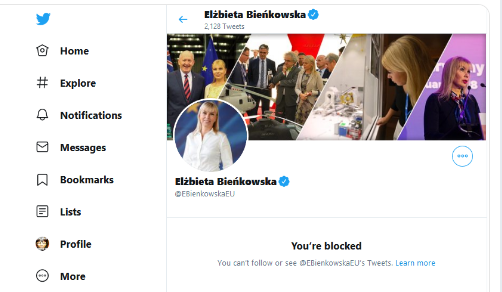
"5+ years down the line, based on many experiences, I had to reach the conclusion that some writers are eager to cover the matter; but their bosses (publishes/editors/site owners) actively prevent that."Days ago I learned that the European Commission's ElÃ
¼bieta BieÃ
âkowska [1, 2] is now blocking people who raise concerns about corruption in Europe's patent system. Yes, actually blocking!
What does that say about her and -- by extension -- EU officials? Not good, Miss BieÃ
âkowska, not good...
This is the kind of attitude that causes people to vote for leaving the EU and choose rather obscene parties instead (like that ridiculous "Brexit Party" with only one single policy!), based perhaps on the misguided assumption that they're the "lesser evil".
An EPO insider has just shared a screenshot to that effect and wrote [1, 2, 3]: "It seems that Mrs ElÃ
¼bieta BieÃ
âkowska is no longer interested in the ongoing unrests, the deteriorating working conditions and deplorable social situation at the EPO. She is now blocking concerned citizens without ever having had a conversation! #patents #deception #Europe [...] To turn a blind eye to the rule of law, remarkable behaviour for an EU representative, to say the least! #patents #deception #Europe [...] Perhaps she should ask herself who is paying her generous salary, right? Ahhh the #EuropeanCommission , alright then..."
"This is the kind of attitude that causes people to vote for leaving the EU and choose rather obscene parties instead (like that ridiculous "Brexit Party" with only one single policy!), based perhaps on the misguided assumption that they're the "lesser evil"."Will (or would) those same European officials let the EPO control the legal system and enforce it at a higher level, EU-wide, without national courts having a say? That would be madness. It would also be illegal and unconstitutional (which is likely worse than the more ordinary "illegal" because laws change over time; constitutions are more stringent). Imagine giving the EPO -- a notoriously corrupt institution -- more power to decide on patent scope in a couple dozen countries! Watch this new tweet from proponents of software patents in Europe; they continue to rely on the EPO (an office that violates its own law, or the EPC) rather than actual, outside, independent courts.
Incidentally, and perhaps in a somewhat timely fashion, people posted a lot of comments about the EPO and the EPC at IP Kat yesterday and the day before that. "Proof of the pudding" (a regular commenter who has not said much since IP Kat started censoring many comments critical of the EPO) wrote:
So, the Board is of the view that "the EPC provides a complete system for determining whether a priority right has been correctly claimed, and that the issue may be resolved by the EPO without reference to national law".
I would have thought that it was, in fact, the Paris Convention that "provides a complete system for determining whether a priority right has been correctly claimed". If the EPC contains any different or additional requirements, then that surely means that the EPC Contracting States are contravening their obligations under the Paris Convention.
Looking into the Board's communication reveals that the relevant paragraphs 27 and 28 are entitled "The EPC and the Paris Convention are a complete System". In fact the provisions of the EPC and the Paris Convention are identical as far as they are relevant for the contested legal issues in this case.
"The Boards themselves likely operate in violation of the EPC (not their fault but Battistelli's) while he's trucking millions of EPO euros to his friends in Paris (no connection to the Paris Convention)."So whatever the context of the above comments (we mentioned that post some days ago), they might be inadvertently overlooking the fact that these Boards lack independence -- by their very own admission -- and are thus unable to rule properly. Again -- it is not their fault! They're the victims here. They have the courage and the sincerity to state out in public that Battistelli robbed their autonomy. It's an extremely risky thing to do; they did that several times in the past. Similarly, as the next commenter's name put it, "EPO is not to blame but the applicant". Here's what that comment said:
The annex to the summons is published by now [it wasn't before]
https://register.epo.org/application?documentId=E3Z2HAR19821DSU&number=EP13818570&lng=en&npl=false
Anybody thinking that the EPC is a complete system and the Paris convention another and different complete system is playing with words and at the brink of bad faith.
As the provisions of the Paris convention and of the EPC are identical as far as they are relevant for the contested legal issues in this case, it should lead to the conclusion that the long standing line of case law at the EPO should be kept.
The question raised by the Board of Appeal is remarkable in its simplicity and the answer is obvious.
If A and B are the original applicants of the priority application, in order to benefit of the priority, both have to be the applicants of the subsequent applications, unless one of the original applicants transfers his right of priority to the second one, or both transfer their right of priority to a third party. The only aspect which touches the EPO when determining who the successor in title is legal regime under which those transfer of rights have been validated.
Disputing the ownership of an application once filed is different from deciding upon the right of priority, although in both cases the EPC speaks about the successor in title. When a first application is filed, or when an application claims priority and the applicant is the same as the one of the priority application, the EPO has no reasons to check whether the applicant in name is the true owner of the invention and hence of the application. The situation is different when an application is filed claiming a priority, and there is a difference in the name of the applicant of the priority application. Then the EPO has the duty to verify who the successor in title is.
One should however not forget that the problem we are faced in the present case stems from the "oddities" of US patent law.
Loss of the patent may only be the result of a document published in the priority interval becomes then prior art under Art 54(2), even if it is the own publication of all the applicants of the priority application.
In the US we have a grace period which is unknown in the rest of the world. Should the publication of an invention before filing not be sanctioned in the rest of world just because the applicant has published his invention in the US?
Translated into the priority system, it is in other words, what the appellants want.
If the right to priority cannot be transferred before the end of the priority period, why should it not be possible that the subsequent application is filed by the holder of the priority right, and the ownership of the subsequent application is then transferred? This would avoid a whole series of problems, not just before the EPO.
It might a priori look unfair that opponents can obtain revocation of a patent for, at a glance, reasons other than of substance, but here it is the applicant of the subsequent application which takes a great risk when the question of ownership of the priority right has not been properly cleared before the subsequent filing.
"They have the courage and the sincerity to state out in public that Battistelli robbed their autonomy.""Someone (a Swedish law firm, of all things!) declared themselves as the registered owners of one of my patents at the USPTO without my knowledge or approval (or the co-author’s) and the USPTO accepted it?!?!? [...] I have sadly had to get myself a lawyer "because IANAL”. Fortunately I happen to know a patent lawyer (friend from Uni)."
So at least it seems like the EPO isn't the worst patent office in every way/aspect (China is a good contender for it). "Suleman Ali" then commented:
I agree with the philosophy of the EPO's present position that it must be established that both applicants have given consent for the priority right to be established for a convention filing. However I disagree with the strict conditions that this means assignments etc must be in place by convention filing. This is completely arbitrary, and does not recognise the time frame for business negotiations and transactions. As always the EPO is applying rules in a mathematical way that serves no greater purpose. More leniency and kindness please
A positive aspect of the arguably harsh consequence of mucking up entitlement to priority is that it has made (more) attorneys in the US sit up and take notice ... and to realise that they cannot always assume that what works just fine in the US might not be good for elsewhere.
In other words, it seems to me to be a good thing that a consequence of this high-profile case could well be that US attorneys will start to ensure that they have a better understanding of an international treaty that is of fundamental importance to intellectual property rights ... and to which the US is a signatory.
Now if we could only find a way of getting patent examiners in the US to start looking at, and understanding the implications of, those pesky international treaties...
"They view patent quality as an obstruction to so-called 'productivity'; they view good examiners as nuisance who engage in gross professional misconduct/incompetence."MaxDrei (patent attorney) then wrote: "If the EPO is going to continue to impose its own EBA-made law on the rest of the world, even though this EBA-made law is said to be less than fully in line with "the aim" of the Paris Convention, the EBA really ought to try very hard this time, to come up with persuasive reasoning. Otherwise it is going to be criticised."
Here's the full comment:
Thanks for that last contribution, which reminds me of the very popular fob-off that, when you come to Europe with your patent applications, "Ignorance of the law is no excuse".
It is said that you, dear Applicant, should have known that, unlike everywhere else in the world, here in Europe i) there is no grace period ii) under Art 54(3), your own earlier filings, unpublished at the date of your claim, nevertheless destroy the novelty of that claim and iii) you need to dot the i's and cross the t's, and memorialize post-filing ownership transfers BEFORE you file PCT.
If the EPO is going to continue to impose its own EBA-made law on the rest of the world, even though this EBA-made law is said to be less than fully in line with "the aim" of the Paris Convention, the EBA really ought to try very hard this time, to come up with persuasive reasoning. Otherwise it is going to be criticised.
There are good reasons for the absence of a grace period and very good reasons for the Art 54(3) self-collision. They persuade me. But as to the TBA question here, having read the Straus Amicus Brief, and now the Annexe to the TBA Communication, I personally am not seeing reasons persuasive enough to justify upholding current practice. Readers, in the enormous EPO file, which is the single doc I should read, that makes the most persuasive case for continuing with present practice? Perhaps that will persuade me.
Dear Max Drei,
The whole discussion turns about the interpretation given to the word "any" or in French “celui qui”. For some scholars, e.g. Prof. Strauss, it means not all of those having filed the provisional application, have to be named in the subsequent application.
According to Prof. Strauss, if A and B have filed a provisional application, A could decide to file in certain countries, and B in others. I am anything but sure of that is what the drafter of the Paris Convention had in mind. By the way what the drafters of the Paris Convention had in mind is
For other scholars, e.g. Prof. Forteau, the word “any” or in French “celui qui” should be interpreted broadly, encompassing one of several co-applicants of the original application acting individually when filing the subsequent application.
Should we follow the views expressed in the name of the proprietor, we would be bang in the question raised by the Board.
To me, “celui qui” has as plural “ceux qui”. This means clearly that in case of one original applicant it must be the same applicant or its successor in title of the subsequent application. If there is a plurality of co-applicants all those co-applicants have to be those filing the subsequent application. It is a question of mere logic.
I am thus not convinced by Prof. Strauss’ statement or by the one of Prof. Forteau.
After all, the purpose of the Paris Convention was to avoid self-collision, and the applicant of the subsequent application should not be penalised if its application was published before 12 months. Avoiding self-collision can only be between two applications having the same applicant or co-applicants. There again it is question of mere logic.
Dear Suleman Ali,
When the assignments are not ready and in place by the convention filing, why then not have the convention filing carried out by the original applicants and the transfer of ownership afterwards. This would obviate any problems of timing.
"If the EPC is so shamelessly being violated and if the EPO continues to demonstrate disregard for the independence of judges (their appointment process and more), how can a system like the UPC ever be tolerated?"So, in summary, there are growing concerns about EBA and about the EPC. There are, accordingly, also concerns about the Unitary Patent (UPC), or the European Union-centric Unified Patent Court Agreement (UPCA). If the EPC is so shamelessly being violated and if the EPO continues to demonstrate disregard for the independence of judges (their appointment process and more), how can a system like the UPC ever be tolerated? Ever?
Incidentally, only two days ago a Team UPC-owned blog (author unnamed, posted under "European Patent Litigation" -- their 'bread and butter') published "Ingve Stjerna: Examination compatibility UPCA with German and EU law was deficient." Whoever the author is, he or she writes about UPC opponent Dr. Ingve Stjerna with his latest analysis. Here are some portions:
The compatibility of the Unified Patent Court Agreement (UPCA) and two pieces of draft legislation submitted for its ratification in Germany with the German Constitution was examined only very selectively, whereas the compatibility with EU law was apparently not examined at all. This is the conclusion of the Düsseldorf based patent lawyer Ingve Björn Stjerna, who meticulously investigated the procedure leading to the German ratification of the UPCA.
Stjerna, the lawyer behind the constitutional complaint against the UPCA which led to a stay of ratification proceedings in Germany, published an article on the issue last month. The timing is not coincidential: a decision of the German Federal Constitutional Court (BVerfG) about the case (2 BvR 739/17) is expected in the upcoming months. At the end of his article, Stjerna implicitly says the BVerfG should take into account his findings:
‘The documents provided suggest that the BMJV [the Federal Ministry of Justice and Consumer Protection] having the overall responsibility for the implementation of the European patent reform in Germany and the ratification of the UPCA, did not comprehensively examine the Agreement for its compatibility with the Grundgesetz nor or [of?] that with Union law, in particular with CJEU Opinion 1/09. The BVerfG may take note of this with interest.’
[...]
In the second chapter of his article, using among others information he gathered with three requests (in October 2017, August 2018 and February 2019) based on the Freedom of Information Act, he writes what happened in practice. ‘The answer is sobering. According to the official information provided by the BMJV, individual aspects were examined for compatibility with the Grundgesetz, but relevant constitutional issues remained unexamined, as did compatibility with Union law’. Then he proceeds with all the details sustaining his conclusion. A few exemples are given below.
"For Europe to remain united (unity, unitary, unified, whatever) we need the perception of functioning accountability mechanisms. We don't have that at the moment, certainly not in EPOnia."Going back to where we started, the EU (or EC) ignores all this at its own peril. The most controversial parties, including AfD, were quick to exploit these UPC scandals, leveraging them to bolster their anti-EU agenda. Unless the EU takes control of the situation at the EPO, at the very least by stripping its immunity and launching an investigation, nothing will improve. Things will get yet worse (faster than anything can ever improve).
When I look at EPO abuses I don't bash the EU. Rather, I am becoming increasingly concerned about the self-harming (in)action of the EU. For Europe to remain united (unity, unitary, unified, whatever) we need the perception of functioning accountability mechanisms. We don't have that at the moment, certainly not in EPOnia. Sweet-talking and fairy tales aren't substitutes as more people become disillusioned over time. ⬆
Related/contextual items from the news:
Lawyers say that the UK Supreme Court’s judgment in Shanks v Unilever is likely to result in changes to business practice and an uptick in compensation claims
Section 40(1) UKPA states that, when considering if an employee should be awarded compensation for his invention, the court should have "regard among other things to the size and nature of the employer’s undertaking". In the UKSC decision, Lord Kitchin reasoned that the Hearing Officer and lower courts had erred in their interpretation of the appropriate "undertaking" of Professor Shanks employer. The "undertaking" to be considered, according to the UKSC, was not that of Unilever as a whole. The relevant undertaking was instead that of the Unilever subsidiary by which Professor Shanks was directly employed (CRL), whilst also taking account of the commercial relationship between CRL and Unilever as a whole.
In order to establish the correct "employer undertaking" in the case in question, Lord Kitchin observed that in many situations relating to employee compensation, identification of the appropriate undertaking "will be comparatively straightforward. It will be the whole or, if it is divided into economic units, the relevant unit of the employer's business" (para. 41). However, the case in question was a different and more difficult case.
Unilever argued that the relevant undertaking was Unilever as a whole. In particular it was argued that it was "unreal to treat CRL as the relevant undertaking because it never generated any material revenues, was not the beneficiary of the royalties in question and is and was simply a service company for the Unilever group" (para. 45). Furthermore, the €£24.3m benefit from the Shanks Patents went to the Unilever group as a whole. By contrast, Professor Shanks argued that the relevant undertaking was that of CRL. Particularly, CRL was Professor Shanks' direct employer and the entire Unilever group could not sensibly be described as CRL's undertaking (para. 45).
Lord Kitchin opted for an approach that lay between these two extremes. The analysis, according to Lord Kitchin, should have a more practical and commercial focus. In particular, the question to ask was what would have been the expected benefit of a patent originating from a research facility such as CRL, operating as part of the larger Unilever group, to Unilever as a whole?
[...]
€£2m compensation is the largest amount of compensation that has been awarded to an employee-inventor under Section 40. Lord Kitchin agreed with the Hearing Officer that a "fair share" of the benefit derived by Unilever from the patents was 5%. Lord Kitchin disagreed with Professor Shanks' argument that a fair share would have been between 10-20%, given that, amongst other factors, the patent had been exploited at no risk to Unilever. Lord Kitchin agreed with the Hearing Officer at first instance that 5% was fair given that 1) Professor Shanks was employed to invent and, in making the invention, did what he was employed to do. Furthermore, the benefit of the patents was brought to fruition by Unilever's negotiation of the licences (something in which Professor Shanks played no part) (para. 91).
The Supreme Court handed down its judgment on 23 October 2019, marking the end of a 13-year struggle between the inventor, Prof Ian Shanks, and Unilever for compensation in relation to an invention relating to disposable glucose monitoring equipment.
The judgment of the Supreme Court provides valuable guidance on the matters to be taken into account when assessing the benefit of an invention, and the amount of compensation to be awarded to the inventor. However, it may encourage conglomerates who currently employ inventors in a small subsidiary within the larger group of companies to re-structure so that inventors are directly employed by a larger manufacturing company in the group, so that the “employer’s undertaking” is a larger entity and thus a higher threshold is set when assessing whether the invention has provided an “outstanding benefit”.
[...]
The Supreme Court did however decide to apply to the 5% share an uplift to reflect the impact of time on the value of money. The original 5% of €£24 million (€£1.2 million) was thus uplifted to an award of €£2 million to Prof Shanks.
[...]
The persistence of Prof Shanks has provided, in the decision of the Supreme Court, important guidance as to the manner in which a claim for compensation under Section 40 is to be dealt with in future.