
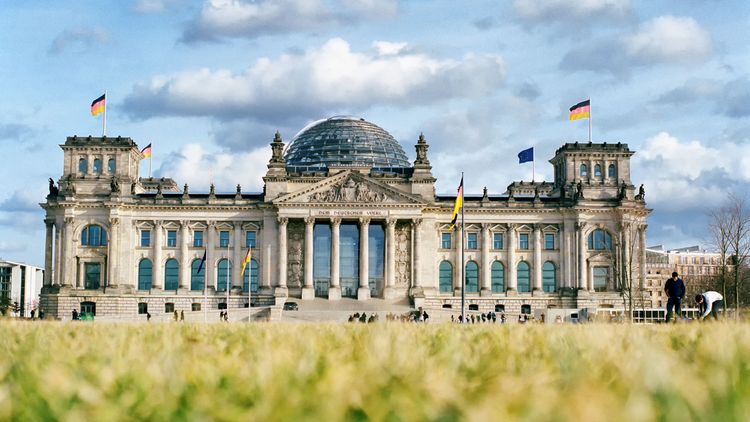
The EPO has been the subject of questions in the German Bundestag on a number of occasions between 2015 and 2020
As mentioned in the last part, when it comes to EPO affairs German politicians have been far more timid and reticent compared to their Dutch counterparts.
"In the EPO's main host state, politicians have - for the most part - preferred to refrain from getting involved in any scrutiny of the lucrative "Dukatenesel" with its headquarters in the Bavarian capital of Munich."At a federal level there was never any significant effort in the German political arena to subject EPO affairs to parliamentary scrutiny.
A rare exception here was Jutta Krellmann of the socialist party "Die Linke" who asked a question in October 2015 following the publication of a report in heise.de about deteriorating working conditions at the EPO (Bundestag Printed Paper [PDF] no. 18/6301).
The response dated 8 October 2015 from the Secretary of State at the Federal Ministry for Justice, Christian Lange, was the usual kind of hand-waving waffle typically dished up on such occasions.
Lange's response was strong on pious platitudes such as "A good working atmosphere at the European Patent Office is a very important concern for the Federal Government". But it was lamentably weak in terms of meaningful substance.
Since Battistelli's departure from the EPO in June 2018, it seems that some other German politicians have finally mustered up the courage to ask some serious questions about the EPO.
In one of his occasional contributions to the Kluwer Patent Blog, published at the start of March 2020, the German patent attorney, Dr Thorsten Bausch, reported on one such parliamentary intervention by members of the liberal party, "Freie Demokratische Partei" (FDP).
At the end of January 2020, a group of representatives from the FDP (Bundestag Printed Paper [PDF] no. 19/17383) had submitted a minor interpellation ("Kleine Anfrage") containing a series of questions about the EPO and its activities.
"Rather than attempting any meaningful engagement with the substance of the matters raised by the FDP, the reaction of the government was to brush these awkward questions aside, citing reasons of “confidentiality”."According to the procedural rules of the Federal Parliament ("Bundestag"), at least five percent of the members of a parliamentary group are required in order to put questions to the government on a particular topic in written form. The questions are transmitted to the President of the Bundestag, who forwards them to the Federal Government, requesting that they be answered. Minor interpellations are answered by the government exclusively in written form.
Under points 4. and 6. of the FDP's "minor interpellation" reference was made to matters connected to the lack of effective data protection at the EPO (in translation):
4. Was the Government aware of the accusations published in the press that staff rights were being violated by surveillance and by labour law restrictions under the EPO’s previous management and what is its view thereon?
6. Was the Government aware of the accusation published in the press of employee surveillance by an internal investigation unit under the EPO’s previous management and what is its assessment thereon?
"Whether the representatives will get good (i.e. meaningful) answers back by the German Ministry of Justice, though, will remain to be seen. I would not hold my breath. But stay tuned, I will try to follow up on this. Transparency is important."
[PDF] no. 19/17809).
Questions 4 to 7 will be answered together. The questions relate to confidential disciplinary proceedings which the Federal Government will not comment on at present. This also applies to proceedings before the internal appeals committees.
"Unfortunately, there is no sign that Dr Bausch followed up on his declared intention to return to the topic. It would have been very interesting to read his comments on the response of the government to the FDP's interpellation. It is difficult to imagine that he would have had anything complimentary to say about the manner in which the matter was handled by the Federal Ministry of Justice."The existence of purportedly "confidential" disciplinary proceedings is no valid reason for refusing to enter into a discussion about the general principle of the use of covert surveillance measures. This is particularly so when such measures are deployed in the context of a deficient data protection framework which fails to provide adequate safeguards against abuse. It is very clear that discussion about the general principles governing such matters does not need to concern itself with the details of individual cases.
Unfortunately, there is no sign that Dr Bausch followed up on his declared intention to return to the topic. It would have been very interesting to read his comments on the response of the government to the FDP's interpellation. It is difficult to imagine that he would have had anything complimentary to say about the manner in which the matter was handled by the Federal Ministry of Justice.
This was not the only occasion on which the FDP made a well-intentioned but unfortunately unsuccessful attempt to subject the activities of the EPO to scrutiny in the Federal Parliament. In the next part, we will look at an earlier parliamentary interpellation by the FDP which was submitted in 2019. ⬆