
Bonum Certa Men Certa

Instead of Worrying About Alice, the Patent Microcosm Ought to Accept That Software Patents Have Been Rendered Obsolete by Software Copyrights

They are still trying to come up with loopholes around Alice

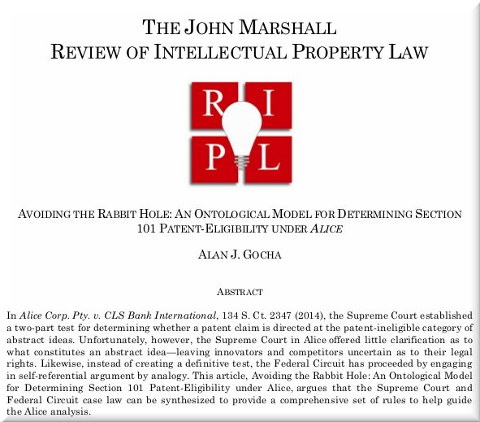
An Ontological Model for Determining Section 101 Patent Eligibility under Alice
An Ontological Model for Determining Section 101 Patent Eligibility under Alice [PDF]


Summary: While it is widely recognised -- at least among technical people -- that it is not worth pursuing patents on software (courts if not examiners would crush hopes of assertion/enforcement), the patent microcosm continues to sing a different tune in order to sell services

TECHRIGHTS soon enters its twelfth year. It's a milestone because the site has run nonstop throughout these years. Software patents were always the primary issue. Here we are at the end of 2017 and as we noted some days ago, the higher courts in the US (including the Federal Circuit) have effectively ended software patents. Those which were granted by the USPTO don't make it far; upon challenge, sometimes citing Alice, these patents get discarded. Throughout 2017 the high courts were very consistent on this.

"Here we are at the end of 2017 and as we noted some days ago, the higher courts in the US (including the Federal Circuit) have effectively ended software patents."The patent microcosm, which got accustomed to making money from software patents, keeps moaning that abstract patents are rejected outright. Get used to it.

Rather than accept defeat and pursue something else, these stubborn people try to utilise and master new 'tricks'; they want to pursue software patents in spite of Alice, irrespective of what courts (with expert testimonies and other scrutinisers) may inevitably say.

DLA Piper LLP's Larissa Park has just published this article in which she insinuates that software can be patented. Not so constructive an advice...

"The patent microcosm, which got accustomed to making money from software patents, keeps moaning that abstract patents are rejected outright."Software is not patentable. It's no longer worth pursuing in the US. Want some software patents in spite of it? Then go to China...

Want to protect software developers from plagiarism? Then rely on copyright instead. It already does the job pretty well, for both proprietary and Free/libre software developers. Enforcement or compliance is accomplished differently, but it works. To quote Park:

If your product or service involves software, you should explore the possibility of filing for and obtaining a software patent. While copyright can protect your actual code from being copied; copyrights cannot prevent others from independently (i.e., without copying) developing the same software. On the other hand, a patent can permit you to exclude others from practicing the functional aspects of the software claimed in your patent, even if the other party independently developed the software. See our corresponding article on patents.

The federal government grants patents on new, useful and non-obvious inventions. While features and functions of your software may be new and non-obvious, the biggest hurdle to obtaining patent protection can be overcoming the useful requirement, that is, whether your new and nonobvious software is even eligible for a patent.

[...]

Software can be protected with copyright and trade secret. As noted above, copyright will protect you from someone copying your actual code. However, you will not be protected if that person independently develops his or her own code that performs similar functions. More details on copyright protection can be found in our corresponding blog post on copyrights. Trade secrets can protect the structure and methodology of your software, but will require you to implement confidentially procedures to keep the material secret. Once the information you are attempting to protect with a trade secret becomes public, it will no longer be protected by trade secret law. More details on trade secret protection can be found in our corresponding article on trade secrets.


Park is correct only in the sense that software can be reimplemented to work around copyright issues, e.g. in a different programming language. The issue she fails to address, however, is that in a world with hundreds of thousands (perhaps millions) of software patents developers won't be able to safely write any code at all. Since she and her colleagues rarely (if ever) claim to have developed software, perhaps the reality of it conveniently evades them*. Moreover, they may simply not care about software development at all; for them, the important thing is maintaining litigation and an atmosphere of hostility. They profit from it.

"Since she and her colleagues rarely (if ever) claim to have developed software, perhaps the reality of it conveniently evades them."What's also absent (or lacking emphasis) in the article from Park is Alice. In the dawn of 2018 it makes absolutely no economic sense to invest in software patents; companies should, instead, form a strategy around copyrights (or copyleft). The world is changing and one must move on with the times...

The new journal article at the top is Alan Gocha’s paper on “Section 101 patent eligibility under Alice.” Patently-O mentioned it a few days ago and so did a few other people. To quote Patently-O:

Alan Gocha’s new article focuses on patent eligibility and provides “an ontological model for determining section 101 patent eligibility under Alice.” I think the most important contribution that Gocha makes is to categorize abstract ideas into those that are “inherently abstract” (preexisting fundamental truths) from those that are only “temporally abstract” (longstanding practices).


Alan Gocha is not a software developer but an attorney or law professional. So these people tend to speak of software from a more philosophical or theoretical perspective, not practical or professional. Gocha, in this paper of his, repeats the patent microcosm's talking points, e.g. that there's lack of "clarity" or "clarification". Gocha says that the "Supreme Court and Federal Circuit [two of the most software patents-hostile courts nowadays] case law can be synthesized to provide a comprehensive set of rules to help guide the Alice analysis." It's an effort to find new loopholes, that's all it is.

"The patent microcosm likes to demonise technology companies as if law which leans towards technology companies is an abomination -- almost as though the law is intended to protect the lawyers rather than developers.""Test Wording" is the title of one section, which says that "[a] claim is directed at an abstract idea if a theoretical being that has errorless and unlimited computative capacity could essentially duplicate the claimed invention in its mind."

That can be done with any algorithm; the author then alludes to "non-tangible ideas for which can be entirely performed in the mind—i.e. purely cognitive processes" and again -- this applies to virtually any algorithm, which can be tackled/solved using pen and paper.

We recognise that it's hard for the patent microcosm to let go; it probably made billions of dollars (altogether) from the terrible decision to permit software patents since decades ago; but things have changed and the way software gets developed and distributed changes very rapidly owing to the Internet. These people ought to focus on copyright/copyleft if they want to remain relevant. The paradigm is inherently different (even if they still refer to it by the misleading term "IP"), but this is what software developers actually want. The patent microcosm likes to demonise technology companies as if law which leans towards technology companies is an abomination -- almost as though the law is intended to protect the lawyers rather than developers. That's just sheer Hubris. _____ * Gene Quinn (Watchtroll) got very irritated after he had claimed that he writes code and once asked for proof of it he was unable to produce or even name any. Instead, he blocked me to avoid further interaction. In other words, it's unlikely that he ever wrote any computer program and he continually demonstrated that he does not understand how computers even work. Actual software developers started mocking him for it and he could not deal with it. If these are the sorts of people who lobby the hardest for software patents, we are in serious trouble. They lack the most basic understanding of digital operations and tools, such as compilers, assemblers, interpreters, and processors.

Recent Techrights' Posts

10 Easy Steps to Follow for Digital Sovereignty in Nations That Distrust GAFAM et al
When "enough is enough"
Dr. Andy Farnell Explains Why Slop Companies Like Anthropic and Microsoft 'Open' 'AI' Basically Plunder and Rob People
This article was published last night at around 10
 
Links 22/01/2026: Ubisoft Layoffs Disguised as "RTO", US "Congress Wants To Hand Your Parenting To GAFAM", Americans' Image Tarnished Among Canadians (Now Planning to "Repel US Invasion")
Links for the day
No, the Problem at IBM/Red Hat Isn't Diversity
Microsoft Lunduke also openly shows his admiration for Pedo Cheeto
Do Not Link to Linuxiac Anymore, Linuxiac Became a Slopfarm
now Linuxiac is slop
Richard Stallman (RMS) at Georgia Tech Tomorrow
After the talk we'll write a lot about "cancel culture" and online mobs fostered and emboldened in social control media
Software Patents by Any Other Name
There is no such thing as "AI" patents
Over at Tux Machines...
GNU/Linux news for the past day
IRC Proceedings: Wednesday, January 21, 2026
IRC logs for Wednesday, January 21, 2026
The "Alicante Mafia" - Part VIII - Salary Cuts to Staff, 100,000 Euros to Managers Busted Using Cocaine (for Doing Absolutely Nothing, Just Pretending to be "Sick")
Today we look at slides from the union
Gemini Links 22/01/2026: Forest Monk, Aurora Observation, and Arduino Officially Launches the More Powerful Arduino UNO Q 4GB Single-Board Computer
Links for the day
Next Week is Close Enough for Wall Street Storytelling About 'Efficiency' by Layoffs for "AI"
This coming week GAFAM and others will tell some creative tales about how "AI" something something...
Google News Still a Feeder of Slop About "Linux", Which Became Rarer in 2026
Our main concern these days is what happened to Linuxiac. Bobby Borisov became a chatbots addict.
Links 21/01/2026: "Snap Settles Lawsuit on Social Media Addiction" and Attempts in the US to Revive Software Patents
Links for the day
Links 21/01/2026: Microsoft 'Open' 'Hey Hi' in More Trouble, US Has "Brown Shirts" Problem
Links for the day
Yesterday Afternoon The Register MS Published Paid Microsoft SPAM Disguised as an Article About "AI PCs"
The Register MS cannot help itself, can it? [...] Follow the money.
Microsoft's XBox is in Effect Dead Already, Now It's a Streaming and Advertising Platform
Expect many layoffs soon
Richard Stallman's Talk at Georgia Tech is Just 2 Days Away
We're still curious to see how malicious people (or trolls) in social control media will try to slant his talk as "bad"
EPO's Web Site Misused for Propaganda About Illegal Kangaroo Courts to Distract From EPO Scandals and Judicial Crisis in Europe
UPC is illegal and unconstitutional
The "Alicante Mafia" - Part VII - The Industrial Actions Began Yesterday, Here's Why
The "Alicante Mafia" might not last much longer
Gemini Links 21/01/2026: Edible Circuits and "Sayonara HTTP"
Links for the day
Over at Tux Machines...
GNU/Linux news for the past day
IRC Proceedings: Tuesday, January 20, 2026
IRC logs for Tuesday, January 20, 2026
IBM Hides Its Own Destruction (and Red Hat's)
It's like scenes out of '1984', which is what a now-famous advertisement from Apple compared IBM to
LLM Slop Not Dead Yet, Examples of Slop About "Linux"
We wish to see the totals down to zero
Links 20/01/2026: Cheeto Blackmails France Into 'Peace' While Looking to Annex EU, Mass Layoffs in Capgemini (Microsoft Reseller/Promoter) in France
Links for the day
Gemini Links 20/01/2026: Boxing and "Inbox Zero" Success
Links for the day
Windows and Slop Declining While Microsoft Silences Critics
Microsoft tries to suppress facts while faking 'demand' by imposing slop on everybody, everywhere
openai.com Traffic Said to Have Fallen 50% in the Past Three Months, Reports Say It Nearly Ran Out of Money to Borrow
After the slop frenzy all we'll have left is environmental destruction
IBM Kills OzLabs, Signalling An Attack on Free Software (a Sign for Red Hat)
ibiblio also appears to have died (or experiences critical issues)
Red Hat Vice President Leaving After Nearly Two Decades
IBM's culture of secrecy is not compatible with Free software
Links 20/01/2026: "ChatGPT Health" (Latest Distraction From Being Insolvent) Flops and Raises Concerns, "The U.S. Military Faces a Reckoning on Greenland"
Links for the day
Rudeness and Vulgarity Won't Stop Journalism About Free Software
we seem to be on the right path
Readers Pleased With Layout Changes
Two days ago we began improving clarity and accessibility in the site
IBM Plans for Layoffs Becoming Clearer With "Employee Reviews"
Of course this impacts Red Hat as well
IBM is Outsourcing Red Hat's Fedora to Slop to 'Save Money'
If IBM cared about quality rather than alleged "cost savings" (cutting corners), it would assign more IBM staff to Fedora, but instead the exact opposite happened, with the likes of Cotton and Miller removed from the project
European Patent Office (EPO) Industrial Actions Formally Start in Two Hours
As per the latest (revised) action plan, today workers will slow down their work and limit patent grants
Microsoft Under Fresh Investigation by the Italian Competition Authority
In 2025 we kept a running tally of 30,000+ Microsoft layoffs, so 40k this year would not be unthinkable
The "Alicante Mafia" - Part VI - More Strikes Planned at the EPO, Starting This Month
Yesterday we said that friends of Berenguer or inside Berenguer's circle may have left
Gemini Links 20/01/2026: New Tea, Using a Roku at a Hotel, and "Voltage-Based Power Management for Any Raspberry Pi"
Links for the day
Over at Tux Machines...
GNU/Linux news for the past day
IRC Proceedings: Monday, January 19, 2026
IRC logs for Monday, January 19, 2026