
Bonum Certa Men Certa

The Anti-35 U.S.C. €§ 101 Lobby Pushes Old News Into the Headlines in an Effort to Resurrect/Protect Software Patents

Advanced Voice Recognition Systems, Inc. ("AVRS") has meanwhile sued Apple with what looks like software patents "in the field of speech recognition and transcription" (according to its own press release)

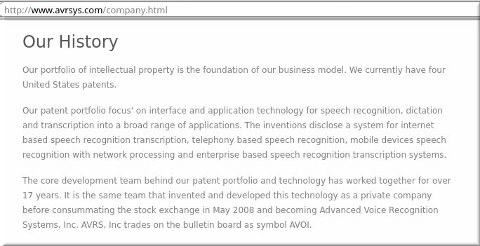
AVRS history
So the whole 'company' is just a pile of patents (since its inception)


Summary: The software patenting proponents (law firms for the most part) are still doing anything they can -- stretching even months into the past -- in an effort to modify the law in defiance of Supreme Court (SCOTUS) rulings

35 U.S.C. €§ 101 isn't too complicated. Based on (or partly inspired by) several SCOTUS decisions, Section 101 limits patent scope and notably eliminates patents on abstract things (or ideas, including algorithms). The USPTO's current guidelines ought to assure that no software patents will be granted anymore; nevertheless, there are conflicting interests. That's why inter partes reviews (IPRs) and court challenges are needed. But, as one might expect, the patent maximalists aren't happy; they see this as an "attack" (a word they use) on their occupation or an attempt to "kill" (also a word they sparingly use) patents. They nowadays sling their guns and shoot from the hip at IPRs, at judges, and at courts. Some if not many are based in Texas, so the gun-slinging metaphor seems apt; not to mention their obsession with words like "attacks" and "kills". They call some tribunals "death squads", evoking a colourful metaphor of genocide.


"They don't profit from innovation; they make a living from extortion and lawsuits."Anything that these patent maximalists (some we call "extremists" because they go even further) throw at 35 U.S.C. €§ 101 is easy to debunk; they just cannot tolerate patent quality, patent justice and so on. They want a culture of protection rackets, not of innovation. They don't profit from innovation; they make a living from extortion and lawsuits. Their trade involves writing threatening letters, demanding money.

35 U.S.C. €§ 101 hasn't been in the headlines lately, partly because of the summer vacation. Some pundits wrote about Mayo, which also helped shape 35 U.S.C. €§ 101. We wrote about Vanda 3 weeks ago in "The Dangerous Adoption of Patents on Life and Nature" and 3 months ago in "The Federal Circuit's (CAFC) Decisions Are Being Twisted by Patent Propaganda Sites". The case is about Mayo, not about Alice, and it isn't as "high level" as either of them. In a sense, it's hardly even a big deal at all. This is very old news, too. Why is Donald Zuhn catching up with it weeks if not months late? Is this the best method for pushing their anti-35 U.S.C. €§ 101 agenda yet again (as news is slow)?

Earlier this week Zuhn (McDonnell Boehnen Hulbert & Berghoff LLP) wrote:

The memorandum explains that in Vanda, the Federal Circuit determined that the claims at issue are "patent eligible under 35 U.S.C. €§ 101 because they are not 'directed to' a judicial exception" (emphasis in memorandum).


Why is this being brought up in July? Heck, why does Managing IP now cover SAS Institute v Iancu? Its latest issue is summarised as follows (this week): "The issue’s cover story assesses the impact that the US Supreme Court’s SAS Institute v Iancu decision has had– and will have – on the Patent Trial and Appeal Board."

The Patent Trial and Appeal Board (PTAB) is safe owing to Oil States (the far more important decision). No coverage of the more important decision? Not even in the cover story? Intentional bias? Bias by omission again?

Even Watchtroll's PTAB bashing has slowed down considerably, knowing that -- as per recent events (notably Oil States) -- the quality of patents in the US will continue to be scrutinised and PTAB not crushed. This is sadly what we've come to expect from media which is literally run by law firms -- an epidemic that suffocates real journalism regarding patent matters.

Yesterday Watchtroll resumed its PTAB bashing, cherry-picking an old Apple case. Another patent maximalist has since then brought up a Federal Circuit case, saying that in "Apple v Contentguard (Fed. Cir. 2018); Fed. Cir. Held that Patent Claims for a Copyright Management System Do Not Qualify for CBM Review: http://www.cafc.uscourts.gov/sites/default/files/opinions-orders/16-2548.Opinion.7-11-2018.pdf …"

Anything which concerns Apple is, as usual, receiving a lot more attention. In fact, yesterday we saw this new press release from Advanced Voice Recognition Systems, which is a "patent assertion" entity (more or less), as covered in the past weekend's posts. There seem to be no actual (finished) products and they merely list lawsuits and patents in their Web site as though these are their products. From their press release:

Advanced Voice Recognition Systems, Inc. ("AVRS") (OTC: AVOI) announced today that it has filed a lawsuit in the United States District Court-Northern District for Arizona against Apple, Inc. ("Apple") for infringement of U.S. Patent No. 7,558,730 entitled "Speech Recognition and Transcription Among Users Having Heterogeneous Protocols" (the "'730 Patent"). The '730 Patent is the first of AVRS' family of patents in the field of speech recognition and transcription


Those are software patents. They're algorithms. Watchtroll is also (on the same day) promoting the HEVC patent trap [1, 2] -- a trap which very clearly concerns patented software in large amounts (many patents, probably too many to challenge at scale, as per the MPEG-LA strategy). Watchtroll wrote:

HEVC (also known as H.265) is a video compression standard originally developed to provide high quality video coding using half the bandwidth.


Software patents all over this. All should be considered void under 35 U.S.C. €§ 101, but there are so many patents that nobody has the funds or will to challenge them all. Certainly not companies like Apple, which actively pariticipate in this "thickening" or "thicketing" (setting up barbwire around industry 'standards').

"Mozilla complained about it yesterday, dubbing it “An Invisible Tax”."The Section 101 conundrum will no doubt continue to occupy the media for a year (if not years) to come. The "thickening" (as in patent thickets) of software standards/APIs, preventing participation by those who lack a large number of patents, is what's at stake. Mozilla complained about it yesterday, dubbing it "An Invisible Tax".

Recent Techrights' Posts

Following Corrections and Adjustments statCounter Sees GNU/Linux at 7.1%, an All-Time High
There is a lot of layoffs at Microsoft this month
Over at Tux Machines...
GNU/Linux news for the past day
IRC Proceedings: Friday, July 10, 2026
IRC logs for Friday, July 10, 2026
Links 11/07/2026: Wednesday-Saturday News Catch-up
Links for the day
Prioritising High-Importance News
In order to fully catch up with news we'll not publish many new articles until next week
The Register MS: "AI" More Than 80 Times in One Article. But It's Not an Article, It's Sponsored Keyword-stuffed Page.
The Register MS is being paid to actively promoted this scheme
Over at Tux Machines...
GNU/Linux news for the past day
IRC Proceedings: Thursday, July 09, 2026
IRC logs for Thursday, July 09, 2026
Over at Tux Machines...
GNU/Linux news for the past day
IRC Proceedings: Wednesday, July 08, 2026
IRC logs for Wednesday, July 08, 2026
Over at Tux Machines...
GNU/Linux news for the past day
IRC Proceedings: Tuesday, July 07, 2026
IRC logs for Tuesday, July 07, 2026
Links 07/07/2026: Microsoft Cuts Doom "id Software" and Turkey Detains Journalists
Links for the day
Gemini Links 07/07/2026: Old Computer Challenge (OCC) and Hardware Tests
Links for the day
A Break From the Routine
What matters is what whistleblowers keep feeding information to us