
Bonum Certa Men Certa

Judge-Bashing Tactics, Undermining PTAB, and Iancu's Warpath for the Litigation and Insurance 'Industries'

The existing USPTO's management feels like it doesn't care about justice (facts), technology and science, only about legal bills

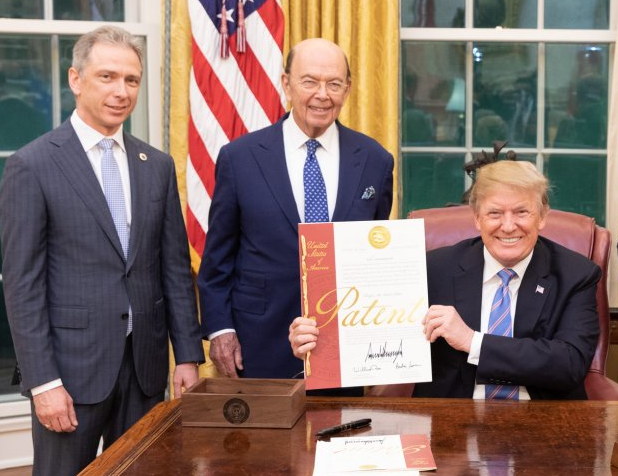
Trump and Iancu


Summary: Many inter partes reviews (IPRs) at the Patent Trial and Appeal Board (PTAB) of the U.S. Patent and Trademark Office (USPTO) leverage 35 U.S.C. €§ 101 against software patents; instead of putting an end to such patents Director Iancu decides to just serve the 'industry' he came from (a meta-industry where his firm had worked for Donald Trump)

THE USPTO under the new leadership (Director) deviates further and further away from Federal Circuit (CAFC) rulings and SCOTUS caselaw. The Office does so at its own peril, however, as the certainty associated with US patents will be further reduced. More and more granted patents will be presumed invalid. Is the leadership/Director OK with that?


This post binds together last week's stories about court cases and Office policies. What we hope to show is a divergence from the law; the Office just cares about granting patents, not defending their value by limiting their scope.

We begin with this affirmation by CAFC -- one in which a U.S. District Court was supported by CAFC. The divergence between the courts is being lowered over time. CAFC learned to obey SCOTUS and U.S. District Courts have, in turn, become more like CAFC. This is a good thing as it's indicative of correct or at least consistent judgment. The same cannot be said about the Office because far too many patents these days are later discovered/unmasked as fake patents.

Yesterday Kluwer Patent Blog wrote about a British court "finding that the claims in question were invalid for obviousness." It's not just a US issue.

A couple of days ago Steve Brachmann and Gene Quinn (Watchtroll) wrote about Swildens and his successful challenge to a patent. They recalled a month-old report:

On September 12th, the U.S. Patent and Trademark Office issued a final office action in an ex parte reexamination of a patent owned by Google self-driving car development subsidiary Waymo. As a result of the reexamination, Waymo stands to lose 53 of 56 claims, including all 20 of the patent claims originally issued. The patent in question had been asserted as part of the company’s well-known infringement suit filed against Uber.

The patent at the center of this reexamination is U.S. Patent No. 9368936, titled Laser Diode Firing System. Issued to Google in June 2016, it claims an apparatus including a voltage source, an inductor coupled to the voltage source and configured to store energy in a magnetic field, a diode coupled to the voltage source via the conductor, a transistor that can be turned on or off by a control signal, a light emitting element coupled to the transistor and a capacitor coupled to charging and discharge paths where the charging path includes the inductor and the diode and the discharge path includes the transistor and the light emitting element. The invention provides a laser diode firing circuit for a light detection and ranging (LIDAR) device where the emission and charging operations of the firing circuit can be controlled by operation of a single transistor.

The reexamination of the ‘936 patent was requested in August 2017 by an engineer named Eric Swildens who, according to news reports, has no connection to either Uber or Waymo but became interested in the potential invalidity of the patent after it was asserted in Waymo’s case against Uber. The reexam requested by Swildens has to date been able to knock out all 20 claims of the claims originally issued in the patent, with only three amended claims that were added to the patent during the reexam proceeding being found to be patentable by the reexamination examiner.


Long story short, this patent should never have been granted. Watchtroll can (and will) whine all it wants, but a lot of US patents get granted in a rush/haste, only to be thrown out as soon as they reach courts (or PTAB).

Jeffrey Killian recently complained about "Patent Uncertainty". He wrote about it on October 9th at Watchtroll. The problem is that the USPTO granted far too many bogus patents. The problem isn't the courts and it's certainly not PTAB, which actually restores some much-needed sanity. Of course these patent maximalists blame courts rather than greed, but one must bear in mind how they make a living.

On the “blocking patent” doctrine, Watchtroll is smearing the courts again. Complaining about CAFC twice in two days [1, 2]. This is unwise a thing to do as it threatens their interests. It undermines the courts' support or trust in law firms. Hans Sauer and Melissa Brand, then just Melissa Brand, basically insinuate that courts lack logic and even use a "Gremlin" caricature. Stay classy, folks...

It should be noted that a patent troll CEO, William Merritt (President and CEO of InterDigital), was writing for Watchtroll last week. This is why it deserves to be called Watchtroll. It's like a megaphone of the trolling 'industry'...

Moving on a bit, PTAB is doing so well that patent maximalists are screaming on the phone with lawyers willing to waste their money. "Today’s new patent complaints," wrote one PTAB proponent, are "usual glut of NPE [troll] suits, sprinkle of operating companies... and a corp suing Iancu/the PTO for a DJ that IPR is unconstitutional (incl under 7A.) Interesting tactic, given that they already lost on appeal to CAFC and SCOTUS disagreed on the 7A q."

PTAB generally helps techies or geeks. It doesn't help parasitic lawyers. Whose side should we be on? Decisions, decisions...

HTIA, which represents technology firms, wrote some days ago: "Let’s debunk myths: #Patent reform has not harmed #innovation. The 300 U.S. companies who have invested the most in R&D have increased R&D spending by 44% since 2012."

This links to an older article, but it's still very much relevant. PTAB guides the hands of examiners, moving the hands away from software patents. PTAB often overturns examiners' decision to the detriment of software patent applicants, but patent maximalists latch onto the rare exception rather than the norm. Here is one such exception:

The examiner originally rejected the claims as improperly directed toward an abstract idea. On appeal, however, the PTAB has reversed finding that “dwell time” is a uniquely “internet-centric challenge” and the claimed solution is “is necessarily rooted in computer technology in order to overcome a problem specifically arising in the realm of computer networks.” quoting DDR Holdings. The PTAB particularly noted that “dwell time” is not merely “some business practice known from the pre-Internet world” that was claimed by simply saying “perform it on the Internet.”


The classic "on the Internet" trick; don't they just say "on the cloud" these days?

Linda Panszczyk wrote about CAFC asking PTAB to have another go assessing a patent (reversals are rare, they don't overturn invalidations much). This is from last week's short post:

The U.S. Court of Appeals for the Federal Circuit has vacated and remanded a Patent Trial and Appeal Board decision that a reference guide qualified as a printed publication, in a case involving reexamination of medical device patents relating to access ports, asking for the Board to clarify its findings on this matter.


They're doing the work examiners should have done in the first place.

"The classic "on the Internet" trick; don't they just say "on the cloud" these days?"Director Iancu cannot gut PTAB, especially not after Oil States; but the head of PTAB (a judge) was recently removed (or departed) and the latest act of sabotage from Iancu seems like a gross case of bypassing courts. As Josh Rich put it:

Under a new PTO administrative rule published today, the PTAB will apply the same claim construction standards in IPRs, PGRs, and CBMs filed on November 13, 2018 or later as would apply in litigation. 83 Fed. Reg. 51340 (Oct. 11, 2018). The PTAB will also consider claim construction decisions from litigation (whether from courts or the U.S. International Trade Commission) in construing claims in AIA proceedings. The new rule abandons the PTO's former approach of using the broadest reasonable interpretation ("BRI") in claim construction, and thereby reflects a continuing move from considering AIA proceedings analogous to prosecution to considering them analogous -- or part of -- the litigation process.

Currently, the PTAB uses the BRI to construe claims in the vast majority of AIA proceedings, the only exceptions being in cases where the patent has expired or is expiring imminently.[1] In doing so, it has treated the AIA proceedings as analogous to a continuation of prosecution (in which claims are given their broadest reasonable interpretation throughout the process). That approach makes sense in the historical context of AIA proceedings, given that it allows the PTO to use the same approach across almost all cases before it, AIA proceedings are to supplement -- not reargue -- issues that were presented during pre-issuance prosecution, and AIA proceedings share many similarities with prosecution (including limited ability to address the counterparty's claim construction arguments). Furthermore, the ability to amend claims during such proceedings provides a "safety valve" for an inopportune, overbroad claim construction.


Dennis Crouch wrote about the Phillips standard:

The USPTO’s Final Rule Package on Inter Partes Review Claim Construction is set to publish in the Federal Register on October 11, 2018. Up to now, the PTAB has been using the USPTO “broadest reasonable interpretation” standard to interpret challenged patent claims. Under the new rule, the PTAB will now rely upon the PHOSITA standard more traditionally used for issued patents as articulated by in Phillips v. AWH Corp., 415 F.3d 1303 (Fed. Cir. 2005) (en banc) and further developed in later cases. This new rule will apply in IPR, PGR, and CBM proceedings. The new rule also indicates that prior claim constructions by a court or USITC “will be considered.” This final rule is essentially unchanged from the proposed rule found in the May 2018 NPRM. Timing: The new claim construction applies to cases involving “petitions filed on or after the effective date of the final rule, which is November 13, 2018.”


Watchtroll's founder said about this Phillips standard that Iancu's office "has published a final rule in the Federal Register changing the claim construction standard applied during inter partes review (IPR), post-grant review (PGR), and covered business method (CBM) review proceedings before the Patent Trial and Appeal Board (PTAB)."

Here is what another patent maximalist said:

The final rule changes the claim construction standard used by the PTAB to the Phillips standard used in district courts. Practitioners predict a surge in filing before it becomes effective in November

The USPTO has published a final rule changing the claim construction standard applied during inter partes review (IPR), post-grant review (PGR), and covered business method patents (CBM) proceedings before the PTAB.


So the filings are expected to temporarily go up again, just like they did before fee hikes. Office Director seem to be missing the point that keeping PTAB affordable and accessible is actually a priority; all they care about is masking the decline in quality -- same thing which the EPO has been doing.

Over at Lexology, Porter Wright Morris & Arthur LLP's Bill T. Storey took note of the Office becoming more of a patent maximalists' office under Iancu when he said:

On July 1, 2018, the United States Patent and Trademark Office (USPTO) began a 3-year pilot program known as The PCT Collaborative Search and Examination Pilot (CS&E) Program, to streamline examination and search procedures for patent examiners in multiple countries. The program is a coordinated effort with patent offices from around the world, together known as the IP5 offices. Specifically, participating International Search Authority (ISA) members include the USPTO, European Patent Office (EPO), Japan Patent Office (JPO), Korean Intellectual Property Office (KIPO), and State Intellectual Property Office of the People’s Republic of China (SIPO). This program is a continuation of two previous programs launched in 2010 and 2011, respectively, involving the USPTO, EPO and KIPO that laid the groundwork for this expanded program aimed at testing user interest, operational and quality standards, and the electronic platform.

Currently, upon filing a PCT application, applicants designate one of the IP5 offices to provide an international search report (ISR) and written opinion. However, upon reaching the national stage as applicants pursue applications in individual countries, applicants can be presented with country-specific search reports involving entirely new art depending on varying search criteria. This can place a burden on applicants and hinder cohesive world-wide prosecution strategies. The CS&E program addresses this issue by coordinating searches from each office, thereby providing a higher quality work product which is more likely to comprehensively identify and consider world-wide art. The CS&E program provides the advantages of having the searching performed by multiple examiners with different language capabilities and an increased predictability of outcome. Importantly, at this time the CS&E program requires no extra cost.


It's worth noting that nobody but a vocal group of trolls' attorneys actually complained about PTAB. One of them wrote: "Amazingly Ebay wins rare 101 #patent appeal because "dwell time, which is an Internet-centric challenge" is not just directed to an abstract idea https://e-foia.uspto.gov/Foia/RetrievePdf?system=BPAI&flNm=fd2017003747-09-26-2018-1 … Once again, proves how handy it is to have the right panel of judges!"

More of that judge-bashing, as usual...

They spent years pushing the fiction that PTAB is "stacked" or corrupt or whatever. Iancu now uses these smears of theirs to frame PTAB as "controversial" with perception issues. Whose? Iancu seems to believe that the USPTO exists for patent law firms rather than for science and technology. Having come from the law firm that worked for Trump, this is hardly surprising.

Not only do firms sell "lawsuits as a service"; nowadays they also sell insurance policies. Watch what Pillsbury (Policyholder Pulse blog) wrote last week; the insurance 'industry' now exploits the demise of low-quality patents that are being invalidated:

To help fill this patent coverage gap, some insurers have recently begun offering more comprehensive and cost-effective intellectual property policies specifically tailored to address the risk of patent (and other intellectual property) claims.

[...]

The patent landscape continues to evolve in the wake of the Leahy-Smith America Invents Act and the Supreme Court’s decision in Alice Corp. v. CLS Bank, which established a more exacting patentability standard for software patents and has opened the door to more motions to dismiss for lawsuits asserting those patents. Nonetheless, patent lawsuits remain prevalent and costly. A well-negotiated patent policy can help close a critical coverage gap, and may even prove critical to your company’s continued viability in the face of such suits.


So when there are lots of patent lawsuits they sell insurance to defendants and when many patent lawsuits fall through they sell insurance to the plaintiffs. Some 'industry', eh?

Recent Techrights' Posts

How We Do Techrights (and What's Changing Next Week)
Many former news sites no longer yield much non-meaningless news (not anymore); there's a gap to be filled
Links 12/07/2026: Palantir Unrest and Wireshark 4.6.7
Links for the day
Links 12/07/2026: New Instrument Time and PalmOS Experiences in 2026
Links for the day
Red Hat Staff Says IBM Policy Has Stigmatised Him as a Tool and a Slopper With Plagiarism Tools
IBM is killing Red Hat with slop
Freedom of Choice or Freedom Versus Choice (or When All Choices Are Incompatible With Freedom)
When some business asserts that it gives people different options, then it can rightly argue that it offers some choices, but that is not the same as freedom
Techrights IRC Turns 5 Without a “Code of Conduct”, “Code of Conduct Committee”, and All Those Bureaucratic Nightmares
18+ years if one counts our time in Freenode as well
Why U No Use AI???
Many hype waves come and go
There Are Still Slopfarms in Google News
Google is trying to participate in if not lead this pyramid scheme
The Cyber Show Explains How Slop and Promotion of Slop is About Taking Control Away From Computer Users
"On making a trustworthy machine"
Keeping Available the Site at All Times
Informal arrangements and crowdfunding keep our work available despite resistance (including from people who break the law)
What If "Era of AI" and "AI Revolution" (Fake News) Never Happened?
So how much longer before the bust (or bubble-burst)?
GNU/Linux Approaches 5% in Australia
5% by year's end?
Europe/EU is Moving Towards Independence, Fast to Adopt Free Software
More and more states (governments, public sector) in Germany are dumping Microsoft
GNU/Linux Grows at the Expense of Windows
People who want to get work done already left Windows
Tux Machines Growing as a Volunteers-Run Site
Historically the site did not have many original stories, but this changed as the audience grew and the site gained more recognition
Links 12/07/2026: European Commission Versus ‘Addictive Design’, "Google Loses Final Appeal Over $4.7 Billion EU Android Antitrust Fine"
Links for the day
GNU/Linux Market Share Increases Some More Today, statCounter Measures It at 7.3%
Will more such thresholds and records be broken?
Gemini Links 12/07/2026: Studying Languages and 2026 Old Computer Challenge (OCC)
Links for the day
EPO "Cocaine Communication Manager" - Part XIII - At the EPO, Cocaine Addicts and Their Friends Are "Protected Class"
What does that tell us about the EPO?
Increasing Output by Focusing on Originals
It's probably more important to carry on with these than it is to keep abreast of non-crucial news
Amid Strikes and Industrial Actions, Young Professionals at the European Patent Office (EPO) Kept on 'Short Leash', According to the Local Staff Committee The Hague
Issues affecting Young Professionals
Over at Tux Machines...
GNU/Linux news for the past day
IRC Proceedings: Saturday, July 11, 2026
IRC logs for Saturday, July 11, 2026
Blogs May be Making a Comeback (They're Not Fediverse, They Are Joined by RSS Feeds)
Don't fake expansion where none existed
ChromeOS and GNU/Linux in the United Kingdom Reach 11%
the UK shows signs of digital maturity
Corporate Media: Blame the People Who Enter the Abandoned IBM Buildings, Not IBM for Abandoning Workers in Pursuit of IT Sweatshops
When the media spreads falsehoods stocks can go up (a lot higher), but at whose expense and how long for?
Canonical is Selling Microsoft, It Pays The Register MS to Sell Microsoft
It's all about money to them. And they call this journalism.
When Red Hat's HR Becomes the Same as IBM's HR (Bluewashing)
Red Hat keeps sacking very experienced engineers and adding temporary interns
GNU/Linux Growing in East Asia
Assuming this is more or less accurate, we could use a plausible explanation
SUEPO Munich Report on the Recent EPO Demonstration and Rolling Strikes That Continue to Grow
"increasing registrations for the 'rolling strikes' running until autumn"
Over a Week After Microsoft Discontinued Some XBox Models It Apparently Exits Some Markets Altogether
We seem to be witnessing the end of XBox
Gemini Links 11/07/2026: Old Computer challenge, Poems, Antenna, and More
Links for the day
Links 11/07/2026: "Trademark wars of Influencer Culture", Xinuos Uses Copyrights Versus UNIX
Links for the day
North America: GNU/Linux Measured at 10%
To better understand what contributes to the gains
Following Corrections and Adjustments statCounter Sees GNU/Linux at 7.1%, an All-Time High
There is a lot of layoffs at Microsoft this month
Over at Tux Machines...
GNU/Linux news for the past day
IRC Proceedings: Friday, July 10, 2026
IRC logs for Friday, July 10, 2026
Links 11/07/2026: Wednesday-Saturday News Catch-up
Links for the day
Prioritising High-Importance News
In order to fully catch up with news we'll not publish many new articles until next week