
“Wikilaundering” Explained
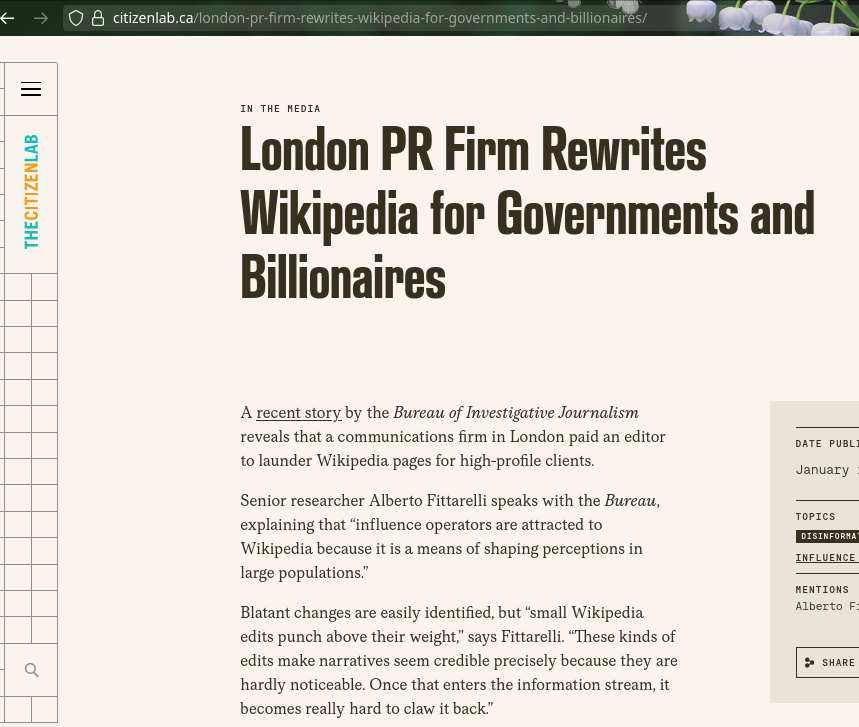
The original is two weeks old:
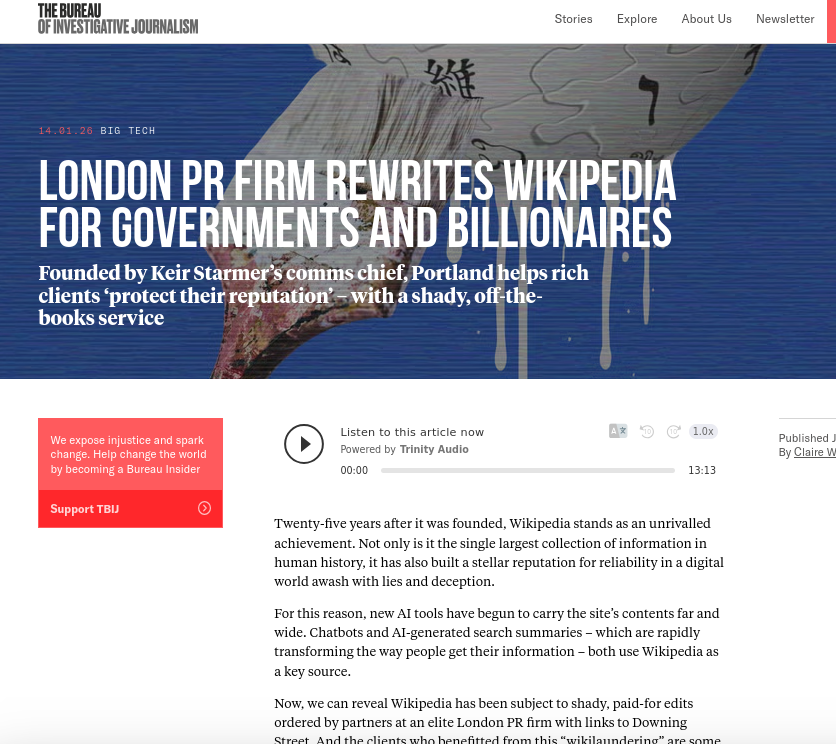
"Now, we can reveal Wikipedia has been subject to shady, paid-for edits ordered by partners at an elite London PR firm with links to Downing Street. And the clients who benefitted from this “wikilaundering” are some of the world’s richest and most powerful people."
You need not be a "Conservative" or "Republican" or "Russia" or "AfD" or whatever to generally distrust Wikipedia. Heck, even its own co-founder doesn't trust it anymore.
The other Wikipedia co-founder blasted Microsoft when Microsoft got caught bribing people for Wikipedia edits. But worry not; this same co-founder is now himself taking bribes not just from Microsoft but also from Bill Epsteingate [1, 2, 3, 4]. He works for billionaires. Companies are no longer donors but CUSTOMERS or CLIENTS of Wikipedia (they buy data for slop, calling it "AI"). This is how bad things have gotten just weeks ago. Some people rightly blasted Wikipedia over this.
A friend who saw some pages about "Open Source" and "Post-Open" noticed an obvious bias with "contested deletion". Previously, a GAFAM employee defamed me and asked people to edit Wikipedia for him.
Welcome to the real Wikipedia. Money outweighs lack of money; put another way, those who are willing to pour out more PR money will "win" the argument and dominate the narrative (through pages).
"I'd look into the edit history of the main page," someone told me, "and see who has watered it down."
See, very few people bother checking "Talk" and "History". They just assume that anything in Wikipedia ("Article") was set in stone after fair and exhaustive debates by all parties involved. Some people ask friends to write pages for and about them. If they insist and persist strongly enough, or for long enough, those pages will stay and 'mature'. It's a very big problem. It's more about class (money) than "wings" (politics). Corporations allocate budget to this kind of activity.
It's not a new problem but a growing concern.
With the OpenDocument Format (ODF), for instance, the Microsofters would do it in several passes. First they'd take out details and make as many paragraphs as vague as possible*. Then they'd consolidate by making the many paragraphs into one or two paragraphs. Then they would petition for deletion since the document not only said nothing relevant as a result of the first pass it was also very, very short as a result of the second pass. That went on continuously against ODF**. Microsoft can hire whole companies which can hire multiple teams each to astroturf. We caught Microsoft doing this in 2008 via its own PR department, Waggener Edstrom. █
_____
* Also, sometime there is a prerequisite step, that of breaking a single page into sub pages so that the dilute-delete cycle can be initiated.
** Also, they make great use of the false equivalence fallacy by insisting on "both sides" of situations where there often only one side backed by facts.