
The European Patent Office (EPO) Illegally Transitioning Into 'Gig' 'Economy' Equivalent (a Shop for Patent Monopolies in Europe)

Following last week's publication regarding EQE for scabs aka SEALs (Pan-European Seal Programme) aka YPs [1, 2] at the EPO the Local Staff Committee The Hague (LSCTH) published another paper, this one a 5-page document, prefaced by:
Feedback on the valued aspects and the issues they face
Dear members, dear colleagues,
The LSCTH has recently collected feedback from our Young Professionals (YP) colleagues in The Hague.
With this report, we aim at highlighting the challenges YPs face regarding integration, training, housing, working conditions, and long-term prospects. YPs express strong motivation, appreciation for supportive managers and tutors, and a positive view of the organisation overall. At the same time, they face significant structural challenges that hinder their ability to thrive during the programme.
The EPO is going down the same trajectory of the so-called 'gig' so-called 'economy' (both are misnomers, hence the scare quotes; in the UK they made up the concept of a "Locum"). It'll result in many invalid European Patents, i.e. injustice, not to mention a lack of accountability and irreversible loss of trust. Who stands to gain from that? We all know, don't we?
But this is how those who get exploited feel (they're pawns in this battle, they're used by a rogue system):
Staff Committee The Hague
Comité du personnel de La Haye
Personalausschuss Den Haag12 March 2026
sc26008hpPulse check of the situation
of Young ProfessionalsDear colleagues,
The LSCTH has recently collected feedback from our Young Professionals (YP) colleagues in The Hague. With this report, we aim at highlighting the challenges YPs face regarding integration, training, housing, working conditions, and long-term prospects. YPs express strong motivation, appreciation for supportive managers and tutors, and a positive view of the organisation overall. At the same time, they face significant structural challenges that hinder their ability to thrive during the programme.
Hereafter, we present the key themes and challenges the LSCTH identified during exchanges with our YP colleagues.
1. Housing and relocation
Housing emerged as the most serious and consistent concern across nearly all YPs.
Main issues
• Severe lack of availability of rental accommodation with high competition.
• Extremely high rental prices and security deposits.
• Some YPs start on the 15 th of the month and thus receive half a salary, but due to the tight housing market, they need to pay a full month’s rent.
• No relocation or rent allowance, nor reimbursement of moving costs.
• Limited effectiveness of the housing agencies recommended by the Office.
• Frequent resort to social media and informal channels, with high risk of scams.
• Lack of guarantors.
• Limited support with home country administrative requirements.
• High transportation costs in the Netherlands.
Illustrative quotes
• “Housing took all my time and energy; it was harder than the job itself.”
• “Everything HR sent was out of budget or not responding.”
• “I had to pay a full month of rent and a deposit while only getting half a month of salary.”
• “Without colleagues helping me, I honestly wouldn’t have found a place.”
• “Moving to The Hague was so expensive that I had to rely on savings and help from family.”
2. Onboarding, equipment, and communication
YPs found their onboarding helpful in many ways, but uneven and sometimes lacking clarity.
Key issues
• Late information about Y1 contract extensions causing personal and financial consequences, particularly with securing housing for Y2, leading to decisions needing to be taken before outcomes are known.
• Significant differences in training depth between DG1 and non-DG1 YPs. Shadowing opportunities are not consistently available across teams, leading to unequal access to informal learning and development. Inconsistent equipment quality: old laptops, missing iPads, slow software.
Illustrative quotes
• “The late communication about the extension caused panic; housing, studies, everything depends on it.”
• “My laptop is so old the software barely works.”
• “Some YPs get new equipment while others get outdated leftovers. It shouldn’t depend on luck.”
3. Integration into teams and role clarity
While relationships with managers and tutors were generally positive, YPs reported structural integration issues.
Key issues
• Team projects often span multiple years, while YP placements last 1–3 years.
• Lack of clarity on what the YP should be trained on or contribute to.
• Significant variation in expectations between teams.
Illustrative quotes
• “My team didn’t really know how to integrate a YP for just one year.”
• “Some colleagues treat me like an assistant, others like an examiner - the expectations are unclear.”
• “My manager is very supportive, but there’s no guidance from the programme on what we should focus on.”
4. Programme structure: one framework, very different realities
YPs noted that the programme treats all YPs equally, but the realities differ sharply between DG1 and other DGs.
DG1 YPs
• Acquire highly specialised skills with limited transferability outside the IP sector.
• Strong desire for EQE training and structured development pathways.
• Restricted access to relevant secondments depending on nationality.
Non-DG1 YPs
• Work in areas such as HR, IT, admin or DG4 where skills are more transferable.
• Positive experiences with shadowing and variety of assignments.
Illustrative quotes
• “The programme treats all YPs the same, but DG1 is completely different from corporate areas.”
• “If you’re in HR or IT, your skills apply everywhere. In DG1, it’s much narrower.”
• “I wish we could prepare for the EQE. It would make a huge difference for our future.”
• “Non-EU YPs can’t apply for most secondments. That doesn’t feel fair.”
5. Workplace perception, culture, and well-being
YPs raised concerns about how they are sometimes perceived by colleagues. Key issues
• Comments comparing YP salaries to examiner salaries, often unintentionally discouraging YPs.
• Being treated like interns in some teams, despite performing substantive work.
• Large differences in expected workload between teams.
Illustrative quotes
• “Some people treat us like interns. It’s demotivating.”
• “Depending on the team, expectations change completely. There is no consistency.”
6. Target setting and workload expectations
Target setting is inconsistent and often unclear for YPs, particularly in DG1.
Key issues
• Targets sometimes based on G7 examiner targets minus 10%.
• Newcomers follow a longer and deeper academy than YPs, despite similar expectations.
• Lack of standardisation across teams.
Representative quotes
• “My target is similar to a newcomer’s, but newcomers have the full academy and we don’t.”
• “Each team does targets differently — it shouldn’t depend on chance.”
7. Career prospects and long-term concerns
Uncertainty about long-term opportunities is a major source of stress.
Key concerns
• DG1 YPs fear stepping back in their engineering career if not recruited after three years.
• Uncertainty about whether YPs or external applicants are prioritised in recruitment.
• Lack of visibility on internal mobility options for YPs.
Illustrative quotes
• “If I’m not hired after three years, I’ll have a three-year gap in engineering.”
• “Leaving after three years shouldn’t feel like failure, but right now it does.”
8. Significant gap in YP entitlements to allowances and financial support
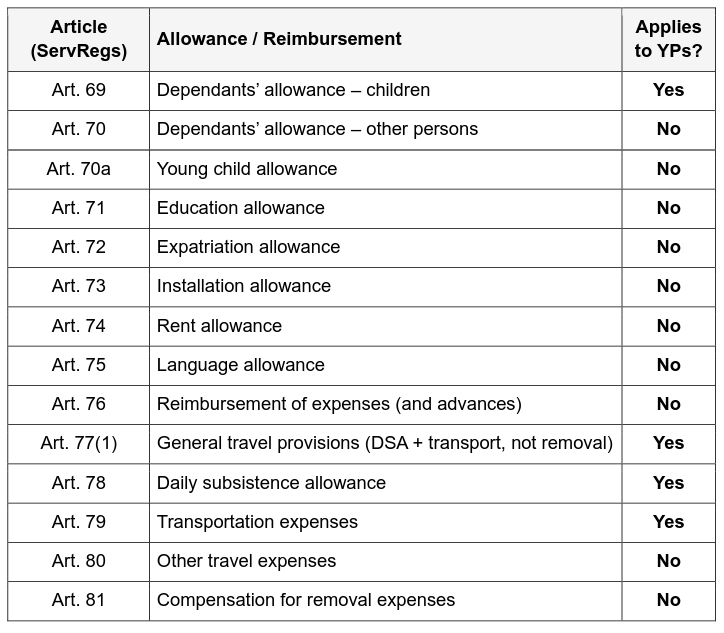
A structural issue that strongly affects YPs is their exclusion from most allowances and reimbursements available to regular staff, as indicated in the Codex, Article 12a of the Conditions of Employment for Young Professionals:
“Young professionals are not entitled to any other allowances as defined in the Service Regulations, including any other family allowances, nor to payment of any other expenses as defined in the Service Regulations.”YPs are not entitled to the following key allowances that would help with relocation, housing, dependants, expenses, and removal costs.
YP eligibility for allowances
Granting YPs eligibility to Articles 70, 70a, 71, 73, 74, 76, 80, and 81 would significantly improve equity and reduce financial strain.
Summary and potential improvements
To summarize the recurring challenges described in this report, we outline eight overarching themes:
1. Severe housing and relocation difficulties
2. Uneven onboarding and delayed communication
3. Inconsistent equipment and training
4. Unclear role expectations in teams
5. Programme not adapted to departmental realities
6. Cultural and perception issues
7. Lack of clarity about long-term career prospects
8. Very limited access to financial allowances and benefits
Further to these observations, the LSCTH identifies the following potential improvements and actions:
1. Extend eligibility for key allowances and benefits
2. Maintain a list of accommodation options, particularly those from EPO colleagues.
3. Facilitate transfer of accommodation from one cohort to the next.
4. Increase notice period for extension decisions.
5. Address the salary issue for YPs starting mid-month.
6. Diversification of the programme for DG1 YPs to increase skill transferability.
7. Explore partnerships with universities for academic recognition.
8. Extend access to EQE training for YPs.
9. Provide standardised equipment and onboarding.
10. Create an official administrative support guide for expatriate YPs.
Conclusion
YPs are motivated, talented individuals who contribute substantially to the organisation. However, their working conditions are comparatively less advantageous with respect to the rest of the EPO staff. The feedback highlights structural issues in their conditions, especially relating to housing, financial support, onboarding, training, and long-term career pathways that require attention to ensure the fairness, accessibility, and reputation of the scheme.
Kind regards,
Your Local Staff Committee The Hague
The EPO has long been incompatible with the EPC. Does anybody among the politicians know or mind? Does any media still exist to point this out? █