
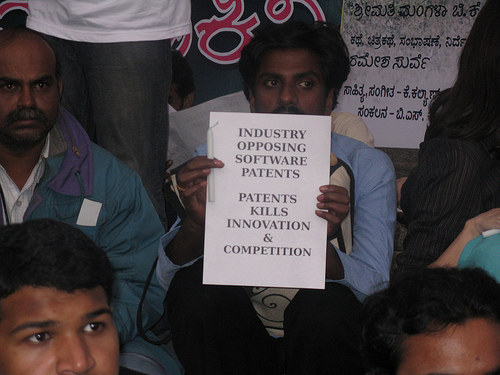
Representation by Knowledge Commons to the
Office of the Controller General of Patents, Designs and Trade Marks
on the
Draft Manual of Patent Practice and Procedure - Patent Office, India (2008)
This representation addresses the section 4.11 of the Draft Manual, which provides the guidelines for defining what is excluded from patenting vide section 3(k) of the Patents Act, 2005.
The Clause 3(k) has defined what is not patentable in quite unambiguous terms. It is a well settled principle in law that a rule or a guidelines cannot change the substantive meaning of legislation. Unfortunately, this is what the Draft Manual proposes to do in its interpretation of this clause.
Indian Patents Act differs from other Patent Laws in so far as it clearly lays down what is not patentable. The Clause 3(k) is one such clause. The lawmakers were clear in their intention, “A mathematical or business method or a computer programme per se or algorithms are not patentable”. Therefore, through guidelines, what is not patentable under law cannot be made patentable through practices and procedures, as the Draft Manual proposes to do.
It might be noted that the Draft Manual is trying to bring in the amendment to the Patents Act which was subsequently not accepted in the Parliament. The relevant 3(k) amendment was, “a computer programme per se other than its technical application to industry or a combination with hardware; a mathematical method or a business method or algorithms;” By retaining the original wording and not accepting the change that software could become patentable by virtue of a technical application, the Parliament made its legislative intent clear. Therefore, by an interpretation of the act, the Patent Office cannot change the legislative intent that with or without technical application, software would not be patentable.
In trying to reach this interpretation, the Patents Office seems to have copied the relevant sections from the “Manual of Patent Practice guidance for interpreting the Patent Act 1977”, UK. This has been done without any reference that would justify such wholesale lifting of interpretation. We reproduce below what the Draft Manual says in for example 4.11 and what the UK manual says.
Indian Draft Manual 4.11.7
4.11.10 A mathematical method is one which is carried out on numbers and provides a result in numerical form (the mathematical method or algorithm therefore being merely an abstract concept prescribing how to operate on the numbers) and not patentable. However, its application may well be patentable, for example, in Vicom/Computer-related invention [1987] 1 OJEPO 14 (T208/84) the invention concerned a mathematical method for manipulating data representing an image, leading to an enhanced digital image. Claims to a method of digitally filtering data performed on a conventional general purpose computer were rejected, since those claims were held to define an abstract concept not distinguished from a mathematical method. However, claims to a method of image processing which used the mathematical method to operate on numbers representing an image can be allowed. The reasoning was that the image processing performed was a technical (i.e. non- excluded) process which related to technical quality of the image and that a claim directed to a technical process in which the method used does not seek protection for the mathematical method as such. Therefore the allowable claims as such went beyond a mathematical method.
The UK Patent Manual Clause 1.17
Similarly, mathematical methods are not patentable but their application may well be patentable. For example, in Vicom/Computer-related invention [1987] 1 OJEPO 14 (T208/84) the invention concerned a mathematical method for manipulating data representing an image, leading to an enhanced digital image. The EPO Technical Board of Appeal defined a mathematical method as one which is carried out on numbers and provides a result in numerical form (the mathematical method or algorithm therefore being merely an abstract concept prescribing how to operate on the numbers). Thus the Technical Board of Appeal rejected claims to a method of digitally filtering data performed on a conventional general purpose computer, since those claims were held to define an abstract concept not distinguished from a mathematical method. However, they allowed claims to a method of image processing which used the mathematical method to operate on numbers representing an image. The reasoning was that the image processing performed was a technical (ie non-excluded) process which related to the technical quality of the image and that even if the idea underlying an invention may be considered to reside in a mathematical method, a claim directed to a technical process in which the method is used does not seek protection for the mathematical method as such. Therefore the allowable claims went beyond a mathematical method as such because they specified the physical entity the data represented and the technical process in which it was used.
Not only are the sentences lifted verbatim, with only some minor re-arrangements, even the reference to the case in the UK Manual, Vicom/Computer-related invention [1987] 1 OJEPO 14 (T208/84), is not listed in the cases given in the Annexure List of cases for the Draft Manual.
According to the Draft Manual, the allowable claim goes beyond a mathematical method as it specifies a physical entity (signals) and the technical process (image processing). Simply put, what the patent office is claiming is that while a mathematical method cannot be patented, however its application to a specific technical field – image processing in the Vicom case – is patentable.
The problem with this approach is that while the patent office may regard image or signal processing as a technical application, what is being patented is still a mathematical method. The mere fact that it is a mathematical algorithm applied to a specific application with specific physical entities does not change that the content of what is being patented, which is still the mathematical algorithm. Only the scope of the patent is being narrowed by limiting it to image processing.
If the above is accepted, all that would be required for securing software patents for the actual mathematical method is to file separate applications for each of the application of the mathematical method, in this case the digital filtering algorithm. This is merely changing the form of the patent application and not its substance. We find such an interpretation completely contrary to the patent law that has been framed in this country.
The Image Processing case is particularly important, as if it is accepted, all compression techniques would also be patentable on similar grounds. Already, the practices of USPTO and EPO have lead to a situation that a number of standard formats such as JPEG and GIF have come under patent threats. Since any company that uses digital pictures – cameras, images on the web, etc., can be sued for infringing such patents, the potential economic consequence of such patents is enormous. This is why software patents under any garb, are particularly pernicious.
One of the earliest software patents was that of the LMZ compression, which was used in the GIF format. It is now widely accepted in the software industry that such patents are in fact patents of mathematical algorithms. It was because the GIF format came under a patent threat that other formats became popular. However, similar threats now exist for other formats for image processing. In most such cases, the software industry has had to file review applications in USPTO to invalidate such patents. We see no reason why we should follow this tortuous path, when we have a clear law on this on our statuette books disallowing software patents.
The language of Section 3 k) of the The Patents Act, 1970 makes it clear that unlike certain countries, where the Patents Offices have been issuing patents for mathematical or business methods and for software, the Indian Parliament has considered software per se not to be patentable.
The clause that software per se is not patentable would mean that only software as a part of a larger invention of which it is a part could be considered for a patent as a whole provided it meets the criteria of patents given in the Act. This makes clear software “standing alone” is not patentable under Indian law. It is pertinent that as software cannot execute on its own without any hardware, this means that software running on general-purpose data processing machines (computers) do not qualify for patents. The mere addition of conventional data processing equipment to a software application does not turn that application into an invention. Only if the software application is a part of a larger system and the system as a whole is eligible for a patent, can the invention be patented as a whole. This is the intent of the Act and therefore we are sure that the Patent office would take this into cognizance when deciding on patent claims.
If we take this clause of software per se not being patentable with the other part of the clause the intent of the Law becomes even clearer. It is clear from 3 k) above, that any mathematical method or a business method or a mathematical algorithm cannot be patented, irrespective of whether it is embodied in software or not. The non-patentablity of business or mathematical method or algorithm is even broader than the non-patentability of software per se and covers all software applications/computer programs.
All software or computer programs are nothing but a sequence of instructions that convert a set of inputs to a set of outputs. This is the definition of an algorithm.
As per 3 k), a mathematical method is not patentable and as computational methods are a sub-set of a mathematical methods, a computational method is not patentable either.
Computer programs essentially convert an algorithm, business or a mathematical method into a sequence of machine executable steps. All computer programs are therefore algorithms/mathematical or business methods implemented for execution on a computer. As algorithms, mathematical or business methods are not patentable under Indian law, no software or computer program, which can run on general-purpose machines, can be considered patentable. The only exception, which can be read into the Patents Act “computer program per se”, is that computer programs in conjunction with special purpose hardware or equipment, can be considered for patenting as a whole, provided it meets all other criteria of patentability given in the Act.
Courts in all parts of the world have held that subject matter which would have the practical effect of preempting laws of nature, abstract ideas or mathematical algorithms is ineligible for patent protection. This age-old and time-tested precedent effectively establishes the ineligibility for patent protection to laws of nature, abstract ideas and mathematical algorithms. If these could be patented, then in effect one would be patenting the tools of scientific enquiry itself, something no patent law allows, as it would lead to halting scientific progress.
Courts have also held that regarding patentable subject that the inquiry into whether subject matter is eligible for patenting is one of substance, not form. This requires that one look, not simply at the language of the patent claim to see if it recites a structure of multiple steps or components, but also at the practical effect of the claim to see if it in fact covers -- or otherwise would restrict the public’s access to -- a principle, law of nature, abstract idea, mathematical formula, mental process, algorithm or other abstract intellectual concept. Otherwise, it would make the determination of patentable subject matter depend simply on the draftsman’s art and would ill serve the principles underlying the prohibition against patents for 'ideas' or phenomena of nature. By skilled patent drafting, one should not be able to start patenting essentially abstract ideas, mental processes and newly discovered laws of nature or mathematical algorithms.
We are aware that though the Law generally holds that such matters are not patentable, a number of patent offices, particularly the US PTO and the EPO have been granting patents recently for software also. This has already created a situation which Tim Berners-Lee, one of the founders of the World Wide Web, director of the World Wide Web Consortium that sets global standards for the Internet, calls as the biggest threat to software development.
All companies developing emerging technology are threatened by the prospect of patent licensing royalties. You could never find out what patent could possibly apply to what technology. You could never guess what things people might have the gall to say they have patented already. It really is a universal fear. (Tim Berners-Lee at Emerging Technologies Conference at the Massachusetts Institute of Technology, September 29, 2004.)
Major software companies such as Cisco, Oracle, Adobe and even Microsoft earlier have come out against software patents. They have held that copyright provides an appropriate level of protection and patenting software is harmful to the software and other industries.
It has also been the basis on which the Small and Medium-sized Business Community in the EU objected to the formalisation of EPO practice and acceptance of software patents. The same argument would apply to Indian software industry as well.
The above clearly shows that no application of mind has taken place in either understanding of the Indian Patents Act or its intentions. While the EPO or the UK practices could be used by the Patent Office to justify what it seeks to do, it cannot do so without first identifying the Patents Act and practices in these countries and the Patents Act and practices in India.
In India, it has been considered patents should be granted only when public good demands granting of such state protected monopolies. This was the practice also in the UK and the US. It is still the basis of the practice in most countries. It is only in the last few decades that the US, followed by the UK, Japan and now the European Patent Office has tried to change the interpretation of their Patents Acts to expand the scope of patentability. This attempt to enlarge the scope is from their national interest as they hold the largest number of patents. Therefore, their belief that strengthening the patent regime internationally will help their companies to build world-wide monopolies.
It is not in India’s national interest or in the interests of its people to expand the scope of state protected monopolies through expanding the patent scope. India’s national interest is best served by restricting the scope of such monopolies. Therefore, the patent regime in India should work on the presumption that patents are to be given only when there is a decisive case for patents. This has been the basis of the Indian Patents Act and is in tune with fundamentals of such legislation world over. It is only the deviation in patent interpretation that has produced a scenario where business methods, software and also mathematical methods are also being patented.
The US Supreme Court has now been correcting some of the excesses that has occurred in the US patents interpretation by the Federal Bench. We see no reason why India should change it understanding of patentability following in the footsteps of the US and the EPO and subsequently need to correct such excesses.
We will not recapitulate the case against software patents. We consider that case is now accepted in Indian law and the Indian Patents Act explicitly prohibits software patenting. We are only concerned here with the attempt to defeat the non-patentability of software patents by an interpretation that runs counter to the Indian law.
We therefore would suggest that the relevant sections of the Draft Manual – namely the section 4.11 should be redrafted keeping the legislative intent in mind. Otherwise, it will constitute a breach of privilege of the Parliament.
Prabir Purkayastha, Knowledge Commons
Sd.-
SP Shukla, National Working Group on Patent Law
Sd.-
G. Nagarjuna, Free Software Foundation of India
Sd.-
Amit Sengupta, All India Peoples Science Network